Categories
Uncategorized

Learning About Python Polymorphism: Understanding Its Role in Object-Oriented Programming

Understanding Polymorphism in Python

Polymorphism in Python allows different classes to define methods with the same names, enhancing flexibility.

It is a key concept in object-oriented programming as it enables objects to take on many forms, allowing functions to use objects of different types.

Defining Polymorphism

Polymorphism comes from Greek words meaning “many forms.” In programming, it represents the ability of different classes to be treated as instances of the same class through a shared interface.

Python’s approach to polymorphism revolves around its dynamic typing. This means that functions can behave differently based on the object they are working with.

It supports method overriding, where a subclass provides a specific implementation for a method already defined in its superclass. This ability to process objects differently based on their class type is a core part of Python’s design, offering high flexibility and scalability.

Polymorphism in Object-Oriented Programming

Polymorphism is a fundamental principle in object-oriented programming (OOP). It allows methods with the same name within different classes to be called seamlessly, depending on the object type.

This means a single function can operate with objects of various classes, provided they implement the function method.

Python employs polymorphism extensively in class inheritance, where subclasses inherit methods from a parent class but can override them for specific behaviors.

This characteristic improves code readability and maintainability by reducing complexity. It fosters code reusability by allowing the same method to be used for different objects, as seen in examples on the W3Schools and Programiz websites.

Python Data Types and Polymorphism

Polymorphism in Python allows for methods to interact with different data types seamlessly. This enables a single function to handle varied inputs, enhancing flexibility and efficiency in programming.

Polymorphism with Built-in Data Types

Python’s polymorphism shines through built-in data types such as strings, tuples, and dictionaries. Functions like len() are inherently polymorphic, as they can process these types differently yet effectively.

For instance, when applied to a string, len() returns the number of characters. When applied to a list or tuple, it returns the count of elements.

This adaptability makes len() versatile and crucial for programmers.

Built-in functions often accommodate multiple data types, allowing developers to write more generic and reusable code. By leveraging polymorphism, these functions reduce the need to write separate code blocks for each data type, optimizing both development time and resource use.

Dynamic Typing and Polymorphism

Python’s dynamic typing complements its polymorphism. Variables can change type during execution, enabling functions to be flexible with input types.

This dynamic nature allows polymorphic behavior without explicit method overriding.

For example, a function designed to handle a dictionary can seamlessly adapt if the input is later a string or tuple. This ability ensures that functions remain robust and versatile.

Dynamic typing, when combined with polymorphism, makes Python powerful for developing applications where behavior varies according to input types. The combined characteristics allow developers to write code that is both adaptable and efficient, catering to a wide array of programming needs.

Classes and Instances

In Python, classes and instances form the foundation of object-oriented programming. This section details how to create these structures and implement class polymorphism to streamline code.

Creating Classes and Objects

To start with classes in Python, one defines a class using the class keyword. Classes serve as blueprints for objects, encapsulating data and behavior. Here is a basic example:

class Animal:
    def __init__(self, name):
        self.name = name

    def speak(self):
        pass

After defining a class, you can create objects. Objects are instances of classes and are initialized using the class constructor. In the example, Animal does not have a specific speak method, making it abstract.

class Dog(Animal):
    def speak(self):
        return "Woof!"

buddy = Dog("Buddy")

Using classes and creating objects allow developers to organize code efficiently by grouping related functionalities.

Using Class Polymorphism

Polymorphism enables different classes to be treated as instances of the same class through a shared interface. For example, Dog and Cat could both inherit from Animal, overriding the speak method independently.

class Cat(Animal):
    def speak(self):
        return "Meow!"

animals = [Dog("Buddy"), Cat("Whiskers")]

for animal in animals:
    print(animal.speak())

This common interface allows objects to be used interchangeably, simplifying the code. Polymorphism with class methods ensures that methods are the same name across classes, yet their implementation works for the specific class in question, offering flexibility.

The concept of a method signature is important here, as it must match across these classes to allow polymorphic behavior.

Inheritance and Polymorphism

In Python, inheritance and polymorphism allow for flexible and efficient code reuse. Inheritance lets new classes inherit properties from existing ones, while polymorphism enhances method functionality across different classes. Together, they form key components of object-oriented programming.

Building Inheritance Hierarchies

Inheritance in Python is a method to create a new class, called a derived class, from an existing class known as the base class. This relationship allows the derived class to inherit attributes and methods from the base class, fostering code reuse and modularity.

For example, if a base class Vehicle contains methods like start() and stop(), a derived class Car can reuse these methods without redefining them. Drilling down further, building an inheritance hierarchy involves establishing a clear chain of classes, leading to more organized and maintainable code structures.

Using inheritance, programmers can easily add new functionalities to classes or modify existing ones without affecting other parts of the program. This capability allows developers to create robust and scalable applications, as it forces careful planning of class relationships and hierarchies.

Polymorphism with Inheritance

Polymorphism in Python often pairs with inheritance to enable objects of different classes to be treated as objects of a common superclass. This means specific child classes can have methods with the same names but potentially different implementations.

For instance, both the classes Boat and Plane might inherit from Vehicle and have their own version of the move() method.

Polymorphism with inheritance allows methods like move() to be executed across different classes seamlessly. This supports a cleaner coding structure, as functions can operate on objects without needing to know their specific class types.

This dynamic application of methods across varied classes is what makes polymorphism a powerful tool in Python.

Common Superclass and Interface

The concept of a common superclass and interface plays a crucial role in polymorphism. A common superclass provides a generic framework, defining methods expected to be overridden or used by derived classes.

On top of this, if several classes derive from this superclass, they can then implement specific uses of this method.

Using a common superclass guarantees a unified method interface across derived classes, leading to code that is easier to read and maintain. This helps achieve consistent behavior and ensures that various components within complex systems function together cohesively.

An interface defines a set of methods a class must implement, serving as a contract, allowing multiple classes to adhere to common functionality while implementing unique behavior. This approach is essential for designing systems that are both extensible and flexible.

Methods and Polymorphism

Methods in Python can demonstrate polymorphism through techniques like overloading and overriding. Each allows classes to use methods in a flexible and dynamic way. Overloading involves using the same method name with different parameters, while overriding lets a subclass replace a parent class’s behavior, providing unique implementations.

Understanding Method Overloading

Method overloading allows a class to have multiple methods with the same name but different parameters. While Python doesn’t support overloading in the traditional sense, it achieves similar functionality through default arguments or variable-length argument lists.

This presents developers with the flexibility to handle different input types and numbers.

For instance, consider a print_area method designed to calculate the area of both squares and rectangles using different parameters.

def print_area(side, other_side=None):
    if other_side:
        return side * other_side
    return side * side

Such flexibility simplifies function calls, enabling broader usability across different contexts. Utilizing method overloading can be highly beneficial in creating more readable and efficient code where the same action varies slightly in operation.

Implementing Method Overriding

Method overriding occurs when a subclass provides a specific implementation of a method that already exists in its parent class. This is key in achieving polymorphism in Python, allowing subclasses to modify or extend the functionality of the parent class’s methods while maintaining the same signature.

Consider a Vehicle class with a move method, and subclasses such as Car and Boat. Each subclass can define its version of move, tailoring the method’s behavior.

For example, a Car might move on roads, while a Boat navigates water.

Such design enriches the program by enabling objects to behave differently based on their types, enhancing code maintenance and scalability. Method overriding thus ensures that subclasses remain distinct while sharing a common interface. More insights on method overriding can be found in Python Polymorphism.

Implementing Polymorphism in Python

Polymorphism in Python lets multiple types share the same interface, which makes code more flexible. This is achieved through techniques like duck typing and following best practices to use polymorphism effectively.

Duck Typing and Dynamic Behavior

Duck typing is a key feature in Python’s ability to handle polymorphism. It means a program method works on objects of any class, as long as they conform to the required interface. In practice, objects don’t need to share a parent class.

This type of dynamic behavior helps when methods with the same name can work on different objects. For instance, Python’s built-in functions often rely on this flexibility.

It allows developers to write code that is easy to manage and adapt.

Here’s a small list of benefits:

  • Simplifies code by removing the need for explicit type checking.
  • Enhances code flexibility to work with new classes.
  • Encourages a design where types conform to an expected behavior.

Best Practices for Polymorphism

To fully leverage polymorphism, certain best practices should be followed.

Firstly, design classes with a clear and consistent interface that makes use of common method names. This ensures that different objects can be processed uniformly.

It’s essential to write clear documentation for each class method. This helps developers understand what behavior is expected when implementing polymorphism.

Testing thoroughly with various object types is also critical to ensuring no unintended consequences arise due to different inputs.

When implementing polymorphism, always focus on maintaining readability while ensuring that different classes work well together.

Reference articles like this one provide practical examples to understand how different objects can interact seamlessly.

Function and Method Polymorphism

Function and method polymorphism in Python allow the same function or method to behave differently based on the object it is acting upon. This flexibility is a key feature in object-oriented programming, providing the ability to define methods with the same name but different implementations across various classes or functions.

Function Polymorphism in Python

Function polymorphism occurs when a single function can work with different data types.

A common example is the len() function, which can be applied to both strings and lists. In essence, this function adjusts its operation based on the argument it receives, such as returning the number of characters in a string or the number of items in a list.

This adaptability makes functions versatile, allowing them to perform appropriately depending on the input type.

Such functionality is crucial in cases where the exact data type might not be known at runtime.

It enables developers to write more flexible and reusable code by creating functions that can handle a variety of input types seamlessly. This concept of writing adaptable functions serves as the foundation for more advanced programming techniques.

Understanding speak and move Methods

The speak method in polymorphism is often used to illustrate how different objects can implement the same method differently.

For example, a Dog class and a Cat class might each have a speak method, but the Dog‘s version might return “Bark” while the Cat‘s returns “Meow.” This allows multiple classes to provide their unique behavior for similar actions, enhancing the flexibility of the code.

Similarly, the move() method can demonstrate how different classes can handle movement in distinct ways.

For instance, a Vehicle class might move differently than an Animal class, with a car moving on wheels and a bird flying. These methods illustrate polymorphism by letting each class define its implementation of an action while maintaining a common method name for usability and coherence across the program.

Polymorphic Behavior of Python Objects

Polymorphism in Python allows objects to respond to the same method call differently depending on their class. This behavior facilitates flexibility by enabling functions to use various object types seamlessly, as demonstrated through an animal sound example and other shared behaviors among objects.

Exploring Animal Sound Example

Polymorphism is effectively demonstrated in the context of animals making sounds. Imagine classes for dogs and cats, both having a method called speak. While a dog’s speak method returns a bark, a cat’s speak method returns a meow. Despite being different animals, they share this common interface to respond accordingly.

Such design enables a function named animal_sound to take any animal object and execute its speak method without knowing its specific type. This way, polymorphic behavior allows using a single function with diverse objects. You can see this in action with examples on platforms like w3resource.

Shared Behavior Among Objects

Polymorphism also enables shared behaviors across different objects.

Consider a base class called Vehicle that provides a method move. Subclasses like Car, Boat, and Plane inherit this method but redefine (or override) it to specify their movement. This concept is not only prevalent in class hierarchies but also applies to functions that can handle various object types.

With this shared method structure, any Vehicle subclass can be passed to a function that calls the move method.

For instance, a single operation can move a Car, a Boat, or a Plane using polymorphic principles outlined on W3Schools. This results in code that’s both flexible and easy to maintain.

Real-life Examples of Polymorphism

Polymorphism in Python allows methods to use the same name across different classes and execute based on the object’s class. It can be compared with its implementation in other languages like Java. This section addresses practical uses, method overloading, inheritance, and real-world applications.

Shapes: Circle and Rectangle

In programming, the concept of shapes like circles and rectangles can help demonstrate polymorphism. A parent class, Shape, might define a method for calculating area. This method can be implemented differently in subclasses like Circle and Rectangle.

For a Circle, the area is calculated using the formula:
[ text{Area} = pi times (text{radius})^2 ]
In contrast, the formula for a Rectangle is:
[ text{Area} = text{width} times text{height} ]

Both shapes rely on the same interface to calculate area, but they execute different logic based on the shape type. Programmers use polymorphism to manage complex systems, allowing them to handle various shapes through a uniform method.

Animal Hierarchy: Dog and Cat

In an animal hierarchy, polymorphism is exemplified by using a common method, like speak, across different animals such as dogs and cats. The parent class, Animal, might define this method, which is then adapted by child classes like Dog and Cat.

When a Dog object uses the speak method, it might return “Bark,” while a Cat object might return “Meow.” Despite having the same method name, the behavior differs based on the specific animal class.

This ability to call the same method on different objects where each object responds in its own way showcases the principle of polymorphism, making code more flexible and easier to extend.

Enhancing Code Flexibility and Reusability

Polymorphism in Python is a key feature that allows developers to write flexible and reusable code. It enables different classes to utilize the same interface, leading to streamlined and efficient programming.

Code Flexibility Through Polymorphism

Polymorphism boosts code flexibility by enabling methods to process data of different types with a single interface. This is useful in complex projects where maintaining scalable and adaptable code is critical.

For instance, when a method can accept multiple objects as input, it allows for versatility. Such flexibility is crucial in machine-learning workflows, where different models use the same training and prediction code.

By embracing polymorphism, developers can build systems that are easier to expand with new features without altering existing code.

The ability to handle various object types using a straightforward method reduces the need for conditional logic, simplifying the code structure and enhancing its flexibility.

Writing Reusable Code with Polymorphism

Polymorphism enhances code reusability by enabling the same function or class method to work seamlessly with different data types. This reduces redundancy, making it easier to maintain and extend code.

For example, in object-oriented programming, polymorphism allows a single function to process various objects from different classes.

Developers can create more generalized code that applies across different scenarios by utilizing polymorphism. This approach leads to cleaner code as common operations are abstracted, reducing repetition. The result is a more efficient development process where updates and enhancements are less time-consuming since the core logic remains consistent while adapting to new requirements.

Frequently Asked Questions

A computer screen displaying Python code with various objects and their interactions

Polymorphism in Python allows methods to use the same name across different classes and execute based on the object’s class. It can be compared with its implementation in other languages like Java. This section addresses practical uses, method overloading, inheritance, and real-world applications.

How can polymorphism be practically applied in Python programming?

Polymorphism enables a function or method to process objects differently based on their class. For instance, a common interface like animal_sound can operate on classes like Dog and Cat, executing functions specific to each. This technique is widely used in building flexible and scalable code. See more about this at Programiz.

What are the differences between polymorphism in Python and Java?

Python allows dynamic typing, meaning the specific object type is determined at runtime. In contrast, Java requires explicit type declarations. This makes Python more flexible in handling polymorphic behavior but can be restrictive in Java without using interfaces or abstract classes. Find out more at IndiaBIX.

Can you explain method overloading and its relation to polymorphism in Python?

Method overloading allows methods with the same name to perform differently based on input parameters. While it is a form of polymorphism in many languages, Python does not natively support true method overloading. Instead, it uses default parameter values and multiple decorators to achieve similar functionality. Learn more at codedamn.

What role does inheritance play in facilitating polymorphism in Python?

Inheritance allows a class to derive properties and behaviors of another class. It is crucial for polymorphism as it lets subclasses modify or extend functionalities of parent classes. This mechanism enables consistently using class hierarchies and makes polymorphic behavior possible. Explore more at GeeksforGeeks.

What are some real-world scenarios where Python polymorphism is effectively utilized?

Python polymorphism is used in game development, where different game characters share a common interface but execute their actions individually. Another example is graphic design software, where shapes like circles and rectangles can be manipulated through a common API, yet display unique characteristics. Discover examples at w3resource.

How do encapsulation and abstraction relate to the concept of polymorphism in Python?

Encapsulation hides the internal state of objects, making code easier to maintain.

Abstraction simplifies complex systems by only exposing necessary details.

Both principles support polymorphism by providing a cleaner interface and segregating responsibilities, allowing objects to interact in varied ways without revealing internal details.


Categories
Uncategorized

Learning DAX – Relationship Functions Explained for Power BI Users

Understanding DAX and Its Context

Data Analysis Expressions (DAX) are essential tools in data modeling and calculations within software such as Microsoft Excel and Power BI. This section delves into the foundational aspects of DAX, focusing on its basic components and syntax structure needed for building effective data models and expressions.

Basics of DAX

DAX, short for Data Analysis Expressions, is a collection of functions, operators, and constants that help create formulas and expressions to analyze data. It provides powerful features that let users manipulate data more dynamically.

Key characteristics of DAX include its ability to work with both calculated columns and measures. Calculated columns perform row-level calculations, while measures aggregate data at a specific level. These capabilities enable intricate data analysis and transformation processes.

DAX is integrated into Microsoft tools like Power BI, SQL Server Analysis Services, and Excel, allowing users to extract deeper insights from data. By utilizing DAX, users can create more interactive and insightful dashboards, enhancing their data analysis processes significantly.

DAX Syntax Essentials

DAX syntax is similar to Excel formulas but with additional functions adapted for relational data. A DAX formula includes references to columns, tables, and expressions. Understanding its syntax is vital for leveraging its full potential in data analytics.

Each expression in DAX starts with an equal sign (=) followed by a function or operator. Parentheses are used to contain arguments, and use of commas separates these arguments.

DAX offers a wide range of functions, including logical, date and time, and statistical functions, equipping users to handle various data scenarios effectively. Familiarity with these functions enhances one’s ability to build complex data models and perform sophisticated analysis tasks.

The Data Model in Power BI

In Power BI, crafting data models is essential for transforming raw data into meaningful insights. Knowing how to handle data types and establish relationships between tables is key to unlocking the full potential of Power BI’s analytical capabilities.

Data Types and Data Modeling

Power BI supports a variety of data types, like integer, decimal, text, date, and Boolean. Choosing the correct data type for each column ensures accurate calculations and efficient storage. For example, using a decimal data type for currency values helps maintain precision in financial reports.

Data modeling involves organizing these data types into tables and defining their roles. Effective data models include well-structured tables with clear relationships that optimize performance and simplify analysis. A well-crafted model uses fact tables for aggregations and dimension tables for context, enabling rich data exploration.

Relationships Between Tables

Relationships in Power BI connect tables to create a cohesive data model. They enable users to perform complex queries and generate insights across multiple data sources. There are three types of relationships: one-to-one, one-to-many, and many-to-many. Each type serves specific scenarios, like connecting customer records to their purchases.

Power BI’s auto-detect feature quickly identifies potential relationships by analyzing column names and types, but manual configuration often ensures greater accuracy. To establish a relationship, the user aligns columns from different tables that share common data points. For better performance, Power BI supports both single-directional and bi-directional relationships, allowing flexibility in data analysis workflows.

Core Concepts of Relationship Functions

Core concepts of relationship functions in DAX are crucial for managing and exploring relationships between tables. By understanding these concepts, users can utilize relationships effectively to influence context and enhance data models.
Understanding Relationships

Relationships in DAX connect tables to facilitate analysis. Each connection is defined by common columns, enabling data from different tables to work together. Recognizing how these links function is key to creating powerful and efficient data models.


In DAX, relationships manage context, which determines how data is filtered and aggregated. Context is crucial as it affects the calculation outcomes. A table can connect to another through one-to-many or many-to-many relationships, each with distinct characteristics and impacts on data analysis.

Practically, these relationships are implemented in software like Microsoft Power BI. Utilizing the right connections enhances data interpretation and visual representation, leading to more accurate results.

Functionality of Relationship Functions

Relationship functions in DAX provide essential tools for managing data connections. These functions, such as RELATED and RELATEDTABLE, enable users to extract and manipulate data from linked tables effectively.

The RELATED function retrieves a value from a related table, allowing users to reference relevant data without directly joining tables. This enhances performance and keeps data models streamlined. Meanwhile, RELATEDTABLE can be used to pull a related table’s row context, offering a more detailed data view.

Using these relationship functions optimally leverages connections between tables, offering users powerful ways to handle complex data scenarios. Recognizing when and how to implement these functions can significantly improve data analysis results and reveal deeper insights.

Implementing Aggregations with DAX Functions

Implementing aggregations with DAX functions involves using specific functions to perform calculations on data sets. Key components include understanding different aggregation functions and accurately formulating measures for effective data analysis.

Aggregation Functions Overview

Aggregation functions in DAX are essential for summarizing data within a model. These functions perform calculations like sum, average, minimum, and maximum. Each function is designed to extract key insights from datasets. For example, the SUM function adds up all values in a column, while AVERAGE calculates the mean.

DAX also supports more complex aggregation functions, such as SUMX and AVERAGEX, which allow for expression-based calculations over tables. These are crucial when standard functions don’t meet analytical needs. Selecting the right aggregation function is vital for accurate data insights and decision-making.

Measure Formulation for Aggregations

Measures in DAX are calculated fields in data models, designed to perform dynamic computations based on filter context. To implement effective aggregations, measures must be carefully formulated to reflect accurate data analysis. A typical measure uses an aggregation function, followed by column or table references.

For instance, the measure Total Sales might use SUM(Sales[Amount]) to aggregate sales data. Advanced measures can include conditional logic, creating more sophisticated calculations. When creating measures, it’s important to ensure they are efficient and return correct results across different dimensions in the data model.

Properly formulated measures enable responsive and accurate data analytics, supporting informed decision-making by providing accurate summaries of critical data metrics.

Time Intelligence Capabilities in DAX

Time intelligence in DAX lets users analyze data across different time periods, enabling complex calculations. It mainly includes functions that work with dates and time, allowing users to gain insights from historical data.

A Guide to Time Intelligence Functions

Time intelligence functions in DAX include operations like calculating year-to-date, month-over-month changes, and comparing data across periods. Functions such as TOTALYTD, DATESYTD, and SAMEPERIODLASTYEAR provide flexibility and power in analyzing trends.

These functions are used in Power BI, SQL Server, and Excel to create reports with dynamic date filters. Important use involves setting the right context, ensuring calculations reflect the desired time frame and context.

Time intelligence functions are crucial for creating dashboards that summarize business performance over various periods, helping in strategic decision-making processes.

Use Cases for Time-Based Data Analysis

Time-based data analysis offers numerous benefits across industries. For example, calculating sales growth over different periods can reveal trends and opportunities.

In retail, analyzing month-over-month sales can identify seasonal trends. Businesses often utilize comparison functions to assess performance changes by examining metrics like revenue from the same quarter last year.

Similarly, rolling averages provide smoother insights to track performance metrics over time. By employing these calculations, companies can better understand their market position and make adjusted decisions based on past performance data.

Advanced Data Analysis with Calculate Function

A computer screen displaying DAX relationship functions and data analysis charts

The Calculate function in DAX is powerful for data analysis. It allows users to control the filter context, leading to deeper insights. This section explores how to maximize its use for effective data analysis.

Deep Dive into Calculate

The Calculate function changes the context in which data is evaluated. It is essential for creating custom calculations and measures. This function modifies filter contexts, enabling analysts to obtain specific data insights.

When using Calculate, users can apply filters on existing data expressions. For instance, calculating total sales for a specific region is straightforward. Analysts often use multiple filters within this function to refine data results further.

Understanding when and how to use Calculate effectively can significantly enhance the analytical power of DAX queries. It requires attention to context changes, which are critical for precise analysis.

Pattern and Context Use

The context is crucial when applying the Calculate function. In DAX, there are row context and filter context. Calculate is mainly used to modify filter context, which governs how data is aggregated.

Pattern use in Calculate helps identify typical scenarios, like year-to-date calculations or growth percentage evaluations. It allows analysts to write efficient DAX measures relying on predictable patterns. This reduces complexity and improves clarity in data analysis tasks.

For complex data models, understanding context switches within Calculate is necessary for accurate data interpretation. Properly designed calculations result in better insights and more actionable intelligence.

Expert Techniques in Filtering Data

Filtering data in DAX involves using specialized techniques that enhance data analysis and provide advanced insights. This section will explain how to effectively utilize filter functions and leverage crossfiltering to gain deeper understanding from your data.

Utilizing Filter Functions

In DAX, filter functions play a crucial role in data analysis. These functions help refine data by applying specific conditions. The FILTER function, for instance, provides a powerful way to narrow down data sets based on defined criteria. By applying this function, users can exclude irrelevant data and focus on key information.

Another useful function is ALL, which removes existing filters from specific columns or tables. This is particularly helpful when you need to calculate totals without the influence of current filters. Additionally, the RELATED function brings in data from related tables, further enriching the analysis and providing comprehensive insights.

Crossfilter for Advanced Insights

The crossfilter capability in DAX allows users to dynamically alter the filtering direction between related tables. Using the CROSSFILTER function, users can control how data flows through relationships, enabling intricate analysis scenarios. This can be particularly beneficial when dealing with complex data structures.

Crossfiltering provides more flexibility and detail in analyzing data. It allows for multiple and bi-directional filters which can reveal hidden patterns and correlations. This technique aids in ensuring that the context of the data remains accurate and meaningful, resulting in more reliable insights for decision-making.

Creating and Using Measures in DAX

A person using a computer to write and learn about DAX relationship functions

In DAX, measures are essential for performing calculations like total sales and analyzing data through functions such as FILTER. They allow users to create complex formulas that adapt based on the data context, enhancing data analysis capabilities in tools like Power BI.

Defining Measures

Measures are dynamic calculations where results change depending on the data context. These calculations are commonly used in reports to compute values like totals and averages.

For instance, a measure to calculate total sales might use the DAX formula:

TotalSales = SUM(Sales[SalesAmount])

This formula sums the SalesAmount column, allowing the measure to automatically adjust based on the selected data view.

Measures save time and can be reused in different reports because they update dynamically as data changes.

DAX measures have built-in flexibility. They can perform aggregations, apply filters, and use relationships between tables.

This adaptability is vital for analyzing data effectively. Using measures, users can develop insights from complex datasets without manually adjusting calculations each time.

Best Practices for Measures

Creating measures involves understanding the data context. Measures should be named descriptively to reflect their purpose.

For example, a measure called TotalSales clearly indicates it calculates sales totals. This helps users easily identify and apply measures in reports.

It’s important to keep measures efficient. Avoid complex calculations within a single measure that can slow down performance.

Breaking them into simpler measures that feed into a main measure can help maintain efficiency. Combining FILTER functions strategically can enhance data insights without compromising speed.

Regularly reviewing and updating measures ensures they reflect the latest data model changes. As datasets evolve, measures might require adjustments to maintain accuracy.

Keeping them relevant helps sustain the quality of data analysis.

DAX Operators and Their Usage

DAX operators play a crucial role in building powerful expressions and formulas in data analysis. These operators work together with functions to manipulate data, perform calculations, and filter results.

Introduction to DAX Operators

DAX operators are symbols that connect terms in an expression. They are used in various calculations and logical operations.

Basic arithmetic operators include +, -, *, and /. These help to perform mathematical operations on data.

Comparison operators like =, <, >, <=, >=, and <> are used to compare values in expressions. They return a true or false result, which is key in filtering data.

Logical operators such as && (AND), || (OR), and ! (NOT) allow for more complex conditions within formulas.

Operators can be combined to create calculated columns and measures, enabling more detailed data analysis.

Syntax plays a significant role, as incorrect use of operators can lead to errors in formulas. Understanding how and when to use these operators is vital for anyone dealing with DAX.

Combining Operators with Functions

Operators and functions work hand-in-hand to enhance the capability of DAX formulas.

For instance, when using the SUM function, an arithmetic operator might be used to adjust the total with additional calculations like taxes or discounts.

Logical operators, when combined with functions like IF or FILTER, can create dynamic expressions.

For example, IF(SUM([Sales]) > 1000, "High", "Low") uses comparison operators within a function to evaluate conditions.

Expressions can be further tailored by using conditional functions with logical operators. This allows users to create intricate data models and analysis scenarios, enabling data to be translated into actionable insights.

Proper use of operators within functions ensures accurate and efficient data handling.

Power BI and DAX Integration

Integrating Power BI with DAX is essential for enhancing the analytical capabilities of your data models. This integration allows for the creation of complex data relationships and robust data analysis.

Power BI Desktop and DAX

Power BI Desktop is a powerful tool that enables the use of DAX functions to create and manage data models. Users can leverage DAX to perform calculations and define new data fields.

This includes calculating sums, averages, and other aggregations on data tables. DAX enables the creation of complex formulas that go beyond basic Excel functions, providing more depth in data analysis.

The integration of Power BI and DAX also helps in managing relationships between data tables. This is crucial when working with large datasets, allowing for seamless data manipulation and analysis.

Users can click on the relationship view to easily manage how data from different sources interconnects. This makes Power BI Desktop an essential toolkit for data analysts.

Developing Power BI Reports

Creating effective Power BI reports involves integrating DAX to provide advanced insights. DAX functions allow users to filter data effectively, enabling them to focus on specific data points or trends.

Use of functions like CALCULATE helps in modifying the context of data analysis, providing more targeted results.

Developers can build interactive visualizations that respond to user inputs. This makes the reports not only informative but also engaging.

The flexibility of DAX in Power BI also allows for customization of charts and dashboards, giving users the ability to tailor visual reports to meet specific requirements.

Consistent use of DAX in report development enhances the overall analytic power of Power BI, making it a preferred choice for business intelligence solutions.

Best Practices in Writing DAX Formulas

Writing efficient DAX formulas requires understanding syntax and structure. Learning how to construct formulas effectively can improve calculation performance in Power BI and Excel.

Formula Syntax and Structure

Understanding the formula syntax is crucial for writing correct DAX formulas. A DAX formula consists of functions, operators, and values. Each formula starts with an equal sign (=) followed by the computation.

Using a fully qualified column name is important for clarity and reducing errors. This involves referencing tables and columns precisely, such as Table[ColumnName], instead of just ColumnName.

This practice helps in distinguishing between columns of the same name from different tables and enhances the readability of the formulas.

Lists within formulas, such as those created with the SUMX or FILTER functions, should be enclosed in curly braces {} when used for calculations that take single columns or constructed tables.

Proper nesting of functions is also vital to ensure the accuracy of data relationships and outcomes, supporting complex calculations without performance issues.

Tips for Efficient DAX Formulas

Efficiency in creating DAX formulas can be achieved by following key guidelines.

Using calculated columns only when necessary helps in saving memory. Instead, leveraging measures for calculations can optimize performance since measures are calculated during query execution rather than data loading.

Minimizing the use of iterative functions like FILTER and SUMX as their overuse can slow down data models.

Prioritize functions like CALCULATE, which can transform and speed up formula handling. Considering relationship handling can also help in creating more efficient formulas by specifying the use of specific data paths only when necessary.

Additionally, maintaining clarity by adhering to naming conventions aids in managing complex formulas.

Utilizing comments within formulas clarifies their purpose and logic, making it easier for collaborators or future self-reference.

Leveraging DAX for Complex Calculations

DAX (Data Analysis Expressions) is powerful for handling complex calculations in Power BI, Excel, and SQL Server Analysis Services. It enables users to create dynamic and flexible data models by using calculated columns and measures, each serving a unique purpose in data manipulation.

Calculated Columns vs. Measures

Calculated Columns are used for row-by-row calculations in tables. They are helpful when the result needs to be stored in the model and used for filtering, grouping, or sorting.

Users can create new columns using DAX expressions, which are then computed during data refresh. This means calculated columns can increase file size, so they should be used wisely.

Measures, on the other hand, are essential for aggregated calculations that adjust based on the context. Unlike calculated columns, measures are computed at query time, making them efficient in resource usage.

They don’t add to database size, providing a flexible solution for dynamic, interactive reports. Measures enable users to perform complex data analysis without the bulk associated with calculated columns.

Design Patterns for Complex Scenarios

When dealing with complex data scenarios, design patterns help streamline DAX usage.

Using CALCULATE with FILTER can modify filter contexts to perform sophisticated calculations. Another pattern is using TREATAS, which establishes virtual relationships between tables, crucial for advanced data models.

Time intelligence patterns are also significant. Functions like DATESYTD or SAMEPERIODLASTYEAR help with intricate date-based analysis, a common requirement in business intelligence.

Applying these patterns can solve many analytical challenges, enabling users to leverage the full potential of DAX for their data needs.

Frequently Asked Questions

Learning how to manage relationships in DAX involves understanding specific functions such as USERELATIONSHIP. This function plays a crucial role in filtering data, creating a connection between tables, and managing complex scenarios in Power BI.

How can I create a relationship between two tables in DAX?

Creating a relationship in DAX typically involves defining relationships within the model view. This can be done by linking fields from two different tables that share a common attribute.

Establishing these links enables users to perform calculations and analyses across tables.

What is the USERELATIONSHIP function and how is it used in DAX?

The USERELATIONSHIP function in DAX is used to activate an inactive relationship temporarily for a specific calculation.

This is useful when there are multiple relationships between tables, and you want to use a non-default one in a measure.

Can you explain how USERELATIONSHIP works when filtering data in DAX?

USERELATIONSHIP modifies the way data is filtered by selecting a particular relationship for a calculation. When applied, it ensures that calculations consider only the data connected through the specified relationship, overriding the default active.

Are there any best practices for managing relationships in DAX measures?

Best practices include carefully managing active and inactive relationships and understanding the logic behind each.

It’s important to avoid ambiguous relationships and to document complex associations clearly. This ensures accuracy and clarity in analyses.

In what scenarios should USERELATIONSHIP be utilized within Power BI reports?

USERELATIONSHIP is highly useful in scenarios where multiple relationships exist between tables but only one is needed for a specific calculation.

It allows fine-tuned control over data joins, especially in complex data models.

What are some common challenges when working with relationships in DAX?

Challenges include managing multiple relationships between tables. This can lead to confusion or errors if not documented. Ensuring all relationships are correctly defined and understanding the impact of each relationship on calculations are crucial steps in data modeling.

Categories
Uncategorized

Learning How to Integrate Python into SQL: Practical Use Cases for Enhanced Data Processing

Understanding the Synergy Between Python and SQL

Python and SQL work together effectively in data science by combining Python’s versatile programming capabilities with SQL’s powerful database management features. This synergy allows for efficient data manipulation, analysis, and visualization.

Significance of Python and SQL in Data Science

Python, with its rich ecosystem of libraries like Pandas and NumPy, handles data analysis and visualization. SQL, or Structured Query Language, efficiently retrieves and manages large datasets. This combination enables data scientists to extract, clean, and analyze data efficiently. Integrating these tools enables professionals to make data-driven decisions, boosting their ability to transform raw data into meaningful insights.

Overview of Python Libraries for SQL Integration

Several Python libraries facilitate integration with SQL databases. SQLAlchemy is popular for its ORM (Object-Relational Mapping), allowing Python objects to interact with SQL databases seamlessly. It abstracts database operations, making them easier to understand and use.

Pandas, with its read_sql function, enables direct SQL queries, simplifying data manipulation.

PyMySQL and psycopg2 are other useful libraries, connecting Python to MySQL and PostgreSQL databases, respectively. These libraries enhance flexibility and the efficiency of managing data tasks in Python.

Essential SQL Commands for Data Manipulation

SQL basics involve commands critical for data manipulation, such as SELECT, INSERT, UPDATE, and DELETE. The SELECT command retrieves data from one or more tables, fundamental for data analysis.

INSERT adds new data entries, while UPDATE modifies existing records. DELETE is used to remove records from a database. Mastering these commands is essential for anyone using SQL for data management, as they form the core operations needed to handle and structure data effectively.

Setting Up the Python Environment for SQL Integration

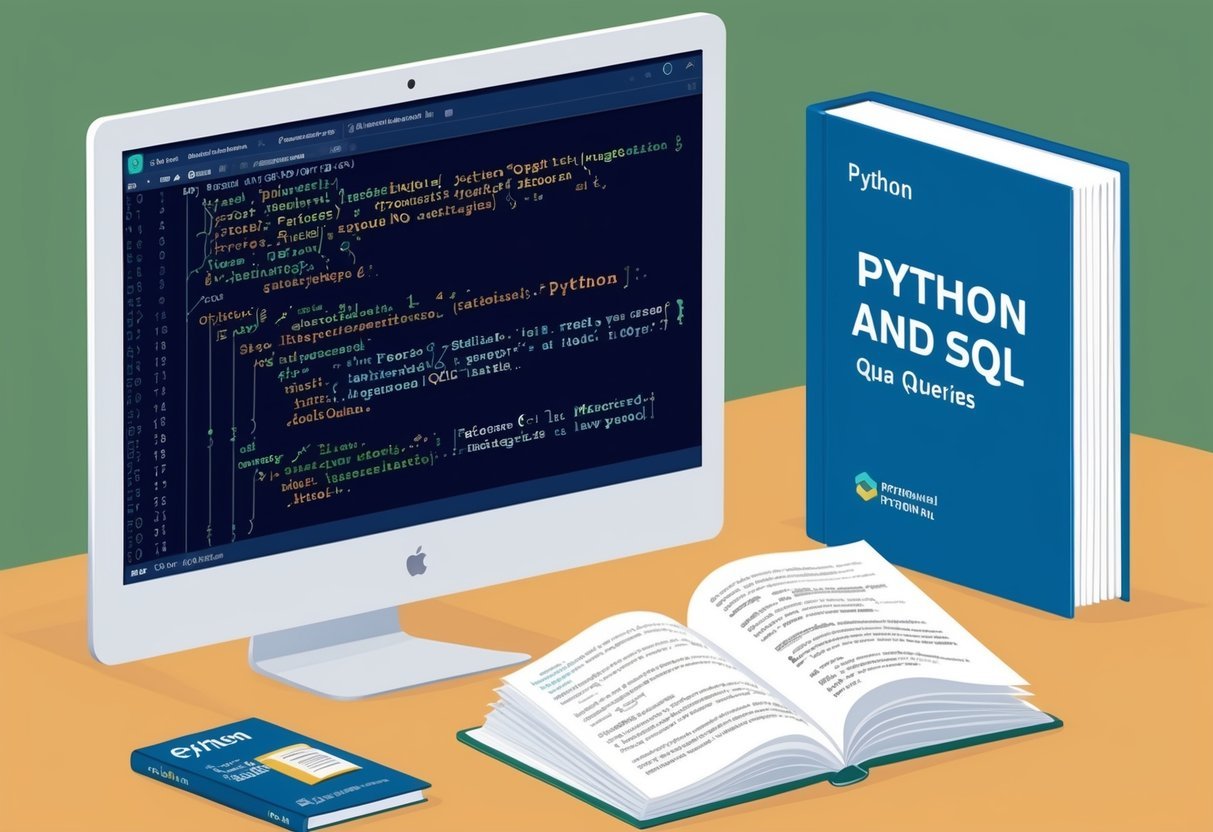
A computer screen showing Python code integrated with SQL queries, with a book on Python and SQL open next to it

Setting up a Python environment for SQL integration involves choosing the right tools and ensuring correct configurations.

Install Python and Necessary Libraries

Installing Python is the first step. Visit the official Python website to download the latest version.

After installing, it’s important to set up a virtual environment using venv to keep dependencies organized.

Within this environment, install essential libraries for database work such as sqlite3, MySQL Connector, and psycopg2 for PostgreSQL.

To facilitate interaction between Python and databases, tools like Jupyter Notebooks and Anaconda offer a good platform.

Configuring Database Connections

Establishing a connection between Python and databases is crucial. Use a database connector specific to the database type. For MySQL, use mysql.connector; for PostgreSQL, psycopg2.

These connectors require specifying a host, database, username, and password in your Python script.

Example:

import mysql.connector

conn = mysql.connector.connect(
    host="your_host",
    user="your_username",
    password="your_password",
    database="your_database"
)

Testing the connection ensures that Python can interact with the SQL database to perform queries.

Understanding Python’s SQLite3 Library

The sqlite3 library is an internal Python library that provides an interface for SQLite databases. These are lightweight and perfect for standalone applications.

By importing sqlite3, developers can execute SQL commands and manage database operations efficiently.

For example, to create a database and table:

import sqlite3

conn = sqlite3.connect('example.db')
cursor = conn.cursor()
cursor.execute('CREATE TABLE students (id INT, name TEXT)')

This method allows storing and retrieving data locally without requiring external database management systems. Understanding the sqlite3 library helps in handling smaller scale data operations confidently.

Executing SQL Queries from Python

Integrating Python with SQL allows for executing SQL commands and automating database tasks. This process involves creating a cursor, handling complex queries, and managing transactions while avoiding risks like SQL injection.

Utilizing Cursors to Interact with SQL Databases

A cursor is a crucial tool when executing SQL queries in Python. It acts as an intermediary between Python and the database.

When a connection to the database is established, the programmer creates a cursor to execute SQL commands and retrieve data.

The Python sqlite3 library, for example, provides the cursor() method to generate cursors.

The cursor can iterate over query results and execute multiple operations without needing to reconnect to the database. This makes tasks like fetching large datasets more efficient.

By utilizing cursors, developers can maintain an active connection to the database, which is vital for running several SQL queries successively.

Writing and Executing Complex Queries

Executing complex queries is often necessary to extract valuable insights from databases. Python, when paired with libraries like pandas, can handle these queries effectively.

Conditions, joins, and aggregations can be combined to form intricate queries that are directly executed from Python.

For precise query execution, Python and SQL allow embedding SQL commands within Python scripts. This can also include parameterized queries, which bind parameters to variables in Python.

This approach not only streamlines the process of executing SQL queries but also ensures clarity and accuracy when dealing with large datasets.

Managing Transactions and Handling SQL Injection Risks

While executing SQL commands, managing transactions is critical to ensure data integrity.

Python provides transaction support through methods like commit() and rollback() within the database connection. This allows programmers to control the state of data changes, especially when executing multiple related queries.

SQL injection poses significant security risks when executing queries from Python. To mitigate these risks, using parameterized queries is essential.

This technique allows for safe inclusion of user input in SQL commands by treating input values as parameters rather than executable code. This reduces the likelihood of SQL injection attacks, keeping the database secure from harmful input.

Data Management with Python and SQL

Integrating Python with SQL databases allows users to automate data management tasks. This combination provides a seamless way to create and modify tables, efficiently insert or delete records, and retrieve or update data for robust analysis and application development.

Creating and Modifying Tables via Python

Python can be used alongside SQL to create and modify tables in relational databases. Using libraries such as SQLite, MySQL Connector, or SQLAlchemy, developers can establish a connection to their database. This connection enables them to execute SQL commands directly from Python scripts.

To create a table, a simple SQL CREATE TABLE statement can be run through a Python function. Python scripts allow for the automation of table modifications and can add, remove, or alter columns as needed.

This approach simplifies the process by using Python’s straightforward syntax. It also aids in error handling by using exceptions to catch and manage SQL errors efficiently.

Efficient Data Insertion and Record Deletion

Python makes inserting and deleting records in SQL databases efficient. Through batch processing methods, users can upload large datasets in a single transaction, reducing the time needed for data insertion.

The executemany() function is particularly useful for this purpose, as it allows multiple rows to be inserted at once.

For deleting records, Python uses SQL DELETE commands executed through database connections. Incorporating conditional statements within these commands ensures only specific records are removed, maintaining data integrity.

Automating these tasks with Python scripts not only speeds up the processes but also ensures precision and helps avoid manual errors. This is crucial in large-scale data management when dealing with massive databases.

Performing Data Updates and Retrieval

Data updates and retrieval are key components of managing information within SQL databases, and Python provides an effective way to accomplish these tasks.

By connecting to the database, users can issue UPDATE SQL commands to modify existing data. The ability to use variables in Python can help dynamically change data based on program logic.

Data retrieval is facilitated through SQL SELECT statements. Python can filter, sort, and even join multiple tables to extract precisely the information needed.

This capability is especially useful for data analysts gathering insights from large datasets, as it allows quick and efficient querying.

Advanced Data Analysis Techniques

Advanced data analysis combines SQL and Python to manipulate and analyze datasets effectively. This approach offers powerful tools for handling large datasets and performing detailed statistical analysis.

Leveraging Pandas for SQL Data Manipulation

Pandas is a Python library that offers robust data manipulation capabilities. It can be used to import data directly from SQL databases, making it easy to perform complex transformations.

With Pandas, users can filter, sort, and aggregate data efficiently. The library’s DataFrame structure allows for operations similar to SQL, such as grouping and merging datasets.

For data analysts, using Pandas to handle SQL data offers advantages like streamlined workflows and the ability to perform operations such as calculating means and standard deviations directly on the data.

Statistical Analysis using SQL and Python

Combining SQL and Python enables comprehensive statistical analysis on large datasets. Using SQL, users can perform initial data queries to filter relevant information.

This data is then analyzed in Python, where libraries like Pandas are used for further statistical operations.

Analysts can calculate descriptive statistics like mean, median, and quartiles, and apply more complex statistical models.

By leveraging SQL’s filtering capabilities and Python’s statistical functions, professionals can derive meaningful insights from extensive datasets.

Working with Large Datasets and Performing Aggregations

Handling large datasets requires efficient data processing techniques. SQL is adept at managing big data through its powerful querying capabilities, including aggregations like summing, averaging, and counting rows.

Large datasets often necessitate scalable solutions for effective analysis.

Using Python with libraries such as Pandas can enhance SQL’s capabilities, offering streamlined aggregation processes and in-depth data exploration.

This combination is especially useful for tasks that require summary statistics or complex calculations on massive datasets, allowing analysts to gain valuable insights efficiently.

Data Visualization with Python and SQL

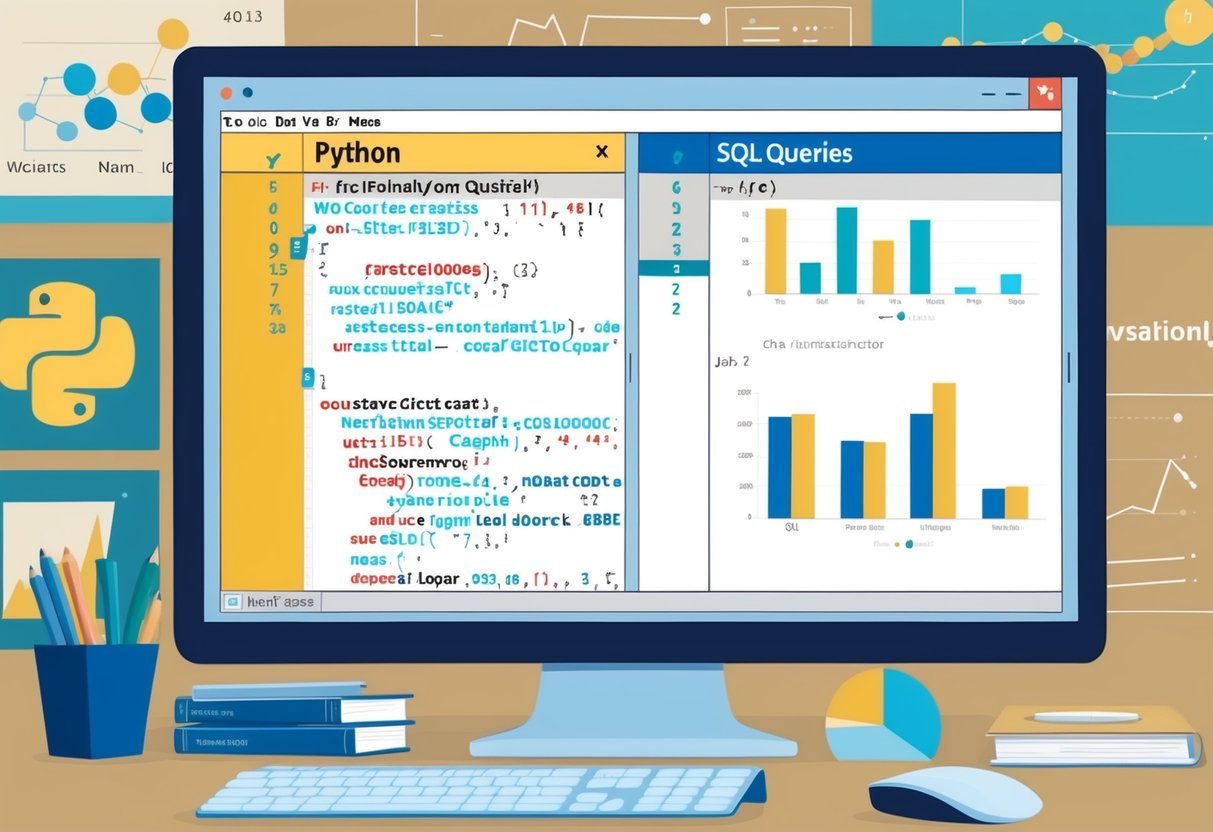
A computer screen displaying Python code and SQL queries side by side, with data visualization charts and graphs in the background

Combining Python with SQL enhances data visualization by leveraging Python’s powerful libraries and SQL’s efficient data management. Visual insights are created by using structured data from databases and advanced visualization tools.

Creating Visualizations with Matplotlib

Matplotlib is a popular library used in Python for creating static, interactive, and animated visualizations. It is especially known for its ability to create simple plots with a few lines of code.

Users can generate bar graphs, scatter plots, and histograms, turning raw data into visual stories. Moreover, customizing colors, labels, and styles adds clarity to the information presented.

Matplotlib is also flexible, allowing integration with other Python libraries to enhance visualization potential. This adaptability makes it a preferred choice for many when displaying structured data.

Integrating SQL Data with Python Visualization Libraries

Integrating SQL data into Python libraries involves fetching data from databases using SQL queries.

Python libraries like Pandas work well with SQL, allowing users to easily load database data into Python data frames. These data frames can be directly used in visualization libraries like Matplotlib, Seaborn, or Plotly to generate detailed visual outputs.

For example, Dataquest demonstrates how Python’s ease and SQL’s strength combine for tackling data visualization challenges.

This integration makes large datasets more insightful and accessible for decision-makers.

Data Visualization Best Practices

When creating visualizations, clarity and accuracy are crucial. Visualizations should effectively communicate the data’s message without overwhelming the audience.

Using clear labels, legends, and titles ensures the audience understands key points at a glance.

It is important to choose appropriate types of graphs or charts for the data being presented. Consistent use of colors and styles helps maintain a cohesive look and feel throughout the visuals.

Applying these best practices makes structured data more understandable and actionable.

A well-structured visualization enables faster and better decision-making by making complex data more digestible.

Machine Learning with Structured Data

A laptop displaying Python code integrated into SQL queries, with a machine learning algorithm running in the background

Machine learning with structured data involves the use of organized data, often found in tables or databases, to build predictive models. This process typically involves creating pipelines for efficient data handling, preprocessing data with SQL and Python, and training models on the processed data.

Building Machine Learning Pipelines

Building machine learning pipelines is essential for managing structured data efficiently. Pipelines streamline the process by automating tasks such as data extraction, transformation, and loading.

They help in organizing data flow, ensuring each step—like data preprocessing or model training—receives the necessary input.

Python libraries, such as Scikit-Learn and TensorFlow, often support pipeline creation. Using these libraries, developers can define a sequence of operations that handle data preparation and modeling tasks seamlessly.

By linking these tasks together, pipelines help maintain consistency and accuracy in machine learning projects.

Data Preprocessing with SQL and Python

Data preprocessing is crucial for machine learning tasks, especially with structured data. SQL databases are ideal for retrieving and manipulating data. SQL queries can extract and clean data, addressing null values or outliers.

Python complements SQL by providing libraries like Pandas and NumPy, enhancing data manipulation capabilities.

Python’s Pandas library works well with SQL by converting query results into DataFrames. This conversion allows further data cleaning and transformation using Python’s vast array of data processing functions.

By integrating SQL and Python, data preprocessing becomes more efficient, preparing the data optimally for model training.

Training Models on SQL Data

Training models on SQL data involves accessing structured data stored in relational databases, cleaning it as needed, and then applying machine learning algorithms. Python libraries, like Scikit-Learn, facilitate this process by allowing easy integration with SQL data sources.

Once the data is preprocessed, it can be fed into machine learning models designed for classification, regression, or clustering.

Libraries such as TensorFlow enable complex model architectures, enhancing predictive accuracy. Utilizing SQL ensures that training data is consistent, high-quality, and readily accessible, which is critical for developing reliable models.

Database Management and Optimization

Effective database management and optimization are crucial for leveraging Python with SQL. Key aspects include indexing and performance tuning, ensuring robust backup strategies and security protocols, and scaling SQL databases like PostgreSQL and MySQL.

Indexing and Performance Tuning

Indexing is essential for speeding up queries in SQL databases. Without indexes, databases might perform slower, especially with large datasets. PostgreSQL and MySQL use indexes to improve search times by allowing the database engine to find data more quickly.

Performance tuning involves modifying database settings. Techniques such as query optimization and adjusting memory settings are common.

For instance, reducing the complexity of SQL queries can result in fewer resources required, leading to faster performance.

Regular monitoring and updating index statistics help maintain the efficiency of the database. Performance tuning should be an ongoing process as data grows and access patterns evolve.

Backup Strategies and Database Security

Implementing reliable backup strategies ensures data safety. Regular backups prevent data loss and can save time during recovery. For SQL databases like MySQL, setting a schedule using tools or automated scripts is effective.

Database security involves restricting unauthorized access. Using user roles and permissions, administrators can control who sees and changes data.

PostgreSQL and SQL Server 2017 offer robust security features, like encryption, to protect sensitive information.

Maintaining logs of database activities serves as an audit trail. Strong passwords and limiting server access also strengthen security strategies.

Scaling SQL Databases with Python

As data grows, scaling databases can become necessary. Horizontal scaling involves adding more machines to handle increased load, while vertical scaling enhances machine power. Python aids in scripting and automation of scaling processes.

For large-scale applications, using database replication or sharding can be beneficial. Tools like SQLAlchemy facilitate building these scalable applications with Python by abstracting database interaction.

PostgreSQL and MySQL offer native support for scaling options. Using Python with these databases can help automate tasks and handle scaling more effectively.

Preparing for growth ensures that performance stays reliable even as user demands increase.

Practical Integration Scenarios

Integrating Python with SQL can optimize various operations, enhance data management, and simplify complex analytics tasks. This is especially beneficial in e-commerce data handling and when working with older database systems, as demonstrated with the AdventureWorks sales data.

E-commerce Data Management

E-commerce businesses can streamline operations by integrating SQL databases with Python. Python helps automate tasks like inventory updates, order tracking, and customer data management.

For instance, using Python scripts, companies can seamlessly pull sales data from SQL databases to analyze purchase patterns.

Visualizing trends with Python libraries such as Matplotlib is straightforward, enabling businesses to make data-driven decisions.

By combining SQL’s robust querying capabilities with Python’s flexibility, e-commerce platforms can enhance their data analytics, resulting in improved customer experiences and optimized inventory management.

Integrating Python with Legacy Database Systems

Legacy database systems often pose challenges due to outdated frameworks. Python serves as a bridge for integrating modern operations with these older systems.

With libraries like PyMySQL or SQLite3, developers can execute CRUD (Create, Read, Update, Delete) operations efficiently. This enables organizations to maintain older databases while incorporating new data handling methods.

By leveraging Python in legacy systems, businesses can automate routine tasks and improve data accessibility.

This integration not only preserves valuable historical data but also modernizes data management practices, ensuring that legacy systems remain viable and useful.

Case Study: AdventureWorks Sales Data

AdventureWorks, a sample database often used for learning and testing, demonstrates the potential of integrating Python with SQL. Through Python, users can process the FactInternetSales table, extracting meaningful insights into sales performance.

Simple queries can transform raw sales data into structured formats suitable for in-depth analysis.

Using Python libraries, one can compute statistics, plot sales trends, or predict future sales. This approach illustrates how integrating Python enhances data analytics capabilities, allowing for more detailed and actionable insights into business operations.

By following these methods, analysts can unlock the full potential of their AdventureWorks data.

Optimizing SQL Queries in Python

Combining Python with SQL can greatly enhance the efficiency of data operations. This synergy helps in analyzing query performance, refactoring for greater efficiency, and using powerful tools like SQLAlchemy for ORM-based queries.

Analyzing Query Performance

To optimize SQL queries, it’s important to first analyze how they perform. This involves using tools to measure execution time and resource utilization.

Techniques such as query profiling can identify bottlenecks by highlighting inefficient operations. For instance, checking execution plans can reveal whether indexes are being utilized effectively or if a query is running sequential scans unnecessarily.

Visualization tools can also help by representing this data graphically.

Understanding these performance metrics is critical in refining and optimizing queries. Also, regularly monitoring these aspects ensures that any changes in data or query complexity are addressed swiftly and accurately.

Refactoring for Efficiency

Refactoring involves rewriting SQL queries to enhance their performance while maintaining their function. This process may include rewriting complex joins or subqueries into simpler forms.

Indexing is another vital strategy; adding or adjusting indexes can drastically reduce query time for large datasets.

Moreover, breaking down larger queries into smaller, manageable parts simplifies processing and can improve speed. Batch processing is beneficial for handling large volumes of data, minimizing the strain on databases.

These strategies collectively lead to more efficient querying and improved performance across applications.

Using SQLAlchemy for ORM-Based Queries

SQLAlchemy is a popular Python toolkit that simplifies interaction with databases. It supports handling databases via an Object-Relational Mapping (ORM) approach, which allows developers to work with SQL databases in Pythonic terms.

This abstraction can make complex querying data tasks easier to understand and maintain.

Through SQLAlchemy, one can streamline query building, making it easier to compose and execute SQL operations.

Furthermore, it facilitates integrating Python scripts with databases, improving both performance tuning and productivity. This encourages writing cleaner, more efficient code that performs well across different environments.

Using SQLAlchemy not only optimizes query execution but also enhances overall application logic and architecture, making the database interactions robust and scalable.

Python and SQL in Web Development

Python plays a crucial role in web development, especially when integrating SQL databases. By using frameworks like Flask and Django, developers can create dynamic web applications. Integrating SQL databases allows for effective data management, while handling user data facilitates personalized experiences.

Developing Web Applications with Flask and Django

Flask and Django are popular Python frameworks for web development. Flask is known for its simplicity and flexibility, making it ideal for small to medium projects. Django is more robust, providing a lot of built-in features to speed up development.

Both frameworks allow for easy integration with SQL databases. Flask can use extensions like Flask-SQLAlchemy to work with databases, while Django comes with an ORM (Object-Relational Mapping) system that simplifies database interactions.

These features empower developers to build feature-rich applications that scale well.

Integrating SQL Databases in Web Projects

Integrating SQL databases in web projects is essential for data storage and manipulation. Python offers multiple libraries like sqlite3, mysql.connector, and psycopg2 for this purpose. Each library caters to different database systems, such as SQLite, MySQL, and PostgreSQL, respectively.

Developers use these libraries to execute SQL queries and manage database operations efficiently.

For example, sqlite3 is lightweight and suitable for applications with smaller datasets, while mysql.connector and psycopg2 provide robust solutions for MySQL and PostgreSQL databases.

Proper integration ensures smooth data flow and reliability in web applications.

Managing User Data and Session Information

Handling user data and session information is critical for building interactive web applications. Both Flask and Django offer methods to manage sessions, track user activity, and secure data.

These frameworks allow developers to store and retrieve user information from SQL databases effectively.

Using SQL databases ensures data integrity and security. For instance, Django’s authentication system offers ready-to-use features to manage users, while Flask can leverage extensions like Flask-Login for user session management.

These tools help maintain personalized user experiences and efficient data handling, which are vital for modern web applications.

Security and Best Practices

A computer screen displaying Python code integrated with SQL, surrounded by security and best practices symbols and icons

When integrating Python with SQL, focusing on security and best practices is crucial. Addressing SQL injection, ensuring data integrity, and adhering to industry standards strengthen the application’s security and reliability.

Protecting Against SQL Injection Attacks

SQL injection attacks pose a significant risk when integrating Python with SQL databases. It’s essential to validate user inputs to prevent malicious code from being executed.

Using parameterized queries or prepared statements is vital. Libraries like psycopg for PostgreSQL provide these features, making it easier to secure queries.

Avoid using dynamic queries constructed with user inputs. It’s also important to keep software updated to mitigate vulnerabilities.

Regular security audits help identify and fix potential weaknesses promptly. Overall, these practices significantly reduce the risk of SQL injection attacks.

Ensuring Data Integrity and Consistency

Maintaining data integrity and consistency is crucial in any database application.

Proper use of transactions with commit and rollback ensures that databases maintain a consistent state, even when errors occur. This is particularly important when handling multiple database operations simultaneously.

Validating data before it is entered into the database helps preserve data integrity. Constraints such as foreign keys and unique keys enforce rules at the database level, minimizing errors.

It’s also advisable to regularly back up data to prevent loss due to hardware failures or other issues.

Adhering to Industry Standards

Following industry standards ensures that Python and SQL integrations are secure and efficient. Adhering to standards like ISO/IEC 27001 for information security or OWASP for web applications provides guidance on implementing best practices.

These standards offer frameworks for securing applications and data, protecting businesses and users alike.

Incorporating Python security practices into development is another key consideration. This may include limiting the use of risky functions such as eval(), using the latest stable Python version, and following best practices from libraries used in the integration process.

Compliance with these standards fosters trust and reliability in software applications.

Frequently Asked Questions

Integrating Python with SQL for database operations can significantly enhance efficiency and functionality. This section will cover best practices, automation methods, scenarios where Python shines over SQL, data manipulation differences, Excel integration, and essential libraries.

What are the best practices for using Python to connect to an SQL Server database?

When connecting Python to an SQL Server database, it’s crucial to use libraries like pyodbc or SQLAlchemy for reliable connections.

Always ensure that database credentials are kept secure and connections are properly closed after use to prevent leaks.

How do Python scripts automate and enhance SQL database management?

Python scripts can automate repetitive database tasks such as backups, data extraction, and transformation.

They can also trigger specific SQL operations at scheduled intervals, greatly reducing manual workload. Libraries like pandas can be used to manage large datasets efficiently.

In what scenarios is it more beneficial to process data using Python rather than SQL alone?

Python is better suited for complex data analysis and manipulation tasks that are cumbersome in SQL.

When operations require advanced mathematical computations or integration with machine learning models, Python provides more flexibility and capabilities.

What are the differences in data manipulation capabilities between Python and SQL?

SQL excels at handling structured queries and relational database interactions.

In contrast, Python offers a wider range of data manipulation through its extensive libraries for statistical analysis and visualization. While SQL is efficient for database querying, Python supports dynamic and advanced data processing workflows.

How to integrate Python with SQL for data analysis in Excel?

Python can access and process SQL database data, which can then be exported to Excel using libraries like openpyxl or xlsxwriter.

This integration allows data analysts to leverage Python’s computational power and combine it with Excel’s accessibility for both analysis and presentation.

Which Python libraries are recommended for effective SQL database interactions?

For seamless SQL database interactions, recommended libraries include SQLAlchemy for ORM and query management, and pandas for data manipulation and analysis. Additionally, pyodbc is recommended for connecting to SQL Server. These tools provide robust functionalities to integrate SQL operations within Python scripts efficiently.

Categories
Uncategorized

Learning T-SQL – Views: Essential Insights for Data Management

Understanding T-SQL Views

T-SQL views are a powerful feature in the realm of SQL databases. A view is essentially a virtual table that represents a saved SQL query. Unlike a physical table, a view does not store data itself.

Views are beneficial in various platforms like SQL Server, Azure SQL Database, and Azure SQL Managed Instance. They help simplify complex queries, making it easier to handle database tasks. By hiding the complexity of the underlying SQL query, views provide a cleaner and more accessible interface.

Using views, users can enhance security by limiting access to specific columns or rows of a table. This is particularly useful in environments like the Analytics Platform System, where data access needs to be carefully controlled. Views can be tailored to meet different analytical needs without altering the base tables.

To create a view in T-SQL, the CREATE VIEW statement is used. For example:

CREATE VIEW view_name AS
SELECT column1, column2
FROM table_name
WHERE condition;

In this way, a view can be queried just like a regular table. They are ideal for reporting and analytics since they allow users to interact with the data without modifying the base data structures. This makes T-SQL views an indispensable tool for database management and data analysis tasks.

Creating Views in SQL Server

Creating views in SQL Server allows users to present data from one or more tables as a single virtual table. This can simplify complex queries and enhance security by limiting data access.

Basic Create View Syntax

To create a view, use the CREATE VIEW statement. The syntax requires specifying a view_name and defining the query with a SELECT statement. This query selects data from a single table or multiple tables, depending on the complexity needed.

CREATE VIEW view_name AS
SELECT column1, column2
FROM table_name;

This simple syntax can be expanded with additional columns or more complex SELECT statements. Understanding the basic syntax provides the foundation for more intricate views with joins and multiple tables. When constructing views, ensure that each view accurately reflects the desired output.

Using Views with Joins

Joins are useful for creating views that combine data from two or more tables. An INNER JOIN in a view can merge rows from different tables that satisfy a join condition. This is useful when related data is stored in separate tables but needs to be viewed as one set.

CREATE VIEW view_name AS
SELECT a.column1, b.column2
FROM table1 a
INNER JOIN table2 b ON a.id = b.foreign_id;

Using views with joins improves query readability and maintains data integrity. This method is not only effective in minimizing redundancy but also helps in scenarios where data must be presented collectively with key associations intact.

Complex Views with Multiple Tables

Creating views from multiple tables involves more extensive queries. In these views, nested SELECT statements or multiple joins might be necessary. Handle these views carefully to ensure they perform well and return correct data.

CREATE VIEW complex_view AS
SELECT a.col1, b.col2, c.col3
FROM table1 a
INNER JOIN table2 b ON a.id = b.foreign_id
INNER JOIN table3 c ON b.id = c.foreign_id;

Complex views can encapsulate multiple operations, offering a simplified interface for end-users. Leveraging multiple tables can lead to intricate datasets presented cohesively through a single view, enhancing application functionality and user experience.

View Management

View management in T-SQL involves modifying and removing views from a database. When dealing with views, understanding how to update existing ones and the process for removing them carefully is essential. These practices ensure data integrity and efficient database operation.

Modifying Existing Views

Making changes to an existing view requires using the ALTER VIEW statement. This statement allows modification of the view’s query. Adjustments might include altering columns, filtering criteria, or joining different tables. It’s important to ensure the new view definition maintains the desired output.

When modifying a view, one should be cautious of dependent objects. Views can be referenced by stored procedures, triggers, or other views. Altering a view might require adjustments in these dependencies to prevent errors, which could disrupt database operations.

It’s beneficial to test the updated view in a non-production environment first. This practice allows a safe evaluation of changes before implementation. Keeping a record of changes can also be useful for future modifications or troubleshooting.

Dropping Views with Care

Removing a view from a database involves the DROP VIEW statement. Before executing this operation, confirm that the view is no longer required by any applications or users. Dropping a view without verifying dependencies can lead to application failures or data access issues.

Consider using database documentation to identify any dependencies. If the view is part of a larger system, dropping it might demand a review of related components. Some database management systems provide features to check dependent objects.

It’s often helpful to create a backup of the view definition prior to removal. This backup ensures the ability to restore if needed later. Careful planning and consideration are essential steps in safely managing views in T-SQL.

Security Aspects of Views

Views in T-SQL provide a way to manage data access and enhance security measures. They play a pivotal role in restricting user access and controlling permissions to sensitive data without affecting the database’s integrity.

Implementing Permissions

Permissions are crucial for safeguarding data within views. Administrators can assign specific privileges to users or roles to ensure only authorized logins can access or modify the data within a view. This not only restricts data access to certain users but also protects sensitive information from unauthorized modifications.

Implementing permissions effectively requires understanding user roles and correctly applying security settings. By using the GRANT, DENY, and REVOKE statements, administrators can control who can select, insert, update, or delete data in the views. This level of control prevents unintended data exposure and potential breaches.

Security Mechanism Benefits

The security mechanisms of views offer significant benefits for managing data access. They enable administrators to define user access at a granular level, ensuring that each user only interacts with relevant data.

Views act as a barrier between the user and the actual tables, thus minimizing the risks associated with direct table access. Additionally, row-level security can be applied to limit data visibility based on specific criteria, enhancing overall data safety.

These mechanisms also streamline auditing processes by providing a clear log of who accessed or altered data through predefined views. Such strategic use of security mechanisms supports a robust and efficient data environment, maximizing security while maintaining convenient access for authorized users.

Optimizing Views for Performance

When working with T-SQL, optimizing views is essential for enhancing performance and query efficiency. Utilizing techniques like indexed views can speed up data retrieval. Additionally, partitioning views offers improved management of large datasets by splitting them into manageable segments.

Indexed Views and Performance

Indexed views are a powerful tool in SQL Server for improving query performance. By storing the result set physically on disk, they allow quicker data retrieval. This makes them especially useful for complex queries that involve aggregations or joins.

Creating an indexed view involves defining a view with a unique clustered index. It acts like a persistent table with pre-computed values. Important constraints are that all tables must be referenced with a two-part name, and they must be schema-bound.

Benefits of indexed views include reduced data processing time and decreased I/O operations. They are particularly advantageous for queries that are executed frequently or require complex calculations. Indexed views can boost performance even more when applied to large and busy databases.

Partitioned Views for Large Datasets

Partitioned views help manage and query large datasets efficiently by dividing data into more manageable parts. This technique improves performance by distributing the load across multiple servers or database instances.

Taking advantage of partitioned views requires defining member tables for each partition with similar structures. Data is typically partitioned based on specific columns like date or region. This setup allows querying only the needed partition, thus enhancing performance and reducing load times.

One primary advantage of partitioned views is their ability to enable horizontal scaling. This approach is highly beneficial for organizations dealing with high volumes of transactional data. Partitioned views ensure that queries execute faster by interacting with smaller, targeted data segments rather than entire tables.

SQL Server Management Studio and Views

SQL Server Management Studio (SSMS) is a powerful tool for managing SQL databases. It offers a user-friendly interface for creating and managing views, which are virtual tables representing a stored query. By using views, users can simplify complex query results and enhance data organization.

Views in SQL Server offer several advantages. They provide a way to restrict data access by only exposing necessary columns. Users can update views in SSMS to reflect changes in underlying data without affecting the primary database structure.

Creating a view in SSMS is straightforward. Users can write a query and save it as a view within the studio. The view can then be used like a table in other queries. This helps in maintaining consistent data presentation across different applications.

In SQL Server Management Studio, the View Designer is a useful feature. It allows users to create and edit views visually, providing a more accessible approach for those who prefer not to write queries manually. This feature can be found in the Object Explorer section of SSMS.

SSMS also supports managing dependencies that views might have with other database objects. It can automatically track these relationships, helping to maintain data integrity when objects are altered.

Advanced View Concepts

Views in T-SQL can serve as powerful tools beyond simple data retrieval. They can act as backward-compatible interfaces and are essential in business intelligence and analytics.

Views as a Backward Compatible Interface

In the world of database management, views can be effectively used as a backward-compatible interface. When changes occur in the underlying database structure, updating existing applications becomes challenging. By using views, developers can shield applications from such changes.

For instance, if new columns are added to a table, the view can present the same schema to existing applications, ensuring continuity and compatibility. This allows developers to introduce new features or fixes to improve performance without requiring alterations to current applications.

Furthermore, views can provide tailored access to the database, limiting exposure to sensitive data and enhancing security. This approach is particularly advantageous for large-scale systems that maintain diverse datasets and need flexible data presentation methods.

Views in Business Intelligence and Analytics

In business intelligence, views play a vital role, especially within platforms like Azure Synapse Analytics. They enable the simplification of complex queries, making it easier to extract insights from large volumes of data.

Through views, users can aggregate crucial information needed for reporting and decision-making processes.

The SQL Analytics Endpoint and Analytics Platform System often leverage views to optimize performance and security. For example, they allow analysts to focus on current data trends by presenting only the most relevant datasets.

In competitive business environments, views also help in managing data consistency and integrity across different platforms. This is essential for businesses aiming to harness data-driven strategies to fuel growth and innovation.

Working with View Schemas

Working with view schemas in T-SQL involves understanding how to properly define them and use consistent naming conventions. This helps organize and manage your database objects efficiently.

Defining Schema and Naming Conventions

A view in T-SQL acts like a virtual table that displays data from one or more tables. To define a schema for a view, the schema_name specifies the logical container for the view. This practice helps separate and organize different database objects.

Proper naming conventions are crucial. Each view definition should have a unique and descriptive name. Use prefixes or suffixes to indicate the purpose of the view, such as vw_ for views.

Each column_name within the view should also be clear and meaningful, reflecting its data content.

Keeping a consistent naming convention across all views ensures easy navigation and management of the database schema. This practice also aids in preventing errors related to ambiguous or conflicting object names.

Querying Data with Views

Incorporating views into SQL queries helps manage complex data sets by simplifying how data is presented and queried. This section focuses on using views in select statements and applying clauses like where, group by, and order by to streamline data retrieval and organization.

Leveraging Views in Select Statements

Views act as virtual tables, allowing users to store predefined queries. When using a select statement with a view, users retrieve data as if querying a table. This is helpful in scenarios where repeated complex queries are common, as views can simplify and speed up the process.

By employing views, users can limit exposure to database details and provide a layer of abstraction. This approach enhances security and maintains data integrity by controlling what columns are visible to end-users.

For instance, a view might include only specific columns from multiple tables, providing a cleaner and more focused dataset.

Utilizing views also allows easier updates and maintenance. When underlying table structures change, altering the view can adjust the exposed data without modifying each individual query, ensuring more seamless integration.

Utilizing Where, Group By, and Order By Clauses

Integrating the where clause with views allows precise filtering of data, enabling users to extract only the necessary records. This enhances performance by reducing the dataset that needs to be processed.

Applying the group by clause organizes data into summary rows, each representing a unique combination of column values. When used in views, it can simplify complex aggregations, making analytical tasks more efficient.

The order by clause is used to sort the result set of a query. Within a view, this clause helps in organizing data according to specified columns, ensuring the data is presented in a logical and easily interpretable order.

By harnessing these clauses, users can effectively manage and analyze their data within views, enhancing both clarity and usability.

Best Practices for SQL Views

SQL views are a valuable tool for database administration, allowing for simplified query writing and data management. To maximize their benefits, follow these best practices.

  1. Keep Views Simple: They should focus on specific tasks. Avoid including too many joins or complex logic. This makes views easier to maintain and improves performance.

  2. Use Views for Security: Restrict access to sensitive data by granting permissions on views rather than base tables. This helps protect data integrity.

  3. Avoid Using Views in Stored Procedures: Integrating views within stored procedures can lead to performance bottlenecks. It’s better to use direct table references when possible.

  4. Maintain Naming Conventions: Consistent naming schemes for views and other database objects aid in clarity. Use prefixes or suffixes to indicate the purpose of the view.

  5. Index Base Tables if Necessary: To enhance performance, make sure the underlying tables are indexed appropriately. This step is crucial when a view is used in business intelligence tasks.

  6. Regularly Review and Optimize: As data grows and business requirements change, regularly review views for improvements. Check query plans and update them as needed.

  7. Document Views: Provide documentation that explains the view’s purpose and usage. This is essential for both current and future database administrators who might interact with the view.

Practical Examples Using AdventureWorks2014 Database

The AdventureWorks2014 Database provides a robust set of tables that are ideal for practicing T-SQL, especially when working with views. Learning to create views with production tables and understanding their business use cases can enhance a user’s SQL skills significantly.

Creating Views with Production Tables

Creating views using the AdventureWorks2014 database’s production tables involves extracting meaningful data. For example, users can create a view that includes details from the Production.Products table. This table contains essential product information such as ProductID, Name, and ProductNumber.

A sample SQL query to create such a view could look like this:

CREATE VIEW vw_Products AS
SELECT ProductID, Name, ProductNumber
FROM Production.Products;

This view simplifies the data retrieval process, allowing users to easily access product information without writing complex queries every time. By structuring views this way, users can efficiently manage and analyze product data.

Business Use Cases for Views

Views are particularly useful in business scenarios where filtered and specific data is required. For instance, a view that combines data from different tables can be utilized by HR to analyze employee JobTitle and their associated BusinessEntityID.

Consider a view like this:

CREATE VIEW vw_EmployeeDetails AS
SELECT BusinessEntityID, JobTitle
FROM HumanResources.Employee
JOIN Person.Person ON Person.BusinessEntityID = Employee.BusinessEntityID;

This view enables quick access to employee roles and IDs, which can be crucial for HR operations. It eliminates the need for repeated complex joins, making it ideal for generating reports or performing audits. Such practical applications of views highlight their importance in streamlining business processes using the AdventureWorks2014 database.

Frequently Asked Questions

This section addresses common questions about using views in SQL, touching on their types, benefits, creation, materialization differences, data update capabilities, and strategic use. Each topic will provide a deeper understanding of the functionality and purpose of views in SQL databases.

What are the different types of views in SQL and their purposes?

SQL views can be classified into standard views and materialized views. Standard views are virtual tables representing the result of a query. Materialized views store data physically, making data retrieval faster. The purpose of using views is to simplify complex queries, maintain security by limiting data access, and encapsulate business logic.

What are the advantages of using views in SQL?

Views provide several advantages in SQL. They help simplify complex queries by breaking them into simpler subqueries. Views also enhance security by restricting user access to specific data rather than entire tables. Additionally, views support consistency by presenting data uniformly across different queries and applications.

How do you create a view in SQL Server?

To create a view in SQL Server, use the CREATE VIEW statement followed by the view’s name and the AS clause to specify the select query. This query defines the data that the view will present. The syntax is straightforward, allowing for easy construction of views that aid in organizing and managing complex data retrieval tasks.

How do materialized views differ from standard views in SQL?

Materialized views differ from standard views in that they store data physically, enabling faster access to data. Unlike standard views, which execute the underlying query each time they are accessed, materialized views update at defined intervals or upon request. This makes them suitable for handling large datasets that require quick retrieval.

Can you update data using a view in SQL, and if so, how?

Yes, data can be updated through views in certain conditions. A view allows data updates if it represents a query from a single table and all columns in the view align with those in the base table. The view must not involve aggregate functions or group by clauses that would make direct updates impractical.

In what scenarios would you use a view instead of a table in SQL?

Views are ideal when you need to simplify complex queries or hide intricate table structures from users. They are also beneficial for implementing row and column-level security. This ensures users only access allowed data. Views can provide a consistent representation of data across various applications. This supports easy query updates without altering the underlying database schema.

Categories
Uncategorized

Learning About Python Lists: Mastering Essential Techniques

Understanding Python Lists

Python lists are a fundamental data structure that allow users to store ordered collections of data. They are mutable, letting users modify their content as needed.

Python lists also allow duplicate values, making them versatile for various programming tasks.

Defining Lists and Their Characteristics

A Python list is a collection of items enclosed within square brackets, like this: [item1, item2, item3]. Each item can be of any data type, and lists can include a mix of types.

Their ordered nature means that items are kept in the sequence they are added, allowing for consistent indexing.

Lists are mutable, which means users can alter their size and contents. Operations such as adding, removing, or changing items are straightforward.

The ability to store duplicate values in lists is crucial for tasks that require repeated elements. This flexibility makes Python lists one of the most popular data structures for managing collections of data.

List vs Tuple vs Set

Although lists are similar to tuples and sets, key differences exist. Lists and tuples both maintain order and allow duplicate items. However, tuples are immutable, meaning once they are created, their content cannot be changed. This characteristic can be advantageous for data stability.

Sets, by contrast, are unordered collections and do not allow duplicate items. This makes sets ideal for situations where uniqueness is essential, like managing a collection of unique data entries.

While lists provide the benefit of order and mutability, the choice between these structures depends on the task’s requirements. Understanding these distinctions helps programmers select the best tool for their needs.

For more comprehensive information, you can view resources like the W3Schools Python Lists guide.

Creating and Initializing Lists

Python offers several ways to create and initialize lists, each serving different needs and use cases. Key methods include using square brackets, the list() constructor, and crafting nested lists.

Mastering these techniques allows for efficient use of this versatile data type.

Using Square Brackets

Lists in Python are most commonly created using square brackets. This method provides flexibility in storing different data types within the same list.

For example, a simple list can be created by enclosing items within brackets: numbers = [1, 2, 3, 4, 5].

Square brackets also support the initialization of an empty list: empty_list = []. Beyond simple list creation, users can employ square brackets for list comprehensions, which offer a concise way to create lists based on existing iterables.

For example, a list of squares can be generated as follows: [x**2 for x in range(10)].

The list() Constructor

The list() constructor presents another approach to list creation. This method is especially useful when converting other data types into a list.

For instance, users can convert a string into a list of its characters: char_list = list("hello"), which results in ['h', 'e', 'l', 'l', 'o'].

This constructor also allows for creating empty lists: new_list = list(). Additionally, it can convert tuples and sets into lists, broadening its utility in various programming scenarios.

For example, converting a tuple to a list is as simple as tuple_list = list((1, 'a', 3.5)), which yields [1, 'a', 3.5].

Nested Lists Creation

Nested lists are lists containing other lists as elements. This structure is beneficial for storing complex data, such as matrices or grids.

A nested list can be created like so: matrix = [[1, 2, 3], [4, 5, 6], [7, 8, 9]].

Accessing elements in a nested list requires specifying indices in succession. For example, matrix[0][1] will return 2 from the first sub-list.

These nested lists are particularly useful when organizing data that naturally exists in a multi-dimensional form, such as pages in a book or coordinates in a 3D space.

Basic List Operations

Python lists offer a range of operations that let users access and modify list elements efficiently. Understanding these basic operations helps in using lists effectively in Python programs.

Accessing List Elements

Each item in a list is assigned a position known as an index. In Python, list indices start at 0, meaning the first item has an index of 0, the second item has an index of 1, and so on.

To access list elements, use square brackets [ ] with the index number inside the brackets.

Lists allow for negative indexing, which is helpful for accessing elements from the end. In this case, the index -1 refers to the last item, -2 to the second last, and so forth.

To demonstrate, consider the list fruits = ['apple', 'banana', 'cherry']. Accessing the first item can be done with fruits[0], which returns ‘apple’. To get the last item, use fruits[-1], which would return ‘cherry’.

Slicing Lists

List slicing allows for creating a new list by extracting a part of an existing list. The syntax for slicing is list[start:stop], where start is the index where the slice begins, and stop is the index where it ends (excluding the stop index).

For example, given fruits = ['apple', 'banana', 'cherry', 'date', 'elderberry'], using fruits[1:4] will yield ['banana', 'cherry', 'date']. This extracts elements starting at index 1 up to, but not including, index 4.

Slicing can also adopt default values. Omitting a value for start means the slice will start from the beginning of the list, and leaving out stop means it will end at the last element. Using fruits[:3] will return ['apple', 'banana', 'cherry'].

Through slicing, one can easily handle sublists without modifying the original list.

List Modification Techniques

Python lists are flexible and allow a variety of operations like adding, updating, and removing elements. Each of these techniques is crucial for efficiently managing data.

Adding Elements

Adding elements to a list can be achieved in several ways. The append() method is commonly used to add a single item to the end of a list.

Another way to add multiple elements is by using the extend() method, which allows another list’s items to be added to the current list.

Using insert() can add an item at a specific position in the list, giving more control over where the new element appears.

Python lists can also be modified using list concatenation. This involves combining two lists using the + operator, creating a new list without affecting the original lists.

When specific insertions are necessary, understanding the differences between these methods can enhance the ability to manipulate data effectively.

Updating Elements

Updating elements in a list requires knowing the position of the element to be changed. This is achieved by accessing the element’s index and assigning a new value.

Consider a list called my_list; to change the first element, one would write my_list[0] = new_value. This updates the element directly without creating a new list.

For more extensive updates, such as replacing multiple elements, list slicing is an effective method. Slicing allows for specifying a range of indexes and then assigning a sequence of new values to those positions.

The use of list comprehensions can also be helpful for transforming each element based on specific conditions. These techniques ensure efficient alterations without extensive loops or additional code.

Removing Elements

Removing elements has its own set of tools. The remove() method finds and deletes the first occurrence of a specified value in the list. It raises an error if the item is not found, so it’s best to ensure the item exists before using this method.

The pop() method can remove elements by their index and even return the removed item. If no index is specified, pop() removes the last item in the list.

For deleting elements without returning them, the del statement is effective. It can delete an element by its index, or even remove a slice of multiple elements. Understanding these options ensures versatility in managing how elements are taken out of a list.

Working with List Methods

Python lists are versatile and come with a variety of methods to manipulate data efficiently. Some key operations include adding, removing, and counting elements.

Knowing how to determine the length of a list is also essential for many programming tasks.

Common List Methods

Python offers several useful list methods to handle data effectively.

The append() method is frequently used to add an element to the end of a list, which is quite useful for growing lists as you collect data.

The remove() method helps in eliminating a specified element, making it easier to manage dynamic data without manually altering list contents.

Another important method is sort(), which organizes list elements in ascending or descending order. This can be beneficial for tasks that require data ranking or ordered presentation.

You also have the reverse() method, which flips the order of elements, helping to quickly change how lists are viewed or used in applications.

For counting specific occurrences, the count() method quickly tallies how many times a certain element appears in your list.

Finding List Length

Understanding the length of a list is crucial in handling collections and iterating through elements. Python provides a simple yet powerful function called len().

This function returns the total number of elements in a list, making it easier to track data size or iterate through list items in loops.

Using len() allows you to verify list capacity during operations like index-based access or slicing. It’s especially useful for conditional logic, where certain actions depend on list length, such as checking if a list is empty or adequately filled with data.

Knowing the list length helps optimize performance and prevent errors related to accessing non-existent indices.

Error Handling in Lists

Understanding how to deal with errors in Python lists is crucial for efficient programming. Errors like IndexError are common when working with lists, and handling them effectively can prevent programs from crashing.

Dealing with IndexError

An IndexError occurs when trying to access an index that doesn’t exist in a list. This error is common and often happens during attempts to access the last element of a list without checking its length.

When this error occurs, Python raises an exception, which stops the program.

To handle this, it’s important to check the length of a list before accessing its indices. Using the len() function ensures the index is within the list’s bounds.

A try-except block can also catch the IndexError and offer a way to handle it gracefully.

By placing potentially problematic code inside a try block, and catching exceptions with except, the program can continue running and handle any list-related issues smoothly.

Advanced List Concepts

Advanced Python list techniques provide powerful ways to create and manage lists efficiently. Focusing on list comprehensions helps make code concise and readable.

Understanding nested lists also becomes essential when working with complex data structures, ensuring the correct handling of such elements in Python.

Understanding List Comprehensions

List comprehensions in Python offer a concise way to create lists. They replace the need for loops to generate list items.

Using square brackets, one can specify an expression that defines the elements. This method makes code shorter and often more readable.

For instance, [x**2 for x in range(10)] quickly generates a list of squares from 0 to 9.

Conditional statements can also be integrated into list comprehensions. By adding if conditions, elements can be filtered before they are included in the list.

For example, [x for x in range(10) if x % 2 == 0] creates a list of even numbers from 0 to 9.

This powerful feature combines the use of loops and conditionals elegantly.

Nested Lists and their Quirks

Nested lists are lists within lists, allowing for multi-dimensional data storage. They are useful for storing data tables or matrices.

Accessing elements involves indexing through multiple layers. For instance, matrix[0][1] can access the second element of the first list in a nested list structure.

Handling nested lists requires attention to detail, especially when modifying elements. A common issue is shallow copying, where changes to nested lists can inadvertently affect other lists.

Using the copy() method or list comprehensions can help create independent copies. This is crucial for manipulating data without unintended side effects.

Working with nested lists can be complex, but understanding their structures and potential pitfalls leads to more robust code.

The Role of Data Types in Lists

Python lists are versatile and can hold a variety of data types, making them one of the most flexible tools in programming. They can contain different data types in the same list and allow easy conversion from other data structures.

Storing Various Data Types

Lists can store multiple data types, such as integers, floats, strings, and booleans. This is due to Python’s dynamic typing, which means the list can hold items of different types without requiring explicit declarations.

For instance, a single list could contain a mix of integers, such as 42, floats like 3.14, strings like “Python”, and booleans like True. This flexibility enables developers to group related but diverse items together easily.

Alongside built-in data types, lists can also hold complex types like lists, tuples, or sets. This capability is especially useful in cases where a hierarchical or nested structure of data is needed.

Typecasting and Converting to Lists

Converting other data structures to lists is a common task in Python programming. Types like strings, tuples, and sets can be transformed into lists using the list() constructor.

For instance, converting a string “Hello” to a list results in ['H', 'e', 'l', 'l', 'o']. Similarly, a tuple (1, 2, 3) converts to a list [1, 2, 3].

This conversion is useful for leveraging list methods, which offer more flexibility in modifying or accessing elements.

While tuples are immutable, lists allow changes, making conversion advantageous when alterations are needed.

Additionally, lists can be created from sets, which are unordered collections, thus receiving a predictable order upon conversion.

Learn more about this process in this resource.

Iterating Over Lists

In Python programming, lists are an ordered collection of items. They are widely used due to their versatility. Understanding how to iterate over lists effectively is crucial. This section explores key methods for looping through these collections to access or modify their elements.

Using Loops with Lists

The most basic way to iterate over a list in Python is using loops. The for loop is popular for this task. It allows programmers to access each element in the list directly.

For instance, using a for loop, one can execute commands on each item in the list. Here’s an example:

fruits = ["apple", "banana", "cherry"]
for fruit in fruits:
    print(fruit)

Another option is the while loop, which involves iterating through the list by index. Programmers have to maintain a counter variable to track the current position:

i = 0
while i < len(fruits):
    print(fruits[i])
    i += 1

Each method has its benefits. The for loop provides simplicity and readability, while the while loop gives more control over the iteration process.

List Iteration Techniques

Beyond basic loops, there are advanced techniques for iterating over lists. List comprehensions offer a concise way to process and transform list data. They can create a new list by applying an expression to each element:

squares = [x**2 for x in range(10)]

This method is efficient and often easier to read.

Another advanced approach involves using enumerate(), which provides both index and value during iteration. It’s especially useful when both position and content of list items are needed:

for index, value in enumerate(fruits):
    print(index, value)

Utilizing different techniques can improve code performance and clarity. Choosing the right method depends on the task’s complexity and the clarity of code required.

User Interaction with Lists

Python lists allow users to interact dynamically. Key actions include taking user input to create or modify lists and building practical applications like shopping lists.

Taking User Input for Lists

In Python, users can input data to form lists. This is typically done with the input() function, which gathers user entries and stores them.

Once gathered, the input can be split into list items using the split() method. For example, when users type words separated by spaces, using split() converts these into list elements.

It’s also possible to iterate over these inputs to transform them, like converting strings to integers. This flexibility enhances how user input is managed.

Consider asking users for several list entries, then printing the list:

user_input = input("Enter items separated by spaces: ")
user_list = user_input.split()
print(user_list)

This example clearly demonstrates how user input translates into list elements.

Building a Shopping List Example

A shopping list is a simple, real-world use case for Python lists. Users can add items, remove them, or view the current list. This involves straightforward list operations like append(), remove(), and list indexing.

Start by initializing an empty list and use a loop to accept inputs. Add and remove functions modify the list based on user entries.

Here’s a basic example:

shopping_list = []
while True:
    item = input("Enter item (or 'done' to finish): ")
    if item.lower() == 'done':
        break
    shopping_list.append(item)

print("Your shopping list:", shopping_list)

This code snippet gives users an interactive way to build and manage their shopping list effectively, demonstrating the practical utility of Python lists.

Application of Lists in Python Programming

A computer screen displaying Python code with multiple lists and their applications in programming

Lists in Python are versatile tools used to manage various types of data efficiently. They have many uses in real-world projects and come with specific performance and storage considerations that every programmer should know.

Real-world List Applications

Python lists are integral in organizing and processing data in numerous applications. In web development, they can handle dynamic content like user comments or product listings.

They also play a crucial role in data analysis by storing datasets for manipulation or statistical operations.

In automation scripts, lists simplify tasks such as file handling and data parsing. Game development also benefits from lists, where they manage collections of game elements like players or inventory items.

Their adaptability makes them vital across diverse programming scenarios.

Performance and Storage Considerations

Understanding the performance aspects of Python lists is key. Lists in Python have an average time complexity of O(1) for appending elements and O(n) for deletions or insertions due to shifting elements. This efficiency makes them suitable for applications where frequent additions are common.

From a storage perspective, lists are dynamic arrays that can grow and shrink. They use more memory than static arrays because they need extra space to accommodate growth.

Developers must balance performance advantages with memory use, especially in memory-constrained environments, to optimize the use of this valuable data structure.

Python lists offer a blend of speed and flexibility that makes them a staple in Python programming.

Frequently Asked Questions

A stack of books with "Python" on the spine, a notebook, and a pencil on a desk

Python lists are a fundamental aspect of programming with Python. They are versatile, allowing for storage and manipulation of various data types. Understanding how to create and use lists is key to efficient coding.

How do you create a list in Python?

Creating a list in Python is straightforward. Begin by using square brackets [] and separating elements with commas.

For example, my_list = [1, 2, 3, 4] creates a list with four integers.

What are the main operations you can perform on a list in Python?

Lists in Python support operations like adding, removing, and accessing elements. You can also iterate through lists using loops.

Common operations include appending elements with append(), inserting elements with insert(), and removing elements with remove() or pop().

Can you provide some examples of list methods in Python?

Python lists come with many built-in methods. For example, append(item) adds an item to the end of the list, while extend(iterable) adds elements from an iterable to the end.

Use sort() to arrange items, or reverse() to change the order of elements.

What are the common uses of Python lists in programming?

Lists are often used to store collections of items such as numbers, strings, or objects. They facilitate data manipulation and iteration, crucial for tasks like sorting and searching.

Lists also support dynamic sizing, which means they can grow and shrink as needed.

Could you explain what a list is in Python and give a simple example?

A list is a mutable, ordered sequence of items. This means items can be changed, and they maintain a specific order.

An example is fruits = ["apple", "banana", "cherry"], which creates a list of strings representing fruit names.

Why are lists considered important in Python programming?

Lists are integral to Python because they offer flexibility and functionality. Their ability to store heterogeneous data types and dynamic resizing capabilities make them suitable for a wide range of programming tasks.

They are a foundational data structure used in algorithms and software development.

Categories
Uncategorized

Learning Linear Algebra for Data Science – Solving Systems of Equations Efficiently

Foundations of Linear Algebra

Linear algebra is essential in data science. It provides tools to manage and analyze data effectively. The key concepts include matrices and vectors, which are used extensively in solving linear equations.

Understanding Matrices and Vectors

Matrices and vectors are fundamental in the field of linear algebra. A matrix is a rectangular array of numbers arranged in rows and columns. They are used to perform linear transformations and organize data.

Matrices can represent datasets, where each row is an observation and each column is a feature.

A vector is a one-dimensional array of numbers. Vectors can represent points in space, directions, or quantities with both magnitude and direction. They are crucial in operations like vector addition or scalar multiplication. These operations help in manipulating and analyzing data points, which are central to data science tasks such as machine learning and computer graphics.

Understanding these two elements enables one to perform more complex tasks like matrix multiplication. Matrix multiplication allows combining data transformations and is vital in applications such as neural networks.

Fundamentals of Linear Equations

Linear equations are expressions where each term is either a constant or the product of a constant and a single variable. In data science, systems of linear equations are used to model relationships among variables.

These equations can be written in matrix form, which simplifies their manipulation using computational tools. Matrix techniques, such as Gaussian elimination or the use of inverse matrices, are typically employed to find solutions to these systems.

Solving them is crucial for regression analysis, optimization problems, and various algorithms in data science.

Linear algebra provides methods to efficiently handle these equations, enabling data scientists to make accurate predictions and optimize models. This skill set is pivotal in creating machines that learn from data, making it a cornerstone of modern data science practices.

Matrix Arithmetic for Data Science

Matrix arithmetic plays a pivotal role in data science by helping to handle complex data structures and perform various calculations. Concepts like matrix multiplication and inverses are crucial for tasks such as solving systems of equations and enabling smooth operations in machine learning algorithms.

Matrix Multiplication Relevance

Matrix multiplication is a core operation in linear algebra, connecting different mathematical expressions efficiently. In data science, it allows practitioners to combine linear transformations, which are essential for building models and manipulating datasets.

Consider a scenario where two matrices, A and B, represent data inputs and transformation coefficients, respectively. Their product, AB, results in a transformation that applies to the data.

Matrix multiplication, hence, becomes vital in expressing complex transformations easily. It helps in various applications, such as optimizing linear regression algorithms.

In machine learning, for example, the weights of layers in neural networks are often represented as matrices. Efficient computation of matrix products speeds up model training and evaluation processes. Matrix multiplication isn’t just a mathematical necessity; it’s a practical tool enabling data scientists to process large datasets and apply sophisticated algorithms.

Inverse Matrices and Systems of Equations

The inverse of a matrix is another fundamental concept with significant benefits in data science. If matrix A has an inverse, denoted as A⁻¹, then multiplying these yields the identity matrix. This property is crucial for solving systems of equations.

For example, to solve Ax = b for x, where A is a matrix and b is a vector, the solution can be expressed as x = A⁻¹b, provided A is invertible.

This solution method is often used in linear regression models and other statistical analyses, supporting efficient computation without reiterating distinct algebraic steps.

In data science, using inverse matrices helps streamline the process of finding solutions to numerous linear equations simultaneously. It also supports other computations, like eliminating redundancies in datasets, making them more manageable for further analysis.

Algebraic Methods and Algorithms

Understanding algebraic methods and algorithms is crucial for solving systems of equations in linear algebra. These methods allow for efficient solutions, essential for data science applications.

The Elimination Method

The elimination method, often called Gaussian elimination, is a systematic way to solve systems of linear equations. It involves manipulating the equations to eliminate variables, ultimately finding the values of all unknowns.

This method is preferred because it can be used for systems with multiple variables and equations. The process starts by rearranging the equations and subtracting multiples to eliminate one variable at a time.

Practicing this technique helps in understanding how changes in one part of a system affect the entire solution. Its structure reduces errors and simplifies the solution process, providing clarity and consistency.

Row Echelon Form and Its Significance

Row echelon form (REF) is a key concept in solving linear equations using matrices. A matrix is in row echelon form when it has a staircase-like structure, where each leading entry (or pivot) is to the right of the one above it.

Achieving REF through row operations simplifies complex systems and makes it easier to interpret solutions quickly. This method highlights dependent and independent equations, assisting in identifying and resolving inconsistencies.

Learning REF is vital for students and professionals as it forms the basis of more advanced techniques like the reduced row echelon form, which further refines solutions in matrix problems. Understanding these concepts aids in developing a deep comprehension of algebraic problem-solving.

Solving Systems of Linear Equations

When solving systems of linear equations, it’s essential to understand the different outcomes. A system can have a unique solution, infinite solutions, or no solution at all. Each outcome depends on the equations’ alignment and structure. Using matrix form helps visualize and solve these systems efficiently.

Unique, Infinite, and No Solutions

Linear systems often result in different solution types. A unique solution exists when the equations intersect at a single point. This occurs when the matrix representing the system has full rank.

Infinite solutions arise if the equations are the same line or plane, meaning they overlap completely. In this case, the system’s rank is less than the number of variables, and all variables in the solution depend on a free variable.

When there is no solution, the equations represent parallel lines or planes that never intersect. In this situation, the system is inconsistent, often due to contradictory equations, resulting in an empty solution set.

Matrix Form Representation

Representing linear systems in matrix form simplifies the process of finding solutions. The system is expressed as a matrix equation, (AX = B), where (A) is the coefficients matrix, (X) is the variable vector, and (B) is the constants vector.

This form makes it easier to apply row operations to reach row echelon or reduced row echelon form. Solving for (X) requires methods like Gaussian elimination or matrix inversion, if applicable.

Efficient computation using matrices is vital in data science for solving systems that arise in tasks like linear regression and data transformation.

Understanding Vector Spaces

Vector spaces are essential in linear algebra and data science. They provide a way to structure data using vectors and transformations. Understanding how these spaces work helps in solving complex problems and developing efficient algorithms.

Span, Basis, and Dimension

In vector spaces, the span refers to all possible combinations of a set of vectors. These vectors can create different points in the space, allowing representation of various data. If vectors are combined and can form any vector in the space, they are said to span that space.

The basis of a vector space is a set of vectors that are linearly independent and span the entire space. A basis includes the minimum number of vectors needed without redundancy. Identifying the basis is crucial because it simplifies the representation of vectors in that space.

The dimension of a vector space is determined by the number of vectors in the basis. This number indicates how many coordinates are needed to specify each vector in the space, which directly impacts operations such as data representation and transformations.

Linear Independence in Data Science

Linearly independent vectors do not overlap completely in their contributions. No vector in the set can be made using a combination of the others.

This property is crucial in data science for ensuring that the data representation is efficient and non-redundant.

In applications like machine learning, using linearly independent vectors avoids unnecessary complexity and redundancy. Algorithms function better with data framed in simplified, independent sets.

Data transformation techniques often rely on ensuring and maintaining linear independence. Understanding these concepts helps in building models and representations that are both robust and easy to work with.

Dimensionality Reduction Techniques

Dimensionality reduction is a crucial part of data science. It helps to simplify datasets while retaining essential information. This section explores two major techniques: Principal Component Analysis (PCA) and Singular Value Decomposition (SVD).

Principal Component Analysis (PCA)

Principal Component Analysis is a technique used to reduce the number of variables in a dataset. It does this by identifying key components that capture the most variance from the data.

This method transforms the original variables into a set of new, uncorrelated variables known as principal components. PCA is useful for simplifying data, reducing noise, and visualizing complex datasets.

The first principal component accounts for the most variance, with each subsequent component explaining additional variance. PCA is widely used in image compression and noise reduction due to its ability to retain significant features from the data. To learn more, check out this article on dimensionality reduction techniques.

Singular Value Decomposition and Its Applications

Singular Value Decomposition (SVD) is another powerful method for dimensionality reduction. It factorizes a matrix into three simpler matrices to reveal underlying patterns in the data.

SVD is often used for data compression and noise reduction, similar to PCA. It can also assist in solving systems of equations and enhancing data representation.

SVD breaks down data into singular values and vectors, providing insight into the data’s structure. This makes it a valuable tool in fields like signal processing and collaborative filtering. For deeper insights on SVD’s applications, explore this guide.

Eigenvalues and Eigenvectors in Machine Learning

Eigenvalues and eigenvectors are essential tools in machine learning, offering insights into data through transformations. They help simplify complex datasets and uncover hidden structures, enabling better understanding and predictions.

Calculating Eigenvalues and Eigenvectors

Calculating eigenvalues and eigenvectors involves solving the characteristic equation of a square matrix. The equation is obtained by subtracting a scalar, often denoted as lambda (λ), multiplied by the identity matrix from the original matrix. The determinant of this expression then equals zero.

Solving this determinant provides the eigenvalues.

Once the eigenvalues are found, solving linear equations involving these values and the original matrix helps determine the corresponding eigenvectors.

Eigenvectors are non-zero vectors that remain in the same direction when linear transformations are applied. These vectors are crucial for machine learning as they form a basis to reshape data and identify patterns.

Significance of Eigenbases

Eigenbases refer to the set of eigenvectors that form a basis for a vector space. In machine learning, they are particularly significant when working with data transformations, like in Principal Component Analysis (PCA).

By converting the correlated variables of a dataset into a set of uncorrelated eigenvectors, or principal components, data can be reduced efficiently.

This transformation amplifies the most important features while suppressing noise, which leads to improved model performance. Eigenbases enhance the performance of algorithms by offering simplified representations that retain essential information, which is beneficial in processing large datasets and in artificial intelligence applications.

Understanding and using eigenbases in machine learning allows for the construction of models that are both efficient and insightful.

Eigenbases play a vital role in ensuring that models are built on robust mathematical foundations, contributing to the success and accuracy of machine learning applications.

Real-World Applications of Linear Algebra

Linear algebra plays a significant role in data science. It is vital in areas like optimizing algorithms in machine learning and enhancing computer vision through image processing and compression.

Optimization for Machine Learning

In machine learning, optimization is critical for improving model performance. Linear algebra helps in solving optimization problems efficiently.

It is used in algorithms like gradient descent, which minimizes error in predictive models by finding the optimal parameters.

Large datasets in machine learning are often represented as matrices or vectors. This allows for efficient computation of operations needed for training models.

Matrix factorization techniques, such as Singular Value Decomposition (SVD), are essential for tasks like recommender systems. These techniques decompose data matrices to reveal patterns and enhance prediction accuracy.

This approach improves processing speed and performance in real-world scenarios by managing large-scale data with precision.

Computer Vision and Image Compression

Linear algebra is fundamental in computer vision and image compression. In this area, transforming images into different formats involves operations on matrices.

Images are often stored as matrices of pixel values, and operations like edge detection rely on matrix operations to highlight features.

Compression algorithms like JPEG use linear algebra techniques to reduce file size without losing significant quality.

Discrete Cosine Transform (DCT), a key technique, converts image data into frequency components to compress it efficiently.

These practices enhance both storage efficiency and image processing speed, making them essential in real-world applications where large amounts of image data are involved. This results in faster transmission and reduced storage requirements, which are critical in fields like medical imaging and streaming services.

The Role of Linear Algebra in AI Models

Linear algebra is crucial in AI, especially in handling data arrays and computations. It forms the backbone of techniques used in neural networks and deep learning, enabling efficient processing and understanding of complex data.

Understanding Neural Networks

Neural networks are a central part of AI models. They use linear algebra to model relationships between inputs and outputs. Each connection in a neural network can be described using vectors and matrices.

Matrix operations help in the transformation and weighting of inputs, which are key in adjusting model parameters.

This adjustment process is essential for training models to accurately predict outcomes.

Neural networks perform calculations through layers, where each layer applies linear transformations to output data.

A good grasp of vectors and matrices helps in optimizing these networks. It not only aids in understanding the spread of data but also in how machine learning models make predictions.

Linear Algebra in Deep Learning

Deep learning builds on the concepts of neural networks by adding more layers and complexity. Each layer’s operations are defined by linear algebra concepts, which include matrix multiplication and vector addition.

These operations allow deep learning models to process high-dimensional data efficiently.

Using linear algebra, deeplearning.ai algorithms can handle diverse tasks, from image recognition to language processing.

Understanding matrix decomposition is key, as it simplifies complex data structures into manageable forms. This is essential in improving computation speed and accuracy.

Linear transformations and other techniques allow models to learn by adjusting weights and biases across layers, leading to more precise predictions.

Programming Linear Algebra Solutions

When working with linear algebra in data science, programming plays a crucial role. Using Python, data scientists can solve systems of equations more efficiently through libraries and carefully implemented algorithms. Understanding which tools and methods to apply can significantly optimize workflows.

Linear Algebra Libraries in Python

Python offers several libraries tailored to linear algebra, making it a popular choice for data scientists. NumPy is fundamental, providing array operations and matrix math. It is often used for handling large datasets efficiently.

SciPy builds on NumPy, offering advanced linear algebra operations. Functions like scipy.linalg.solve() allow for direct solutions to linear equations.

For more specialized needs, SymPy handles symbolic mathematics, useful for deriving formulas or solving equations exactly.

These libraries help automate complex calculations, reducing error and saving time. Mastery of them equips data scientists with powerful tools for tackling challenging problems.

Implementing Algorithms for Efficiency

Efficient algorithms are key to solving linear systems quickly. The Gauss-Jordan elimination method is widely used for its ability to simplify matrices to row-echelon form, making solutions apparent.

In contrast, LU decomposition breaks a matrix into lower and upper triangular forms, helping to solve equations more systematically.

Python’s libraries implement these algorithms with functions like numpy.linalg.solve(). Using these allows data scientists to focus on analysis rather than computation.

Additionally, optimizing these algorithms involves considering computational complexity, which is crucial for processing large datasets efficiently and effectively.

Effective programming practices in Python ensure precise and fast solutions, integral to data science applications.

Statistic and Calculus Interplay with Linear Algebra

Statistics and calculus play crucial roles in understanding and optimizing linear algebra applications. They interact closely in areas like linear regression and optimization techniques, providing the tools needed for data science.

Linear Regression and Correlation

Linear regression uses calculus and linear algebra to find relationships between variables. It involves finding a line that best fits data points, using the least squares method to minimize error. Correlation measures the strength and direction of this relationship between two variables.

Linear algebra techniques help solve these regression equations through matrices. A key concept here is the matrix equation Y = Xβ + ε, where Y is the response vector, X is the design matrix, β is the coefficient vector, and ε is the error term.

By utilizing these equations, data scientists can predict trends and make informed decisions.

The Calculus Behind Optimization

Optimization in data science often relies on calculus concepts applied through linear algebra. Calculus, particularly derivatives, helps determine the minimum or maximum values of functions, essential for optimization.

In machine learning, gradient descent is a method used to find the minimum of a function by iteratively moving in the direction of the steepest descent as defined by calculus.

The calculations benefit significantly from linear algebra techniques, where large systems can be optimized efficiently. Understanding these interactions allows for better model performance and more precise predictions, improving how algorithms learn and adapt.

Advanced Matrix Concepts in Data Science

Matrices play a crucial role in data science, especially in solving complex problems like classification and noise reduction. Key concepts involve using matrix operations to transform and understand data more effectively.

Classification Through Matrices

In data science, classification tasks often use matrices to organize and process input data. Matrix operations, such as multiplication and addition, are used to transform data into formats suitable for algorithms.

By representing data as matrices, it becomes easier to implement classification algorithms like logistic regression, which rely on linear combinations of input features.

Matrices can simplify the computation involved in feature extraction. This process helps algorithms identify the most relevant aspects of the data, improving precision and efficiency.

Techniques such as Singular Value Decomposition (SVD) aid in reducing the dimensionality of data, allowing classifiers to focus on the most valuable features.

This mathematical approach ensures that classifiers are not overwhelmed by unnecessary information and can perform at their best.

Covariance Matrices and Noise Reduction

Covariance matrices are vital for understanding data variability and relationships between different data dimensions. They help in assessing how one feature varies in relation to others.

This understanding is crucial in data science for recognizing patterns and making predictions.

Noise reduction often involves manipulating covariance matrices to filter out irrelevant information. By focusing on the principal components identified in these matrices, data scientists can maintain the integrity of the dataset while reducing noise.

Techniques like Principal Component Analysis (PCA) rely on covariance matrices to transform data and enhance signal clarity. These methods are essential for maintaining the accuracy and reliability of models, especially when dealing with large datasets.

Accurate covariance analysis helps ensure that only meaningful variations are considered in data modeling.

Frequently Asked Questions

A person at a desk, surrounded by books and papers, working on solving systems of equations using linear algebra for data science

Understanding linear algebra is vital for data science, particularly in solving systems of equations. It facilitates model optimization and data manipulation using a wide range of mathematical techniques.

What are the most crucial linear algebra concepts to understand for data science?

Essential concepts include matrix multiplication, vector addition, and understanding eigenvalues and eigenvectors. These are foundational for algorithms like principal component analysis and support vector machines.

How does one apply linear algebra to solving real-world data science problems?

Linear algebra is used for data transformations and dimensionality reduction, which helps in efficiently handling large datasets. Techniques like gradient descent benefit from these mathematical principles.

Can you recommend any comprehensive textbooks on linear algebra geared towards data scientists?

A recommended textbook is “Linear Algebra and Its Applications” by Gilbert Strang. It offers practical insights with a focus on applications relevant to data science.

What online courses would you suggest for mastering linear algebra in the context of machine learning?

Courses like “Linear Algebra for Machine Learning and Data Science” on Coursera cover essential applications using tools like Python.

How important is proficiency in linear algebra for performing well in data science roles?

Proficiency in linear algebra is crucial. It enhances the ability to build, understand, and refine machine learning models, making it a valuable skill in data science roles.

What are some effective strategies for learning the algebraic method to solve systems of linear equations?

One effective strategy is to practice using software tools like MATLAB or Python. These tools provide hands-on experience in visualizing and solving equations. They also reinforce theoretical knowledge through application.

Categories
Uncategorized

Understanding Normalization Levels: Key Concepts and Applications

Database normalization is a vital process in organizing data within a database and reducing redundancy.

At its core, normalization aims to create well-structured databases that enhance data integrity and efficiency.

By dividing data into tables and defining relationships between them, normalization helps to minimize duplication and anomalies.

A series of ascending blocks, each increasing in size, symbolizing the concept of understanding normalization levels

The levels of normalization, referred to as normal forms, range from the First Normal Form (1NF) to the more complex Fifth Normal Form (5NF). Each level addresses specific data issues and introduces rules to ensure data consistency.

Understanding these forms is essential for anyone looking to improve their database design skills. For more detailed guidance on these levels, you can explore resources like the DataCamp guide or the Visual Paradigm guide.

Normalization can be challenging but also rewarding. By mastering these techniques, database designers create systems that efficiently manage transactions and meet the data demands of various applications.

Exploring advanced normal forms and techniques leads to databases that not only maintain their integrity over time but also adapt to growing data needs.

Key Takeaways

  • Database normalization reduces data redundancy and improves structure.
  • Understanding normal forms is essential for effective database design.
  • Normalization techniques ensure data integrity and efficiency.

Understanding Database Normalization

Database normalization is a process that organizes data to reduce redundancy and improve data integrity. It involves several stages, each aiming to structure data logically within a database system.

Concept and Importance

The main concept of database normalization is about structuring a database to minimize duplicates and ensure consistency. This often involves dividing large tables into smaller, related tables.

By doing so, normalization addresses common problems like data anomalies, which can occur when inserting, deleting, or updating data.

Data redundancy is reduced significantly through this method. It is important because it helps maintain data consistency across the database.

Consistency ensures that data remains uniform throughout, which is crucial for maintaining accuracy. Normalization also addresses data integrity, which involves maintaining the correctness and reliability of the data.

Overall, database normalization is an essential practice for creating efficient and reliable database systems.

Normalization Goals and Principles

The primary goals of normalization are to eliminate redundancy, ensure data consistency, and improve data integrity. These goals are achieved through several normal forms, each providing a step-by-step approach to refining the database structure.

First Normal Form (1NF): Removes duplicate columns and creates separate tables for related data.

Second Normal Form (2NF): Builds on 1NF by removing subsets that apply to multiple rows.

Third Normal Form (3NF): Ensures that columns do not depend on non-primary key attributes.

Boyce-Codd Normal Form (BCNF) and higher forms, like Fifth Normal Form (5NF), further eliminate redundancies and join dependencies. Each step in the normalization process strengthens the reliability of data within the database.

Exploring Normal Forms

Normalization organizes databases to minimize redundancy and ensure data integrity. Several normal forms guide this process, each addressing different aspects of data organization.

First Normal Form (1NF)

The First Normal Form (1NF) requires each table column to hold atomic, indivisible values. This means that each field should contain a single piece of data.

For example, a table with a “Phone Numbers” field should not have multiple numbers in one field, such as “555-1234, 555-5678.” Additionally, there should be no repeating groups, and each column should have a unique name to maintain data integrity. Data duplication across rows is reduced to support this structured approach.

Conforming to 1NF helps in setting a solid foundation for more complex normalization levels.

Second Normal Form (2NF)

Second Normal Form (2NF) builds on 1NF by addressing partial dependencies. It ensures that all non-key attributes are fully functionally dependent on the primary key.

In simpler terms, 2NF requires that each non-key column in a table be dependent on the table’s entire primary key not just part of it. This form prevents certain types of data anomalies that can occur when inserting, deleting, or updating data. A table in 2NF reduces redundancy and ensures closer association between data points.

Achieving 2NF typically involves dividing data into smaller, related tables.

Third Normal Form (3NF)

Moving to Third Normal Form (3NF), the focus shifts to eliminating transitive dependencies. In 3NF, non-key attributes must depend only on the primary key, not on other non-key attributes.

For instance, in a database for student records, if “Student ID” determines “Department,” and “Department” determines “Department Head,” then “Department Head” should depend directly on “Student ID.” This avoids issues where a change in non-key data can cause inconsistent records. Third Normal Form (3NF) helps maintain stable data relationships and reduces potential anomalies in database updates.

Boyce-Codd Normal Form (BCNF)

Boyce-Codd Normal Form (BCNF) is more strict compared to 3NF, targeting situations where 3NF might not suffice. In BCNF, every determinant must be a candidate key.

A candidate key is a minimal set of fields that can uniquely identify a record. BCNF addresses specific anomalies that arise when there are multiple candidate keys and non-prime attributes depend on them. For example, if a table has two candidate keys and one non-key attribute depends on both, BCNF resolves this through further decomposition. Boyce-Codd Normal Form (BCNF) ensures even tighter data constraints and consistency.

Functional Dependencies and Keys

Functional dependencies and keys are crucial concepts in database normalization. They ensure data integrity and reduce redundancy by establishing relationships between attributes and enforcing constraints.

Understanding Functional Dependencies

Functional dependencies describe a relationship where one or more attributes determine another attribute. In a database table, attribute A is said to functionally determine attribute B if each value of A is associated with exactly one value of B.

This concept helps in organizing data and eliminating redundancy. Transitive dependencies, where one attribute depends on another through a third attribute, should be removed to achieve higher normalization forms.

For example, in a table of students, if student IDs determine names and courses, there is a dependency from ID to name and ID to course. Functional dependencies are pivotal in achieving normal forms like 2NF, 3NF, and Boyce-Codd Normal Form (BCNF).

Role of Keys in Normalization

Keys are vital for identifying records and maintaining data integrity within tables.

A primary key is a unique identifier for a table record. No two records can have the same primary key.

A candidate key can qualify as a primary key, and there may be multiple candidate keys in a table.

A super key is any set of attributes that can uniquely identify a record, which includes candidate keys.

Composite keys combine two or more attributes to create a unique identifier, known as a composite primary key. A foreign key establishes a link between two tables, maintaining referential integrity by ensuring that one table’s field matches the primary key in another table.

Proper use of keys aids in reaching various normalization levels, optimizing database design.

Advanced Normal Forms

In database management, the advanced normal forms—Fourth Normal Form (4NF), Fifth Normal Form (5NF), and Sixth Normal Form (6NF)—reach higher levels of data integrity. They aim to eliminate redundancies and complexities while ensuring robust database structures.

Fourth Normal Form (4NF)

Fourth Normal Form (4NF) addresses complex database scenarios by eliminating multi-valued dependencies. This occurs when one column has multiple values associated with another column.

A table is in 4NF if it is already in Boyce-Codd Normal Form (BCNF) and it prevents records from having these multi-valued dependencies.

4NF is important because it ensures that a change in a single fact involves updating one place only. This enhances consistency and reduces the chances of anomalies. It involves decomposing relations to remove these dependencies, maintaining a structure that is easy to manage and update.

Fifth Normal Form (5NF)

Fifth Normal Form (5NF), also known as Project-Join Normal Form (PJNF), focuses on eliminating join dependencies. A table reaches 5NF when it solves any remaining redundancies while being in 4NF.

This normal form ensures that data can be subdivided into smaller tables without losing integrity or the ability to be perfectly reconstructed.

By refining data into more granular tables, 5NF helps address and eliminate redundancy, ensuring each piece of data is stored within its smallest possible division. It’s especially useful in complex databases with many entity relationships, offering a robust framework for high-quality data management.

Sixth Normal Form (6NF)

Sixth Normal Form (6NF) tackles temporal databases where data changes over time. It ensures that a table is decomposed to its simplest, irreducible form, focusing on eliminating temporal dependencies.

This allows for more precise tracking of historical data without unnecessary repetition.

6NF is particularly useful in environments where data accuracy and history are critical. It aligns with time-based data systems and helps manage historical records efficiently, ensuring that every piece of data is atomic and independent from temporal factors.

Anomalies in Database Design

Multiple interconnected nodes representing database tables at varying levels of normalization, with arrows indicating relationships between them

Anomalies in database design create inconsistencies and inaccuracies. They can occur during data updates, insertions, or deletions, affecting the database’s reliability. Understanding these anomalies is crucial for effective database management.

Types of Anomalies

Anomalies in databases primarily include update, insertion, and deletion anomalies.

Update anomalies happen when changes in data are not propagated consistently throughout the database. For example, if a customer’s address is updated in one table but not in another, it creates discrepancies.

Insertion anomalies occur when certain information cannot be added to the database without adding other, perhaps unnecessary, data. For instance, if a database requires a student to have a course before entering their basic information, it restricts data entry improperly.

Deletion anomalies happen when the removal of a piece of data inadvertently causes loss of additional data. If deleting a course from a database also deletes all student information related to that course, it’s a deletion anomaly. These anomalies disrupt data integrity and can lead to inaccurate data storage and retrieval.

Preventing Anomalies through Normalization

Normalization is a database design process that helps prevent anomalies by organizing data into smaller, related tables.

By doing so, it limits redundancy and ensures data dependencies are logically stored.

For example, applying First Normal Form (1NF) eliminates repeating groups, ensuring each field contains only atomic, indivisible values. Third Normal Form (3NF) removes transitive dependencies, further reducing redundancy. Higher forms like Fifth Normal Form (5NF) address more complex anomalies by ensuring all relationships are accurately represented.

Normalization Techniques

A series of data sets arranged in varying levels, with arrows pointing towards a central point, representing the understanding of normalization techniques

Normalization techniques are essential for organizing data efficiently within databases. They help eliminate redundancies, ensure integrity, and make sure data is stored in a logical and accessible manner. This section explores the process of normalizing data and the role of decomposition.

Process of Normalizing Data

The normalization process begins with breaking down data into atomic values. An atomic value represents data that is indivisible, ensuring each table column holds the smallest conceivable unit of information.

This step mitigates redundancy and refines data structure.

Partial dependencies are then addressed. A partial dependency occurs when a non-key attribute depends on only part of a composite primary key.

To fix this, tables are restructured so non-key attributes depend completely on the primary key. This step leads to achieving the Second Normal Form (2NF).

Transitive dependencies are dependencies where non-key attributes depend on other non-key attributes. Addressing these ensures data falls into the Third Normal Form (3NF).

By carefully removing transitive dependencies, data inconsistency problems are minimized, making the database more robust and easier to maintain.

Decomposition and Its Effects

Decomposition is a crucial step, assisting in the formation of new tables. It involves splitting large tables into smaller ones and ensuring that they are linked by keys.

This makes the data easier to manage and access.

Handling partial dependencies requires careful decomposition so that each attribute depends solely on the table’s primary key. Similarly, when addressing transitive dependencies, relationships between non-key attributes should be carefully examined and resolved.

Challenges and Considerations in Normalization

A series of interconnected levels, each with varying degrees of complexity and organization, representing the challenges and considerations of normalization

When working with normalization, balancing it with query performance is crucial. While normalization helps reduce data redundancy, it can sometimes lead to complex queries.

Another important factor is the strategy of denormalization, which optimizes data retrieval at the cost of increased storage space.

Balancing Normalization and Performance

Normalization is useful for reducing data redundancy. However, it can affect performance. Highly normalized databases can lead to slower query performance because data is split across many tables.

To enhance performance, sometimes denormalization is employed. This involves intentionally duplicating data to reduce the number of table joins needed.

Additionally, using indexing strategies can improve query speeds in a normalized database. Care must be taken to ensure indexes are not excessive, which could lead to increased maintenance time.

Balancing these factors ensures an efficient and responsive database system.

Denormalization Strategy

Denormalization is sometimes used to enhance query efficiency by reducing the number of joins needed in a query. This means duplicating certain data in several places.

Though this can speed up data retrieval, it increases storage requirements and can lead to data redundancy. As a result, data integrity becomes more complex to maintain.

Choosing a denormalization strategy involves assessing the need for speed versus storage optimization. For high-demand applications where speed is critical, denormalization may be a necessary compromise.

It is essential to manage this process carefully to maintain the balance between flexibility and efficiency.

Normalization in Relational Databases

A series of interconnected tables, each with clearly defined columns and relationships, demonstrating the concept of normalization in relational databases

Normalization is a key process in designing relational databases, focusing on organizing data efficiently to reduce redundancy and enhance data integrity. This section explores how normalization influences relational database design and its impacts.

Relational Database Design

Relational databases consist of tables that store data in a structured format. Normalization involves organizing tables to ensure data is stored without unnecessary repetition. The primary goal is to model data effectively, which leads to better performance and easier management.

In the design process, normalization involves dividing a database structure into smaller tables. Each table represents a specific entity and is connected through relationships.

This process reduces data duplication and maintains data integrity by ensuring non-prime attributes depend on primary keys only.

This method involves various normal forms, starting from First Normal Form (1NF) to more advanced levels like Fifth Normal Form (5NF). Each form addresses specific issues, refining the structure and logic of the database.

The process ensures that relational databases are efficient and scalable.

Impact of Normalization on Relational Databases

Normalization brings several benefits to relational databases. It enhances data integrity by eliminating inconsistencies. This ensures that the information remains accurate across the database, reducing the risk of errors.

Another crucial impact is improved query performance. Well-structured databases, achieved through normalization, allow more efficient data retrieval.

This can be vital in large databases, where speed and accuracy are essential for data access and manipulation.

Normalization helps manage database storage effectively. By minimizing redundancy, it saves space and optimizes data management, contributing to better performance over time.

Normalization Beyond Structure

A series of interconnected gears and cogs, each turning at different speeds, symbolizing the concept of normalization levels beyond structural understanding

Normalization goes beyond just organizing data. It plays a crucial role in enhancing database efficiency and tackling problems such as data duplication and inconsistency.

Normalization and Database Management

Database normalization is vital in managing relational databases. It helps minimize data duplication and inconsistency by structuring data into tables that reduce redundancy. First Normal Form (1NF) is the initial step, ensuring each table column contains atomic values. As databases progress to higher normal forms, each form builds on the previous one.

Second Normal Form (2NF) eliminates subsets of data that apply to multiple rows. Third Normal Form (3NF) removes columns not dependent on primary keys. As databases reach Fourth and Fifth Normal Forms, they address complex dependencies and multi-valued data, creating a more streamlined database management system.

Future of Normalization

Moving forward, database systems will continue to evolve through improved normalization practices. These advancements aim to enhance efficiency and adaptability in dynamic environments.

In particular, 6NF is significant for its ability to decompose tables finely, which is useful for tracking historical data and changes.

Artificial intelligence and machine learning play crucial roles. They help automate normalization processes and make databases smarter.

As data volumes grow, maintaining normalized databases becomes essential. This ensures reliable data management, decreases redundancy, and reduces inconsistency across datasets.

To stay efficient, databases must adapt to new technological trends and standards.

SQL and Normalization

A flowchart illustrating the process of SQL normalization, with various tables and their relationships depicted using symbols and connecting lines

Normalization in SQL helps in organizing a database to reduce redundancy and improve data integrity. By applying various normal forms, databases achieve a more efficient structure, minimizing errors and inconsistencies.

Applying Normal Forms in SQL

The process of normalization includes applying specific rules called normal forms. Starting with the First Normal Form (1NF), it requires each column in a table to contain only atomic values, eliminating repeating groups.

The Second Normal Form (2NF) focuses on eliminating partial dependencies, ensuring that all non-key attributes are fully dependent on the primary key.

In the Third Normal Form (3NF), transitive dependencies are removed, requiring that non-key attributes depend only on the primary key. Boyce-Codd Normal Form (BCNF) deals with cases where more complex dependencies exist, ensuring that every determinant is a candidate key.

Higher forms like the Fourth Normal Form (4NF) address multi-valued dependencies, essential for complex datasets.

SQL Code Examples

In practice, SQL queries are used to transform tables into their respective normal forms. Here’s how a table might change from 1NF to 2NF:

1NF Example:

StudentID Course Instructor
1 Math Jones
2 Science Smith

2NF Transformation:

StudentID Course
1 Math
2 Science
Course Instructor
Math Jones
Science Smith

These transformations serve as a framework for reducing redundancy and ensuring that the database structure logically represents the data. SQL queries allow for the efficient restructuring of data, aligning with normalization goals. For more on how these forms work in practice, consider exploring guides on database normalization in SQL with examples.

Frequently Asked Questions

A stack of books labeled "Frequently Asked Questions" with arrows pointing to different levels of a bar graph

Normalization in database management helps organize data efficiently. It improves consistency by breaking tables into smaller, related tables using rules called normal forms, which include 1NF, 2NF, and 3NF.

What are the different types of normalization in database management systems?

Normalization consists of several levels, known as normal forms. Common forms include First Normal Form (1NF), Second Normal Form (2NF), and Third Normal Form (3NF). Each level has specific criteria that a database structure needs to meet, ensuring data is organized without redundancy.

How do you determine the appropriate level of normalization for a given database?

Choosing the right level of normalization depends on factors like data consistency, speed of access, and application requirements. Generally, databases should be normalized to 3NF, but levels beyond this, such as Fourth or Fifth Normal Form, might be necessary for complex systems requiring reduced redundancy.

Can you explain 1NF, 2NF, and 3NF in the context of database normalization?

1NF ensures that all table columns contain atomic values, meaning they cannot be further divided. Second Normal Form (2NF) builds on 1NF by ensuring all non-key attributes are fully functionally dependent on the primary key. Third Normal Form (3NF) removes transitive dependencies, ensuring that non-key attributes are only dependent on the primary key.

What are the advantages and disadvantages of higher levels of normalization?

Higher levels of normalization, like 4NF or 5NF, can enhance data integrity and eliminate redundancy. However, they can make the database more complex, leading to slower query performance due to the need for joining multiple tables. It’s a balance between data integrity and system performance.

How can one interpret the impact of normalization on database performance?

Normalization can improve data consistency and integrity but might impact performance. More joins might be needed, which can slow queries. Proper indexing and database optimizations can help balance normalization with performance, ensuring efficient data retrieval without compromising data quality.

What are common misconceptions about normalization in databases?

A frequent misconception is that higher normalization always improves performance. In reality, it might complicate query handling and slow down systems if not balanced with practical application needs.

Another misconception is thinking only normalized databases are valid, although denormalization can be beneficial for specific read-heavy applications.

Categories
Uncategorized

Learning about SQL CTEs and Temporary Tables for Simplifying Complex Processes

Understanding Common Table Expressions: An Introduction to CTEs

Common Table Expressions, or CTEs, in SQL are temporary result sets. They make complex queries easier to manage and enhance readability.

By structuring these result sets with defined names, CTEs can simplify challenging SQL operations without creating permanent tables.

Defining the Basics of CTEs

A Common Table Expression (CTE) acts as a temporary table. It is created directly within a SQL statement and used immediately within that query.

CTEs are particularly useful for breaking down complex queries into smaller, more readable parts. They are defined by using the WITH clause, followed by the CTE name and the query that generates the dataset.

CTEs excel in handling tasks like managing duplicates, filtering data, or performing recursive querying. In SQL, this makes them essential for developers dealing with nested queries or self-referential data.

Exploring the Syntax of Common Table Expressions

The syntax of a CTE begins with the WITH keyword. This is followed by the name of the CTE, enclosed in parentheses, and the query needed to form the result set. A basic example looks like this:

WITH CTE_Name (Column1, Column2) AS (
    SELECT Column1, Column2
    FROM SomeTable
)
SELECT * FROM CTE_Name;

This straightforward structure allows SQL developers to implement temporary tables without altering the database structure.

Using CTEs avoids cluttering queries with complex nested subqueries, enhancing overall code maintenance and comprehension.

CTE Versus Subquery: Comparing Techniques

When comparing CTEs with subqueries, both are used to simplify complex SQL operations. Subqueries are enclosed within the main query and can be highly nested, sometimes impacting readability.

CTEs, in contrast, appear at the beginning of a SQL statement and provide a clear, named reference to use later in the query.

CTEs are particularly advantageous for recursive operations, a task that subqueries struggle with. The recursive nature of CTEs allows repeated execution of a query set until a certain condition is met, which greatly aids in tasks involving hierarchical data.

SQL Temporary Tables: Definition and Usage

SQL temporary tables are essential for handling intermediate data during complex query processing. They allow users to break down queries into manageable steps by storing temporary results that can be referenced multiple times within the same session. This section explores how to create and use temporary tables effectively and examines how they differ from common table expressions (CTEs).

Creating and Utilizing Temporary Tables

To create a temporary table in SQL, the CREATE TEMPORARY TABLE statement is used. Temporary tables exist only during the session in which they were created. Once the session ends, the table is automatically dropped, allowing for efficient resource management.

These tables are ideal for storing data that needs to be processed in multiple steps, like aggregated calculations or intermediate results. Temporary tables can be used similarly to regular tables. They support indexes, constraints, and even complex joins, providing flexibility during query development.

For example, if a query requires repeated references to the same dataset, storing this data in a temporary table can improve readability and performance.

Temporary Tables Versus CTEs: A Comparative Analysis

While both temporary tables and common table expressions (CTEs) can handle complex queries, they have distinct features and use cases.

Temporary tables are explicitly created and persist for the duration of a session. This persistence allows for indexing, which can improve performance in larger datasets.

In contrast, CTEs are defined within a single query’s execution scope. They are intended for readability and simplifying recursive queries but lack the ability to persist data between queries.

This makes CTEs suitable for scenarios where data access does not require indexing or multiple query execution. For more details on this comparison, refer to a discussion on temporary tables vs. CTEs.

Optimizing Query Performance with CTEs

Common Table Expressions (CTEs) can greatly impact SQL query performance when used effectively. They provide ways to use indexing, improve readability with joins, and optimize recursive queries. Understanding these elements can enhance the efficiency of CTEs in large or complicated databases.

Utilizing Indexing for Enhanced CTE Performance

Indexing plays a crucial role in improving the performance of a query involving CTEs. Though CTEs themselves cannot directly use indexes, they can benefit from indexed base tables.

Proper indexing of underlying tables ensures faster data retrieval, as indexes reduce the data to be scanned. Using indexes smartly involves analyzing query plans to identify which indexes may optimize data access patterns.

Testing different index types may provide varying performance boosts. Indexes should be chosen based on the unique access patterns of queries involving the CTE.

Improving Readability and Performance with Joins in CTEs

Joins can enhance both clarity and performance in queries using CTEs. By breaking a large query into smaller, manageable components, readability improves, making debugging and maintenance easier.

Well-structured joins can also reduce computational overhead by filtering data early in the process. Joins should be designed to eliminate unnecessary data processing. This can involve selecting only relevant columns and using inner joins where appropriate.

By limiting the data processed, query speed increases, and resources are used more efficiently. This method often results in a more transparent and efficient query execution.

Optimizing Recursive Common Table Expressions

Recursive CTEs allow complex hierarchical data processing, but they need optimization for performance gains. Without careful design, they may lead to long execution times and excessive resource use.

Setting a recursion limit can help prevent excessive computation, especially with large datasets. Using appropriate filtering criteria within a recursive CTE is essential.

This involves limiting the recursion to relevant records and ensuring base cases are well-defined. With this approach, recursive operations can process data more efficiently, minimizing the workload on the SQL server. Understanding the recursive logic and optimizing it can drastically improve query processing times.

Advanced SQL: Recursive CTEs for Hierarchical Data

Recursive CTEs are powerful tools in SQL that help manage complex hierarchical data. They simplify tasks like creating organizational charts and handling tree-like structures, making complex data easier to work with and understand.

Understanding Recursive CTEs and Their Syntax

Recursive Common Table Expressions (CTEs) are used to execute repeated queries until a certain condition is met. They are defined with an anchor member and a recursive member.

The anchor member initializes the result set, while the recursive member references the CTE itself, building the result iteratively.

For instance, a recursive CTE can list employees in an organization by starting with a top-level manager and iteratively including their subordinates.

This recursive structure allows developers to handle large and complex queries efficiently. It is essential to carefully construct the recursive part to ensure proper termination conditions to avoid infinite loops.

Building Organizational Charts with Recursive Queries

Organizational charts are an example of hierarchical data that can be modeled using recursive queries. These charts represent employees in a company where each employee reports to a supervisor, forming a hierarchy.

A typical SQL recursive query starts with the top executive and recursively gathers information about each employee’s supervisor. This can be visualized through an organizational chart which clearly shows the hierarchy and relations.

Structuring the query correctly is crucial for retrieving the data without overload, focusing on necessary columns and conditions.

Handling Tree-Like Data Structures Efficiently

Tree-like data structures, such as genealogy trees or file directories, require efficient handling to avoid performance issues. Recursive CTEs provide a way to traverse these structures smoothly by breaking down the queries into manageable parts.

In large datasets, it’s often necessary to optimize the query to prevent retrieving unnecessary information, which can slow down processing time.

By using optimized recursive CTEs, you can improve performance and maintainability by focusing on essential data points and reducing computation load.

Techniques such as simplifying joins and using indexes purposefully contribute to efficient data retrieval and organization.

The Role of CTEs in Database Management Systems

Common Table Expressions (CTEs) are instrumental in simplifying complex queries within database management systems. They improve code readability and efficiency, especially in handling hierarchical or recursive data structures. Different systems like PostgreSQL, SQL Server, MySQL, and Oracle have their specific ways of utilizing these expressions.

CTEs in PostgreSQL: Utilization and Advantages

In PostgreSQL, CTEs are used to streamline intricate SQL queries. They allow for the creation of temporary result sets within a query, making the SQL code more readable and maintainable.

This is particularly helpful when dealing with large and complex data operations. PostgreSQL supports recursive CTEs, which are ideal for solving problems that involve recursive relationships such as organizational charts or family trees.

The natural syntax of CTEs enhances query transparency and debugging. Compared to nested subqueries, CTEs offer a cleaner structure which helps developers quickly identify logical errors or understand query flow.

PostgreSQL’s implementation of CTEs optimizes query execution by allowing them to be referenced multiple times within a query, thus reducing repetition and enhancing performance.

Leveraging CTEs across Different RDBMS: SQL Server, MySQL, and Oracle

In SQL Server, CTEs serve as a powerful tool for improving complex query readability and efficiency. They are defined using the WITH clause and can handle recursive operations effectively, much like in PostgreSQL.

MySQL supports non-recursive CTEs, allowing developers to define temporary result sets to simplify and clarify lengthy queries. This functionality aids in optimizing the query-building process and improves code management within the database environment.

Oracle’s CTE implementation also allows for recursive query capabilities. These features are particularly useful when processing hierarchical data.

CTEs allow for more concise and organized SQL statements, promoting better performance in data retrieval and manipulation tasks. By leveraging CTEs, users can improve both the clarity and execution of SQL queries across these popular RDBMS platforms.

Common Table Expressions for Data Analysis

A person using a whiteboard to visually break down and explain the concept of Common Table Expressions and temporary tables for data analysis in SQL

Common Table Expressions (CTEs) are useful in breaking down complex SQL queries by creating temporary result sets. These result sets can make data analysis more efficient. They are particularly valuable for handling tasks such as aggregating data and evaluating sales performance.

Aggregating Data using CTEs

When working with large datasets, aggregating data can be challenging. CTEs simplify this process by allowing SQL users to create temporary tables with specific data.

This method of aggregating helps in consolidating data from different sources or tables without altering the original data. For example, a CTE can be used to sum up sales by region for a specific period.

Using CTEs, analysts can format results for better readability. They can focus on specific aspects like monthly sales or customer demographics. A CTE might look like this:

WITH RegionalSales AS (
    SELECT region, SUM(sales) as total_sales
    FROM sales_data
    GROUP BY region
)
SELECT * FROM RegionalSales;

This snippet calculates total sales for each region. It can be expanded with more complex logic if needed.

CTEs offer a structured way to perform multiple operations on the dataset, enhancing the capability to conduct meaningful data analysis.

Analyzing Sales Performance with Temporary Result Sets

Sales performance analysis often involves mining through voluminous and intricate data.

Temporary result sets created by CTEs help by holding interim calculations that can be reused in final reports. They allow for an effective breakdown of figures such as quarterly performance or year-over-year growth.

For instance, a company wants to assess the rise or fall in sales over different fiscal quarters.

A CTE can calculate average sales per quarter and track changes over the years. The CTE might look like this:

WITH SalesTrend AS (
    SELECT quarter, AVG(sales) as avg_sales
    FROM sales_data
    GROUP BY quarter
)
SELECT * FROM SalesTrend;

This temporary table extracts average sales per quarter, helping businesses to identify patterns or anomalies in their sales strategies. Using CTEs for such analysis enriches the assessment process, allowing analysts to focus on actionable metrics rather than data complexities.

Managing Complex SQL Queries

A computer screen displaying a series of interconnected SQL queries and temporary tables, organized into manageable steps for complex data processing

Managing complex SQL queries often involves breaking them down into manageable parts.

Using Common Table Expressions (CTEs) and temporary tables helps simplify complex joins and multiple CTEs in one query.

Breaking Down Complex Joins with CTEs

CTEs, or Common Table Expressions, are a helpful tool for handling complex joins.

By using the WITH clause, developers can create temporary named result sets that they can reference later in a query. This approach not only improves readability but also makes it easier to debug.

When working with large datasets, breaking down joins into smaller, more focused CTEs helps in isolating issues that might arise during query execution.

Example:

WITH CustomersCTE AS (
    SELECT CustomerID, CustomerName
    FROM Customers
)
SELECT Orders.OrderID, CustomersCTE.CustomerName
FROM Orders
JOIN CustomersCTE ON Orders.CustomerID = CustomersCTE.CustomerID;

Using CTEs in this way simplifies understanding complex relationships by clearly defining each step of the process.

Handling Multiple CTEs in a Single Query

In certain scenarios, using multiple CTEs within a single SQL query helps deconstruct complicated problems into simpler sub-queries.

This method allows different parts of a query to focus on specific tasks, ensuring that data transformations occur in a logical sequence. For instance, one CTE might handle initial filtering, while another might perform aggregations. Linking these together provides flexibility and organization.

Example:

WITH FilteredData AS (
    SELECT * FROM Sales WHERE Amount > 1000
),
AggregatedData AS (
    SELECT SalespersonID, SUM(Amount) AS TotalSales
    FROM FilteredData
    GROUP BY SalespersonID
)
SELECT * FROM AggregatedData;

Managing multiple CTEs helps separate complex logic, making the query more modular and easier to troubleshoot. These advantages make CTEs powerful tools in the SQL developer’s toolkit.

Best Practices for Writing Efficient SQL CTEs

A person using a whiteboard to diagram the process of breaking down complex SQL queries into manageable steps using CTEs and temporary tables

When writing efficient SQL CTEs, it is crucial to focus on maintaining clear naming conventions and addressing common performance issues. These practices help improve readability and maintainability while ensuring optimal execution.

Naming Conventions and Maintaining a CTE Dictionary

A clear naming convention for CTEs is essential to keep SQL queries understandable.

Descriptive names that reflect the role of the CTE make the code easier to read and maintain. Consistent naming helps when working with multiple CTEs in a complex query.

Creating and maintaining a CTE dictionary can be beneficial in larger projects. This dictionary should include CTE names and brief descriptions of their purpose. By documenting these parts of SQL code, developers can save time and reduce errors when transferring knowledge to other team members.

Avoiding Common Performance Issues

To avoid performance issues, it is vital to understand how SQL engines execute CTEs.

Sometimes, CTEs are materialized as temporary tables, which might impact performance negatively. Analyzing the execution plan helps identify potential bottlenecks.

Avoid using CTEs for simple transformations that can be handled directly in a query, as this could complicate the execution.

Limit the use of recursive CTEs to necessary scenarios since they can be resource-intensive. When structuring complex queries, ensure that CTEs do not include unnecessary columns or calculations to enhance efficiency.

Refactoring Legacy SQL Code with CTEs

A programmer using a whiteboard to map out SQL CTEs and temporary tables, breaking down complex processes into manageable steps

Refactoring legacy SQL code using Common Table Expressions (CTEs) can vastly improve both readability and efficiency. By breaking down complex queries into manageable parts, CTEs enable smoother transitions to modern coding practices, offering a clear path away from outdated methods.

Enhancing Code Readability and Reusability

CTEs make SQL code more readable by allowing developers to separate complex queries into smaller, understandable parts.

Each CTE segment acts like a temporary table, helping to organize the code logically. This not only simplifies the debugging process but also makes maintenance easier.

In addition to this, CTEs encourage reusability. By defining common patterns within the query using CTEs, code can be reused in multiple parts of an application, making it adaptable for future changes.

Using CTEs can lead to cleaner and more modular code, which developers can quickly understand and use. This improvement in code readability and reusability is particularly useful when dealing with a large codebase containing legacy SQL code.

Transitioning from Legacy Practices to Modern Solutions

Transitioning from legacy SQL practices to using CTEs involves understanding both the limitations of traditional queries and the benefits of modern SQL features.

Legacy systems often rely on nested subqueries or temporary tables, which can be cumbersome and inefficient. By adopting CTEs, developers reduce clutter and improve execution plans.

Modern solutions like CTEs support improved performance through optimization techniques in newer database systems. They also reduce the need for complex joins and multiple temporary tables, allowing smoother data processing.

As CTEs are widely supported in modern SQL databases, making this transition eases integration with other technologies and systems, leading to more robust and efficient applications.

CTEs in SQL Statements: Insert, Update, and Delete

A computer screen displaying SQL code with CTEs and temporary tables, organized in a step-by-step process

Common Table Expressions (CTEs) offer a flexible way to manage data in SQL. By using CTEs, SQL statements can be structured to make updates, deletions, and selections more efficient and easier to understand. This section explores the application of CTEs in insert, update, and delete operations, showcasing their ability to handle complex data manipulations seamlessly.

Incorporating CTEs in the Select Statement

CTEs are defined using the WITH keyword and provide a convenient way to work with temporary result sets in select statements. They are often used to simplify complex queries, making them more readable.

By breaking down logical steps into smaller parts, CTEs allow developers to create layered queries without needing nested subqueries.

For instance, a CTE can help in retrieving hierarchical data, enabling clear organization of code and data without prolonged processing times. Additionally, by naming the CTE, it helps keep track of working datasets, reducing confusion.

When using a CTE in a select statement, memory efficiency is crucial. Because the result set is not stored permanently, it is crucial for quick comparisons and calculations.

Modifying Data with CTEs in Update and Delete Statements

CTEs are not limited to select statements; they are also powerful tools for update and delete operations.

For updates, a CTE can filter data to ensure modifications affect only the intended records. This minimizes errors and enhances data integrity.

In delete operations, CTEs simplify the process by identifying the exact data to remove. By organizing data before deletion, CTEs prevent accidental loss of important data.

For instance, using a CTE, developers can quickly detach dependent records, ensuring smooth database transactions.

By incorporating a CTE into SQL operations, the readability and maintenance of code are improved, streamlining the workflow for database administrators and developers.

Practical Applications of Common Table Expressions

A computer screen displaying a SQL code editor with a CTE and temporary table being used to simplify a complex data processing task

Common Table Expressions (CTEs) are valuable tools in SQL for breaking down complex processes into manageable parts. They are especially useful in navigating organizational hierarchies and handling intermediate results, making data retrieval more efficient.

Case Studies: Organizational Hierarchy and Intermediate Results

In corporate settings, understanding organizational structures can be complicated. CTEs simplify this by effectively managing hierarchical data.

For instance, a company might need to generate reports on management levels or team structures. By using CTEs in SQL, users can create a temporary result set that lists employees and their managers. This approach reduces query complexity and improves readability.

Creating intermediate results is another practical application of CTEs. Sometimes, a query requires breaking down steps into simpler calculations before obtaining the final result.

By storing intermediate data temporarily with a CTE, multiple steps can be combined smoothly. This method helps in scenarios like calculating quarterly sales, where every period’s total needs compilation before arriving at annual figures.

Real-world Scenarios: Employing CTEs for Complex Data Retrieval

CTEs prove indispensable in real-world situations involving intricate data retrieval. They are particularly beneficial when dealing with datasets containing nested or recursive relationships.

For example, obtaining data that tracks product components and their sub-components can become clear with the use of CTEs.

Another real-world application involves situations where queries must repeatedly reference subsets of data. Instead of performing these operations multiple times, a CTE allows the definition of these subsets once. This results in a more efficient and readable query.

By utilizing CTEs with examples, SQL users can streamline their coding process.

Frequently Asked Questions

A person using a computer to study SQL CTEs and temporary tables for breaking down complex processes

SQL Common Table Expressions (CTEs) and temporary tables are tools used to simplify complex database queries. Understanding when and how to use each can improve query performance and readability.

What is a Common Table Expression (CTE) and when should it be used?

A CTE is a temporary result set defined within a query using the WITH clause. It is used to simplify complex queries, especially when the same subquery is reused multiple times.

By structuring queries in a clear and organized way, CTEs enhance readability and manageability.

How does a CTE differ from a temporary table and in what scenarios is each appropriate?

A CTE is defined within a query and lasts for the duration of that query, whereas a temporary table is stored in the database temporarily.

Use CTEs for short-lived tasks and when the query structure needs simplicity. Temporary tables are more suitable for situations requiring complex processing and multiple queries.

Can you explain recursive CTEs and provide a scenario where they are particularly useful?

Recursive CTEs allow a query to reference itself. They are useful for hierarchical data, such as organizational charts or family trees.

By iterating through levels of data, recursive CTEs find relationships across different levels.

What are the performance considerations when using CTEs in SQL?

CTEs may not offer performance benefits over subqueries or temporary tables. They are designed for query readability, not optimization.

Performance can be the same or slower compared to temporary tables, which are better for complex data transformations.

How are complex SQL queries simplified using CTEs?

CTEs break down queries into smaller, more manageable parts by allowing developers to write parts of a query separately. This approach makes the query easier to read and understand, particularly when dealing with multiple layers of operations.

What are the pros and cons of using CTEs compared to subqueries?

CTEs offer improved readability and reusability compared to subqueries, making complex queries less daunting.

They help reduce query nesting and enhance logical flow. However, CTEs do not inherently improve performance and are typically equivalent to subqueries in execution.

Categories
Uncategorized

Learning What Data Science Entails: A Comprehensive Overview

Understanding the Basics of Data Science

Data science blends various disciplines to analyze large datasets. At its core, it involves working with both structured and unstructured data to extract valuable insights and make informed decisions.

Data Science and Its Interdisciplinary Nature

Data science is an interdisciplinary field that encompasses areas like computer science, mathematics, and statistics.

By combining these disciplines, data science utilizes computational power to handle and analyze large datasets.

Data scientists use machine learning algorithms and statistical models to interpret data. They also rely on data visualization tools to present results clearly.

The role of a data scientist requires both technical skills and domain expertise. Collaboration with professionals from different fields enhances the understanding and application of techniques in real-world scenarios.

By integrating diverse domains, data science enables tackling complex problems efficiently.

Core Concepts in Data Science: Structured and Unstructured Data

Structured data refers to information organized in a clear, predefined format, like spreadsheets or databases. This data is easy to manage and analyze using common tools and programming languages. It includes numbers, dates, and strings neatly arranged.

On the other hand, unstructured data lacks a specific format. Examples include text documents, emails, images, and videos. It requires advanced techniques for processing and analysis.

Handling unstructured data is complex due to its varied formats. Data scientists employ natural language processing and image recognition to analyze it.

Incorporating both structured and unstructured data is vital for comprehensive analyses, offering a broader view to inform strategic decisions.

Essential Skills for Aspiring Data Scientists

A person surrounded by books, a computer, and data charts, with a globe and calculator nearby

Aspiring data scientists need a blend of skills to succeed. Key areas are statistical expertise, proficiency in programming languages like Python and SQL, and effective data wrangling techniques. These skills form the backbone of data analysis and problem-solving in data science.

Statistical Expertise and Mathematical Foundation

A strong statistical and mathematical foundation is crucial for data scientists. This includes knowledge of probability distributions, hypothesis testing, and regression analysis.

These concepts help in making data-driven decisions and predictive models.

Statistics helps translate raw data into actionable insights. Understanding mathematics is also essential, especially for complex machine learning algorithms. Mastery of these topics enables data scientists to interpret and analyze data effectively, ensuring they can approach problems with structured methodologies.

Programming Proficiency: Python and SQL

Programming is vital for data manipulation and analysis. Python is popular among data scientists due to its simplicity and a rich ecosystem of libraries like NumPy, pandas, and Scikit-learn. These tools assist in managing data, performing statistical analysis, and building machine learning models.

SQL skills are equally important. SQL is used to extract and manage data stored in relational databases.

Proficiency in these languages enables data scientists to efficiently gather and process data from different sources, ensuring they can work with large datasets effectively.

Data Wrangling and Preparation Techniques

Data wrangling involves cleaning and transforming raw data into a usable format. This includes handling missing values, filtering out noise, and ensuring the data is accurate and consistent. Data preparation is often a time-consuming task but is essential for accurate analysis.

Data cleaning ensures that the datasets are free from errors and ready for analysis. Techniques such as normalization and data integration help in refining the datasets. Mastery of these processes allows data scientists to develop reliable and valid models, ultimately leading to better business decisions.

Diving into Data Analysis and Visualization

A person surrounded by computer screens, charts, and graphs, analyzing and visualizing data for a data science project

Data analysis and visualization are crucial for transforming raw data into meaningful insights. Techniques for analyzing data help uncover trends and patterns, while visualization tools make these findings accessible.

The Art of Extracting Insights through Data Analysis

Data analysis involves examining datasets to identify important information and guide decision-making. This process typically starts with data cleaning to ensure accuracy, followed by exploration to spot patterns. Analysts use various statistical methods to interpret data and draw conclusions.

Visualizations, such as graphs and charts, simplify complex data sets, making it easier for stakeholders to understand findings. By focusing on key metrics and trends, data analysis enables businesses to make informed choices and predictions about future outcomes.

Tools for Presenting Data: Tableau and Excel

Tableau and Excel are popular tools for data visualization.

Tableau is known for its powerful and interactive visualizations, making it easy to connect to various data sources. Users can create dashboards that highlight key trends and insights, which enhances stakeholder engagement.

Excel is a versatile tool widely used for simpler data visualization tasks. With features like pivot tables and charts, it allows users to manipulate and present data effectively. Though not as advanced as Tableau, Excel is suitable for basic data tasks due to its accessibility and ease of use. Both tools play significant roles in translating data findings into clear, visual formats.

The Role of Machine Learning in Data Science

Machine learning is essential in data science for processing large datasets and creating insights. It automates data analysis and improves accuracy in predictions. This section explores machine learning algorithms and their role in building predictive models.

Understanding Machine Learning Algorithms

Machine learning algorithms are crucial tools in the field of data science. They enable computers to learn from data without being explicitly programmed. Common algorithms include linear regression, decision trees, and neural networks.

Linear regression is used to predict continuous outcomes. For example, estimating a house’s price based on its features.

Decision trees are used for classification tasks, like determining if an email is spam.

Neural networks mimic the brain’s structure and are used in more complex tasks such as image recognition.

The choice of algorithm depends on the problem nature and data characteristics. It’s important for data scientists to understand the strengths and limitations of each algorithm. This understanding helps in selecting the best approach and achieving the desired outcomes effectively.

Building Predictive Models from Data

Building predictive models requires organizing and analyzing data to forecast future outcomes. In data science, machine learning is a key player in this process. It enhances the ability to make precise predictions based on historical data.

These models are used in various fields, such as finance for stock market trends, or healthcare for predicting disease outbreaks.

The process begins with data collection and cleaning. Afterward, the data is divided into training and test sets.

Training is crucial as it allows the machine learning algorithm to recognize patterns. Once trained, the model is evaluated using the test set to validate its predictive power.

Data scientists continuously refine models to improve accuracy and reliability. By doing so, organizations can make better strategic decisions based on data-driven insights.

Real-World Applications of Data Science

Data science plays a crucial role in various fields, offering pioneering solutions and enhancing efficiency. From health care innovations to e-commerce personalization and transportation advancements, its impact is evident in our daily lives.

Health Care Innovations: Genomics to Medical Imaging

In health care, data science enhances both genomics and medical imaging. Medical professionals use data science to identify genetic patterns by analyzing large genomic datasets. This aids in understanding diseases and developing targeted treatments, making strides in personalized medicine.

Medical imaging benefits from data science through improved diagnostics. Techniques such as machine learning analyze images for early disease detection. For instance, identifying tumors from radiographs with high accuracy helps in timely treatments.

Data science also streamlines pharmaceutical research, speeding up drug discovery by predicting molecular interactions, allowing researchers to focus on promising candidates quickly.

E-Commerce Personalization and Fraud Detection

Data science revolutionizes e-commerce by personalizing user experiences and detecting fraud effectively. Personalization involves analyzing shopping behavior to suggest products that align with customer preferences. This helps retailers enhance engagement and retention by delivering relevant recommendations.

For fraud detection, data science employs algorithms to monitor transactions for anomalies. By analyzing patterns and historical data, systems can flag potentially fraudulent activities.

These techniques reduce false positives and safeguard user information. Techniques like machine learning adapt to new fraud tactics, continuously updating detection models for robust protection against financial losses.

Transportation Advancements with Self-Driving Vehicles

In transportation, self-driving technology relies heavily on data science. Autonomous vehicles use vast amounts of sensor data to navigate and make real-time decisions. This involves processing data from cameras, lidar, and radar to understand surroundings and predict movements.

Data science algorithms ensure vehicles can react safely in complex environments. This technology aims to reduce road accidents by minimizing human error.

Additionally, self-driving vehicles optimize traffic flow and contribute to more sustainable urban transportation by reducing congestion and emissions. Through machine learning, these systems continually improve, refining driving strategies for diverse conditions.

Advanced Topics in Artificial Intelligence

A classroom with a whiteboard filled with diagrams and equations, surrounded by students and a professor discussing advanced topics in artificial intelligence and data science

Advanced topics in artificial intelligence (AI) cover a wide range of methods and tools. Key areas include deep learning and neural networks, which are powerful for tasks like image recognition. Natural language processing (NLP) and recommendation systems enhance user interaction with technology by understanding and predicting human preferences.

Deep Learning and Neural Networks

Deep learning involves the use of neural networks with many layers to analyze complex data inputs. These networks, like convolutional neural networks (CNNs) and recurrent neural networks (RNNs), excel in tasks such as image and speech recognition.

  • Convolutional Neural Networks (CNNs): Ideal for image data, CNNs use layers that focus on small chunks of input data, making them great at handling visual patterns.

  • Recurrent Neural Networks (RNNs): Used in speech and text, RNNs process data sequences, essential for time series and language tasks.

With neural networks, AI systems make sense of large data sets, improving accuracy and efficiency in data-heavy applications.

Natural Language Processing and Recommendation Systems

Natural language processing (NLP) is crucial for enabling machines to understand and respond to human language. NLP powers chatbots, virtual assistants, and tools like translation apps. It uses techniques to process, analyze, and generate language comprehensibly.

Recommendation systems enhance user experience by suggesting products, services, or content based on data analysis. These systems are widely used in platforms like streaming services and online retail.

  • Collaborative Filtering: Uses user behavior data for predictions, grouping similar users to provide relevant suggestions.

  • Content-Based Filtering: Analyzes item attributes to recommend similar items to those a user has liked before.

Both NLP and recommendation engines are central to building responsive and personalized AI systems. They help create interactions that feel intuitive and human-like, thereby enhancing user satisfaction and engagement.

Career Opportunities and Job Outlook

The data science field offers a range of career paths and maintains a strong job outlook. With roles like data scientist and machine learning engineer, professionals can find rewarding opportunities. Further growth is encouraged through educational pathways and certifications.

Exploring Diverse Roles in Data Science

Data science presents numerous job opportunities across various roles. A data scientist typically handles gathering and analyzing data, while a data engineer focuses on the architecture that enables data flow.

Machine learning engineers apply algorithms to automate predictions and decisions. Database administrators ensure data integrity and performance. Analysts, including business, financial, data, and product analysts, interpret data to guide decision-making. A data system developer designs and implements effective data management systems. This diversity in roles allows skills to be applied across different industries.

Educational Pathways and Certifications

Educational requirements for roles in data science often include a Master’s degree in data science or related fields. Specialized programs in data science and machine learning are becoming popular.

Certifications can enhance career prospects. The Cloudera Certified Professional credential is recognized in the industry.

Other relevant certifications include Google Professional Data Engineer, IBM Data Science Professional Certificate, and Microsoft Certified: Azure Data Scientist Associate. These certifications provide specialized knowledge and skills, helping to validate a professional’s expertise. Continuous learning and skill development are essential in this rapidly evolving field.

Emerging Trends and the Future of Data Science

A futuristic data visualization with interconnected nodes and flowing data streams

Data science is transforming rapidly due to major trends that enhance data processing and usage.

Key developments involve advancements in big data technologies and the expansion of predictive analytics applications. These changes aim to boost efficiency and insight generation across industries.

Technological Advancements in Big Data and Analytics

Big data is increasing in importance as technologies evolve to handle larger datasets more efficiently.

Innovations in cloud computing have enabled scalable and flexible storage solutions. This allows companies to access vast amounts of data from anywhere, enhancing their analysis capabilities.

Data analytics tools are also advancing, providing businesses with sophisticated methods to extract meaningful insights.

These tools rely on machine learning and AI to automate processes and improve decision-making. More organizations are adopting big data analytics to stay competitive, as they can derive actionable insights and forecast future trends with greater accuracy.

Predictive Analytics and Advanced Applications

Predictive analytics is becoming a cornerstone of modern data science.

By using historical data and machine learning algorithms, it forecasts future outcomes with high accuracy. This capability is crucial for sectors like finance, healthcare, and marketing, where anticipating trends leads to strategic advantages.

Advanced applications now include automated decision-making and intelligent systems, which are transforming how businesses operate.

For example, customer behavior can be predicted, allowing for tailored marketing strategies. The technologies also enhance risk management by predicting potential issues before they arise. This is essential for maintaining competitiveness in rapidly changing markets.

The integration of augmented intelligence, where humans collaborate with AI, is expected to further elevate predictive analytics, making it more intuitive and impactful.

The Data Science Process from Start to Finish

A person brainstorming, gathering, cleaning, analyzing, and visualizing data, then drawing conclusions and presenting findings

The data science process involves several critical stages that transform raw data into actionable insights.

These stages typically involve structured data collection, management, and sophisticated analytical techniques to produce accurate predictions.

Data Collection and Management Strategies

Data collection forms the backbone of the data science process. This involves gathering data from various sources such as databases, APIs, or sensors.

Effective management strategies ensure that this data is clean, organized, and ready for analysis. Cleaning data may involve removing duplicates, correcting errors, and handling missing values.

To manage data efficiently, data scientists often employ tools that automate these tasks, ensuring a smooth data pipeline flow.

A well-defined pipeline facilitates the seamless transition of data from collection to analysis. This infrastructure is crucial for ensuring consistent data quality and reliability throughout the project. Integrating these strategies within a framework helps maintain data integrity, which is vital for subsequent analysis.

From Data Mining to Insightful Predictions

Data mining is a key stage in extracting valuable patterns from vast datasets.

Techniques like clustering, classification, and association help uncover hidden relationships in the data. These techniques form the foundation for generating insights that guide decision-making.

Once patterns are identified, statistical analysis is employed to validate these findings. This involves using statistical models to understand relationships within the data.

Predictive analysis builds on this by using historical data to forecast future trends. These predictions are crucial for businesses as they enable data-driven decision-making and strategic planning.

By continuously refining models, data scientists ensure that predictions remain accurate and relevant in a dynamic environment.

Effective Business Strategies with Data Science

A computer displaying data visualizations and graphs, surrounded by books on data science and business strategy

Businesses today use data science to improve their strategies. It plays a vital role in enhancing growth and marketing through analytics and quantifying efforts.

Leveraging Analytics for Business Growth

Data analytics is a powerful tool that enables businesses to understand patterns and trends.

By utilizing advanced analytics, companies can identify potential market opportunities and optimize operations. Predictive modeling helps in forecasting future trends, allowing businesses to make informed decisions.

A business analyst examines data to pinpoint inefficiencies and suggest improvements. They use historical and real-time data to enhance performance.

Through analytics, businesses can tailor their strategies to align with market demands, creating more targeted campaigns. The application of data analytics leads to resource optimization and enhanced productivity.

Quantifying Marketing Endeavors with Data

In the realm of marketing, quantifying efforts through data is crucial.

Businesses can analyze customer behavior and preferences with detailed data, enhancing targeted marketing strategies. Data science allows marketing teams to evaluate the effectiveness of different campaigns and channels.

By using data analytics, companies can allocate their marketing budgets more efficiently. This involves adjusting strategies to focus on the most impactful activities.

Predictive modeling provides insights into consumer trends, aiding in the creation of personalized experiences. Marketers rely on data-driven insights to tailor messages that resonate with their audience, increasing engagement and conversion rates.

Frequently Asked Questions

A person reading a book with a magnifying glass, surrounded by various data science-related objects and tools

Data science is a vast field covering technical skills, analytical thinking, and real-world applications. Understanding different roles and processes helps beginners focus on essential learning paths.

What constitutes the core knowledge base for a beginner in data science?

Beginners in data science should focus on learning programming skills, particularly in languages like Python or R. Knowledge of statistics and data analysis is crucial. They should also understand data visualization techniques to present findings clearly.

How does data science apply to real-world problems?

Data science is used to solve various problems, such as predicting consumer behavior, optimizing supply chains, and detecting fraud. It helps in making data-driven decisions that improve efficiency and effectiveness in multiple industries.

What are the various types of roles within the data science field?

The data science field includes roles like data analyst, data engineer, data scientist, and machine learning engineer. Each role focuses on different aspects, such as data management, model building, or analyzing large datasets.

Can you outline the typical process involved in a data science project?

A typical data science project involves defining the problem, collecting and cleaning data, analyzing data, building models, and interpreting results. It often requires iteration between these steps to improve and refine outcomes.

What is the significance of data science in today’s technology landscape?

Data science is crucial in today’s technology landscape as it supports innovation and decision-making across industries. With data-driven insights, companies can better understand trends, optimize operations, and improve customer satisfaction.

For someone new to the field, what are the essential topics to learn in a data science course?

Essential topics for newcomers include programming, statistics, machine learning, and data visualization. They should also explore the ethical considerations of data usage and how to handle large datasets efficiently.

Consider browsing through online resources that offer self-study options for a comprehensive learning experience.

Categories
Uncategorized

Learning SVM Kernel Trick and Mathematics in Python: A Practical Guide

Understanding Support Vector Machines

Support Vector Machines (SVM) are used for classification tasks, finding the optimal boundary that separates classes in a dataset. They focus on maximizing the margin between different classes and utilize hyperplanes to achieve this separation.

The Concept of Hyperplanes

Hyperplanes are crucial in SVM as they serve as the decision boundary that separates classes. In a two-dimensional space, a hyperplane is simply a line that divides the space into two parts.

For an SVM, the goal is to find the hyperplane that best separates the data points of different classes.

In higher dimensions, the concept remains the same, but the hyperplane could be a plane or a multidimensional shape.

An optimal hyperplane is the one that not only divides classes but does so with the maximum possible margin—the distance between the hyperplane and the nearest data point from any class. This maximizes the classifier’s ability to generalize to new data.

Support Vectors and Margin Maximization

Support vectors are the data points nearest to the hyperplane and are critical in defining its position. These points lie on the edge of the margin and directly affect the orientation of the hyperplane.

The margin is the gap between these support vectors and the hyperplane.

Margin maximization is a key focus for SVM. By maximizing the distance from the nearest support vectors on either side, the model aims to improve its accuracy and robustness against misclassification.

This approach helps in making the SVM model more effective, especially in scenarios with linear separability between classes.

The Kernel Trick Explained

The kernel trick is a powerful technique in machine learning that allows algorithms like Support Vector Machines (SVM) to handle data that is not linearly separable. By using various kernel functions, it maps data from a lower-dimensional space to a higher-dimensional one, enabling better classification.

Kernel Functions and Their Roles

Kernel functions play a crucial role in the kernel trick. They allow the SVM to operate in a high-dimensional space without explicitly calculating the coordinates of the data in that space. This is achieved by computing the dot product between the data points in the feature space directly, which is computationally efficient.

There are several types of kernel functions, each serving a specific purpose.

These functions map data points into higher dimensions to make them linearly separable.

Commonly used functions include the linear kernel for linearly separable data, and the radial basis function (RBF) kernel for more complex, non-linear problems.

The choice of kernel function impacts the model’s performance significantly, making it crucial to select the right one for the task at hand.

Common Kernel Types

Different kernel types offer varying capabilities for mapping data. The linear kernel is suitable for linearly separable data and is computationally simple.

The polynomial kernel, with its adjustable degree, can manage more complex data patterns by mapping them to a higher polynomial degree space.

The RBF or Gaussian kernel is widely used for handling non-linear datasets because it can map input data to an infinite-dimensional space, enhancing flexibility in classification tasks.

The sigmoid kernel, similar to the activation function used in neural networks, is another option for non-linear problems, although it is less commonly used than the RBF. Each kernel brings unique strengths that must be matched to the problem being addressed.

Python and Support Vector Machines

Support Vector Machines (SVMs) are powerful tools for classification and regression. With Python, implementing these algorithms becomes accessible, especially using libraries like Scikit-Learn and Numpy. Each of these tools offers distinct advantages and functionalities.

Leveraging Scikit-Learn for SVMs

Scikit-Learn is a widely-used library in Python for implementing machine learning algorithms, including SVMs. It offers the SVC (Support Vector Classification) class that simplifies building SVM models.

Users can easily customize hyperparameters like C, kernel, and gamma, which control margin complexity and kernel type. This flexibility can enhance model performance in various datasets.

In Scikit-Learn, kernels such as linear, polynomial, and RBF can transform data, making it easier to find the optimal hyperplane that separates different classes. This is crucial for handling complex classification tasks.

The library also provides tools for model evaluation and optimization, allowing developers to validate and tune their models for best results. Visit this guide on implementing SVM and Kernel SVM to explore more about Scikit-Learn’s capabilities.

Using Numpy in SVM Model Training

Numpy is essential for numerical computing in Python, making it integral for training SVM models from scratch. It aids in managing data arrays and performing mathematical operations efficiently.

Numpy allows developers to implement the mathematical underpinnings of SVMs, such as calculating decision boundaries and optimizing SVM loss functions.

Arrays in Numpy can be used to store feature vectors and perform linear algebra operations required in SVM training. Using Numpy, mathematical concepts like dot products, sums, and matrix multiplications can be executed seamlessly, ensuring efficient training of models.

For a deeper dive into implementing SVMs from the ground up using Numpy, check out the tutorial on SVMs from scratch.

Classification and Regression with SVMs

Support Vector Machines (SVMs) are versatile in both classification and regression. They excel at finding the optimal boundary for predictions and are especially useful in multi-dimensional data spaces.

Binary and Multi-Class Classification

In binary classification, SVM aims to find the best way to separate classes using a hyperplane. This hyperplane maximizes the margin between two classes, ensuring accurate predictions.

SVMs handle not just linear data but also non-linear data with the help of kernel tricks, which map data into a higher dimension.

For multi-class classification, SVM uses strategies like the “one-vs-one” and “one-vs-all” approaches.

The “one-vs-one” method creates a classifier for every pair of classes, while the “one-vs-all” strategy involves creating a separate classifier for each class against all others. This allows the SVM to manage and predict more than two classes effectively.

SVMs in Regression Problems

SVMs are not limited to classification tasks; they are also effective in regression problems, known as Support Vector Regression (SVR).

SVR works by defining a margin of tolerance (epsilon) around the function and seeks to find a fit within that boundary.

The goal of SVR is to predict continuous values rather than classes.

It does this by considering the margin of tolerated error as a tube around the function and minimizing it, which makes SVR powerful for tasks such as predicting continuous outputs in financial forecasting and other machine learning applications. With SVR, SVM can effectively map input features to continuous numerical predictions, addressing a wide range of predictive regression tasks.

Handling Non-Linear Data

Dealing with non-linear data often requires transforming it into a higher-dimensional space using techniques like the kernel trick in SVM. This allows complex data structures to be effectively separated, even when they are not linearly separable in their original form.

From Non-Linear to Higher-Dimensional Space

Non-linear data can be challenging because it doesn’t fit into simple linear separation methods. The kernel trick is essential here. It transforms the data into a higher-dimensional space where it becomes easier to draw a separating hyperplane.

This transformation is done without explicitly computing the coordinates in high-dimensional space, saving computational resources.

Support Vector Machines (SVM) use kernel functions, such as the Radial Basis Function (RBF) kernel, to accomplish this. These kernels allow SVM to create complex decision boundaries.

Functions like polynomial or RBF kernels are popular choices for transforming data with intricate patterns into a space where it can be linearly separated.

Challenges of Non-Linearly Separable Data

Non-linearly separable data poses unique challenges, often requiring sophisticated techniques for efficient processing. In its original space, this data doesn’t allow for a straightforward separator, which is where kernel SVMs become crucial.

Kernel functions are used to make data linearly separable in a high-dimensional space.

However, choosing the right kernel and tuning its parameters is critical. Missteps here can lead to overfitting or underfitting.

Additionally, working with high-dimensional data can result in increased computational costs and memory usage, which must be balanced against the benefits gained.

These challenges highlight the importance of understanding both the data and the impact of dimensional transformations.

Optimizing SVM Performance

Improving the performance of a Support Vector Machine (SVM) involves selecting the appropriate kernel function and fine-tuning hyperparameters. The right choices can significantly affect the accuracy and speed of the algorithm, leading to better classification or regression performance.

Selecting the Right Kernel Function

The kernel function is crucial in SVM as it determines the transformation of data into a higher-dimensional space.

Common kernel functions include linear, polynomial, and radial basis function (RBF) kernels. Each has advantages and drawbacks depending on the data distribution.

A linear kernel is useful for linearly separable data, providing simplicity and efficiency. On the other hand, the polynomial kernel is adept at capturing more complex patterns, but it may increase the computational load.

The RBF kernel, known for its flexibility, is effective with nonlinear data but might require careful tuning of parameters.

Kernel functions impact the number of support vectors, ultimately affecting the optimization problem’s complexity. Choosing wisely based on data characteristics optimizes performance and resource use.

Tuning Hyperparameters

Hyperparameter tuning is essential for maximizing SVM performance.

The most significant hyperparameter is C, controlling the trade-off between maximizing margin and minimizing classification error.

A smaller C results in a wider margin but potentially more misclassified data points. Conversely, a larger C focuses on classifying all data points correctly, possibly at the cost of a more complex model.

Other important hyperparameters include kernel-specific parameters like the degree of the polynomial kernel or gamma for the RBF kernel.

These influence the flexibility and accuracy of the model and require adjustment based on the nature of the input data.

Employing cross-validation techniques helps find the optimal set of hyperparameters, leading to improved accuracy and performance.

Theoretical Foundations of SVMs

Support Vector Machines (SVMs) are powerful tools for classification and regression. They rely on convex optimization to find the optimal decision boundary. The decision function, which determines where this boundary lies, is a key part of the algorithm.

Convex Optimization in SVMs

SVMs use an optimization problem to find the best hyperplane for data separation. This involves convex optimization, where the goal is to minimize a specific loss function.

Convex optimization ensures that any local minimum is also a global minimum, making it efficient for SVMs.

The optimization process seeks to maximize the margin between different classes. A larger margin reduces the risk of misclassification.

By using kernels, SVMs can handle non-linear data, mapping it to higher dimensions where it becomes linearly separable. This transformation is crucial for the algorithm’s success.

The Mathematics of Decision Functions

The decision function in SVMs determines the class of a given input. Mathematically, it is expressed as:

Decision Function: f(x) = w · x + b

Here, w represents the weight vector, x is the input feature vector, and b is the bias term.

The function evaluates the position of x relative to the separating hyperplane.

The sign of the decision function reveals the class of the input. If positive, the input belongs to one class; if negative, it belongs to another.

This clear mathematical representation makes it easy to understand and implement SVMs for classification tasks.

The incorporation of kernels allows this function to work in transformed feature spaces, enhancing the model’s flexibility.

Practical Applications of SVM

Support Vector Machines (SVM) are crucial in several domains, enhancing tasks such as text classification and bioinformatics. They serve as effective tools in supervised learning, demonstrating versatility across various complex machine learning models.

SVMs in Text Classification

SVMs excel in text classification by sorting and categorizing data into meaningful classes. They handle large feature spaces effectively, making them ideal for applications that require handling massive datasets, such as spam detection and sentiment analysis.

Their ability to create non-linear decision boundaries allows them to accurately distinguish between different text categories.

One reason SVMs are favored is their effective feature extraction. They transform textual data into numerical vectors, allowing the algorithm to create highly accurate models for predicting outcomes.

The kernel trick enhances their application by improving performance with non-linearly separable text data.

Bioinformatics and Handwriting Recognition

In bioinformatics, SVMs play a significant role in analyzing genetic data and protein classification. Their capacity to manage high-dimensional data is especially useful here.

SVM models can identify patterns and classify biological sequences, making them a critical tool for researchers exploring genetic mutations and disease markers.

Handwriting recognition applications leverage SVMs for character recognition tasks. SVMs can effectively differentiate between various handwriting styles, improving accuracy in systems like digital notepads or automated postal systems.

Using different kernels, they can adapt to the nuances of handwritten text, bolstering their application in real-time recognition tasks.

Advanced Topics in SVM

In Support Vector Machines (SVM), understanding the geometric concepts like planes and decision boundaries is essential. The use of kernel methods facilitates the handling of non-linearity, making SVMs versatile and powerful in complex data scenarios.

Understanding the Role of Planes

Planes in SVM are crucial for defining the decision boundaries that separate different classes. A hyperplane, which can be viewed as a flat affine subspace, is used in higher-dimensional space to split datasets.

The best hyperplane is the one that has the largest distance, or margin, from any data point. This maximizes separation between classes and reduces classification errors.

In cases where data is not linearly separable, techniques such as soft-margin SVMs are used. These allow for some overlap by using a penalty method to handle misclassifications.

Exploring Non-Linearity and Linearity

Kernel methods enable SVMs to handle data that is not linearly separable. These methods map data to higher-dimensional feature spaces, where linear separation is possible.

Common kernels include the polynomial and radial basis function (RBF).

While linear SVMs work well for simple datasets, kernel SVMs can navigate complex patterns by transforming input data into a more workable form. This ensures that SVMs can effectively distinguish between classes even when the relationship isn’t linear.

By using these kernel techniques, SVMs gain a powerful edge in solving real-world classification problems.

Evaluating and Improving Model Accuracy

When working with support vector machines (SVMs) in supervised machine learning, making accurate predictions and evaluating the model effectively are crucial steps. This section focuses on how to use SVMs to make predictions and the metrics that can be used to assess model accuracy.

Making Predictions with SVMs

Support vector machines are powerful tools for classifying data, and they utilize hyperplanes to separate different classes based on the provided data. This model is able to handle both linear and non-linear data efficiently.

To make predictions, the model is first trained on a dataset. This involves finding the optimal hyperplane that best separates the data points into different categories.

Once the SVM model is trained, it can be used to predict new data points’ classes. In Python, libraries like Scikit-learn simplify this process with methods such as fit() for training and predict() for making predictions.

The implementation of an SVM model with a correct kernel function can significantly improve prediction accuracy.

Metrics for Model Evaluation

Evaluating machine learning models is essential to ensure they perform well. For SVMs, several metrics can be used to assess model accuracy.

The most common metric is accuracy, which measures the percentage of correctly predicted instances over the total instances. A high accuracy indicates a well-performing model.

Other important metrics include precision, recall, and F1-score, which provide deeper insights into a model’s performance. These metrics are particularly useful in cases of imbalanced datasets where accuracy alone may be misleading.

Python’s Scikit-learn library offers functions like accuracy_score() and classification_report() to calculate these metrics, allowing for comprehensive evaluation of the model’s performance.

Dataset Preparation for SVM Training

Preparing a dataset for SVM involves several crucial steps to ensure the model performs well. These steps include selecting the right features and cleaning the data, as well as balancing classes and detecting outliers. Each task has a significant impact on the accuracy and efficiency of SVM models.

Feature Selection and Data Cleansing

Effective feature selection is vital in SVM training. By identifying the most relevant features, one can enhance the model’s ability to differentiate between classes. This involves considering correlations and potential redundancy among the features.

Data cleansing is equally important. It involves removing duplicate entries and handling missing values.

This ensures the dataset does not introduce noise or errors into the SVM training process. Cleaning the data might involve techniques like imputation for missing values or using tools to detect and eliminate anomalies.

A clean and well-structured dataset provides a solid foundation for accurate SVM predictions, making the model more efficient and robust against noise.

Balancing Classes and Outlier Detection

Class imbalance can significantly affect SVM performance. If one class dominates the dataset, the model may struggle to correctly predict the minority class. Techniques like resampling or SMOTE (Synthetic Minority Over-sampling Technique) can help balance classes effectively.

Outlier detection is also crucial. Outliers can lead to skewed results as SVM is sensitive to extremes. Techniques like Z-score analysis or the IQR (Interquartile Range) method can be used to identify and handle outliers.

By ensuring that class distribution and outlier management are addressed, the SVM model is better equipped to make precise and reliable predictions.

Putting It All Together: Building an SVM Model in Python

A computer screen displaying Python code for SVM kernel trick and mathematics, with a notebook and pen nearby

Building an SVM model in Python involves understanding the key steps of implementation and using the model for predictions in real-world scenarios. It requires preparing the data, training the model, and making accurate predictions with support vector machines.

Step-by-Step SVM Model Implementation

To build an SVM model in Python, one begins by preparing the dataset. This usually involves importing data libraries such as pandas and numpy.

Once the dataset is ready, they proceed to import the SVM module from scikit-learn. Using the fit() method, the model is trained on the data.

Next, it is important to choose the right kernel, such as linear or radial basis function (RBF), based on the complexity of the data.

Kernels play a crucial role in transforming input data into a higher-dimensional space, making it easier to find a linear separator. Once the model is trained, predictions can be made using the predict() method.

Finally, model evaluation is key to ensure accurate predictions. This involves calculating metrics like accuracy. It is essential to evaluate and tune the model to improve its performance further.

Using SVM for Real-World Predictions

Once the SVM model is trained, it can be used to make predictions in various real-world applications.

SVMs are widely used in fields such as image classification, bioinformatics, and text categorization. In these applications, the model helps to classify data into different categories based on learned patterns.

For practical use, SVMs require validation on unseen data to confirm their reliability. Techniques like cross-validation can be used to test the model’s performance.

It is also important to manage overfitting by selecting the right hyperparameters.

By leveraging the SVM capabilities of Python, users can apply these models effectively, ensuring their solutions are both accurate and dependable.

Frequently Asked Questions

This section addresses common queries about the kernel trick in SVMs, including insights into kernel functions, model tuning, and the mathematical concepts supporting SVM applications.

How does the kernel trick enhance the capabilities of SVMs in high-dimensional spaces?

The kernel trick allows SVMs to work efficiently in high-dimensional spaces by mapping input data into a higher-dimensional space without explicitly computing the coordinates.

This technique makes it possible to find a linear separator in a space where the data is inherently non-linear.

What are the differences between linear and non-linear kernel functions in SVM?

Linear kernels are best when data can be separated by a straight line. Non-linear kernels, such as polynomial and radial basis function (RBF), handle data that is not linearly separable by mapping it into higher dimensions.

Each kernel function has its unique way of interpreting the input space Kernel Trick in SVM.

Could you explain the concept of the support vector machine in the context of classification problems?

Support Vector Machines (SVMs) are algorithms used for binary classification. They work by finding the optimal hyperplane that maximizes the margin between two classes. The chosen hyperplane is determined by support vectors—data points that lie closest to the decision boundary.

How do you choose an appropriate kernel function for a specific dataset in SVM?

Choosing a suitable kernel function often involves trial and error, guided by the dataset structure. For instance, linear kernels suit linearly separable data, while RBF kernels are ideal for data with more complex boundaries. Cross-validation can help determine the most effective kernel for a specific problem.

What are the mathematical underpinnings of the polynomial kernel in SVM?

The polynomial kernel maps input features into polynomials of given degrees, allowing the separation of data that’s not linearly separable.

It computes the similarity of two vectors in a feature space over polynomials of the original features, controlled by kernel parameters: degree, coefficient, and independent term.

Can you illustrate the process of tuning hyperparameters for an SVM model in Python?

In Python, tuning SVM hyperparameters can be performed using libraries like scikit-learn. Techniques like grid search or random search optimize parameters such as C (regularization), kernel type, and kernel-specific settings.

Proper tuning enhances model performance by balancing underfitting and overfitting Implementing SVM with Scikit-Learn.