Categories
Uncategorized

Learning about L1 Regularization – Lasso Regression: A Comprehensive Overview

Understanding L1 Regularization

L1 regularization, also known as Lasso Regression, is a technique used in machine learning to enhance model performance by reducing overfitting.

It involves adding a penalty term to the loss function, encouraging simpler models with fewer coefficients.

In the context of L1 regularization, the penalty term is the sum of the absolute values of the coefficients, multiplied by a parameter, often denoted as λ (lambda).

This can shrink some coefficients to zero, effectively performing feature selection.

The main advantage of L1 regularization is its ability to balance the bias-variance tradeoff. By selecting only the most important features, it helps reduce variance while managing bias in the model.

L1 regularization is commonly applied in high-dimensional datasets where numerous features might lead to overfitting.

By simplifying the model, L1 regularization enhances prediction accuracy and generalization capabilities.

L1 regularization is often compared to L2 regularization, which uses squared coefficients instead of absolute values.

While both methods aim to control model complexity, L1 is particularly effective in scenarios where feature selection is crucial. More information on L1 regularization in deep learning can be found here.

A helpful way to remember L1 regularization is through bold and italic notes. The key is its simplicity and effectiveness in improving models by automatically choosing which features to focus on while ignoring others. This selective approach makes L1 regularization a valuable tool in statistical modeling and machine learning.

Fundamentals of Lasso Regression

Lasso regression, or Least Absolute Shrinkage and Selection Operator, is a powerful tool in machine learning and statistics. It is widely used for feature selection and regularization in linear models. Important differences exist between Lasso and other methods like Ridge Regression.

Core Concepts of Lasso

Lasso focuses on reducing overfitting by adding a penalty to the absolute size of the coefficients in a model. This penalty is known as L1 regularization.

By doing so, Lasso can effectively shrink some coefficients to zero, leading to simpler models with relevant features. This characteristic makes it a valuable tool for feature selection in high-dimensional datasets.

The mathematical formulation of Lasso involves minimizing the sum of squared errors with a constraint on the sum of the absolute values of coefficients.

The balance between fitting the data and keeping coefficients small is controlled by a tuning parameter, often called lambda (λ).

Small values of λ can lead to models resembling ordinary linear regression, while larger values increase the regularization effect.

Differences from Ridge Regression

Although both Lasso and Ridge Regression are forms of regularization, their approaches differ significantly.

Lasso uses L1 regularization, which means it penalizes the coefficients by their absolute values. In contrast, Ridge Regression applies L2 regularization, penalizing the square of the coefficients.

A key difference is that Lasso can set some coefficients exactly to zero. This results in models that are often simpler and easier to interpret. Ridge Regression, on the other hand, tends to keep all features in the model, shrinking them only toward zero. Consequently, Lasso is often chosen for cases where feature selection is crucial.

These distinctions help users choose the right method based on the specific needs of their data analysis tasks. For further reading, consider learning more about Lasso Regression.

Mathematical Formulation of Lasso

Lasso regression is a technique that helps enhance model accuracy and interpretability. It involves L1 regularization, which adds a penalty to the cost function. This penalty term forces some coefficients to be exactly zero, aiding in feature selection.

The cost function for lasso is:

[ J(theta) = text{Loss Function} + lambda sum_{i=1}^{n} |theta_i| ]

  • Loss Function: Often, the loss function is the mean squared error for regression tasks.
  • Regularization term: Here, (lambda) is the regularization parameter that determines the strength of the penalty. Larger (lambda) values increase regularization, which can lead to simpler models.

The purpose of L1 regularization is to minimize the cost function, balancing both model fit (loss function) and complexity (regularization term).

In lasso regression, this can lead to sparse models by shrinking some coefficients to zero, effectively eliminating some features from the model.

This mathematical strategy helps combat overfitting by discouraging overly complex models. By introducing penalties tied to the absolute values of coefficients, lasso ensures models remain both accurate and interpretable.

For more detailed insights, Lasso’s approach to regularization can be seen in Stanford’s exploration of feature selection.

Advantages of Lasso in Feature Selection

Lasso Regression, known for its L1 regularization, is valuable for improving model accuracy by focusing on critical features. It reduces complexity and enhances interpretability, especially when models are dealing with numerous variables.

Promoting Model Sparsity

Lasso Regression promotes sparsity by reducing many feature coefficients to zero. This helps in identifying only the most significant variables and ignoring irrelevant features.

By adding a penalty for large coefficients, it encourages a simpler and more efficient model.

This method is particularly effective in high-dimensional datasets where distinguishing between relevant and irrelevant features is crucial. The sparsity it creates is beneficial for creating models that are not only easier to interpret but also faster in processing.

Handling Multicollinearity

Multicollinearity occurs when independent variables in a dataset are highly correlated, which can complicate model interpretation. Lasso addresses this by selecting one variable from a group of correlated features, essentially reducing unnecessary feature inclusion.

Through this selection process, more stable and unbiased estimators are established. This makes models built with Lasso Regression more reliable in predictions as they manage multicollinearity effectively.

By simplifying the feature set, it helps in enhancing the robustness of statistical models.

Comparing L1 and L2 Regularization

L1 Regularization (Lasso Regression) and L2 Regularization (Ridge Regression) are techniques used in machine learning to prevent overfitting.

L1 regularization adds the “absolute value of magnitude” of coefficients as a penalty term. This tends to make some of the weights exactly zero, leading to sparse models and making it valuable for feature selection. More details can be found in Understanding L1 and L2 Regularization for Deep Learning.

L2 regularization, on the other hand, adds the “squared magnitude” of coefficients as a penalty term. Unlike L1, it does not force coefficients to become zero, but rather shrinks them toward zero evenly.

This method is often more stable for models where feature selection is not important. Further insights are available in Understanding Regularization: L1 vs. L2 Methods Compared.

Key Differences

  • L1 Regularization: Leads to sparse models, useful for feature selection.
  • L2 Regularization: Provides evenly distributed weights, does not reduce coefficients to zero.

Both techniques are widely used in machine learning, each with unique advantages for different types of problems. Combining them can sometimes provide a balanced approach to regularization challenges. For more, visit The Difference Between L1 and L2 Regularization.

Optimizing the Lasso Regression Model

When optimizing a Lasso Regression model, selecting the right hyperparameters and using effective cross-validation techniques are crucial. These steps help balance bias and variance, minimizing the mean squared error.

Tuning Hyperparameters

Tuning hyperparameters is vital for Lasso Regression. The main tuning parameter in Lasso is alpha, which impacts the L1 regularization strength.

A higher alpha penalizes large coefficients more, which can help reduce overfitting by creating a sparser model.

To find the optimal alpha, try different values and evaluate the model’s performance on a validation set. Using a grid search approach is common. It systematically tests a range of alpha values and finds the combination that results in the lowest mean squared error.

This approach helps in understanding how different hyperparameter settings affect model performance.

Cross-Validation Techniques

Cross-validation techniques are essential to assess model performance and improve its reliability.

The most common method is k-fold cross-validation, which involves splitting the data into k subsets. The model is trained on k-1 of these subsets, and validated on the remaining one. This process is repeated k times, with each subset used once as the validation set.

A variation of this is stratified k-fold cross-validation, ensuring each fold is representative of the entire dataset. This is particularly useful when dealing with imbalanced data.

Cross-validation helps in controlling bias and variance and provides a more robust estimate of the model’s mean squared error.

Using these techniques ensures that the model isn’t sensitive to a single data split and performs consistently across various samples.

Impact of Regularization on Overfitting

Regularization is a key technique in machine learning for managing overfitting, which happens when a model learns the training data too well, including noise and random fluctuations.

Overfitting often leads to poor performance on new data because the model doesn’t generalize well. When a model is too complicated, it captures this noise along with the underlying pattern.

Regularization Techniques:

  1. L1 Regularization (Lasso): Adds the absolute value of coefficients as a penalty to the model’s error. This can result in some coefficients becoming zero, effectively reducing the complexity of the model by selecting only significant features. Learn more about L1 regularization’s impact on feature selection and overfitting from DataHeadhunters.

  2. L2 Regularization (Ridge): Adds the squared magnitude of coefficients to the penalty. This shrinks the coefficients towards zero, reducing model complexity without necessarily setting them to zero.

Bias-Variance Tradeoff:

Regularization helps balance the bias-variance tradeoff. Low bias and high variance can indicate overfitting.

By introducing a penalty on the model’s complexity, regularization increases bias slightly but decreases variance, resulting in a more generalized model.

Implementing regularization wisely can prevent overfitting and improve a model’s ability to generalize from training data to new, unseen data. When done correctly, it ensures that a model captures the fundamental patterns without memorizing the noise.

Handling High-Dimensional Data with Lasso

Lasso regression is a powerful tool for managing high-dimensional data. It applies L1 regularization, which adds a penalty equal to the sum of the absolute values of the coefficients.

This method effectively controls model complexity and reduces overfitting.

A key advantage of lasso regression is its ability to perform variable selection. By forcing some coefficients to zero, it automatically eliminates less important features, helping to focus on the most relevant ones.

This makes it particularly useful for creating more interpretable and sparse models.

In the context of high-dimensional data, where there are more features than data points, lasso regression is valuable. It deals with the problem of multicollinearity and helps improve model prediction performance.

It ensures that only a few variables are selected, which simplifies the model and enhances its predictive power.

High-dimensional datasets often contain noise and irrelevant data. Lasso regression minimizes the impact of this noise by focusing on significant variables and reducing the complexity of the data.

A detailed guide on handling high-dimensional data highlights how L1 regularization aids in feature selection. Researchers and data scientists utilize these features for better model accuracy and efficiency.

Lasso Regression and Model Interpretability

Lasso regression enhances interpretability by simplifying regression models. It uses L1 regularization to push the coefficients of less important features to zero.

This results in models that are more sparse and easier to understand.

Increased sparsity means fewer variables are included, making it simple to identify which features are most influential. This is a form of feature selection, as it naturally highlights significant variables in the model.

Feature selection through lasso also aids in reducing overfitting. By only retaining impactful features, the model generalizes better to unseen data.

This makes it a valuable tool for analysts and data scientists.

Comparing lasso with other methods, such as ridge regression, lasso stands out for its ability to zero-out coefficients. While ridge adjusts coefficients’ sizes, it doesn’t eliminate them, making lasso uniquely effective for interpretability.

Applying lasso in both linear and logistic regression contributes to a more straightforward analysis. For people seeking to balance model accuracy and simplicity, lasso regression is a reliable option.

In practice, interpreting model results becomes simpler with fewer coefficients. Because of this, analysts can communicate findings more effectively, supporting decision-making processes. Lasso’s ability to enforce sparsity ensures a clearer picture of the data landscape.

Case Studies of Lasso Regression in Practice

Lasso regression is widely used for model fitting and predictive performance, particularly in cases with high-dimensional data. It improves model accuracy by applying a penalty that forces regression coefficients towards zero. This results in simpler and more interpretable models.

In a medical study, researchers used lasso regression to identify key predictors of disease from a vast set of genetic data. By applying L1 regularization, they were able to enhance the model’s predictive power while reducing the risk of overfitting.

Real estate analysts often employ lasso regression in R to predict housing prices. With numerous variables like square footage, location, and amenities, lasso helps in selecting the most influential features, offering more accurate estimates.

In marketing, businesses utilize lasso regression for customer behavior analysis. By selecting important variables from customer data, companies can tailor their strategies to target specific segments effectively. This ensures more personalized marketing campaigns.

Here is a simple example in R where lasso regression can be implemented to fit a model:

library(glmnet)

# Example data
x <- matrix(rnorm(100*20), 100, 20)
y <- rnorm(100)

# Fit lasso model
model <- glmnet(x, y, alpha = 1)

# View coefficients
coef(model)

These practical applications demonstrate how lasso regression aids in streamlining complex models and enhancing predictive performance across diverse fields.

Assessing Model Performance

A computer screen displaying a graph with a curve being adjusted by a slider, while a notebook with equations and a pen sit nearby

Assessing model performance in Lasso Regression involves evaluating how well the prediction aligns with actual outcomes. Key metrics and the balance between test and training accuracy are critical for a robust analysis.

Evaluation Metrics

One crucial metric for evaluating Lasso Regression is the residual sum of squares (RSS). The RSS measures the sum of squared differences between the observed and predicted outcomes. A lower RSS value indicates better predictive performance of the model.

Another important metric is model accuracy. This tells us how often the model’s predictions are correct. Validation accuracy helps confirm that the model generalizes well to new, unseen data.

These metrics provide a well-rounded view of performance, guiding adjustments to improve the model.

Test vs Training Accuracy

The comparison between test dataset accuracy and training accuracy is crucial in assessing performance.

High training accuracy might indicate that a model is fitting well to the data it was trained on. However, if the test accuracy is low, it suggests overfitting, where the model struggles with new data.

Balancing these accuracies requires adjusting Lasso’s regularization strength to find the optimal setting.

This ensures that the model performs consistently well across different datasets. By monitoring these accuracies, one can refine the model to achieve reliable prediction outcomes.

Regularization Techniques Beyond Lasso

A maze of tangled ropes, with some being pulled taut and others left slack, symbolizing the complexity of L1 regularization in lasso regression

Ridge Regularization: Ridge regularization, also called L2 regularization, is another popular method. It adds a penalty equal to the square of the magnitude of the coefficients.

This helps in stabilizing solutions to problems like ordinary least squares (OLS) by discouraging overly complex models. It often handles multicollinearity and improves model generalization by reducing variance.

Elastic Net: Elastic Net combines the strengths of both Lasso and Ridge regularization. It introduces penalties that include both the absolute value of coefficients (like Lasso) and their squared values (like Ridge).

This makes Elastic Net suitable for scenarios where there are many more predictors than observations or when predictors are highly correlated.

Lists and tables can make complex topics simpler. Here’s a comparison:

Technique Penalty Use Case
Ridge Squared values of coefficients Multicollinearity, general model tuning
Lasso Absolute values of coefficients Feature selection, sparse models
Elastic Net Combination of Ridge and Lasso Handling correlated features, high-dimensional data

Constraints in these techniques guide the model to find the best balance between simplicity and accuracy.

By applying these regularization techniques, models can be tuned to achieve better performance, especially in the presence of large datasets with complex patterns or noise.

Frequently Asked Questions
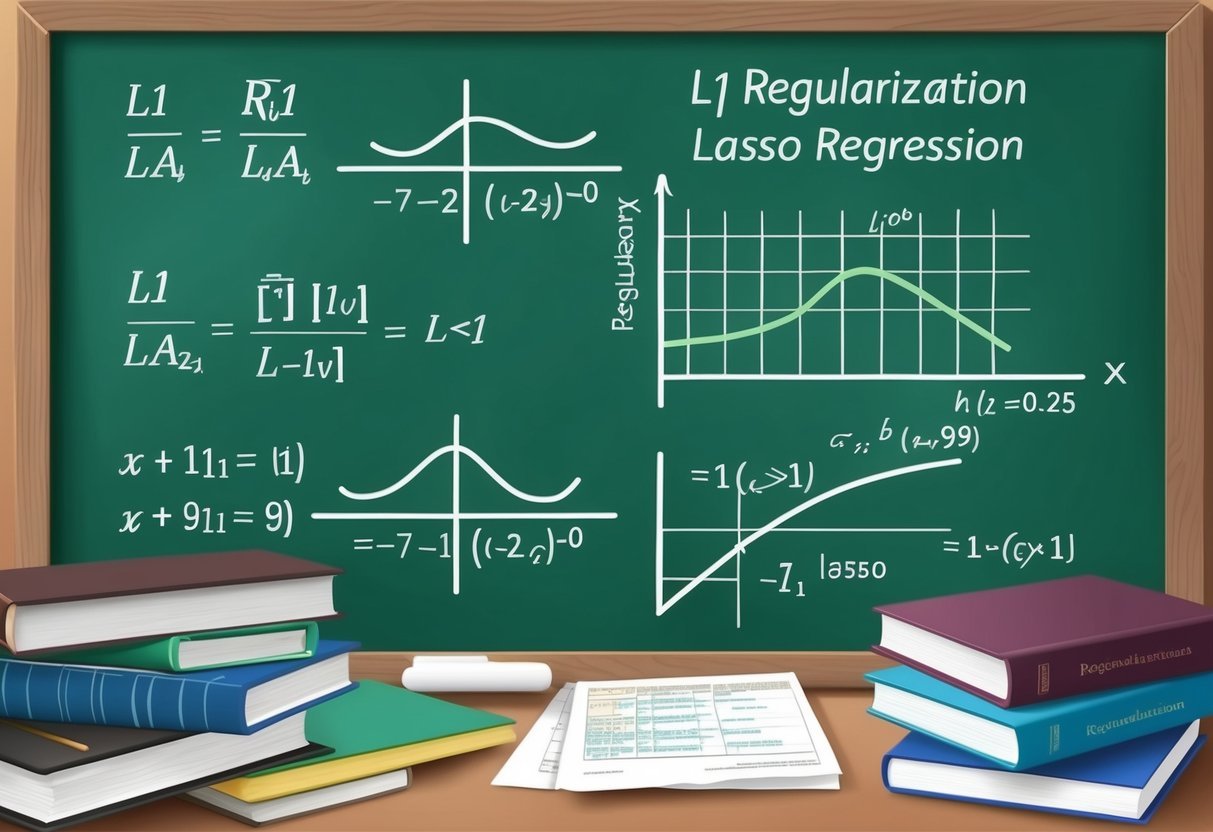
A chalkboard filled with equations and graphs related to L1 regularization and lasso regression, surrounded by books and research papers on the topic

Lasso regression is a powerful tool in machine learning for tasks like feature selection and dealing with high-dimensional datasets. It introduces the concept of sparsity in model parameters through L1 regularization, setting it apart from other techniques.

How does L1 regularization in Lasso regression affect feature selection?

L1 regularization in Lasso regression applies a penalty to coefficients. This penalty can shrink some coefficients to zero, effectively removing these features from the model.

This feature selection ability helps simplify models and can improve their interpretability.

In what scenarios is Lasso regression preferred over Ridge regression?

Lasso regression is preferred when the goal is to perform automatic feature selection. It is particularly useful when reducing the number of features is important, such as in high-dimensional datasets.

In contrast, Ridge regression is better when dealing with multicollinearity without dropping variables.

Can you explain how L1 regularization can lead to sparsity in model parameters?

L1 regularization penalizes the absolute magnitude of coefficients. This can lead to some coefficients becoming exactly zero, which means those features are not used in the model.

This sparsity helps in creating simpler, more interpretable models, which is particularly beneficial in datasets with a large number of predictors.

How do you choose the regularization strength when applying Lasso regression?

The regularization strength in Lasso regression is crucial and is often selected using cross-validation. This involves testing different values and selecting the one that results in the best model performance.

The right strength balances between bias and variance, leading to an optimal model.

What are the implications of using Lasso regression for variable reduction in high-dimensional datasets?

Using Lasso regression in high-dimensional datasets can significantly reduce the number of features, leading to more manageable and efficient models.

This can improve model interpretability and performance, particularly in cases where many features are irrelevant or redundant.

How does the implementation of Lasso regression in Python differ from conventional linear regression models?

Implementing Lasso regression in Python typically involves using libraries such as scikit-learn. The process is similar to linear regression but includes setting a parameter for the regularization strength.

This allows Python to automatically handle feature selection and regularization, unlike standard linear regression models.


Categories
Uncategorized

Understanding Databases and DBMS: Your Comprehensive Guide to Data Management

Why I Wanted to Learn This

  • Personal motivation, struggles, or past confusion about the topic
  • Brief overview of what I hoped to understand

What I Set Out to Learn

  • Goals for the weekend
  • Expectations vs what I thought I already knew

What Databases and DBMS Actually Are

  • Clear definitions and differences
  • Use simple analogies and examples
  • Add diagrams or code snippets (where appropriate)

Core Concepts I Covered

Relational vs Non-relational Databases

SQL vs NoSQL

Schema Design and Normalization

Indexing, Keys, and Query Optimization

Transactions and ACID Properties

ERDs and Data Modeling Basics

What I Actually Learned (My Takeaways)

  • Reflect on surprises, misconceptions corrected, or clarity gained
  • Include visuals, charts, and simple code if helpful

Struggles I Faced and How I Overcame Them

  • What confused me
  • Mental models or reframes that helped

Tools and Resources I Used

  • Mention platforms or tools (e.g., Notion, GitHub, SQLite, pgAdmin)
  • Do not include affiliate links

What I’d Do Differently Next Time

  • Learning strategy tweaks
  • Resource swaps or advice to past self

What This Connects To (Next Learning Session Ideas)

  • Topics I’ll cover next (e.g., SQL joins, query performance tuning, MongoDB intro)
  • Link to future or past posts as appropriate

Key Takeaways

  • Bullet points summarizing my most important insights from this weekend

FAQ

What is a DBMS?

What’s the difference between a database and a table?

What is normalization?

What is ACID compliance?

What should I learn after this?

Categories
Uncategorized

Learn About Relationships: Key Insights for Building Strong Connections

Understanding Relationship Foundations

Healthy relationships rely on key foundations such as love, trust, respect, and boundaries. Each of these elements plays a crucial role in maintaining stability and happiness in partnerships.

Defining Love and Infatuation

Love and infatuation are commonly confused, but they are different concepts. Love tends to be deeper and lasts longer, often involving commitment, care, and mutual growth. It’s built on the willingness to support and understand another person.

Infatuation, on the other hand, is intense but usually short-lived. It often includes feelings of excitement and desire, primarily driven by attraction and idealization.

Recognizing these differences is important. Love involves accepting someone’s flaws and valuing the relationship over personal desires. Infatuation might feel thrilling at first, but it lacks the depth needed for lasting connections. Understanding these distinctions helps individuals navigate their emotions more effectively.

The Role of Trust and Respect

Trust and respect are pillars of any strong relationship. Trust is about believing in the reliability and honesty of a partner. It allows people to feel safe and secure in the relationship.

When trust is present, partners are more likely to communicate openly and resolve conflicts with empathy.

Respect involves recognizing and valuing each other’s beliefs, opinions, and boundaries. It means treating each other with kindness and fairness. Without respect, relationships can become one-sided or even toxic.

Both trust and respect need mutual effort to develop and maintain.

Together, trust and respect encourage equality and harmony in relationships. They help prevent misunderstandings and build a positive, supportive environment.

Establishing Healthy Boundaries

Boundaries are essential for maintaining individual identities and ensuring mutual satisfaction. They define how partners engage with each other and what is acceptable behavior.

Healthy boundaries are clear and agreed upon by both partners, fostering mutual respect and understanding.

Setting boundaries might involve discussing personal needs, limits, and expectations. It’s important for partners to listen and be willing to compromise.

Healthy boundaries allow individuals to feel comfortable and valued, making sure that their needs are met without feeling overwhelmed or ignored.

Effective boundaries contribute to balanced and respectful relationships. They help prevent conflicts and ensure that both partners can openly discuss their feelings and needs.

Communicating Effectively in Relationships

Communication plays a crucial role in building trust and respect within a healthy relationship. By focusing on active listening, effective conflict resolution, and honest communication, partners can strengthen their bonds and handle challenges together.

Active Listening and Expression

Active listening involves giving full attention to the speaker, showing genuine interest, and responding thoughtfully. It requires individuals to not only hear words but also interpret emotions and body language.

Being present during conversations helps avoid misunderstandings.

Expressing one’s thoughts and feelings openly is equally important. Sharing personal experiences and emotions in a clear and respectful manner fosters understanding.

Partners should aim for a balance in listening and speaking, ensuring each person feels heard and valued. This reinforces trust, creating a more harmonious relationship.

Conflict Resolution Strategies

Conflict is a natural part of any relationship. Handling disagreements with respect is key to maintaining a healthy connection.

Effective strategies involve remaining calm, avoiding blame, and focusing on the issue at hand, not personal attacks.

Partners can benefit from taking a time-out to collect their thoughts before discussing a problem. This allows for more rational and constructive conversations.

Compromise and collaboration are essential, with both parties working together to find solutions that consider each other’s needs. This nurtures respect and mutual understanding.

The Importance of Honesty

Honesty is the foundation of trust in relationships. Being truthful helps partners understand each other’s perspectives and strengthens their connection.

When individuals are open about their feelings and thoughts, it builds a sense of security.

It’s important to communicate truthfully yet sensitively, especially when discussing difficult topics.

Honesty includes admitting mistakes and taking responsibility for one’s actions without fear of judgment. This level of transparency fosters a safe environment where both partners can express themselves freely, leading to a more solid and trusting relationship.

Maintaining Individuality

Maintaining individuality in a relationship means balancing your own identity with the bond you share with your partner. It involves staying true to your passions and engaging in self-care activities, which can lead to personal growth and healthier relationships.

Fostering Independence

Having independence in a relationship is crucial. Each person should have space to pursue hobbies, friendships, and interests outside the partnership. This promotes personal satisfaction and prevents reliance on the partner for all emotional needs.

Setting boundaries can help each person understand and respect each other’s need for personal time. Communicating these needs can strengthen the relationship by creating a sense of trust and support.

Couples who respect independence are often more engaged and appreciative of time spent together.

Self-Care and Personal Development

Engaging in self-care is essential for maintaining one’s individuality. Regular activities that promote well-being can help keep a person grounded and fulfilled. This can include anything from exercising to meditating or spending time on a hobby.

Personal development is also key. Continuously learning and growing can keep a person motivated and excited about life.

Exploring new skills or taking a class can bring fresh perspectives and create more dynamic interactions with a partner. Being proactive about self-care ensures that individuals come into the relationship as their best selves.

Building Emotional Connections

Creating emotional connections in relationships involves both deepening intimacy and expressing gratitude. These practices are fundamental in fostering closeness and appreciation, helping to strengthen bonds between partners.

Deepening Intimacy

Deepening intimacy requires time and commitment. Quality time is essential for nurturing these connections. Partners can benefit from regular, meaningful conversations, which provide a space to share thoughts and emotions.

Spending time without distractions, such as putting away phones or turning off the TV, allows for more focused interactions.

Engaging in shared activities, like taking a walk or cooking together, can enhance emotional closeness. These experiences help partners learn about each other’s inner worlds, leading to a deeper level of understanding and connection.

Effective communication is vital, including active listening, which ensures both partners feel heard and valued.

Techniques from the famous study of 36 questions to build intimacy can further strengthen bonds by encouraging partners to discuss personal topics they might not often talk about.

Expressing Gratitude and Appreciation

Expressing gratitude can significantly impact the strength of a relationship. Small gestures, like saying “thank you” or acknowledging a partner’s efforts, reinforce appreciation.

Writing notes or expressing feelings through text can keep the gratitude flowing. These acts remind partners of their worth and importance in the relationship.

Regularly expressing gratitude helps to maintain a positive atmosphere. It nurtures an environment where both partners feel valued and respected.

This practice can also contribute to greater emotional intimacy by creating an atmosphere of warmth and affection.

These habits of appreciation can be incorporated into daily life, ensuring they become a natural part of the relationship dynamic.

Fostering Mutual Support

Fostering mutual support is key in maintaining a healthy relationship. Happy couples often find that navigating challenges together and celebrating each other’s successes enhances their relationship satisfaction.

Navigating Challenges Together

Supporting each other during difficult times strengthens bonds between partners. When challenges arise, it’s important for each person to listen actively and show empathy. This kind of support helps to build trust and makes both partners feel valued.

Creating a plan to tackle problems can also be beneficial. By approaching challenges together, couples can find solutions that satisfy both parties. This teamwork not only resolves issues but also deepens their connection.

Strong communication is vital throughout the process.

Keeping an open line of dialogue allows partners to express their needs and concerns. This openness can prevent misunderstandings and ensure that both feel supported.

Encouragement and reassurance during tough periods can boost confidence in the relationship.

Celebrating Successes as a Couple

Acknowledging and celebrating achievements is another vital aspect of mutual support. When one person reaches a goal, sharing in the joy can strengthen the relationship.

These moments of happiness contribute to overall relationship satisfaction.

Small gestures can be meaningful. Whether it’s a heartfelt compliment or a special celebration, showing appreciation reinforces a couple’s bond.

Celebrations don’t need to be grand but should be sincere and appropriate to the achievement.

Expressing gratitude for each other’s efforts and successes promotes a culture of positivity. This can lead to a more fulfilling partnership where both partners feel recognized and cherished. Each celebration is a step toward a more supportive and happy partnership.

Investing in Quality Time

Investing in quality time involves deliberate efforts to nurture and strengthen relationships. It is essential for building emotional connections and creating lasting memories. This requires planning meaningful activities and balancing alone time with couple time to maintain a healthy relationship.

Planning Meaningful Activities

Quality time is more than just being together; it means engaging in activities that foster connection. Couples can plan activities like cooking together, taking walks, or starting a new hobby. These activities should be enjoyable and allow both partners to communicate openly.

Game nights can also bring fun into the relationship. Board games, puzzles, or video games can encourage teamwork and collaboration. It’s about focusing on the experience and making memories that enhance the relationship.

Spending time outdoors can be another great option. Nature walks, picnics, or stargazing can create a relaxing atmosphere. These moments help couples unwind and appreciate each other without the distractions of daily life.

Balancing Alone Time and Couple Time

Maintaining a balance between alone time and couple time is crucial for a healthy relationship. Both partners need personal space to pursue their interests and recharge. This independence can lead to a stronger partnership, as it prevents feelings of being overwhelmed or suffocated.

Alone time can include reading, exercising, or spending time with friends. It’s important for individual growth and self-reflection, allowing each person to bring their best self to the relationship.

Meanwhile, couple time is about shared experiences that build intimacy and trust. Dedicating time to activities that both enjoy creates a bond and ensures that the relationship remains a priority amidst busy schedules. Finding this balance strengthens the relationship and keeps the connection vibrant.

Cultivating Happiness in Relationships

Building a joyful and satisfying relationship requires effort and understanding. Key aspects include recognizing what brings joy and fostering a healthy, positive dynamic between partners.

Understanding the Ingredients of Joy

Happy couples often engage in activities that bring fun and satisfaction to their relationships. These might include shared hobbies, adventures, or simply spending quality time together.

It’s crucial to express appreciation regularly. Using phrases of gratitude can significantly boost happiness, as acknowledging small gestures adds warmth and positivity.

Communication is another crucial element. Partners should openly discuss what makes them happy and areas where they feel changes are needed. This helps align expectations and fosters mutual support.

Encouraging each other’s personal growth can also contribute to relationship satisfaction, as it shows care for each other’s wellbeing beyond the relationship itself.

Creating a Positive Dynamic

Establishing a positive emotional environment is essential for long-term happiness. Couples can start by consistently supporting each other’s goals and dreams. This creates a strong foundation of trust and understanding.

Addressing conflicts constructively is also important. Using techniques like active listening can help partners feel heard and valued, reducing misunderstandings.

Including regular relationship check-ins can maintain a positive dynamic. These conversations ensure that both partners feel their needs are being met.

It’s also helpful to embrace new experiences together, as trying different activities can bring fresh excitement into the relationship.

Lastly, maintaining a balance between togetherness and individuality allows each person to contribute their best selves to the partnership.

Understanding the Psychology of Relationships

Relationships deeply affect mental health by shaping emotions and thoughts. They rely on attachment styles and human connection to foster love and meaningful bonds between partners.

Attachment Styles and Their Impact

Attachment styles play a crucial role in how individuals form and maintain relationships. These styles develop in childhood and include secure, anxious, avoidant, and disorganized.

A secure attachment style often leads to healthy, trusting relationships, where individuals feel comfortable with intimacy and independence.

An anxious attachment style may cause someone to frequently seek approval and worry about potential rejection. This can create stress and tension in relationships.

Avoidant individuals often struggle with closeness, preferring independence, which might result in emotional distance from their partners.

Understanding these styles can help individuals recognize their patterns and work toward healthier connections. Comprehending one’s attachment style can aid in personal growth and relationship satisfaction.

The Science of Human Connection

Human connection is a fundamental component of meaningful relationships, involving emotional, psychological, and physical bonds. This connection is essential for love and companionship.

Studies show that strong relationships can positively impact mental health, reducing stress and promoting well-being.

Key factors that enhance human connection include open communication, empathy, and shared experiences.

Couples who effectively communicate and show empathy tend to have deeper connections. Shared activities and interests can also strengthen bonds, creating memorable experiences together.

Neurobiological studies reveal that human connection activates brain areas linked to pleasure and reward. This suggests that strong social bonds are essential for overall happiness.

Developing these connections can lead to more fulfilling and supportive relationships, enrich love, and improve mental health.

Evaluating Relationship Health

A couple sitting on a park bench, facing each other and engaged in deep conversation. The surrounding nature is lush and serene, creating a peaceful atmosphere

Evaluating the health of a relationship involves looking for positive traits and keeping an eye out for potential problems. It’s important to notice how partners interact, communicate, and handle challenges together.

Identifying Signs of a Healthy Partnership

In healthy relationships, trust and respect are key factors. Partners who trust each other feel secure and confident, knowing they can rely on each other.

Respect in a relationship involves listening to one another and valuing each other’s opinions and boundaries. Effective communication includes honestly sharing thoughts and feelings.

Healthy couples support one another and encourage personal growth. This support can be seen when both partners are motivated to pursue their own interests, like hobbies or education, without feeling threatened.

Affection and appreciation play a significant role, allowing each partner to feel loved and valued. A balance of time together and apart helps maintain individuality while still fostering a strong connection.

Consistent effort from both sides can lead to a thriving partnership.

Recognizing Red Flags

Recognizing potential problems early can prevent future conflicts. Frequent arguments, unresolved tension, or avoiding important conversations could signal deeper issues.

If there is a lack of trust or if one partner often questions the other’s intentions, it may be a sign of instability. Jealousy that limits personal freedom and independence can also be damaging.

Pay attention to any imbalances in power, where one partner may exert control over decisions or finances. A healthy relationship involves equal input and cooperation.

Communication that includes yelling or name-calling can erode trust and respect. Recognizing these red flags can guide partners towards seeking change or professional help if necessary. Identifying these signs can pave the way for a more balanced and respectful partnership moving forward.

Enhancing Relationship Satisfaction

A couple sitting together on a park bench, smiling and enjoying each other's company while surrounded by blooming flowers and a peaceful setting

Improving relationship satisfaction involves setting clear goals and maintaining a sense of novelty and excitement. By focusing on mutual growth, couples can foster a healthier and more fulfilling connection.

Setting and Achieving Relational Goals

Creating relational goals helps couples focus on what is important in their partnership. They may aim to improve communication, spend more quality time together, or support each other’s personal growth.

Regularly discussing these goals ensures both partners are on the same page and actively working towards a shared vision.

It’s essential to break these goals down into manageable steps. Setting milestones can help track progress and maintain motivation.

For instance, if the aim is to enhance communication, the couple might plan weekly check-ins to discuss emotions and resolve conflicts.

Accountability is crucial. Couples should hold each other accountable gently and positively, reinforcing commitment. This approach fosters a sense of shared responsibility, which can enhance relationship satisfaction by building trust and partnership.

Keeping the Relationship Fresh

Keeping a relationship fresh involves introducing new experiences and maintaining excitement. Couples can plan regular date nights or try new activities together. This helps prevent monotony and encourages a deeper connection.

Trying new things can be as simple as cooking a new recipe together or attending a class for shared interests. These experiences not only break routine but also create opportunities for bonding and discovery.

Variety and surprise in a relationship can reignite feelings of excitement akin to early dating stages.

Additionally, maintaining individuality is important. Encouraging each other’s personal interests and hobbies can inject freshness into the relationship.

By allowing room for personal growth, both partners bring renewed energy and perspectives into their shared life, contributing to a healthier and more satisfying relationship.

Navigating Relationship Transitions

A couple walks along a winding path, passing through various stages of a relationship - from holding hands to sitting apart, symbolizing different transitions

Navigating transitions in relationships often requires strong communication skills. When partners openly share their thoughts and feelings, they understand each other better. This openness reduces misunderstandings and fosters a supportive environment, allowing couples to address changes effectively.

Trust is the foundation of any relationship, especially during transitions. It involves believing in each other’s intentions and commitment. When trust is present, couples feel more secure, making it easier to face new challenges together.

Support from a partner is crucial during these times. Feeling supported means knowing there is someone to lean on.

The support might include listening, offering advice, or simply being present. The presence of this emotional backing helps partners feel valued and understood.

Transitions can range from shifting roles, like becoming parents, to changes in living arrangements. In all scenarios, focusing on shared goals can guide the relationship through uncertain times.

Working towards common objectives ensures both partners feel involved and invested in their future.

According to research, long-distance couples transitioning to living together benefit from negotiation and shared aspirations.

Such transitions are pivotal, marking significant growth within the relationship. By approaching these moments with a mindset geared towards learning and adaptation, couples can maintain their connection and even strengthen it.

Embracing change as an opportunity to learn more about themselves and their relationship is key. This perspective encourages a positive outlook and supports personal and relational growth, making each transition a chance to enhance their bond further.

Cultivating Long-Term Partnerships

A tree with intertwining roots and branches, surrounded by blooming flowers and thriving plants, symbolizing interconnected and enduring relationships

Building long-term partnerships is a valuable strategy for any business. These relationships rely on trust and require consistent effort. Partners need to communicate openly and address any issues promptly. Regular check-ins are key to maintaining a strong connection.

Gratitude and appreciation play important roles in solidifying these partnerships. Acknowledging contributions fosters a positive atmosphere, encouraging both parties to invest more in the relationship. Simple gestures, like thank-you notes or recognizing achievements, go a long way.

Creating healthy relationships with partners also hinges on setting clear expectations. This involves outlining roles and responsibilities early on. Doing so prevents misunderstandings and ensures that everyone is on the same page.

Listing mutual goals can align efforts and focus both parties on the bigger picture. This approach enhances cooperation and prioritizes long-term success. Collaborative efforts also encourage innovation and shared growth.

In a business environment, it’s crucial to nurture relationships by delivering on promises. This builds trust and strengthens commitment.

Keeping communication honest and transparent supports a positive partnership dynamic.

To further cultivate strong links, it’s beneficial to incorporate feedback loops. This helps partners improve processes and adapt to changing conditions. By listening and adjusting, these relationships become resilient and enduring.

Many organizations now recognize the importance of collaboration for long-term success.

Businesses that leverage each partner’s strengths can solve complex challenges more effectively. This synergy not only creates competitive advantages but also fuels continuous improvement.

Frequently Asked Questions

A group of people gathered around a table, engaged in conversation and sharing information. A sense of curiosity and learning is evident in their body language

Building and maintaining strong relationships involves understanding key factors that contribute to their success. Recognizing early indicators can help partners navigate their journey together. Seeking guidance from professionals can also provide valuable insights for long-term happiness.

What are the key factors that contribute to a healthy relationship?

Trust and communication are essential elements. Partners benefit from mutual respect and shared goals. The ability to resolve conflicts without damaging the relationship is crucial, as is honesty in all interactions.

What are some early indicators of a successful partnership?

Positive signs include effective communication, mutual support, and shared values. Couples often exhibit an ability to compromise and adapt to changing situations together. A strong sense of friendship forms a solid basis for a long-lasting relationship.

What are effective strategies for maintaining a strong and happy relationship?

Regular communication and quality time together strengthen bonds. Addressing issues openly and promptly prevents misunderstandings. Appreciation and affection expressed regularly contribute to ongoing happiness and fulfillment.

What can partners do to enhance and increase their emotional connection?

Engaging in activities that foster intimacy can deepen emotional bonds. Spending time together and sharing personal thoughts and feelings enhance connection. Asking intimate questions can be valuable, as seen in the 43+ Intimacy Relationship Questions which aim to deepen understanding between partners.

Who are appropriate professionals to consult for relationship advice and problems?

Licensed therapists, counselors, or relationship coaches are suitable professionals. Consulting with them provides guidance during challenging times. They offer skills and techniques to navigate complex emotional landscapes.

What steps should one take to prepare for a serious and committed relationship?

Understanding personal goals and values is important.

Communication skills and emotional maturity lay a strong foundation.

Preparing emotionally and practically for shared life changes helps partners enter a committed relationship with confidence and readiness.

Categories
Uncategorized

Learning Math for Machine Learning – Probability Fundamentals Explained

Probability Foundations

Probability foundations are crucial for understanding how algorithms make decisions under uncertainty. This section introduces the fundamentals of probability theory and explains the basics of combinatorics, which is essential for counting possibilities in various scenarios.

Probability Theory Basics

Probability is the study of how likely events are to occur. In mathematics, it is represented as a number between 0 and 1. An event with a probability of 1 is certain to happen, while an event with a probability of 0 is impossible.

Key concepts in probability theory include random variables, which are variables whose outcomes are determined by chance, and probability distributions, which describe how probabilities are distributed over the possible outcomes.

Understanding conditional probability is also important. It is the probability of an event occurring given that another event has already happened.

Bayesian probability is another approach, relying on prior knowledge to update the probability estimates as more data becomes available. This probabilistic approach is often used in machine learning for developing predictive algorithms.

Combinatorics and Counting

Combinatorics is an area of mathematics focused on counting, arranging, and combining items. It plays a key role in probability, especially in determining the number of ways an event can occur.

Basic concepts in combinatorics include permutations and combinations. Permutations are arrangements where the order matters, while combinations are selections where order does not matter.

For instance, in algorithms, combinatorics can help decide the number of possible states or configurations in a problem. This branch of mathematics enables precise calculation in probability theory, making it a vital tool for machine learning.

Understanding Variables and Distributions

Understanding variables and probability distributions is key in machine learning. Variables can change and be described using different distributions, like normal or binomial. Knowing these concepts helps in analyzing data accurately.

Random Variables

Random variables are crucial in statistics and machine learning. They represent potential outcomes of experiments. For example, in rolling a die, a random variable can denote the number on the top face.

There are two main types: discrete and continuous. Discrete variables have specific values, like counting students in a class. Continuous variables can take any value within a range, such as measuring a person’s height. Understanding these distinctions helps in selecting the right tools and methods for analysis.

Random variables are often represented as vectors. These can contain multiple values, each corresponding to different outcomes. This approach helps in analyzing experiments with numerous possibilities.

Common Probability Distributions

Probability distributions describe how outcomes of a random variable are spread out. Some common types include normal, binomial, and Poisson distributions. Each has its unique properties and applications.

The normal distribution is symmetric and bell-shaped, often used in natural and social sciences. It is defined by its mean and variance. A key feature is its mode, which is the peak of the distribution curve.

The binomial distribution is used for experiments with two possible results, like flipping a coin. It is defined by the number of trials and probability of success in each trial.

The Poisson distribution models the number of events in a fixed interval of time or space, such as the number of emails received in an hour. Understanding how these distributions work aids in choosing the right model for data analysis.

Mathematics for Machine Learning

A chalkboard filled with mathematical equations and diagrams related to probability, surrounded by books and computer screens

Understanding mathematics is essential for building and refining machine learning models. Two key areas are calculus and linear algebra, which help explain how algorithms optimize and manage complex data structures.

Calculus Review

Calculus is used to optimize algorithms, enhancing the efficiency of machine learning models. Concepts like differentiation and integration help in understanding how changes in input variables affect outcomes.

Derivatives are used to minimize or maximize functions, crucial for tasks like minimizing error in predictions. Meanwhile, gradient descent, a popular optimization method, relies heavily on calculus to iteratively adjust weights and biases in neural networks.

By understanding calculus, developers can fine-tune models to achieve greater accuracy and performance.

Linear Algebra Essentials

Linear algebra forms the backbone of machine learning calculations. It deals with vectors, matrices, and linear transformations.

Machine learning algorithms often require manipulation of large data sets and matrices, making linear algebra an indispensable tool.

Operations like matrix multiplication help in expressing complex operations in a compact form which is useful in various aspects, from data preprocessing to the implementation of neural networks.

Engineers use concepts such as eigenvectors and eigenvalues for dimensionality reduction, crucial in managing high-dimensional data spaces. Understanding linear algebra is vital for anyone looking to excel in the field of machine learning.

Statistical Principles in Data Science

Statistical principles play a critical role in data science by allowing practitioners to summarize, analyze, and draw conclusions from data. They require strong math skills to understand and apply various statistical methods effectively.

Descriptive Statistics

Descriptive statistics provide simple summaries about the sample and the measures. They form the basis of virtually every quantitative analysis of data.

Measures such as mean, median, and mode describe the central tendency, while range, variance, and standard deviation explain data variability.

Tables and charts are often used to represent these measures visually.

Descriptive statistics are crucial in exploratory data analysis, helping data scientists see patterns or trends before diving into more complex analyses. By summarizing data sets, they offer a helpful overview, making large amounts of data digestible. This approach simplifies data interpretation and determines the initial insights needed to explore cause-and-effect relationships further.

Inferential Statistics

Inferential statistics go beyond mere summaries and deal with making predictions or inferences about a population based on a sample.

Using tools like hypothesis testing, confidence intervals, and regression analysis, data scientists can infer trends and patterns and make data-driven decisions.

These methods rely heavily on the principles of probability to quantify the degree of uncertainty involved in drawing conclusions from the data.

Inferential statistics are essential when working with large data sets where full data analysis is impractical. They support the testing of hypotheses to validate assumptions, enabling evidence-based decision-making that is integral to many applications in data science.

Exploration of Algorithms and Structures

A stack of math textbooks surrounded by geometric shapes and computer code, with a focus on probability theory and machine learning algorithms

Understanding algorithms and data structures is essential in computer science and engineering. They form the backbone of machine learning models and influence their efficiency and accuracy. This section discusses the foundational principles of algorithms and the importance of selecting appropriate data structures.

Algorithmic Foundations

Algorithms are step-by-step procedures or formulas for solving problems. They play a critical role in computer science by optimizing processes and making complex tasks manageable.

In machine learning, algorithms are used to train models, allowing computers to learn from data and make predictions.

Key elements of algorithms include correctness, efficiency, and scalability.

Ensuring an algorithm runs correctly and efficiently is paramount for optimal performance. Engineers and computer scientists develop different types of algorithms, such as searching and sorting algorithms, to enhance processing speed.

Understanding these core areas helps in creating more sophisticated and intelligent models that can process large datasets effectively.

Data Structures and Their Importance

Data structures organize and store data efficiently, enabling quick access and modification.

Choosing the right data structure can significantly affect the performance of machine learning algorithms.

Common structures include arrays, linked lists, stacks, and queues, each with unique benefits.

For example, arrays provide fast access to elements, while linked lists offer efficient memory use. The use of advanced structures like trees and graphs can optimize complex operations.

In engineering, understanding how to implement and manipulate these structures aids in solving real-world problems.

Selecting appropriate structures is crucial for enhancing the scalability and efficiency of machine learning systems, ultimately improving their ability to handle large volumes of data successfully.

Programming for Mathematical Computing

A computer displaying code for mathematical computing with a focus on probability, surrounded by books on machine learning and math

Programming is essential in mathematical computing, serving as the backbone of implementing algorithms efficiently. Notably, Python plays a crucial role, offering versatility and a range of libraries. Writing efficient code for mathematical operations is key to optimizing performance in machine learning tasks.

Python in Machine Learning

Python is a highly favored language for machine learning due to its simplicity and robust libraries like NumPy, SciPy, and TensorFlow.

These tools allow developers to handle complex mathematical computations seamlessly.

NumPy provides support for large multi-dimensional arrays and matrices, along with a collection of mathematical functions to operate on these arrays.

SciPy extends this functionality to provide further modules for optimization and signal processing.

For those working on machine learning models, the ability to process large datasets efficiently is essential.

Libraries like TensorFlow and PyTorch are widely used for building and training machine learning models, enabling the execution of tasks across various platforms.

These libraries support both CPU and GPU, making them versatile for different computing needs.

Efficient Code for Mathematical Operations

Writing efficient code involves optimizing algorithms to reduce computational time and resource usage. This is particularly significant when working with large datasets or complex calculations.

Techniques such as vectorization, which is supported by NumPy, help in speeding up the execution by performing batch operations on data.

Utilizing built-in functions and avoiding loops where possible can drastically decrease execution time.

Python’s extensive library support provides optimized algorithms for common tasks. For instance, using libraries like SciPy for linear algebra operations ensures that the most efficient algorithms are employed, often leveraging underlying compiled code for speed.

Parallel computing is another strategy, utilizing libraries like Dask to distribute work across multiple cores or nodes.

This allows for the handling of massive datasets and intensive computation, making programming for mathematical computing both efficient and scalable.

Machine Learning Model Fundamentals

A computer displaying probability equations and graphs for machine learning

In machine learning, understanding the types of learning models is crucial. Supervised learning involves training models with labeled data, while unsupervised learning uses data without explicit labels. Both methods have distinct approaches and applications.

Supervised Learning

Supervised learning uses labeled datasets to train models in predicting outcomes.

Common methods include linear regression, which predicts continuous values, and classification techniques for categorizing data. For instance, email spam detection falls under this category.

Neural networks can enhance supervised learning by enabling complex pattern recognition in data.

These models typically require a large amount of accurately labeled data and are evaluated using metrics like accuracy and precision.

Challenges in supervised learning include overfitting, where a model learns noise rather than meaningful patterns. To counter this, techniques like cross-validation and regularization are employed. These methods ensure models perform well on new, unseen data.

Unsupervised Learning

Unsupervised learning works with data that lacks explicit labels, allowing models to find hidden patterns or groupings.

Techniques like clustering and dimensionality reduction are common. Clustering groups data based on similarities, useful in customer segmentation, while dimensionality reduction simplifies data, which can enhance performance in higher-dimensional datasets.

Neural networks in unsupervised learning, such as autoencoders, assist in feature learning and generation of new data formats.

Unlike supervised methods, unsupervised learning does not provide specific predictions but identifies data structures that weren’t obvious. These insights are essential for data exploration and preliminary analysis, aiding the development of further machine learning models.

Data Handling and Manipulation

A computer screen displaying a graph with data points, a calculator, and a textbook open to a page on probability

Data handling and manipulation are vital when working with machine learning models. These processes include organizing and preparing data for analysis. Methods in linear algebra, like matrix operations, play a key role in this, transforming data for better machine learning performance.

Working with Matrices

Matrices are essential in machine learning for structuring data.

Matrix multiplication is a common operation that facilitates various machine learning tasks.

When data is in matrix form, it allows for efficient calculations, such as transforming datasets using transformations.

In linear algebra, understanding the structure of matrices can help in dimensionality reduction. This is crucial for simplifying datasets without losing important information.

Singular value decomposition (SVD) is a technique used for this purpose, helping models perform better by reducing computational load.

Matrices also support operations like inversion and transposition, which are important in algorithms like regression analysis.

By leveraging matrices, complex data relationships become easier to interpret, enhancing the effectiveness of machine learning models.

Data Preprocessing Techniques

Preprocessing prepares raw data, improving the quality of input data for machine learning.

This involves cleaning, transforming, and encoding data to make it suitable for analysis.

Techniques include scaling, where features are adjusted to fit within a certain range, making models more robust.

Handling missing values is another important step. Methods like imputation fill in gaps where data is incomplete, ensuring that models do not encounter errors during training.

Encoding categorical data transforms categorical values into numerical formats, enabling algorithms to process them effectively.

Other preprocessing methods involve filtering noise from data.

Techniques such as normalization and standardization ensure that different variables contribute equally to the analysis, promoting better model performance and accuracy when predicting outcomes.

Dimensionality and Its Challenges

A complex web of interconnected nodes and lines representing mathematical probability concepts

Dealing with high-dimensional data is a core challenge in machine learning. It involves handling numerous variables or features, which can complicate analysis and increase the risk of overfitting models.

Solutions like dimensionality reduction are key in streamlining the process and improving outcomes.

Understanding Dimensionality

Dimensionality in machine learning refers to the number of features or variables used to describe data. As the number grows, the complexity of the problem can increase.

This phenomenon, often called the “curse of dimensionality,” can make it hard to model data accurately.

In high dimensions, data points can appear sparse. This sparseness can affect algorithms, making them less reliable due to a lack of nearby data points for accurate predictions.

Moreover, calculations involving distances, such as clustering and nearest neighbor algorithms, can become less effective.

Dimensionality also impacts storage and computation. High-dimensional data can require significant computational resources.

It is vital to balance the benefits of additional features with the costs related to processing and storage.

Approaches to Dimensionality Reduction

Dimensionality reduction techniques help mitigate the challenges of handling high-dimensional data. These methods aim to reduce the number of input variables while retaining as much information as possible.

Common techniques include Principal Component Analysis (PCA) and t-Distributed Stochastic Neighbor Embedding (t-SNE).

PCA is widely used and works by transforming data into a new set of variables called principal components. These components capture the most variance in the data.

t-SNE is particularly useful for visualizing high-dimensional data by mapping it to lower dimensions.

Feature engineering also plays a role in dimensionality reduction.

It involves creating new features from existing ones, which can better represent the underlying patterns in the data.

By doing this, engineers can often reduce the dimensions without losing critical information, making models more efficient and effective.

Learning Resources and Pedagogy

A chalkboard filled with mathematical equations, graphs, and probability diagrams, surrounded by colorful math manipulatives and educational resources

Exploring effective ways to learn probability for machine learning involves both innovative teaching methods and various resources for self-learners.

Innovative Teaching Methods

Educators are continually developing new strategies to improve how students learn probability.

One approach is using modeling in teaching, which helps students visualize complex problems by creating real-world scenarios. These models make abstract concepts more tangible.

Another effective method is integrating games into the curriculum, which studies have shown can boost engagement and understanding.

Research suggests that games create interactive and participatory learning environments. This engagement helps students develop practical skills necessary for understanding probability.

A blend of traditional and modern pedagogical tools can cater to different learning styles, ensuring a comprehensive learning journey for students.

Resources for Self-Learners

For those who prefer self-directed learning, a variety of resources are available.

Digital platforms, such as e-learning courses, provide access to high-quality content. These platforms often include videos, quizzes, and practical exercises, helping learners grasp difficult concepts at their own pace.

Textbooks remain a valuable resource, offering structured content and exercises for in-depth study.

Some textbooks focus on promoting a deep understanding of mathematical principles, guiding learners with step-by-step approaches.

Furthermore, educational websites and forums offer additional support, allowing self-learners to collaborate and engage with a community of peers.

These resources empower learners to explore probability in a flexible and comprehensive manner.

Real-World Applications of Probability

Probability plays a vital role in transforming theoretical concepts into practical applications across various fields. It is crucial for making predictions and decisions in technology and engineering.

Applications in Artificial Intelligence

Probability is fundamental in the field of artificial intelligence, especially in machine learning.

It helps in developing models that can predict outcomes and make decisions based on data. Techniques like logistic regression use probabilistic methods to assess data and determine probabilities.

In AI, probabilistic models are used to handle uncertainties and make decisions under uncertain conditions.

Bayesian networks, for example, model relationships between different variables and update their beliefs as more data becomes available. This is key for applications like speech recognition, where the system must decide between multiple possible interpretations.

Probabilistic Models in Engineering

Engineering uses probabilistic models to improve design and decision-making processes. These models help predict failure rates and optimize systems for reliability.

In civil engineering, for instance, probability is used to analyze and mitigate risks such as structural failure.

By applying probabilistic concepts, engineers can anticipate potential issues and design safer structures.

In electronics, probabilistic methods are utilized to evaluate circuit performance under varying conditions.

These approaches ensure components work effectively under uncertain and dynamic environments. Thus, probability is not only an analytical tool but also a crucial aspect of innovative design and safety assurance in engineering projects.

Career Paths and Progression in Data Science

A computer screen displaying a graph of probability distribution with mathematical equations and data science career progression paths in the background

Data science offers various career paths, including roles in data analysis, engineering, and research. Each path requires specific skills and experiences. Learning doesn’t stop after becoming a data scientist. Continuous education and specialization can lead to advanced positions.

Becoming a Data Scientist

To become a data scientist, one generally needs a strong foundation in mathematics, statistics, and computer science.

Key skills include:

  • Programming languages: Python and R
  • Statistics and probability
  • Machine learning algorithms

Gaining experience through internships or projects can be very helpful. Entry-level roles often include data analyst or junior data scientist positions.

Certifications in data science can also boost a candidate’s resume and increase job prospects. Networking and joining professional organizations like the Data Science Society can help in finding opportunities and advancing one’s career.

Further Studies and Specializations

In data science, continuous learning is important.

Professionals may choose to specialize in areas like:

  • Machine learning engineering
  • Data mining techniques
  • Artificial Intelligence (AI)

Pursuing a Master’s or PhD in data science or related fields can open doors to research positions or advanced roles such as senior data scientist or data science manager.

Specialized certifications in tools like TensorFlow or Hadoop can also enhance one’s skills and job appeal. Engaging in workshops and conferences helps stay updated with industry trends and technologies.

Frequently Asked Questions

Understanding probability is crucial for developing effective machine learning algorithms. This section looks at the essential concepts, the role of probability in enhancing model performance, and key resources for learning.

What are the fundamental probability concepts necessary for understanding machine learning algorithms?

Key concepts include random variables, probability distributions, expectation, variance, and independence. These form the backbone of statistical models, helping to interpret data and predict outcomes.

How does a solid grasp of probability and statistics enhance model accuracy in machine learning?

A strong foundation in probability allows the machine learning practitioner to effectively handle uncertainty and variability in data. This knowledge leads to better algorithm tuning, improved data sampling techniques, and more accurate predictions.

Which probability distributions are most commonly used in machine learning and why?

Common distributions include the normal, binomial, and Poisson distributions. These are frequently used because they model a wide range of phenomena and support various machine learning tasks, such as classification and regression.

In what ways is Bayes’ theorem applicable to machine learning models?

Bayes’ theorem is used in updating the probabilities of hypotheses as more evidence becomes available. It plays a critical role in classification problems and in models like the Naive Bayes classifier.

Can you recommend any comprehensive resources for learning about probability in the context of machine learning?

“Python for Probability, Statistics, and Machine Learning” offers extensive code examples and is available on Springer. Additionally, “Probabilistic Machine Learning: An Introduction” provides insights into probabilistic frameworks and can be accessed through Google Books.

Why is an understanding of probability essential for evaluating the performance of a machine learning model?

Probability is vital for evaluating model performance. It helps in understanding model behavior, assessing uncertainty in predictions, and making data-driven decisions. This leads to more reliable and robust performance evaluations.

Categories
Uncategorized

Learning How to Search and Sort in Python: Essential Techniques for Efficient Coding

Understanding Python Basics

Python is a versatile programming language, known for its simple syntax and powerful capabilities.

This section covers Python’s key data structures and the built-in sort() method, essential for efficiently managing and organizing data.

Python Data Structures

Python offers several data structures that are essential for organizing and storing data.

Lists are one of the most flexible and widely used data structures in Python. They allow storing an ordered collection of items, which can be of different types.

Lists are mutable, meaning you can change their content after creation. You can add, remove, or modify elements easily.

Tuples, on the other hand, are similar to lists but are immutable. Once created, tuples cannot be altered, which makes them suitable for data that should not change throughout the program.

Additionally, Python provides sets, which are unordered collections of unique elements, and dictionaries, which store data in key-value pairs, allowing fast access to elements using keys. Understanding these structures is crucial for effective data manipulation in Python.

Python’s sort() Method

The sort() method is a built-in Python function used to arrange elements in a list into a specific order. It sorts the list in place, meaning it reorders the original list without creating a new one.

By default, sort() arranges elements in ascending order.

An optional key parameter can be added to customize the sorting criteria. For example, you can sort a list of strings by their length or a list of tuples by the second element.

The reverse parameter, if set to True, will sort the list in descending order. Understanding how to use the sort() method effectively is vital for managing lists in Python. For more about sorting techniques, visit this guide on sorting and searching in Python by Envato Tuts+.

Introduction to Searching Algorithms

Searching algorithms are essential in computer science for retrieving data efficiently. They are used to find specific elements within a data structure, such as a list or array.

This section covers four key searching algorithms: linear search, binary search, interpolation search, and jump search. Each of these algorithms has unique properties and use cases.

Linear Search Algorithm

Linear search is one of the simplest searching algorithms. It checks each element in a list, one by one, until it finds the target or reaches the end. This makes it straightforward but not always efficient for large datasets.

Linear search is useful when dealing with unsorted data because it doesn’t require any prior data ordering.

In linear search, the time complexity is O(n), where n is the number of elements in the list. This means that the time taken grows linearly with the size of the data.

Despite this inefficiency in larger datasets, its simplicity and ease of implementation often make it a good choice for small or unsorted collections.

Binary Search Algorithm

Binary search is more efficient than linear search but requires that the data be sorted. It works by repeatedly dividing the list into halves, focusing on the half where the target is most likely to be. If the list is sorted, binary search can quickly find the target using fewer comparisons.

The efficiency of binary search comes from its time complexity of O(log n). This logarithmic growth means it handles large datasets much more effectively than linear search.

The process involves checking the middle element, eliminating half of the data from consideration, and repeating until the target is found or the sublist is empty.

Interpolation Search

Interpolation search improves on binary search by making educated guesses instead of dividing the list into equal halves. Based on the principle of interpolation, it assumes that the target may be closer to a certain part of the list, depending on the values.

This is especially useful with evenly distributed numerical data.

In the best case, interpolation search has a time complexity of O(log log n), but it can degrade to O(n) if the data is not well-distributed. This method works well for numeric data types that are uniformly distributed, as it can skip large sections of data and reach the target more swiftly than binary search.

Jump Search

Jump search offers a middle ground between linear and binary search. It works by jumping ahead by fixed steps and then performing a linear search once it surpasses the target element.

It is particularly practical for sorted data that cannot be divided easily like in binary search.

Typically, the step size is the square root of the list length. This method has a time complexity of O(√n), which is more efficient than linear search for larger datasets. Jump search is useful for sorted arrays where traditional binary search might be too complex or when dealing with data in non-contiguous storage, such as linked lists.

Implementing Sorting Algorithms in Python

Sorting algorithms are essential for organizing data efficiently. Python provides various methods to implement these algorithms, each with unique approaches and use cases. Examining Bubble Sort, Selection Sort, and Insertion Sort can provide a better understanding of their processes and applications.

Implementing Bubble Sort

Bubble Sort repeatedly steps through a list, compares adjacent elements, and swaps them if they are in the wrong order. The algorithm passes through the list multiple times until no swaps are needed, indicating that the list is sorted.

This approach is simple to implement but has a time complexity of O(n²), making it less efficient on large lists.

To implement Bubble Sort in Python, a for loop iterates over the list, while an inner loop handles the comparison and swapping of elements. This method is mainly used as an educational tool due to its straightforward implementation, despite not being performance-friendly for substantial datasets. More details can be found on sorting algorithms in Python.

Implementing Selection Sort

Selection Sort divides the list into a sorted and an unsorted part. It repeatedly selects the smallest (or largest, depending on order) element from the unsorted part and swaps it with the first unsorted element. As a result, the sorted list gradually grows until all elements are sorted.

In Python, Selection Sort is implemented using nested loops to find the smallest element by comparison. The outer loop tracks the boundary between sorted and unsorted parts, while the inner loop finds the minimum in the unsorted section.

This algorithm also has a time complexity of O(n²), making it inefficient for large lists. You can read more about these sorting techniques on GeeksforGeeks.

Implementing Insertion Sort

Insertion Sort builds a sorted list one element at a time by repeatedly picking an element from the unsorted portion and inserting it into the correct position. Its time complexity is O(n²), but it performs better than Bubble and Selection Sort on average cases, especially for smaller datasets or when the list is already partially sorted.

In Python, Insertion Sort is implemented using a loop that iterates over the list. An inner loop shifts elements that are greater than the current one to make space for its correct position.

This algorithm can be efficient when employed on nearly sorted data. For further reading, visit 4Geeks.

Advanced Sorting Techniques

Advanced sorting techniques like merge sort, quick sort, and heap sort are crucial for efficiently managing large datasets. These algorithms offer improved performance over basic sorting methods, making them invaluable tools for programmers.

Understanding Merge Sort

Merge sort is a divide-and-conquer algorithm. It works by splitting a list into smaller sublists, sorting each sublist, and then merging them back together in order. This technique ensures that the final list is sorted.

A key advantage of merge sort is its consistency; it maintains a time complexity of O(n log n) regardless of how the data is initially distributed. This makes it highly reliable when dealing with large datasets. The sorting techniques in Python demonstrate the power of merge sort for working with big data efficiently.

Exploring Quick Sort

Quick sort is another efficient sorting method that uses a divide-and-conquer approach. It selects a pivot element and partitions the list into two halves based on this pivot. Elements less than the pivot go to the left, and those greater go to the right.

Quick sort is known for its speed, often outperforming other algorithms like merge sort when dealing with small to medium-sized datasets. Its average-case time complexity is also O(n log n).

Although its performance can degrade to O(n²) in the worst case, proper pivot selection helps avoid this issue. The advanced sorting algorithms emphasize efficient pivot choice for optimal performance.

Heap Sort Fundamentals

Heap sort utilizes a binary heap data structure. It builds a max heap with the maximum element at the root. After constructing the heap, it swaps this maximum element with the last element of the heap and reduces the heap size. This process repeats until the list is sorted.

With a consistent time complexity of O(n log n), heap sort offers a good balance between quick sort’s speed and merge sort’s reliability. Additionally, it is an in-place sort, meaning it doesn’t require extra space, unlike merge sort. The role of heap sort in sorting algorithms can be explored in more detail on websites like GeeksforGeeks.

Algorithm Efficiency and Time Complexity

A computer screen displaying Python code for searching and sorting algorithms

Algorithm efficiency is important when evaluating how quickly an algorithm completes tasks as the input size grows. Time complexity is one way to measure this efficiency, often using Big O notation to express the performance in different scenarios.

Best Case and Worst Case Scenarios

In algorithm analysis, the best case scenario refers to the situation where the algorithm performs at its fastest. For example, in a sorted array, a search algorithm might find the item immediately.

The worst case scenario describes when the algorithm takes the longest time to complete its task. For instance, searching in an unsorted array might mean checking every item.

These scenarios help developers understand the limits and potential pitfalls of their algorithms. Knowing both cases ensures that algorithms remain efficient across varied situations.

Analyzing Time Complexity

Time complexity quantifies the amount of time an algorithm takes relative to the input size. Big O notation is commonly used to represent this. For example, O(1) indicates constant time, while O(n) suggests that time grows linearly with input size.

To analyze time complexity, consider both the number of operations and their frequency. GeeksforGeeks provides insights into calculating average and worst-case complexities for different sorting algorithms. This helps in selecting the appropriate algorithm based on the specific needs of a program.

Sorting in Data Science

A computer screen displaying python code for searching and sorting data

Sorting is a fundamental operation in data science, providing structure and order to data sets. It is critical in preparing data for analysis, allowing for efficient search operations and ensuring that algorithms perform optimally.

Role of Sorting in Data Analysis

In data analysis, sorting plays a vital role in organizing data for more straightforward examination. It enables easier identification of patterns or anomalies in large data sets.

Analysts often employ sorting to arrange data in ascending or descending order based on certain criteria, making comparison tasks more efficient.

For example, sorting may be used to order sales figures by date to help identify trends over time.

Sorting algorithms, such as quicksort and mergesort, are frequently used due to their efficiency and speed.

By arranging data prior to analysis, sorting can reduce complexity in various processes, such as filtering or merging datasets. Thus, incorporating sorting techniques is essential for effective data analysis and extracting meaningful insights.

Search Optimization Techniques

Improving search algorithms is key for efficient data handling. Techniques for optimizing linear and binary searches can help reduce time complexity and boost performance in Python applications.

Optimizing Linear Searches

Linear search is simple but can be inefficient for large datasets because it checks each item individually.

One optimization is the Sentinel Linear Search, which places a sentinel value at the end of the list. This eliminates bounds checking during each iteration, potentially speeding up the process.

Using a loop unrolling technique can also boost efficiency. This approach involves processing multiple list elements in a single loop iteration.

For lists that are mostly sorted, applying a method that skips unlikely matches can significantly cut down comparisons.

Despite these improvements, the basic time complexity remains O(n).

For increased efficiency on already sorted data, combining linear search with other methods like hinting can offer marginal gains, but the improvements are case-specific.

Optimizing Binary Searches

Binary search works well on sorted data, reducing the search space by half with each step.

One way to optimize it is by using Exponential Search to find an appropriate range before performing binary search. This is especially beneficial for large datasets.

Another method is Iterative Binary Search. Switching to an iterative approach rather than a recursive one can save on call stack memory.

Utilizing bit manipulation to avoid overflow errors when calculating the midpoint is another subtle optimization technique.

Binary search has a time complexity of O(log n), which makes these enhancements particularly advantageous for handling extensive datasets, maintaining both speed and accuracy.

Sorting Techniques for Large Datasets

Sorting large datasets efficiently is crucial in data processing. Choosing the right algorithm affects performance significantly, especially with big data. Two effective techniques for sorting extensive data in Python are merge sort and heap sort.

Merge Sort for Big Data

Merge sort is a popular choice for handling large datasets. It follows a divide-and-conquer approach, breaking the data into smaller parts and sorting them individually before merging. This method ensures that it performs well even with large volumes of data.

Unlike some other algorithms, merge sort has a time complexity of O(n log n), making it efficient for big data tasks.

Its stability is a key advantage, maintaining the original order of equal elements. This is particularly useful when dealing with datasets that have multiple keys or priorities.

In practice, merge sort can be implemented using recursion or iteratively. The merge sort algorithm is frequently used in external sorting, where data is too large to fit into memory at once.

Heap Sort in Practice

Heap sort is another efficient algorithm used for large datasets. It transforms the list into a complete binary heap, then repeatedly extracts the largest element and rearranges the heap. This process continues until all elements are sorted.

With a time complexity of O(n log n), heap sort compares favorably with other algorithms, providing reliable performance across various data sizes.

One benefit of heap sort is its in-place sorting capability, which requires minimal additional memory space. This makes it suitable for environments with limited resources.

It’s a great choice when an in-memory sort is feasible and quick execution is required. In practical terms, heap sort offers consistency and effectiveness, especially in resource-constrained scenarios.

Custom Sorting with Lambda Functions

In Python, lambda functions allow for efficient, custom sorting solutions. They can apply specific criteria during the sorting process, making them versatile for various tasks, like setting a custom order or sorting by multiple keys.

Custom Sort Order

Custom sorting in Python can be achieved using the sort() method or the sorted() function alongside lambda functions. By using a lambda function, users can define their own sorting order according to their needs. This is useful when the default sorting order is not suitable.

For instance, suppose a user wants to sort a list of tuples by the second element. They can apply a lambda function like key=lambda x: x[1] which directs the sort function to consider only the second element of each tuple.

Using this approach, Python will sort the entire list based on the specified element.

Additionally, both sort() and sorted() provide the reverse parameter, which can reverse the sorting order if set to True. This feature allows for both ascending and descending sorting, further adding to the flexibility of using lambda functions for custom order sorting.

Sorting with Multiple Keys

When data requires sorting using multiple criteria, lambda functions become indispensable tools. By combining multiple keys in a single lambda function, users can specify a prioritized sorting order.

For example, with a list of dictionaries representing students, where keys are “name” and “score”, users can sort primarily by “score” and then by “name”. The lambda function key=lambda x: (x['score'], x['name']) would perform this, sorting by score first and name second.

The order of keys determines the priority of sorting — the first key has the highest priority. This method allows users to handle complex sorting requirements easily without writing elaborate comparison functions.

Sorting and Searching in Computer Programming

Sorting and searching are essential techniques in computer science. They help in organizing data and finding specific items efficiently. This section explores how sorting and searching algorithms are applied in various programming contexts.

Applications of Sorting Algorithms

Sorting algorithms are widely used in computer programming to arrange data in a specific order. This can be ascending or descending numeric values, alphabetical order, or any other criteria.

Common algorithms include bubble sort, selection sort, and merge sort. In databases, sorting helps speed up query operations by arranging records in a way that makes them easier to retrieve.

E-commerce platforms use sorting to display products by price or popularity. In addition, algorithms like quick sort are used in software applications for managing files and folders in an organized manner.

Sorting also plays a role in graphics rendering where data points need to be ordered efficiently to draw images correctly. Projects that involve large amounts of data often rely on the effectiveness of sorting to improve performance and usability.

Applications of Searching Algorithms

Searching algorithms are crucial in locating particular elements within a data structure. Linear search and binary search are two examples, with the latter being more efficient for sorted lists.

In search engines, algorithms help identify relevant web pages based on keywords entered by the user.

These algorithms are also important in text processing, where tasks like finding a word in a document or pattern recognition are common. In addition, searching is used in artificial intelligence for decision-making processes, where quick identification of optimal paths or solutions can significantly enhance performance.

Digital storage systems like databases and cloud services implement these algorithms to make data retrieval swift and reliable.

Understanding the Selection Sort Algorithm

The Selection Sort algorithm is a straightforward and easy-to-understand method for arranging elements in a list in order. This algorithm works by repeatedly finding the minimum element from the unsorted part and placing it at the beginning, gradually creating a sorted list.

Mechanics of Selection Sort

Selection Sort follows a simple process. It starts by scanning the entire list to find the smallest element. This element is then swapped with the first element.

In the next step, the algorithm looks at the remaining unsorted portion to find the smallest element again, and swaps it with the second element. This process is repeated until the whole list is sorted.

This algorithm has a time complexity of (O(n^2)), making it less efficient for large datasets.

Despite this, its simplicity makes it a useful tool for educational purposes and small-scale sorting needs. Understanding how this process works helps in grasping the fundamentals of sorting and algorithm design.

Selection Sort in Python

Implementing Selection Sort in Python involves using loops to traverse and compare elements. The code structure is straightforward, often using nested loops: one to iterate over each position in the list, and another to find the smallest element in the remaining unsorted section.

def selection_sort(arr):
    for i in range(len(arr)):
        min_index = i
        for j in range(i + 1, len(arr)):
            if arr[j] < arr[min_index]:
                min_index = j
        arr[i], arr[min_index] = arr[min_index], arr[i]

data = [64, 25, 12, 22, 11]
selection_sort(data)
print("Sorted array:", data)

This code consistently swaps the found minimum with the first unsorted element, gradually sorting the entire list. Resources like GeeksforGeeks provide an illustrative guide for implementing this algorithm. Selection Sort in Python is helpful for learners wanting to practice basic algorithm design and coding skills.

Improving Search and Sort Performance

Enhancing the performance of search and sort functions in Python is essential, especially when dealing with large datasets. Efficiency in algorithm choice and implementation can dramatically affect processing time complexity. This section will explore key metrics and strategies for improving these functions.

Performance Metrics

To improve search and sort algorithms, understanding key performance metrics is vital. Time complexity helps determine how an algorithm’s run time increases with input size.

Common measures include O(n log n) for efficient sorts like Quick Sort. Space complexity is another critical metric, indicating memory usage.

Running tests with varying data sizes provides insights into algorithm effectiveness. Analyzing these metrics can aid in selecting the best-fitting algorithm for specific tasks.

Utilizing performance metrics allows developers to make informed choices.

Optimization Strategies

Efficient search and sort functionality hinges on solid optimization strategies.

Implementing comparison optimizations makes sorting faster, such as using the .sort() method for in-place sorting or the sorted() function for creating new lists.

Selecting the right data structures, like hash tables, can speed up search algorithms significantly.

It’s crucial to adjust strategies for big data environments. For instance, parallel processing can be used to run sorting operations concurrently, thereby improving performance.

These strategies contribute to both efficiency and effectiveness in processing large datasets. Understanding these tactics ensures better handling of complex operations.

Frequently Asked Questions

A computer screen displaying Python code with search and sort algorithms, surrounded by open books and a notepad with handwritten notes

Python provides several methods for searching and sorting data. Each method has its own use cases and efficiency, making it crucial to choose the right one for the task at hand.

How do I implement bubble sort in Python?

Bubble sort repeatedly steps through the list to be sorted, compares adjacent elements, and swaps them if they are in the wrong order. The process is repeated until the list is sorted. This algorithm is simple to implement but not very efficient for large datasets. Practice Bubble Sort for a hands-on experience.

What are the different searching algorithms available in Python?

Python includes several searching algorithms like linear search, binary search, and hash tables. Linear search checks each element in sequence, while binary search is faster by dividing the search interval in half each time, working only with sorted lists.

Can you give an example of merge sort in Python?

Merge sort is a divide-and-conquer algorithm that splits the list into halves, sorts them, and then merges the sorted halves back together. This method is efficient and has a consistent runtime complexity. An example of merge sort can be found online.

What is the most efficient sorting algorithm available in Python?

Among the efficient sorting algorithms, Python’s built-in sort() and sorted() functions utilize Timsort, a hybrid sorting algorithm derived from merge sort and insertion sort. It is designed to perform well on various types of real-world data.

How can I perform a selection sort in Python?

Selection sort divides the input list into two parts: a sorted part and an unsorted part. It repeatedly selects the smallest or largest element from the unsorted part and moves it to the end of the sorted part. This sorting method is straightforward to implement but inefficient on large lists.

What is the easiest method to sort a list in Python?

The easiest method to sort a list in Python is to use the sort() method or sorted() function. These handle sorting in ascending or descending order with simple syntax and are efficient for most uses.

For a straightforward guide, refer to Python list sorting techniques on DataCamp.

Categories
Uncategorized

Learning About Python Number Data Types: A Comprehensive Guide

Understanding Python’s Numeric Data Types

Python’s numeric data types are foundational for calculations and data manipulation. These types include integers, floating-point numbers, and complex numbers.

Understanding each type is key for efficient coding.

Integers are whole numbers without any decimal part. They are represented by the int class.

Examples include 1, -5, and 42. Integers are useful for countable values, like items or positions.

Floating-point numbers are numbers with a decimal point. They are created using the float class.

Examples include 3.14 and -0.001. Floating-point numbers are ideal for measurements that require precision, such as temperatures or weights.

Python also supports complex numbers for advanced mathematical computations. These numbers have a real part and an imaginary part, usually written in the form a + bj. The complex class handles these numbers.

They are crucial in fields like engineering and physics.

Below is a basic table summarizing these types:

Type Class Example
Integer int 10, -3
Float float 2.5, -7.1
Complex complex 1+2j, 3-4j

Numeric data types in Python provide flexibility and power for various applications. From simple arithmetic to complex equations, they form an integral part of programming in Python.

Exploring these data types helps one utilize the full potential of Python in data manipulation and problem-solving.

The Basics of Integers in Python

In Python, integers are a core numeric data type that represents whole numbers, both positive and negative. They are widely used for counting, indexing, and calculations because of their efficiency and ease of use.

Working With the int Class

The int class in Python handles whole numbers without decimal points. Integers can be written directly in the code, such as 5, -3, or 1024.

Python’s integers have unlimited precision, meaning they can be as large or small as memory allows.

One practical aspect of the int class is type conversion. For example, using int() can convert strings or floating-point numbers to integers. Here’s an illustration:

num = int("42")  # Converts string to integer
decimal = int(3.14)  # Converts float to integer (truncates to 3)

When using integers, understanding how the int class interacts with other data types is crucial. This interaction enables developers to perform versatile operations with numbers.

Integer Division and Arithmetic Operations

Arithmetic operations with integers include addition, subtraction, multiplication, and division. Each performs predictable tasks, such as computing sums or products between numbers.

Division between integers in Python can be straightforward or specific. Standard division using / results in a float, while // operator results in integer division, providing only the whole number part.

For example:

result = 10 / 3  # Yields 3.333...
integer_result = 10 // 3  # Yields 3

Integer arithmetic operations are fundamental, enabling tasks such as iterating over loops or calculating offsets in data structures. Understanding these operations is key to harnessing Python’s number manipulation capabilities effectively.

Floating-Point Numbers and Precision

Floating-point numbers in Python are managed by the float class, which provides support for decimal numbers and scientific notation. These numbers, though powerful, come with limitations in precision due to the way they are stored in binary form. Understanding this precision is essential when performing arithmetic operations.

Using the float Class

The float class represents floating-point numbers in Python, conforming to the IEEE 754 standard. This format provides about 15-17 significant decimal digits, which is why it is often used for scientific calculations.

Floats can represent numbers in scientific notation, using either e or E to denote powers of 10.

For example, the number 3.14 can also be written as 3.14e0, and 0.001 as 1e-3. This flexibility allows for a wide range of values to be expressed concisely.

Despite this, floats are limited by the number of bits used for storage, leading to precision issues.

When exact decimal precision is necessary, other types like the decimal module may be more suitable, as it offers better accuracy with customizable precision.

Handling Floating-Point Arithmetic

Floating-point arithmetic can introduce subtle errors due to binary representation limits. Since binary cannot precisely represent all decimals, some rounding occurs, which can affect calculations.

This can lead to unexpected results in complex computations.

Python provides various strategies to minimize these issues. For example, libraries like decimal offer higher precision by allowing custom precision settings.

This can be especially useful when financial calculations are involved, where exact results are necessary.

Moreover, programmers should be cautious when comparing floats. Small differences in results can occur because of precision errors, so it’s often better to check if a value is within a small range rather than directly equal. For further details, the Python documentation explains the issues with floating-point arithmetic.

Complex Numbers and Scientific Computing

Complex numbers play a critical role in scientific computing. In Python programming, they allow for calculations involving real and imaginary parts. These are essential in fields like physics and engineering.

Interacting With the complex Class

In Python, the complex class is used to create complex numbers. A complex number consists of a real part and an imaginary part, written as a + bj, where a is the real part and b is the imaginary part.

Creating a complex number is straightforward. For example, z = complex(3, 4) sets z to 3 + 4j. The real and imaginary components can be accessed with z.real and z.imag.

Complex numbers are vital for tasks such as signal processing and solving polynomial equations. Python’s built-in support makes it easier for developers to perform these complex calculations accurately. Libraries like NumPy further extend these capabilities, allowing efficient processing of large arrays of complex numbers commonly found in scientific computing.

Boolean Values and Logic

Boolean values in Python are fundamental for programming decisions. These values are either True or False and are used in various control structures, like conditionals and loops. Understanding how to manipulate the bool data type is essential for effective coding.

Manipulating bool Data Type

In Python, booleans are a subclass of integers, allowing for flexible manipulation. The bool data type has two values: True and False.

They are often used in comparison operations. For instance, 5 > 3 evaluates to True, while 3 == 4 results in False. Developers can also convert different data types to booleans using the bool() function.

For example, bool(0) returns False and bool(1) returns True.

Boolean values are significant in control flow statements. Functions like isinstance() return a boolean to confirm an object’s type. Logical operators such as and, or, and not also play a key role, combining boolean expressions to evaluate complex conditions.

For more details on boolean logic, see the Python Boolean guide.

Sequence Types in Python

Python includes several sequence types that are essential for organizing and managing data. These include lists, tuples, and strings, each having unique properties that make them suitable for different tasks. Understanding these types is crucial for any programmer looking to work efficiently in Python.

Lists: Mutable Sequences

Lists in Python are versatile and can store various data types, such as integers, strings, and even other lists. They are mutable, meaning their contents can be changed after creation. This flexibility allows for efficient data manipulation. Lists can be initialized using square brackets, like my_list = [1, 2, 3].

One can add elements using methods such as append() or extend(). Elements can be removed using remove() or pop(). Lists also support slicing, which helps access a range of elements, like my_list[1:3].

Being highly versatile, lists are ideal for scenarios that require frequent updates or dynamic data changes.

Tuples: Immutable Sequences

Tuples, unlike lists, are immutable, which means once defined, their elements cannot be modified. This characteristic makes tuples suitable for maintaining constant data sets. They are created using parentheses, such as my_tuple = (1, 2, 3).

Due to their immutability, tuples can be used as keys in dictionaries, unlike lists. This makes them valuable for maintaining integrity and performance in settings where data must remain constant.

Despite their immutability, tuples support indexing and can be accessed in a similar manner to lists. This makes them useful when data grouping is needed without later changes.

String Fundamentals

Strings in Python represent sequences of characters and are used extensively for text manipulation. Defined with single or double quotes, like my_string = "Hello", they are immutable, similar to tuples. This means once created, the characters in a string cannot be altered directly.

Python strings support various operations, including concatenation, slicing, and iteration. Methods like upper(), lower(), and split() allow for extensive text processing.

Strings are fundamental in Python for all tasks involving text data, from parsing to formatting and beyond.

Their immutability ensures that they remain constant, thus facilitating reliable and predictable text handling.

Python’s Set Types and Set Operations

Python includes several data types, among which set and frozenset stand out for their unique characteristics. These types allow for efficient handling of collections of unique elements, each offering different features for data manipulation.

Understanding set and frozenset

A set in Python is an unordered collection of unique elements. It is changeable, meaning that you can add or remove items after the set has been created. Sets do not allow duplicate values and are implemented using hash tables, providing efficient operations for checking membership and removing duplicates.

On the other hand, a frozenset is an immutable version of a set. Once a frozenset is created, it cannot be changed, which makes it suitable for use as a dictionary key or an element of another set.

While both sets and frozensets offer similar functionality when it comes to methods for membership testing and iterating, frozensets cannot be modified after creation.

Performing Set Arithmetic

Sets support a variety of arithmetic operations similar to those found in mathematics.

The union operation combines elements from two sets and can be performed using set1 | set2 or set1.union(set2).

The intersection operation finds common elements, using set1 & set2 or set1.intersection(set2).

The difference operation, done by set1 - set2 or set1.difference(set2), retrieves elements in set1 not found in set2.

Set operations are key to efficiently solving problems involving unique collections of elements.

Each of these operations can be applied to both set and frozenset types, providing flexibility in how data can be managed.

Since frozensets are immutable, any operation that would alter a set instead returns a new frozenset without modifying the original.

Mapping Types: dict and Other Dictionaries

Mapping types in Python, particularly dictionaries, are crucial for storing and managing data efficiently.

This section delves into how key-value pairs work and explores the characteristics that make dictionaries unique among Python data types.

Working With key-value Pairs

A dictionary, or dict, allows pairing keys with values. Each key-value pair links a unique identifier (the key) to a specific value. This makes dictionaries similar to a real-world lookup table.

Keys in a dictionary must be immutable. Common key types are strings and numbers. Values can be any data type, including lists or other dictionaries. This flexibility enables developers to create complex data structures.

Adding or updating a key-value pair in a dictionary is simple. You can use the assignment operator with a specific key. To delete a pair, use the del statement with the desired key.

A useful feature is the retrieval of values. By inputting the key within square brackets, you can quickly find and use the associated value in your code. This makes searching for data efficient, even in large datasets.

Dictionary Data Type Characteristics

The dictionary stands out as the main mapping type in Python.

Being mutable allows users to change values, add or remove items, and perform other operations without creating a new object each time.

Dictionaries maintain order from version 3.7 onwards, which means keys maintain the order they are inserted. This is important for both readability and predictability when iterating over a dictionary.

Hashability is a key requirement for dictionary keys. This ensures keys have a fixed hash value for comparisons and retrieval. Built-in data types like strings, numbers, and tuples are hashable, making them ideal candidates for keys.

Python dictionaries are highly optimized, making them faster than list-based structures for certain tasks. Their speed and flexibility underpin many core Python functionalities, emphasizing their central role in Python programming.

Python’s Data Type Conversion and Casting

Python provides powerful capabilities for handling various data types.

One key feature is type conversion, where data is transformed between different types. This is often done to ensure compatibility in operations or functions.

Implicit Conversion: In this process, Python automatically changes data types. For example, when adding an int and a float, Python converts the int to a float to perform the operation.

Explicit Conversion: Also known as casting, this requires manual intervention from the programmer. Python’s built-in functions like int(), float(), and str() are used to convert between types. For example, int(3.5) turns the float 3.5 into the integer 3.

It’s important to understand the function of each data type:

  • int: Represents whole numbers.
  • float: Represents decimal numbers.
  • str: Represents text by storing sequences of characters.

Python supports other complex types, like lists and tuples, which hold collections of items. Lists are mutable, meaning they can be changed, while tuples are immutable.

Another key type is the set, which stores unordered, unique items. Conversion functions can be used here, such as converting a list to a set to remove duplicates.

Developers often rely on the type() function to check the data type of a variable, which is useful in debugging or when working with multiple data types.

Understanding these conversions in Python aids in writing flexible and efficient code. For more detailed insights into type conversion and casting, Programiz and PYnative provide excellent resources.

Array and Binary Data Types

Python provides excellent support for working with various data types, including arrays and binary data. This involves using specific objects like bytes, bytearray, and memoryview to efficiently handle data at a low level.

Bytes, bytearray, and memoryview

Bytes are immutable sequences used to handle binary data. Each element is a byte, represented by an integer between 0 and 255. Bytes are useful when dealing with raw binary data like files or network protocols.

A bytearray is similar to bytes but mutable, allowing modifications. It is often used when in-place updates to binary data are needed. This can help improve performance when large datasets are involved.

The memoryview object provides a way to access the memory of other binary objects without creating duplicates. This is beneficial for large data processing as it saves memory and can lead to faster data operations. This is especially useful with the efficient handling of binary collections or when interfacing with C extensions. To learn more, visit Built-in Types — Python 3.13.0 documentation.

Type Checking with the type() Function

A computer screen displaying Python code using the type() function to check number data types

The type() function in Python is an essential tool for examining the class type of variables. Understanding its use can significantly enhance the process of debugging and ensuring data integrity in code.

Two common uses of this function are integrating it into conditional logic and inspecting data types directly.

Using type() in Conditional Logic

The type() function is instrumental when making decisions based on variable types. For instance, in a program that processes user input, checking the input type could steer the flow of operations. To ensure that an operation is safe to perform, a developer might write:

if type(variable) is int:
    # Perform operations specific to integers

This snippet highlights how checking a type beforehand can protect against errors. If the type matches, the program will proceed with type-appropriate actions. The use of type() ensures that operations align with data characteristics, enhancing both safety and efficiency.

Inspecting Data Type with type()

Inspecting a variable’s data type is perhaps the most straightforward use of the type() function. By simply passing a variable as an argument, the function returns the type of the variable:

data_type = type(variable)
print(data_type)

The output might look like <class 'int'>, clearly indicating the type. This can be particularly useful in debugging scenarios where the nature of a variable might be in question. Understanding the type helps in anticipating how a variable might behave in different operations, offering clarity and confidence in debugging complex code structures.

Advanced Numeric Operations

A computer screen displaying Python code with mathematical operations and numeric data types

Advanced numeric operations in Python often rely on using specialized functions that provide more capabilities than basic arithmetic.

The math module plays a key role by offering tools like absolute value calculations and operations relevant to scientific notation.

Using Python’s math Module

Python’s math module offers a wide range of functions designed to perform advanced mathematical operations. It is particularly useful for scientific computations.

Functions like fabs() return the absolute value of a number, ensuring a positive result. This is crucial when handling both positive and negative numerical data consistently.

For situations that require dealing with large numbers or precise calculations, the math module offers power functions and exponential notation support. These tools allow users to work seamlessly with numbers in scientific notation, a format used frequently in scientific fields.

To use these functions, the math module must first be imported. This unlocks all its functionalities, providing users with a powerful toolkit for various mathematical needs without needing to reinvent the wheel.

Frequently Asked Questions

A computer screen displaying Python number data types with a list of frequently asked questions below

Understanding Python’s number data types involves knowing their forms, uses, and potential issues like precision and conversions among them. This section explores how Python manages integers, floats, and complex numbers.

What are the different numerical data types in Python?

Python’s numerical data types include integers, floating-point numbers, and complex numbers. Integers are whole numbers without decimal points. Floating-point numbers have a decimal component for more precision. Complex numbers consist of a real and an imaginary part.

How do you use integers and floating-point numbers in Python?

Integers in Python are used for counting and indexing, and they can be positive or negative. Floating-point numbers represent real numbers with decimal points. Python supports arithmetic operations like addition and subtraction for both. For example, 3 + 4 adds two integers, while 4.5 * 2.0 multiplies two floats.

Can you give examples of how to work with complex numbers in Python?

Complex numbers in Python use the complex() function or a j suffix for the imaginary part. For instance, z = 3 + 4j creates a complex number. Operations like addition and subtraction work directly: (2 + 3j) + (4 + 5j) results in (6 + 8j). Python has built-in support to handle these.

What methods are available for converting between different numerical types in Python?

Python provides functions like int(), float(), and complex() for conversions. For example, int(4.6) will convert the float to an integer, dropping the decimal. Similarly, float(3) turns an integer into a float. Conversion between types must consider loss of precision or information.

How does Python handle arithmetic operations with mixed numeric types?

Python performs arithmetic operations with mixed types by converting operands to a common type. When combining integers and floats, the result is a float. For complex numbers, any operation with a float or an integer converts the result to a complex number, maintaining compatibility.

What is the precision and range of numeric data types in Python?

Python’s integers have unlimited precision but are constrained by available memory.

Floating-point numbers are based on double precision, but precision issues can occur with repeating or large decimals.

Complex numbers also rely on the limits of floating-point precision for their real and imaginary parts.

Categories
Uncategorized

Learning About Linear Regression Theory and How to Implement in Scikit-learn: A Comprehensive Guide

Understanding Linear Regression

Linear regression is a fundamental statistical method used in predictive modeling. It helps in understanding the linear relationship between variables and predicting continuous outcomes.

This section covers key aspects like the definition of linear regression and the differences between simple and multiple linear regression.

Defining Linear Regression

Linear regression is a technique used to predict the value of a dependent variable based on one or more independent variables. The aim is to find the best-fitting straight line, known as the regression line, through the data points.

This line is defined by the equation:
[ Y = a + bX ]
Here, (Y) is the dependent variable, (X) represents the independent variable, (a) is the intercept, and (b) is the slope.

The method minimizes the difference between the predicted values and actual data. It becomes crucial in scenarios where understanding the impact of changes in an independent variable on a dependent variable is necessary.

Simple vs. Multiple Linear Regression

Simple linear regression involves a single independent variable predicting the dependent variable. This model is straightforward and is useful when exploring the relationship between two variables. It’s often represented by the equation given earlier.

In contrast, multiple linear regression uses two or more independent variables to predict the outcome. The equation expands to:
[ Y = a + b_1X_1 + b_2X_2 + \ldots + b_nX_n ]
Each (X) represents a different feature impacting (Y), and each (b) denotes the change in the dependent variable per unit change in the corresponding independent variable.

Understanding these distinctions is essential for selecting the right model for data analysis, ensuring accurate predictions, and explaining complex relationships among multiple factors.

The Mathematics Behind Linear Regression

Linear regression is about finding the best fit line for data points, using methods like Ordinary Least Squares (OLS) and optimizations through cost functions and gradient descent. These techniques help calculate coefficients, intercepts, and the slope of the line.

Ordinary Least Squares Method

The Ordinary Least Squares (OLS) method is the foundation for calculating linear regression. It minimizes the sum of the squared differences between observed and predicted values, known as residuals.

OLS determines the best fit line by finding the coefficients, such as the slope and intercept, that minimize these differences.

The equation for a simple linear model is y = mx + b, where m is the slope and b is the intercept. OLS calculates these values by solving equations that can handle datasets with multiple variables. This makes OLS a key tool for understanding data relationships through linear models.

Cost Function and Gradient Descent

The cost function in linear regression, often termed the mean squared error, measures how well the model’s predictions match the actual data. A smaller cost indicates a better model fit.

The cost function’s formula is expressed as the sum of squared differences between predicted and actual values, divided by the number of samples.

Gradient descent is an optimization algorithm used to minimize the cost function. It iteratively adjusts the coefficients to reduce the error.

This involves calculating the gradient, or slope, of the cost function with respect to the coefficients, and then updating these coefficients by moving them in the direction that decreases the cost.

Gradient descent helps achieve more accurate predictions by refining the slope and intercept of the regression line.

Preparing Data for Regression Analysis

Proper preparation of data is crucial for effective regression analysis. Key steps include cleaning datasets, selecting important features while handling multicollinearity, and correctly splitting data into training and testing sets.

Data Cleaning Techniques

Data cleaning is essential for accurate modeling. It involves removing or correcting errors and inconsistencies in the dataset.

Missing values can be treated by methods like imputation, which replaces missing data with estimated values.

Inconsistent data types should be standardized. For instance, converting all numerical data to a uniform format ensures compatibility with regression algorithms. Outliers, which can skew results, may be addressed through methods like trimming or winsorizing.

Data cleaning improves the quality of data, making it reliable for regression analysis.

Feature Selection and Multicollinearity

Selecting the right features is vital for a successful regression model. Feature selection involves identifying the most significant variables that impact the target variable.

This can be achieved through methods like recursive feature elimination or using correlation matrices.

Multicollinearity occurs when two or more independent variables are highly correlated, which can make the model unstable. Techniques such as removing one of the correlated variables or using principal component analysis can help mitigate this issue.

Proper feature selection enhances model performance by focusing only on relevant attributes.

Splitting Data into Training and Test Sets

Once data is cleaned and selected, it is critical to split it into training and test sets. This division allows for model evaluation and validation.

Typically, the dataset is divided with around 70-80% as training data and 20-30% as test data.

The train_test_split function in scikit-learn is often used to randomly split datasets. Keeping the test data separate ensures that the evaluation is unbiased and that the model’s predictive power is accurately assessed.

These splits ensure that models generalize well to new, unseen data.

Scikit-Learn for Linear Regression

Scikit-Learn provides tools to build robust linear regression models, allowing users to efficiently handle and predict data. Key features include configuring the sklearn.linear_model module and using the LinearRegression class for model creation.

Utilizing the Sklearn.Linear_Model Module

The sklearn.linear_model module in Scikit-Learn is essential for implementing linear regression models. It offers a user-friendly interface to construct and manage models.

The module supports Ordinary Least Squares, also known simply as linear regression, which aims to find the best-fitting straight line through data points.

This module is particularly important because it includes options to configure the model’s performance. Options like fit_intercept determine whether the intercept term is added to the model, which can affect the accuracy of predictions.

Other parameters include copy_X, which ensures the input data isn’t overwritten during model training, and n_jobs, which lets users specify the number of CPU cores to use for computations.

Such flexibility supports diverse use cases and helps optimize efficiency.

Instantiating the LinearRegression Class

The LinearRegression class in Scikit-Learn lets users create a linear regression model with ease. Instantiation involves setting key parameters to tailor the model to specific needs.

A common parameter, fit_intercept, is often set to True to include the intercept, adjusting the starting point of the line.

Users can also set copy_X to manage data handling, and n_jobs to enhance computation speed by utilizing multiple CPU cores. Moreover, sample_weight can be included to assign different importance to data points, impacting the model’s emphasis during fitting.

This class is a central component of Scikit-Learn’s functionality for linear regression and allows for extensive customization in model building. Understanding how to configure these parameters ensures the model aligns well with the data’s characteristics and the analyst’s objectives.

Implementing Linear Regression Models in Python

Implementing linear regression in Python involves using libraries that simplify the process. By leveraging tools like Scikit-learn, developers can efficiently build predictive models. Python libraries, particularly Numpy and Pandas, play crucial roles in data manipulation and analysis, enabling precise implementation of regression models.

Coding with Python Libraries

Python offers a range of libraries that make implementing linear regression straightforward. Scikit-learn is a popular choice due to its robust functionalities for machine learning tasks.

To start, import the LinearRegression class from this library. It allows users to easily fit a model to the data by calling methods like fit() and predict().

Using Matplotlib is helpful for visualizing the regression line against the data points. With simple commands, developers can plot data and the fitted line to assess model performance.

Drawing from these Python libraries streamlines the coding process, making it accessible even for those new to machine learning.

Working with Numpy and Pandas

Numpy and Pandas are fundamental for data handling, which is vital for successful regression analysis. Numpy is ideal for handling arrays and performing operations efficiently, an essential step before feeding data into the model.

It supports mathematical functions and array operations necessary for data preparation.

Pandas excels in data manipulation with its DataFrame structure, which allows for easy data selection, cleaning, and transformation.

Using Pandas, one can manage datasets with multiple variables, ensuring the data is in the right format for modeling. This combination of Numpy and Pandas empowers users to prepare and process data effectively, setting the stage for accurate linear regression modeling.

Visualizing Regression Results

Visualizing regression results helps to understand the fit of the model and identify patterns or anomalies. It involves looking at data points, the regression line, and residuals using different tools for a clear view.

Plotting with Matplotlib and Seaborn

Matplotlib is a powerful library that creates detailed plots. It allows users to plot data points and the regression line in a clear manner.

The function plt.scatter() can be used to display the data points, while plt.plot() is ideal for drawing the regression line.

Seaborn complements Matplotlib by making plots more aesthetically pleasing and easier to read. Its function sns.lmplot() automatically fits and plots a simple regression line, making it a popular choice for quick visualizations.

Fine-tuning these plots involves customizing colors, labels, and adding titles, which makes the information more accessible at a glance.

Interpreting Regression Plots

After creating the plots, interpreting them is crucial. The fit of the regression line to the data points indicates how well the model predicts outcomes.

An ideal regression line will closely follow the pattern of the data points with minimal residuals. Residuals are the differences between actual and predicted values; they should be randomly scattered around zero for a good fit.

By analyzing residual plots, users can detect trends or patterns that hint at potential issues with the model, such as heteroscedasticity or non-linearity. Understanding these aspects ensures the model’s assumptions hold true and validates its reliability.

Assessing Model Performance

Knowing how to evaluate a machine learning model is crucial for understanding its effectiveness. Different metrics offer insights into various aspects, like accuracy and error.

Evaluation Metrics for Regression

Evaluation metrics for regression help quantify the accuracy of predictions. Commonly used metrics include mean_squared_error and mean_absolute_error.

The mean_squared_error (MSE) measures the average of squared differences between actual and predicted values and is useful for highlighting larger errors.

Root Mean Squared Error (RMSE) is the square root of MSE and provides error in the same units as the target variable, offering more intuitive insights.

Another key metric is the coefficient of determination (R²). This score indicates how well the model’s predictions match the actual data.

An R² value of 1 suggests perfect predictions, while a negative value indicates a poor fit. Each metric provides unique insights into model performance.

Overfitting vs. Underfitting

Overfitting and underfitting critically affect model performance.

Overfitting happens when a model learns the training data too well, capturing noise along with the signal. This results in high accuracy on training data but poor generalization to new data.

Underfitting occurs when a model fails to capture the underlying trend in the data. This results in both training and test errors being high as it neither performs well on training data nor on unseen data.

Balancing the model complexity through techniques like cross-validation helps find the sweet spot between bias and variance, reducing the risk of overfitting or underfitting.

Improving Regression Models

Optimizing regression models often involves techniques like regularization to reduce overfitting and methods to handle non-linear data effectively.

These approaches improve prediction accuracy and make the models more robust.

Regularization Techniques

Regularization is crucial in refining regression models by addressing issues like overfitting. Among the popular methods are ridge regression and lasso.

Ridge regression adds a penalty to the loss function based on the square of the magnitude of coefficients, reducing their impact when they might cause overfitting. In contrast, lasso uses L1 regularization, introducing a penalty based on the absolute value of coefficients, which can shrink some coefficients to zero, effectively selecting features.

ElasticNet combines both ridge and lasso penalties, offering flexibility in model tuning and handling datasets with correlated features better.

These techniques are essential for fine-tuning regression models, especially when dealing with complex and high-dimensional datasets. They help in stabilizing the model output, making it more reliable for predictions.

Handling Non-Linear Data

Regression models assume a linear relationship, but real-world data might not always fit this.

To address this, one can use polynomial regression or transformation techniques to capture non-linear patterns.

Polynomial regression, for instance, includes polynomial terms, enabling the model to fit curves to the data. This approach can be effective, but caution is needed to avoid overfitting by not using excessively high polynomial degrees.

Handling outliers effectively is another strategy.

Outliers can significantly skew results, so identifying and managing them through robust regression techniques or data preprocessing steps ensures a more accurate model. Implementing these methods allows for better adaptation to complex data shapes, improving prediction reliability.

Advanced Regression Analysis

Advanced regression analysis involves understanding and addressing issues like heteroscedasticity and applying regression methods to time series data for forecasting.

Both topics are crucial for accurate predictions and interpreting results in linear regression.

Dealing with Heteroscedasticity

Heteroscedasticity occurs when the variance of errors, or the residuals, is not constant across all levels of the independent variable. Unlike homoscedasticity, where variance remains constant, heteroscedasticity can lead to inefficient estimations.

To detect it, a scatter plot of residuals can be helpful, showing whether the spread of residuals changes with the fitted values. Methods like the Breusch-Pagan test can also identify non-constant variance.

Addressing heteroscedasticity involves transforming variables or using robust standard errors. The latter can correct standard errors without transforming the data.

Another approach is weighted least squares regression, which gives more importance to observations with lower variance, helping achieve more reliable outcomes.

Time Series and Forecasting

Time series analysis focuses on data points collected or recorded at specific time intervals. When forecasting using regression, it’s essential to model these temporal patterns accurately.

A critical aspect is the autocorrelation of residuals, where past values influence future values, violating typical regression assumptions.

Autoregressive models can account for such dependencies, providing a framework for predicting future outcomes based on past data.

Additionally, time series regression can incorporate trends and seasonality, offering more nuanced forecasts. Methods like the ARIMA model or exponential smoothing are often used when specific patterns need to account for in the data to enhance predictive accuracy. These approaches ensure better results for tasks such as demand planning or econometric analyses.

Practical Applications of Linear Regression

Linear regression is a versatile tool used across various fields for predictive analysis. It helps in forecasting trends and understanding relationships between variables, making it invaluable for tasks like determining housing market dynamics and analyzing sales data.

Predicting Housing Prices

In the real estate market, linear regression is widely used to predict housing prices. It considers factors such as location, size, and condition of the property.

By quantitatively analyzing these variables, linear regression models can identify patterns and forecast future prices.

Key Factors Analyzed:

  • Location: Proximity to schools, workplaces, and public transportation.
  • Size and Layout: Square footage and number of rooms.
  • Market Trends: Economic conditions and interest rates.

Sales Forecasting and Trend Analysis

In business, linear regression is essential for sales forecasting. Companies use it to predict future sales based on historical data.

This involves analyzing factors like seasonal trends, marketing efforts, and economic conditions to estimate demand.

Elements of Trend Analysis:

  • Historical Sales Data: Review of past sales performance.
  • Seasonal Variations: Identification of peak sales periods.
  • Market Influences: Impact of external economic factors.

Extending Linear Regression

Extending linear regression involves exploring its applications beyond traditional regression tasks and combining it with other models for enhanced capabilities. This approach helps in dealing with complex datasets by leveraging multiple techniques.

Supervised Learning Beyond Regression

Linear regression is a staple in supervised learning, typically used for predicting continuous values. However, it can be adapted for classification tasks as well.

By transforming linear regression into a classification model, it helps in distinguishing between categories or classes within data.

For example, logistic regression modifies linear regression for binary classification by using a logistic function to produce probabilities. This allows the distinction between two classes effectively.

As machine learning evolves, models like linear regression are fine-tuned for a variety of supervised learning challenges.

Combining Linear Regression with Other Models

Combining linear regression with other models expands its analytical power, allowing it to handle diverse datasets and tasks.

A common approach is to integrate linear regression with ensemble methods, such as boosting or bagging, to improve accuracy and generalization.

Hybrid models like stacking use the outputs of several models, including linear regression, as inputs to a final model. This creates a robust system that balances the strengths of each model.

Machine learning practitioners may also pair linear regression with neural networks to capture both linear and non-linear patterns in data.

Frequently Asked Questions

Linear regression in scikit-learn involves a series of clear steps, from setting up the model to interpreting results. It covers different types of regression, including polynomial and multiple linear regression, and explores the differences between linear and logistic regression in this context.

What are the steps to perform linear regression in scikit-learn?

To perform linear regression in scikit-learn, one begins by importing the necessary libraries.

The dataset needs to be split into training and test sets. Then, an instance of LinearRegression is created and fitted to the training data. Finally, predictions are made on the test set.

How can I interpret the coefficients of a linear regression model in scikit-learn?

In scikit-learn, the coefficients of a linear regression model represent the change in the response variable for each unit change in the predictor variable.

For instance, a positive coefficient indicates a direct relationship, while a negative one suggests an inverse relationship.

What is the process to implement multiple linear regression using scikit-learn?

Implementing multiple linear regression involves using multiple predictor variables. This setup follows a similar process as simple linear regression: splitting the data, fitting the model using LinearRegression, and interpreting the coefficients to understand the relationship with the target variable.

How can polynomial regression be conducted in scikit-learn?

Polynomial regression can be conducted by transforming the original features into polynomial features using PolynomialFeatures from scikit-learn. Then, these features are used with LinearRegression to fit a model that can capture non-linear patterns in data.

What is the difference between linear and logistic regression in the context of scikit-learn?

In scikit-learn, linear regression is used for predicting continuous outcomes, whereas logistic regression is used for classification problems, predicting the probability of class membership. Logistic regression uses the logistic function to output probabilities.

Can you provide an example of performing linear regression on a dataset using Python with scikit-learn?

An example of performing linear regression involves importing scikit-learn, preparing the dataset, and using the LinearRegression class.

After fitting the model, predictions can be made on new data.

A step-by-step guide is available in this article.

Categories
Uncategorized

Learning DAX – Calendars and Date Tables: Mastering Time Intelligence

When working with data in Power BI, it’s crucial to understand the role of DAX for creating calendars and date tables. These tables are the backbone of time-based analysis, allowing for precise data slicing and detailed reporting.

A calendar with dates and data tables surrounded by books and computer screens

Learning how to use DAX to build and manage calendars and date tables opens up new possibilities for data analysis. By mastering these components, users can develop a more effective approach to time-based data tracking and insights. This article explores the importance of these elements in data modeling.

Understanding DAX Syntax

DAX, or Data Analysis Expressions, is a powerful formula language used in Microsoft tools like Power BI. It is designed to work with data models and provides advanced calculations and queries.

Understanding DAX syntax is crucial for creating effective data solutions.

DAX formulas are similar to Excel formulas but are much more advanced. They can create custom calculations based on your data model. A DAX formula always starts with an equal sign, followed by a function or expression.

Functions are a key part of DAX syntax. Each function has specific arguments that define its operations. For example, the CALENDAR function generates a table with a range of dates by specifying start and end dates.

You can find more about using this function to create calendars.

DAX syntax also includes operators like plus, minus, multiply, and divide for arithmetic operations. Logical operators such as AND, OR, and NOT are used for logical tests. These operators help in constructing more complex expressions within your data models.

When using DAX, understanding context is important. There are two types: row context and filter context. Row context applies to a single row in a table, while filter context applies to any filters that affect the data. This understanding allows for precise data calculations and analyses.

Another crucial element is relationships between tables. DAX allows creating calculated columns and measures that draw from these relationships. This interconnectedness enhances the ability to analyze large datasets effectively.

Through practice and exploration, users can develop a strong grasp of DAX syntax, allowing them to unlock the full potential of their data in tools like Power BI.

Creating Baseline Date Tables

Creating baseline date tables is a key step in working with data analysis in Power BI. Date tables provide a structured way to manage and analyze data over time. They typically contain columns that represent dates and are crucial for tasks such as filtering, grouping, and comparing data.

To create a baseline date table in Power BI, DAX functions like CALENDAR or CALENDARAUTO are often used. CALENDAR allows users to set a specific start and end date, while CALENDARAUTO automatically detects the range of dates within the dataset.

Both options produce a table with a column named “Date” containing sequential date values. Using these functions ensures that there are no gaps in the date sequence, even if certain dates do not correspond to specific events.

After creating a date table, it is important to mark it as a date table. This involves selecting the date column within the table’s settings.

Marking the table ensures that Power BI correctly interprets this table as a reference for date-based calculations. This action is vital for achieving accurate results in time-based analyses, like comparing sales year-over-year or understanding trends on a monthly basis.

In addition to providing basic chronological structure, baseline date tables can include extra columns. These might represent different date parts like year, quarter, month, or day of the week.

Incorporating these columns facilitates more detailed analysis and reporting tasks, enabling users to quickly drill down into specific timeframes within their reports. This makes baseline date tables an indispensable tool for data analysts and business intelligence professionals.

Using CALENDARAUTO Function

The CALENDARAUTO function in DAX is useful for generating a date table automatically. This function doesn’t require specific start and end dates, making it simple to implement. It examines the data model and generates a contiguous range of dates based on existing date columns.

This function is ideal when users want a straightforward date table without manually specifying date ranges. The function scans all date columns in the model to determine the earliest and latest dates and creates a complete date range. This helps ensure all dates within the model are covered.

A unique feature of CALENDARAUTO is its ability to adapt to changes in data. If new dates are added to the data model, the function automatically adjusts the date range.

This ensures that the date table remains accurate even as the model evolves, saving users time and effort.

The CALENDARAUTO function defaults to using January as the start of the fiscal year, but users can specify a different month if needed. This flexibility allows for better alignment with a company’s fiscal calendar.

For more technical details, you can explore the CALENDARAUTO function documentation.

Incorporating Fiscal Year Calculations

A calendar with highlighted fiscal year dates and DAX formulas

Incorporating fiscal year calculations in Power BI is important for businesses whose fiscal years do not align with the calendar year. This helps in generating accurate reports and visualizations.

To start, create a fiscal year date table using DAX in Power BI. This table clearly organizes fiscal information, like fiscal years and quarters. A custom fiscal year date table allows you to accurately reflect your fiscal calendar in your reports and visuals, as suggested by Amelia in a guide on creating a Dynamic Fiscal Year Date Table using DAX.

Use DAX functions to define fiscal periods. By leveraging functions like DATEADD() and EOMONTH(), users can manage data consistently. This ensures seamless integration into existing reports.

To indicate the start of the fiscal year, add columns for fiscal month and quarter. This provides a clear breakdown of data across different fiscal periods. Such detailed structuring aids in precise analysis and reporting.

Mark the newly created date table as a Date Table in Power BI. By doing so, users ensure it is recognized by Power BI and linked correctly to other tables. Insights derived from this setup are reliable and consistent.

Implementing these steps helps organizations manage their fiscal data effectively. It streamlines operations and enables better strategic decisions based on comprehensive data insights.

Implementing Dynamic Time Zones

A calendar with dynamic time zones and date tables being implemented in a DAX learning environment

Incorporating dynamic time zones in Power BI enhances the way users interact with date and time data. This involves adjusting date tables to reflect specific time zone changes accurately.

A common approach to handle time zones dynamically is by using DAX functions that convert time data based on the user’s location or selected time zone. The UTCNOW() function can be utilized to get the current UTC time and then adjusted as needed with offsets.

Date tables can be designed to include additional columns that calculate and display time in multiple zones. This allows users the flexibility to switch between views depending on their reporting needs.

It’s crucial to ensure data accuracy, especially for businesses operating in multiple regions.

Implementing dynamic time zones requires thorough testing. It’s important to verify the calculations across different time periods such as daylight saving time shifts. This ensures all time-related data remains correct and consistent throughout the year.

Users should also be able to easily select or change time zones in their reports. This can be done through slicers or report filters.

By enabling dynamic updates, the data remains relevant to the user’s current time zone, improving the report’s utility.

For those new to this concept, online resources and documents, like Power BI’s official documentation, are recommended to better understand the intricate details of handling time zones dynamically.

Mastering this feature results in more adaptable and user-friendly reports or dashboards, suitable for diverse audiences with different time zone preferences.

Mastering DateAdd Functionality

The DateAdd function in DAX is a powerful tool for managing date calculations. It allows transforming a given date by adding or subtracting specific intervals. This function is essential for creating time-based analyses in Power BI.

DateAdd requires three arguments: the dates column, the number of intervals to add or subtract, and the interval type. Common interval types include day, month, and year.

For example, to shift a date by one month forward, the DateAdd function can be used with the interval type set to “month”. This can help create comparisons between current and previous periods by adjusting date ranges dynamically.

One useful application of DateAdd is in calculating year-to-date figures. By consistently adjusting dates, users can examine data relative to a specific time span. This helps in spotting trends and patterns without manually altering date fields.

DateAdd also facilitates rolling averages. By incrementing dates regularly, it enables the analysis of data across overlapping periods. This smooths out anomalies and highlights consistent performance over time.

When working with DateAdd, it’s important to ensure the date column is connected correctly in Power BI models. The links in the data model define how tables interact, impacting the results of any DateAdd operations.

Careful application of DateAdd enhances the understanding of time-based data. It offers flexibility to adapt analyses to various time frames, enriching the insights derived from datasets. Through continuous practice, mastering DateAdd can greatly improve time intelligence functions within DAX.

Working With Multiple Date Tables

When using Power BI, handling multiple date tables can be useful for complex models. Different tables can cater to different reporting needs. Creating separate date tables allows users to analyze data by different time perspectives, such as order dates and shipping dates.

In Power BI, adding multiple date tables involves creating calculated tables using DAX functions. The CALENDAR function creates a new date table with specified start and end dates. For automatic detection of date ranges, CALENDARAUTO is handy. These functions simplify the creation and management of date tables.

It’s possible to connect each date table to relevant data. For instance, linking a date table to sales data may reveal sales trends by order date. Similarly, linking another table to shipment data can provide insights into delivery schedules. This makes analysis more flexible and precise.

To ensure seamless integration, it’s crucial to mark date tables properly. Users can mark a table as a date table in Power BI, ensuring it functions correctly within the model and any time-intelligence functions. This step prevents errors and ensures data accuracy.

When managing multiple date tables, one must ensure clear relationships between tables. Establishing relationships allows data models to use these connections effectively. This helps in filtering and analyzing data across different tables, providing more comprehensive insights.

For more detailed guidance on creating multiple date tables and their setup, explore how to create multiple date tables in Power BI using DAX. Understanding these setups enhances the ability to analyze data from various angles, catering to diverse reporting requirements.

8) Handling Holidays and Special Dates

A calendar with highlighted holidays and special dates, surrounded by DAX formulas and tables

When creating date tables in Power BI using DAX, handling holidays and special dates is essential. This can provide a more accurate analysis of workdays versus non-workdays.

A common method is using the LOOKUPVALUE() function.

By gathering holiday information from the internet or other reliable sources, users can create a separate holiday table. This table can list special days relevant to the business or region.

Once a holiday table is available, it can be linked with the main calendar table. This way, each date can indicate whether it’s a holiday.

Adding a holiday column can help filter or differentiate dates during data analysis.

To further refine a calendar, the IF() function can be used to determine workdays versus holidays. This approach allows the automation of daily flags indicating whether the date is a working day or not.

Handling special dates dynamically can be tricky due to varying holiday schedules across different regions or divisions.

In such cases, having a dynamic approach with the DAX functions ensures that holiday calculations respond to specific needs.

For users dealing with multiple divisions across countries, the calendar must adjust holidays by region. Having a flexible model allows the calendar to reflect accurately, considering each division’s specific holidays and workdays.

By doing this, the analysis becomes more relevant and tailored.

Users can assess performance considering non-working days, giving a complete view of operational timelines and productivity. This makes decision-making processes more insightful and informed.

Designing Efficient Data Models

Creating efficient data models is crucial in Power BI to ensure performance and flexibility. A well-structured model relies on a clear organization of tables and relationships.

One important aspect is creating a dedicated date table. This allows users to perform time-based analysis effectively.

The date table should contain continuous dates and additional columns for year, quarter, month, and day.

Using DAX functions like CALENDAR or CALENDARAUTO helps generate these date tables. They automatically create a single-column table of dates, making it easier to define time-related calculations.

relationships in the data model should be clearly defined. Each table should have a distinct primary key.

Establish relationships between tables using foreign keys. This ensures data integrity and allows users to create meaningful reports.

It’s beneficial to minimize the number of columns in tables. Only include necessary columns for analysis. This reduces memory usage and speeds up processing.

Data types should be chosen carefully. Accurate data types ensure efficient storage and processing. For instance, use integer data types for numerical columns where appropriate.

Implementing measures instead of calculated columns helps in optimizing performance. Measures are evaluated only when needed, whereas calculated columns increase storage.

Use DAX to define these measures to perform dynamic calculations on the fly.

Finally, regularly reviewing and refining the data model is key to maintaining its efficiency.

As data needs evolve, adjustments may be necessary to keep the model aligned with business goals. Regular updates and optimizations help keep the model efficient and effective.

Utilizing Time Intelligence Functions

Time intelligence functions in DAX are powerful tools for working with data over time periods. They help in comparing sales data across months or analyzing trends over years.

These functions are essential for businesses to understand seasonal trends or year-over-year performance quickly. The versatility of these functions allows users to manipulate data for days, months, quarters, and years.

The DAX language includes various time intelligence functions. Some common ones are TOTALYTD, which calculates the year-to-date total, and SAMEPERIODLASTYEAR, allowing comparisons with data from the previous year.

Before using time intelligence functions, it’s important to mark a table as the date table. This step ensures that DAX functions calculate accurately.

To learn more about marking tables, refer to Microsoft’s guide on time intelligence functions.

By using functions like DATEADD, businesses can forecast future trends by adding or subtracting specific times from the current data. This helps in planning and making strategic decisions for growth.

Using DAX to create a calendar table makes it easier to use time intelligence functions.

For creating a basic calendar table, the CALENDAR function comes in handy, requiring a start and end date. To explore more about creating a calendar table, visit the Power BI guide.

Date tables in Power BI serve as essential tools, enabling users to slice and analyze data effectively. Understanding how to leverage these functions can offer valuable insights into an organization’s data.

Understanding DAX Calendars

DAX calendars are essential for organizing and managing time-based data within Power BI. They help create structured and reusable date tables, which are vital for data analysis and visualization.

Importance of Calendars in DAX

Calendars in DAX are crucial for building organized data models. They allow users to perform time-based calculations and analyses.

By using functions like CALENDAR and CALENDAR AUTO, users can automatically generate date ranges. These functions simplify setting up date tables, making it easier to perform operations like filtering or grouping by time periods.

Accurate date tables also help with time intelligence functions in Power BI. These include functions for calculating year-to-date totals or comparing different time periods. Reliable date tables ensure that these calculations are accurate and meaningful.

Common Calendar Formats

DAX supports various calendar formats tailored to different analytical needs. The standard calendar, which is commonly used, spans from January to December. This format is suitable for most general analyses that align with the calendar year.

Fiscal calendars are structured differently. They start and end in months other than January and December, respectively, aligning with an organization’s fiscal year. These custom calendars are crucial for businesses that operate on non-standard fiscal years.

Additionally, calendar tables in DAX can include detailed information, such as weekdays, work weeks, or quarters. This detail supports a wide range of analyses and visualizations, catering to varied business needs.

Date Tables in DAX

Date tables, also called calendar tables, serve an essential role in time-based data analysis using DAX in Power BI. This section focuses on their functions and how to create them efficiently.

Role of Date Tables

Date tables are crucial in data modeling as they allow for precise time-based calculations. They enable analysts to track time trends, perform year-to-year comparisons, and seasonality analysis. In Power BI, any comprehensive data model should include a date table to enhance slicing and dicing capabilities across datasets.

A well-defined date table connects seamlessly with other datasets, enabling comprehensive time insights. The importance of consistently defining these tables cannot be understated. They should be detailed enough to cover all needed aspects of time analysis, such as year, month, and day fields.

Creating Efficient Date Tables

To create an efficient date table using DAX, one common method is employing the CALENDAR function. This function allows users to specify date ranges, thus customizing the table to fit the data model’s requirements.

Beginning with a start and end date, the table can be expanded by adding columns for weekdays, months, or quarters.

To mark it as a date table within Power BI, the user must set the correct date column. This step is vital to establishing accurate relationships with other tables.

Sharing a template with a predefined date table structure is recommended for consistency among data modelers.

For more detailed guidance on time-based analysis, refer to creating dynamic date tables and other related resources.

Frequently Asked Questions

Creating calendar tables in Power BI using DAX can enhance data analysis. Key elements include using DAX functions, defining holidays, and adapting tables for fiscal year needs.

How do you create a custom calendar table in DAX for Power BI?

To create a custom calendar table, use DAX functions like CALENDAR and CALENDARAUTO. These functions generate a range of dates.

First, decide on the start and end dates, then input these into the CALENDAR function. This method is effective for building a customized calendar structure.

What are the necessary DAX functions to generate a date table in Power BI?

The main functions for generating a date table include CALENDAR and CALENDARAUTO.

CALENDAR requires specific start and end dates, while CALENDARAUTO automatically determines the range based on data. These functions help produce a comprehensive date table, allowing for efficient time-based analysis.

Can you manually define holidays in a DAX calendar table, and how?

Yes, holidays can be manually defined in a DAX calendar table by creating an additional column. This column can list specific holiday dates.

Use logical DAX functions to check if dates in the calendar match these holiday dates, allowing clear visibility and management of holidays in reporting.

Is there a predefined script for creating a DAX date dimension table in Power BI?

There is no single predefined script for all scenarios, but templates exist that include standard configurations.

You might find all-in-one scripts for creating a DAX date dimension table like the one available on RADACAD.

What is the best way to integrate a calendar table into Power BI reporting?

Integration involves connecting the date table to other data tables using relationships. This connection supports robust and flexible report creation.

Ensure the date column in the calendar table is marked as the date in Power BI. This practice enhances the use of time intelligence functions.

How do you ensure a DAX calendar table supports different fiscal year configurations?

To accommodate different fiscal years, adjust the start date of the fiscal year in the calendar table.

Add columns that represent fiscal periods and use DAX calculations to define these.

This customization allows for accurate reporting aligned with organizational financial calendars.

Categories
Uncategorized

Learn How to Determine The Goal Of The Database: Expert Tips and Strategies

Understanding Database Design Goals

Clear database design goals are crucial for creating efficient systems. They help in guiding the design process, ensuring alignment with business needs, and optimizing both logical and physical designs for performance and scalability.

Defining Database Objectives

Defining objectives involves determining what the database needs to accomplish. This includes identifying the types of data that will be stored and how this data will be accessed. Goals like improving retrieval speed or ensuring data accuracy can guide this process.

These objectives are critical in good database design, as they influence the choice of data models and the overall architecture.

Creating a list of objectives aids in aligning the database with overall business strategies. It is also important to involve stakeholders to ensure that the database meets user demands and supports enterprise data management systems efficiently.

Understanding the scope and limitations from the start helps in avoiding costly redesigns later.

Importance of Data Requirements Analysis

Data requirements analysis is an essential step in good database design. It ensures that all necessary data is collected systematically to support the database’s objectives.

This analysis involves detailed study of how the data will be used, stored, and retrieved.

It is crucial for planning both logical and physical designs, ensuring that the database can handle current and future needs.

By analyzing data requirements meticulously, designers can prevent data redundancy and improve data integrity and security. This process often includes interviews with users to gather real-world insights, aligning the database design with practical demands.

Fundamentals of Data Modeling

Data modeling is a crucial skill in database design, focusing on how data is structured and interrelated. This process often involves creating visual representations to simplify complex data arrangements. Understanding these aspects can improve data organization and enhance the overall functionality of a database.

Exploring Entity-Relationship Diagrams

Entity-Relationship Diagrams (ERDs) are visual tools used in data modeling to represent entities and their relationships within a database. They simplify complex data structures by showing how data entities like customers or products are connected.

In ERDs, entities are typically depicted as rectangles, while relationships are shown as diamonds or lines connecting entities.

These diagrams help developers and analysts understand data flow and identify linkages between different data elements. ERDs utilize cardinality to indicate the numerical relationship between entities, such as one-to-one, one-to-many, or many-to-many associations.

By providing a clear blueprint of the database structure, ERDs aid in accurate database design and implementation.

Attributes and Data Types

Attributes in data modeling define the properties of an entity. For instance, a “Customer” entity may have attributes like “Name,” “Email,” and “Phone Number.” Each attribute is assigned a specific data type, which dictates the kind of data it can hold. Common data types include integers, strings, and dates.

Selecting the appropriate data type is critical as it affects data integrity and storage efficiency. For example, using an integer data type for a phone number could lead to errors, as phone numbers often require a string type for proper formatting.

By correctly defining attributes and data types, developers ensure that the database accurately reflects real-world scenarios and maintains high data quality.

Effective Database Structures

Creating effective database structures is crucial for data management and performance. Key factors include understanding data relationships and applying normalization principles.

Identifying Key Data Relationships

Identifying data relationships is foundational in database design. Understanding how data entities relate to each other helps in determining the optimal structure for a relational database. Relationships can be one-to-one, one-to-many, or many-to-many.

In a one-to-many relationship, a single record in one table is linked to multiple records in another table, which enhances organization and efficiency. Many-to-many relationships require an associative table to map connections effectively.

Clarifying these relationships ensures efficient data retrieval and integrity. It also reduces redundancy, enhancing the database’s overall efficiency and performance.

Clear relationship mapping is central to robust and scalable database structures.

Integration of Normalization Practices

Normalization is crucial in crafting an efficient database design. It involves organizing data to reduce redundancy and improve data integrity. This process breaks down tables into smaller, more manageable pieces, ensuring data is stored logically and consistently.

Normalization typically includes several standard forms, with each focusing on different aspects of data organization. For instance, the first normal form eliminates duplicate columns, while the second normal form ensures all columns depend on the primary key.

Applied correctly, normalization leads to more efficient data storage and retrieval. It also aids in maintaining data consistency and cost-effectiveness, resulting in a streamlined database system that is easier to manage and scale.

Design Process and Logical Planning

A well-structured database design involves clear strategies and a detailed development process. Effective database design ensures efficiency, consistency, and integrity.

Conceptual Design Strategies

In the initial stage, the focus is on understanding the data requirements. Designers identify the data that needs to be stored. This involves defining the types of data, such as customer details or transaction records. Concepts like entities, attributes, and relationships are crucial.

Entities represent real-world objects or concepts. Attributes describe the properties of these entities. Relationships define how entities interact with each other.

A good conceptual design helps in creating a blueprint that systematically prepares for the logical design phase. Using diagrams and models, designers can visualize the database structure.

Logical Design Development

Logical design translates conceptual models into a technical framework. This phase focuses on how the database will be structured technically. The process involves creating a logical data model, which includes defining tables, columns, data types, and relationships.

Normalization is a key part of the logical design, ensuring data redundancy is minimized.

The aim is to develop a logical model with efficiency in mind. Relationships between tables are clearly outlined, supporting data integrity and retrieval efficiency.

This stage sets the foundation for the physical implementation, ensuring that the database is both practical and functional.

Physical Database Design Considerations

Physical database design plays a critical role in balancing performance and cost-efficiency. Key factors include selecting appropriate hardware and software, alongside strategies for partitioning and storage.

Choosing Hardware and Software Systems

Selecting the right hardware resources is essential for optimal database performance. These include processors, memory, and storage devices. Ensuring that the database server has sufficient CPU power and memory helps process data efficiently. High-performance disk storage space like SSDs can significantly reduce data retrieval times.

Software systems are equally important. The choice of database management systems (DBMS) affects how the physical database design is implemented. Some DBMS options offer more flexibility with indexing and data retrieval strategies.

It’s crucial to match the hardware capabilities with the software features to maximize efficiency.

Regular updates and performance tuning of both hardware and software ensure that the system remains capable of handling growing data volumes. This balance can prevent future bottlenecks and reduce long-term costs.

Partitioning and Storage Solutions

Partitioning divides the database into smaller, more manageable pieces. This process can improve query performance and facilitate easier backups and management. Horizontal partitioning, which involves distributing data rows across partitions, often speeds up access times.

For storage solutions, choosing between RAID configurations can influence data redundancy and speed. RAID 0 offers improved speed through striping, while RAID 1 provides redundancy with mirroring.

Selecting the appropriate configuration depends on the balance between performance and data safety requirements.

Efficient storage management also involves monitoring and optimizing disk space. Implementation of data compression and deletion of unnecessary data can free up valuable resources and maintain system efficiency. Regular evaluation of storage practices ensures scalable database environments.

Ensuring Data Integrity and Consistency

A computer screen displaying a database schema with interconnected tables and data fields, accompanied by a flowchart outlining the process of determining the database's goal

Data integrity and consistency are key elements in maintaining reliable databases. Ensuring these aspects involves implementing rules and relationships that keep data accurate and dependable. Specific methods include setting up constraints and managing dependencies, alongside reinforcing referential integrity.

Constraints and Dependencies

Constraints play a crucial role in maintaining data integrity by setting specific rules on data entries in a database. Common constraints include primary keys, which ensure each entry is unique, and unique constraints, which prevent duplicate values.

Dependencies define relationships between data elements, often using keys like primary keys, foreign keys, and dependency chains. These elements help maintain data consistency by ensuring changes in related data elements do not lead to inconsistencies or errors.

Well-implemented constraints and dependencies ensure no invalid data disrupts database operations. They act as safety nets, preventing users from entering data outside predefined limits, thus safeguarding data reliability over time.

A well-managed data governance framework can help manage these constraints effectively.

Referential Integrity

Referential integrity is essential for managing relationships between tables in a database. It ensures that references between data, such as foreign keys, remain valid. For instance, if an entry on one table links to another table, both entries must be correct and meaningful.

This relationship is often maintained using foreign keys, which link tables by referencing specific entries in other tables.

Enforcing referential integrity avoids accidental data loss or corruption, maintaining data integrity throughout database operations. Databases like SQL systems provide mechanisms to enforce these rules automatically.

Ensuring that every table connection remains accurate reduces errors and enhances the usability of reports and queries, leading to more robust data management.

SQL and Data Manipulation Techniques

A person analyzing a database schema with SQL queries and data manipulation techniques

SQL plays a crucial role in data retrieval and processing. Effective data manipulation in SQL involves techniques like indexing for speedy data access and using SQL commands to handle data operations efficiently.

Database Indexing for Efficient Retrieval

Database indexing improves the speed of data retrieval. By creating indexes, a database can quickly locate and access data without scanning each row. Indexes are like a table of contents in a book, pointing to where information is stored.

There are different types of indexes, like B-trees, which are commonly used. Indexes are especially useful when querying large datasets. They reduce the search area, making SELECT queries run faster. However, they need to be kept up-to-date, which may involve some extra storage space and maintenance effort.

Using indexing carefully ensures that the balance between performance and storage is maintained.

SQL Commands and Data Processing

SQL commands are essential for data processing in any relational database. The most common data manipulation commands are SELECT, INSERT, UPDATE, and DELETE. These involve accessing and modifying data stored in tables.

The SELECT command is crucial for data retrieval. It allows users to specify which columns to view and provides filtering options like WHERE clauses. INSERT adds new data, UPDATE modifies existing data, and DELETE removes data from tables.

Mastering these commands is vital for any database professional. They enable effective data analysis and ensure that the data remains accurate and organized.

Proper use of these commands helps in maintaining data integrity and consistency within the database.

Database Management and Security

Database management systems (DBMS) play a crucial role in organizing, storing, and retrieving data efficiently. Security measures are essential to protect sensitive information and ensure the reliability of database systems.

Roles of DBMS in Data Management

DBMS are designed to handle large amounts of data and provide multiple users access without compromising integrity. They ensure that data is consistently organized, making it easier to retrieve, update, and manage.

Key functions include maintaining the structure of databases, allowing queries for specific data, and facilitating backups.

DBMS also support data integrity by enforcing rules that prevent erroneous data entry. The ability to manage transactions effectively ensures that all operations are completed successfully, or the data system returns to its original state in case of errors. This maintains the accuracy and consistency of information within the database.

Implementing Security Measures

Ensuring database security involves protecting the data and the system it resides on. This includes implementing strong access controls, such as authentication and authorization, to ensure only qualified users can access sensitive data.

Encryption is vital for data both at rest and in transit, adding a layer of protection against unauthorized access.

Regular audits and monitoring are necessary to detect any suspicious activity quickly. Backup and recovery plans are also part of a robust security strategy, ensuring that data can be restored in the event of a breach or failure.

These measures safeguard databases against potential threats, ensuring data confidentiality, availability, and integrity are maintained. For more information on database security best practices, Microsoft Azure provides detailed insights at database security best practices and solutions.

Scalability and Performance Optimization

Optimizing a database involves making it scalable and improving query performance. Scalability ensures that the database can handle increased loads.

Query performance tuning helps in speeding up data retrieval, which is essential for efficient database management.

Scaling Databases for Load

Scalability refers to the ability of a database to grow with increasing demands. To achieve this, one strategy involves adding more hardware resources, known as vertical scaling.

Another approach is horizontal scaling, where additional database instances are created to distribute the load.

Choosing between these options depends on the application’s needs and budget. Techniques like database normalization also play a role. They reduce redundancy and anomalies, making it easier for the database to scale efficiently.

Monitoring tools help identify bottlenecks, ensuring the database adjusts dynamically to user demands without compromising performance.

Query Performance Tuning

Improving query performance is critical for database efficiency. Slow queries can become bottlenecks, affecting overall application speed.

Performance tuning starts with analyzing query execution plans to identify inefficient operations. Indexing can significantly enhance performance by reducing data retrieval time.

Regularly reviewing and updating indexes is important to keep queries efficient. Cleaning up unused indexes and optimizing existing ones aids in performance.

Additionally, understanding the physical data design model is vital. It influences how data is accessed and stored, which can impact query speed.

Optimized schema design ensures faster and more efficient data retrieval processes.

Data Redundancy and Duplication

Data redundancy and duplication can lead to errors, slowed performance, and increased storage costs. Balancing database design to eliminate these issues ensures efficient data management and retrieval.

Avoiding Redundancy in Design

Reducing redundancy is crucial in database design. When the same piece of information is stored multiple times, it takes up extra space and can result in inconsistencies.

One way to avoid this is through database normalization. This process involves organizing data into tables and defining relationships to ensure that each piece of data is unique.

Normal forms are stages of normalization that help in structuring a database. For example, First Normal Form (1NF) ensures that all columns contain atomic values. As normalization progresses, additional rules are implemented in Second Normal Form (2NF) and Third Normal Form (3NF), each of which further reduces redundancy.

Appropriate indexing and careful schema design also contribute to minimizing redundancy.

Dealing with Data Duplication

Data duplication occurs when identical data appears in different areas of the database. This can complicate data processing and analysis.

Deduplication techniques help in managing this issue by identifying and removing exact copies. Automated tools can be used to scan databases and highlight duplicate entries.

Additionally, data normalization can help in reducing duplication. By ensuring that the same data is not unnecessarily replicated across tables, normalization keeps data management efficient.

Regular audits of the database can also catch and fix duplication issues. These practices contribute to maintaining the integrity and accuracy of the database.

Testing and Validation Practices

A person analyzing data on a computer, with various charts and graphs displayed on the screen, while referencing a database schema diagram

Testing and validation practices in databases ensure data integrity and accurate results. Key aspects include ongoing testing throughout the development cycle and meticulous checks for data accuracy.

Development Lifecycle Testing

During the database development lifecycle, testing begins at the design phase and continues through deployment. This ongoing process involves unit testing, integration testing, and regression testing.

Unit testing focuses on database objects like procedures and functions. Each code segment is tested individually before being integrated into the main build. This ensures that each part functions correctly on its own.

Integration testing checks if these parts work together as expected. It verifies that data flows smoothly between different database components without errors or data loss.

Regression testing helps ensure that updates or changes do not adversely affect existing functionality. It is crucial to conduct these tests regularly to catch any issues early.

By maintaining a testing schedule that aligns with the development timeline, potential problems can be identified and rectified, ensuring a robust and reliable database system.

Validation for Data Accuracy

Validation for data accuracy focuses on ensuring that the data within the database is correct and consistent. This involves several strategies:

Data integrity checks confirm that data is not duplicated, corrupted, or incorrectly formatted. These checks help maintain the quality of data stored in tables.

Cross-referencing data sources is another technique. By comparing data entries with source documents or systems, inaccuracies can be identified and corrected.

Data validation rules are implemented to enforce specific standards. These rules prevent invalid data entry by checking data types, formats, and ranges at the time of input.

Such precautions ensure that the database only contains accurate and reliable information, crucial for decision-making processes and compliance with standards.

Considering Alternative Databases

A person researching different types of databases, surrounded by books, computers, and various data storage devices

Exploring alternative databases requires identifying specific database types that support various data needs. The focus will be on NoSQL databases and their typical use cases, as well as business intelligence and analytic databases, which are tailored for data analysis and insights.

NoSQL Databases and Their Use Cases

NoSQL databases are designed to handle varied data types and offer flexible schema configurations. They are particularly effective for applications with big data and real-time web applications.

These databases, such as MongoDB and Cassandra, support semi-structured or unstructured data, making them ideal for managing social media, logs, and other complex data elements.

Unlike relational databases, NoSQL databases can horizontally scale across multiple servers, providing robust performance for handling vast amounts of data.

Many startups and tech companies leverage NoSQL databases to rapidly adapt to changing data requirements. Using a NoSQL approach can be beneficial when the application requires speed, scalability, and the ability to handle different data formats. This flexibility makes NoSQL databases a powerful component in building modern applications.

Business Intelligence and Analytic Databases

Business intelligence and analytic databases are tailored for extracting and analyzing data to deliver actionable insights. These databases, like Snowflake and Amazon Redshift, are optimized for complex queries and report generation.

They support business intelligence tools by providing efficient access to large datasets, allowing organizations to process and visualize data effectively.

Key features include data warehousing capabilities and support for ETL processes, which transform raw data into an analyzed format.

Such databases are essential for companies focused on data-driven decision-making. They enable users to derive patterns, trends, and forecasts, which are crucial for strategic planning.

By choosing the right analytic database, businesses can enhance their data analysis capabilities, offering detailed insights for various operational needs.

Frequently Asked Questions

A person at a desk, surrounded by books and computer screens, studying and analyzing data to determine the goal of a database

Determining the goals of a database involves understanding its design process and objectives. This section addresses essential steps, best practices, tools, and principles that contribute to successful database design.

What are the essential steps involved in the database design process?

Designing a database starts with gathering requirements to understand user needs. This is followed by creating a conceptual model that outlines the data and relationships.

The logical model comes next, detailing data structures. Finally, the physical design is implemented in a database system.

Can you outline the primary objectives of implementing a database system?

The main objectives of a database system include ensuring efficient data storage, retrieval, and management. It aims to maintain data integrity and security while supporting multiple user access.

The system also helps in organizing data to facilitate easy updates and robust reporting features.

What are the recognized best practices in database design to ensure optimal performance?

Best practices include normalizing data to reduce redundancy, indexing to speed up retrieval times, and maintaining clear relationships between tables.

Regular backups and the use of constraints to ensure data accuracy are also crucial. Using these practices ensures a well-performing database.

Which tools and resources are recommended for facilitating the online database design?

Tools like MySQL Workbench, dbdiagram.io, and Lucidchart are often used for online database design. These platforms provide intuitive interfaces for creating and managing databases effectively.

They support various database systems, making them versatile choices for designers.

How do principles of database design contribute to achieving a database’s goals?

Database design principles ensure organized data storage, which enhances accessibility and reliability. By following these principles, databases maintain data consistency and integrity.

This approach allows for efficient scaling, more accurate data analysis, and improved user experience.

What distinguishes a well-designed database from a poorly designed one?

A well-designed database is characterized by its ability to handle large volumes of data efficiently and accommodate future growth. It minimizes redundancy and ensures accuracy and consistency.

In contrast, a poorly designed database may suffer from slow performance, lack of scalability, and data integrity issues.

Categories
Uncategorized

Learning T-SQL – Row-based vs Set-based Operations Explained

Understanding T-SQL and SQL Server Basics

T-SQL is a specialized extension of SQL used primarily for managing data in SQL Server. It adds features that make transaction processing more powerful.

Understanding the role of T-SQL and its interaction with SQL Server helps leverage its full capabilities effectively.

Introduction to T-SQL

T-SQL, or Transact-SQL, is Microsoft’s proprietary extension of SQL. It introduces additional features such as local variables, procedural programming, and error handling.

These enhancements improve database management and data manipulation.

Functions and procedures in T-SQL allow users to create modular, reusable code for complex operations. Additionally, T-SQL supports powerful integration with SQL Server, making it indispensable for tasks that need more than just querying data.

SQL Server Overview

SQL Server is a relational database management system developed by Microsoft. It provides a platform to store, retrieve, and manage data efficiently.

SQL Server integrates robust security, scalability, and data integrity features. Its architecture supports multiple databases and allows for concurrent processing, making it suitable for businesses of all sizes.

Within SQL Server, T-SQL plays a significant role by enabling complex queries and transaction management, ensuring efficient data handling.

T-SQL vs Procedural Languages

T-SQL differs from procedural languages like C++ or Java in its approach to data manipulation. While procedural languages focus on step-by-step instructions, T-SQL emphasizes set-based operations—a method that operates on entire sets of data at once.

This difference is crucial because set-based processing can be more efficient for database operations.

T-SQL’s integration with SQL Server allows it to efficiently execute operations like joins, aggregates, and nested queries, making it a preferred choice for database-centric applications.

Foundations of Set-Based Operations

Set-based operations are essential for efficient database management and query execution. By processing entire sets of data at once, rather than individual rows, set-based programming minimizes resource use and enhances speed.

Defining Set-Based Approach

The set-based approach processes data as complete sets instead of singular rows. This method focuses on manipulating collections of data using declarative SQL commands. The primary goal is to describe what data is needed rather than detailing how to retrieve it.

This strategy aligns with mathematical set theory principles, allowing operations like UNION, INTERSECT, and JOIN to manipulate large datasets effectively.

It’s integral to relational databases, conforming to SQL’s nature of handling data in bulk rather than through repetitive, row-by-row actions.

Advantages of Set-Based Operations

Set-based operations offer significant performance benefits. By reducing the number of iterations over data, systems can handle large volumes efficiently, leading to faster query processing.

This efficiency stems from using fewer resources, which is crucial for operations on huge datasets.

Another advantage is maintainability. Set-based SQL code tends to be cleaner and easier to understand, making modifications more straightforward. This also aids in reducing errors, as well-written set-based queries decrease complexity compared to iterative, row-based solutions.

Set-Based Operations in SQL Code

SQL provides numerous clauses and functions supporting set-based operations. Common SQL commands like SELECT, JOIN, and GROUP BY are inherently set-based, designed to work with sets of rows in bulk operations.

These commands help in managing and retrieving data efficiently from relational databases.

For instance, a JOIN operation combines rows from multiple tables based on related columns, pulling entire datasets at once rather than retrieving one row at a time.

Similarly, GROUP BY allows aggregation over a set of records, facilitating efficient summary of large data groups. Using set-based SQL code, developers can achieve scalability and performance enhancements vital for handling complex database operations.

Diving Into Row-Based Operations

Row-based operations in T-SQL allow for processing data on a row-by-row basis. This method is often used when specific tasks require precise control over data manipulation.

Understanding Cursors and Loops

Cursors in T-SQL are used to handle each row individually. They start by defining the cursor, then use loops to go through each row.

First, data is fetched using FETCH NEXT, which retrieves the current row data for processing. Throughout this loop, developers can update or manipulate data as needed. Once all operations are done, it is important to close and deallocate the cursor to free system resources.

Loops, such as WHILE loops, are commonly used with cursors. These loops allow for repeated actions until a specific condition is met.

In the context of row-based operations, loops ensure each row is processed one at a time. Understanding when and how to use these tools allows for efficient row-by-row data handling, particularly for complex logic or when accessing data sequentially is necessary.

When to Use Row-Based Operations

Row-based operations are ideal in scenarios where set-based operations fall short. This includes situations requiring step-by-step processing or handling of individual rows with unique processing needs.

They are particularly useful when there is a need to fetch data sequentially or apply conditional logic to each row.

Despite being slower than set-based methods due to their iterative nature, row-based operations provide more precise control over data. They are often used when dealing with legacy systems or when data dependencies exist between rows.

Knowing when to employ these operations can lead to more effective T-SQL programming, especially for tasks such as batch processing or detailed reporting.

Performance Considerations

When working with T-SQL, it’s important to think about how queries will perform, especially when choosing between row-based and set-based operations. Understanding the strengths and weaknesses of each approach helps in creating efficient queries that execute smoothly and quickly. This section explores performance differences and optimization strategies.

Comparing the Performance of Set-Based vs Row-Based

Set-based operations typically handle data in bulk, which can be more efficient for large datasets. This approach leverages SQL’s ability to process multiple rows at once, reducing the overhead of looping through data one row at a time.

In contrast, row-based operations execute logic row by row, which can lead to slower performance, especially with large datasets.

Set-based operations are usually preferred when the goal is to improve performance for large-scale data processing. They take advantage of built-in database optimizations that speed up execution.

However, there are scenarios where row-based operations might be necessary, such as when complex calculations depend on the previous row’s data. Understanding these differences helps inform the best strategy for writing efficient SQL queries.

Optimizing Queries for Better Performance

Optimizing T-SQL queries often involves rewriting row-based operations to set-based operations where possible. This can significantly boost performance by minimizing resource consumption and speeding up query execution.

Techniques like index optimization, query rewriting, and leveraging SQL Server’s execution plans aid in improving efficiency.

Indexes play a key role in query performance as they can drastically reduce the time needed to retrieve data. Developers should ensure that indexes are applied appropriately to support query execution.

Tools like SQL Server Management Studio provide execution plans that help identify bottlenecks and suggest areas of improvement. By focusing on these areas, T-SQL queries can run more efficiently, meeting performance needs effectively.

SQL Server Data Management Techniques

SQL Server offers several data management techniques crucial for handling large datasets efficiently. Effective use of indexes and careful transaction management are key aspects that help maintain performance and data integrity.

Effective Use of Indexes

Indexes in SQL Server play a significant role in boosting query performance by allowing quick data retrieval. They serve as a roadmap, helping SQL Server find the requested data efficiently rather than scanning entire tables.

Creating indexes on columns commonly used in WHERE clauses or join conditions can significantly enhance search speed.

However, while indexes improve read operations, they can negatively affect insert operations, as each insert requires updating the index structure. Thus, having the right balance and using indexes judiciously is crucial.

For instance, a comprehensive guide on SQL Server suggests monitoring index usage to manage this performance trade-off effectively.

Transaction Management

Managing transactions is another vital aspect of data management in SQL Server. Transactions ensure that a sequence of operations is completed fully or not at all, maintaining data integrity.

By using commands like BEGIN TRANSACTION, COMMIT, and ROLLBACK, SQL Server helps manage data consistency, especially during complex operations involving multiple tables.

Proper transaction management involves keeping transactions as short as possible to reduce locking and blocking, which can degrade system performance.

Additionally, it is essential to account for error scenarios, ensuring that ROLLBACK is properly implemented to handle any failures during a transaction.

These strategies make SQL Server a robust platform for managing transactional data effectively. Insights from this resource emphasize the importance of balancing performance with data consistency through efficient transaction management.

Implementing Aggregate Functions

Understanding aggregate functions is essential for efficient data analysis in T-SQL. These functions operate on sets of values to return a single value. Common functions include SUM, MIN, MAX, and AVG, which help in summarizing data efficiently and accurately.

Utilizing Sum, Min, Max, and Avg Functions

The SUM function adds all the values in a column, which is useful for calculating totals, like sales or expenses. It is often used in financial or inventory reports to provide insights into data trends.

The MIN and MAX functions identify the smallest and largest values in a data set, respectively. These functions are crucial for detecting data outliers or understanding range limitations.

For example, MIN can be used to find the lowest score in a test, while MAX can reveal the highest salary in an organization.

The AVG function calculates the average of a set of numbers. It’s commonly used to find mean values, such as average temperature or average customer ratings.

This provides a central value that represents the data collectively, which is foundational in statistical analysis and performance evaluations.

Working with Common Table Expressions (CTE)

Common Table Expressions (CTEs) make SQL queries more readable and manageable by allowing complex subqueries to be named and reused. They are especially useful for recursive operations and simplifying query structure.

CTEs improve query writing by making code cleaner and easier to follow.

Creating and Using CTEs

A Common Table Expression (CTE) is created using the WITH keyword followed by a unique name for the CTE. This is then followed by an AS clause with a query in parentheses.

Here’s a basic example:

WITH Sales_CTE AS (
    SELECT OrderID, CustomerID, OrderDate
    FROM Orders
    WHERE OrderDate >= '2024-01-01'
)
SELECT * FROM Sales_CTE
WHERE CustomerID = 1234;

In this example, Sales_CTE contains selected rows from the Orders table, which can be queried later. CTEs are temporary and exist only during query execution. They help in breaking complex queries into simpler, more comprehensible parts.

Advantages of Using CTEs in Queries

CTEs offer several advantages over other SQL constructs. They increase code readability by organizing subqueries, which makes the main query less cluttered.

Developers can avoid repeating similar subqueries by defining a CTE once and reusing it.

In recursive queries, CTEs excel by enabling a statement to repeatedly reference itself. This is particularly useful for hierarchical data or problems involving repeated data access.

Additionally, CTEs can improve query performance by reducing the need for temporary tables.

By using CTEs, it is easier to experiment and modify complex queries without altering the entire query structure, thus providing flexibility in query development. This makes them a valuable tool for SQL developers.

Advanced Data Retrieval Techniques

A computer screen displays rows of data being processed and manipulated using T-SQL commands

Advanced data retrieval in T-SQL involves using precise operations for effective data manipulation. Techniques like self-joins, inner joins, subqueries, and nested selects are crucial.

Each method offers specific capabilities for organizing and retrieving data efficiently within a database environment.

Self-Joins and Inner Joins

Self-joins are used when a table is joined with itself to find relationships within the same dataset. This can be beneficial in hierarchical data structures, such as organizational charts or tree-like structures.

For example, to identify managers and their direct reports, a self-join connects employees with their managers using their IDs.

Inner joins, on the other hand, combine rows from two tables where there is a match in both tables. The select statement specifies the columns and joins criteria, often using a common column.

Inner joins are fundamental for combining related data spread across multiple tables, ensuring only matched records are retrieved. For more details on manipulating multiple datasets, consider exploring advanced join techniques.

Subqueries and Nested Selects

Subqueries, also known as inner queries or nested selects, allow one query to be embedded within another. This is useful for cases when the result of the inner query is needed by the outer query.

For example, a subquery can find the maximum value in a set, which is then used by the outer query to filter records.

Nested selects are particularly helpful in complex queries where certain data retrieval conditions need to be processed before the main query executes. They provide a flexible method for achieving tasks like calculating aggregated data or filtering results based on a correlated subquery. Practical applications of these techniques can be found in many SQL resources.

Scripting with Procedural Constructs

Procedural constructs in SQL enhance the ability to control data flow and manage operations efficiently. This approach lets users implement detailed logic through functions like loops and conditionals, offering an alternative to purely declarative methods.

Using While Loops in SQL

While loops in SQL provide control to repeat a group of statements as long as a specified condition remains true. This is vital in procedural programming, enabling repetitive tasks that require frequent iterations, similar to loops in traditional programming languages.

When using a while loop, an initialization occurs first, followed by a condition check. If the condition is true, the SQL statements within the loop execute.

After execution, the loop re-evaluates the condition. This repeats until the condition becomes false, allowing developers to perform tasks like updating rows gradually rather than all at once.

Proper care must be taken to alter the loop’s condition within to avoid infinite loops, as seen in books discussing SQL programming.

Control-of-Flow with Break and Continue

The break and continue statements are crucial in managing control-of-flow. While break exits a loop or switch statement entirely, continue skips the current iteration and moves to the next loop cycle.

In a procedural approach, these commands reduce complexities by simplifying loop behaviors and improving code readability.

The break statement is useful when a certain condition requires immediate termination of the loop, helping to prevent unnecessary computations and potential errors.

On the other hand, continue is effective when an iteration doesn’t need processing under a specific condition but others should proceed.

The choice between using break and continue depends on the specific logic requirements in the script. This control is essential for optimizing flow in SQL practices, especially in environments requiring dynamic and efficient data handling.

Best Practices for Writing Set-Based SQL

When working with SQL, using set-based operations is often more efficient than row-based operations. Set-based SQL processes data in groups, which can improve performance and readability.

Understand Set-Based Logic

Set-based operations are like using math for groups of numbers. Instead of handling each number one by one, they work on the whole set at once. This approach can speed up queries and reduce the computational load on the server.

Use Meaningful Table Aliases

Using clear and concise aliases for tables can make complex queries easier to read. For example, in a query involving multiple joins, using short aliases like “e” for “Employees” can improve readability and keep the code clean.

Avoid Loops

Loops handle one row at a time and can be slow with large datasets. Instead, use SQL features like joins, unions, and subqueries which process data as a collective unit. This approach leverages the database’s full potential for set-based operations.

Employ Window Functions Wisely

Window functions allow calculations across a set of rows related to the current row. They provide powerful analytic capabilities when used in set-based queries and can significantly enhance the performance of data analysis tasks.

Optimize Joins

Choosing the right type of join is crucial. Inner joins exclude nulls and are faster, while outer joins are used when all records in one table are needed. Optimizing join conditions can make a significant difference in how set-based operations are executed efficiently.

SQL Server Evolution and Version-Specific Features

A series of evolving SQL Server versions with specific features, contrasting row-based and set-based T-SQL operations

SQL Server has gone through many changes over the years, each version introducing enhancements that boost performance and manageability. Understanding these changes helps users make informed decisions about upgrades and implementations.

New Features in SQL Server 2012

SQL Server 2012 delivered significant improvements aimed at enhancing data management capabilities and performance efficiency. One of the standout features is the introduction of Always On Availability Groups, which boosts high availability and disaster recovery solutions.

This feature enables users to have multiple replicas of a database, ensuring data integrity and availability.

Another important addition is the Columnstore Index, which optimizes data warehousing queries by storing data in a columnar format. This approach results in faster query performance and reduced I/O operations, making it ideal for analytics workloads.

Additionally, SQL Server 2012 brought data quality services, a toolset aimed at improving data accuracy and consistency across the organization. This set of features helps businesses maintain higher data quality standards, ensuring reliable data-driven decision-making.

These features exemplify how SQL Server 2012 has aimed to address key challenges in data management, offering comprehensive solutions for modern business needs.

Leveraging Stored Procedures

Stored procedures in SQL Server are essential tools for efficiently managing and manipulating data. They allow developers to execute complex queries and operations within the database, optimizing performance and ensuring consistent execution. This section explores how to create, execute, and maintain stored procedures.

Creating and Executing Stored Procedures

Creating stored procedures is a fundamental task in SQL Server. These procedures are precompiled collections of SQL statements that can be executed as a single unit.

By defining a stored procedure, developers can simplify the execution of repetitive tasks. For instance, stored procedures can be used to insert, update, or delete data consistently and securely.

To create a stored procedure, the CREATE PROCEDURE statement is used, followed by a name and the SQL statements the procedure will execute. Once created, a procedure can be executed using the EXEC command, allowing for flexible integration with applications.

Stored procedures help reduce network traffic between applications and the database server. Because they are executed on the server, they minimize the data exchanged over the network, enhancing performance, especially in large-scale systems.

Maintaining Stored Procedures

Maintaining stored procedures is crucial for ensuring a database system’s long-term reliability and performance.

Regularly reviewing and optimizing these procedures can prevent inefficiencies and ensure consistent performance.

Over time, as data structures and application requirements change, stored procedures may need to be updated.

Optimizing stored procedures involves examining execution plans, identifying bottlenecks, and making necessary adjustments. Tools in SQL Server can assist in analyzing performance.

Version control is important when maintaining stored procedures. Keeping track of changes ensures that updates do not inadvertently cause issues in the application.

Effective documentation of stored procedures aids in understanding their functionality and facilitates easier maintenance and updates by development teams.

Frequently Asked Questions

Set-based operations in T-SQL offer performance benefits and require less transaction log activity compared to row-based operations. While set-based approaches are often preferred for large datasets, understanding the situations where each method excels is crucial.

What are the advantages of using set-based operations in T-SQL?

Set-based operations process entire datasets at once, which can improve performance, especially with large volumes of data. They are usually more efficient and can reduce the complexity of SQL queries by leveraging SQL’s capabilities to handle sets of data.

How does T-SQL differ from ANSI SQL in terms of row-based operations?

T-SQL includes extensions and features specific to Microsoft SQL Server, which might not be present in ANSI SQL. This can lead to differences in row-based operations, where T-SQL might offer additional functions or syntax to enhance row processing capabilities.

Can you explain the main differences between set-based and row-based approaches in database manipulation?

Set-based operations handle a collection of rows in a single go, making them efficient for aggregate and batch processing tasks. In contrast, row-based operations handle one row at a time, which might be easier for procedures requiring row-specific logic but can be slower for large datasets.

In what scenarios should set-based operations be preferred over row-based operations in T-SQL?

Set-based operations should be used when working with large datasets or when performing tasks like updates, inserts, or deletes in bulk. They enhance performance by minimizing loop iterations and taking advantage of SQL Server’s optimized internal operations.

How do transaction logs get affected by set-based vs. row-based operations in T-SQL?

Set-based operations typically generate fewer records in transaction logs because they process data in batches, reducing log overhead. Row-based operations write more entries to the logs as each row is processed individually, leading to greater log file growth and potential performance impacts.

What are the performance implications of using set-based operations versus row-based operations in T-SQL?

Set-based operations generally provide better performance due to batch processing. This leverages SQL’s optimization features.

Row-based operations can be slower, particularly on large datasets. This is due to the repetitive processing of each row, which increases CPU usage and execution time.