Categories
Uncategorized

Azure Data Studio Export as SQL: A Quick Guide

Overview of Azure Data Studio
A laptop screen displaying Azure Data Studio with the export as SQL feature highlighted

Azure Data Studio (ADS) is a versatile tool for database management. It supports SQL Server, Azure SQL Database, and other database systems.

ADS is popular among data professionals due to its robust features and user-friendly interface.

One of ADS’s strengths is its extensibility. Users can enhance functionality with extensions, making it adaptable to various database management needs. This flexibility ensures that it remains useful for both basic and advanced tasks.

Key Features:

  • Multi-database support: SQL Server, Azure SQL Database, PostgreSQL, and MySQL.
  • Integrated terminal for command-line tools.
  • Customizable dashboards and widgets.

Benefits:

  • They provide a unified environment for managing multiple databases.
  • Users can efficiently execute SQL queries and scripts.
  • Integrated tools allow seamless data import and export.

Azure Data Studio also provides a flexible editor with IntelliSense for SQL code completion. This feature helps users write queries more efficiently and accurately.

Additionally, users can create and manage connection profiles for quick access to their databases.

Furthermore, visualization capabilities, such as charts and dashboards, aid in data analysis and presentation. This makes it easier for users to understand their data without leaving the platform. These features demonstrate ADS’s ability to handle a wide range of database management tasks.

Exporting Data from Azure Data Studio

When working with Azure Data Studio, exporting data is a fundamental task. This process can be done in a few different ways, including using the SQL Server Export Wizard, creating a bacpac file, or exporting data to flat files.

Using the SQL Server Export Wizard

The SQL Server Export Wizard is a straightforward tool to help users export their database data. This wizard provides a user-friendly interface and guides users through each step.

One begins by connecting to the target database in Azure Data Studio. Following the prompts, the user can select tables or views for export and choose their destination file type.

Supported formats include CSV, Excel, and TXT files.

The wizard is ideal for those who need to quickly move data while maintaining the integrity of their database schemas. It’s compatible with SQL Server Management Studio, further enhancing its utility for diverse database management tasks.

Exporting as a bacpac File

Creating a bacpac file is another method to export data from Azure Data Studio, particularly for those who require a comprehensive package of their data along with schema configurations.

A bacpac file contains both the database schema and data, making it ideal for backups or migrations to other environments.

This option is accessible through the Azure portal or by utilizing the SQL Server Management Studio Import/Export service.

Users initiate the process by selecting the database to export, then choosing the bacpac option. This format ensures a high-fidelity transfer of information, maintaining relationships, indexes, and other SQL Server-specific objects.

Exporting Data to Flat Files

Exporting data to flat files is an efficient method when dealing with simpler data structures or when preparing data for analysis in tools like Excel.

Azure Data Studio makes this task easy by offering intuitive options to save query results to formats such as CSV and TXT files.

To export, users can simply run their query within Azure Data Studio and choose to save the results to their desired file format.

This approach is especially useful for data analytics, as the exported data can be immediately imported into Excel or loaded into visual reporting tools like Power BI.

For those who prefer an automated approach, utilizing PowerShell scripts can further streamline the export process, offering more flexibility and control. Flat file exports align well with the functions traditionally available through Azure Data Studio, making it accessible for users handling frequent data extractions.

Exporting Through Scripts and Automation

Exporting data from Azure Data Studio can be effectively achieved through the use of scripts and automation. These methods allow for precise control over the export process, making it seamless for frequent tasks and large datasets.

Generating Scripts with SQLPackage

SQLPackage is a versatile command-line utility used for automating data exports and imports in SQL Server environments.

When using SQLPackage, users can generate .bacpac files that capture the database schema and data, providing a complete export solution.

The command-line tool SqlPackage.exe facilitates this by offering various options to tailor the export process, such as specifying specific tables or data constraints.

Creating scripts with SQLPackage involves setting up a command with parameters that define the scope of the data export. Users can direct the output to different storage options, like local or cloud-based storage.

This tool is particularly beneficial for regular backup strategies and large data management.

Using PowerShell for Automation

PowerShell scripts offer robust automation capabilities for exporting data from Azure databases.

By utilizing cmdlets like New-AzSqlDatabaseExport, users can script and schedule the export process based on specific criteria. This allows for consistent data handling with minimal manual intervention.

PowerShell also integrates with Azure services, enabling extensive automation options for exporting and managing SQL data.

The Get-AzSqlDatabaseImportExportStatus cmdlet can be used to monitor and verify the status of exports, ensuring everything runs smoothly.

This is a powerful way to maintain operational efficiency, especially in complex or large-scale database environments.

Utilizing Azure Services for Export

Azure services provide robust options for exporting data efficiently. These tools help integrate database exports with Azure Blob Storage and manage processes through Azure Portal. Such features are essential for users seeking streamlined data handling solutions.

Azure Blob Storage Integration

Azure Blob Storage serves as a flexible storage solution for database exports. It supports storing data in multiple formats, including BACPAC files.

These files can conveniently hold entire database structures and content, suitable for both on-premises and cloud environments.

When exporting data from an Azure SQL Managed Instance, setting up Blob Storage involves configuring access keys for security. Users can handle large volumes of data and ensure that database backups are safely stored off-site.

This approach is crucial for data recovery and continuity.

Utilizing Azure Blob also offers scalability, allowing users to adjust storage needs with growing data demands.

Managing Exports with Azure Portal

Azure Portal offers a comprehensive interface for managing exports. It simplifies the task of scheduling and monitoring database exports.

The portal allows users to initiate export requests directly, leveraging services like Azure Data Factory or the SQL Database service.

By using the portal, users can automate recurring exports, which ensures up-to-date backups without manual intervention.

SQL Server Management Studio can be integrated for tasks such as exporting data-tier applications.

This feature is beneficial for database administrators aiming to maintain consistency and reliability in data exports.

Overall, Azure Portal offers intuitive management, enhancing user efficiency in system operations.

Additional Export Methods and Considerations
An open laptop displaying the Azure Data Studio interface with export options highlighted

When working with Azure Data Studio, users may need to explore various export methods. These options include using SSIS packages, command-line tools like BCP, and exporting in different data formats. Understanding how each method functions can help streamline database operations.

Exporting Data with SSIS

SSIS (SQL Server Integration Services) is a useful tool for efficiently exporting data from Azure Data Studio. It allows users to create ETL (Extract, Transform, Load) workflows that can be automated for routine tasks.

SSIS provides a user-friendly interface for designing complex data export processes, ideal for larger databases where customization is needed.

With SSIS, users can handle data flow tasks, apply transformations, and choose the desired format for export.

Additionally, SSIS supports integration with other database services and technologies, enhancing flexibility.

It’s especially beneficial for those looking to export to XML, JSON, or CSV formats, supporting a wide variety of data structure requirements.

Using Command Line Tools

Command line tools such as BCP (Bulk Copy Program) offer a straightforward way to export data from SQL databases. These tools are useful for users who prefer scripting and automation.

By executing precise commands, data can be quickly transferred to local storage or other locations.

BCP works well for exporting large volumes of data efficiently. Using the command prompt, users can specify parameters to export datasets into structured formats.

It is preferred in scenarios where performance and speed are crucial.

Additionally, command line tools can interact with ODBC drivers, allowing connectivity with various database systems. This facilitates cross-platform data workflows, improving data management flexibility.

Data Formats and Structures

Selecting the appropriate data format is critical when exporting from Azure Data Studio. XML and JSON are common formats supported across various applications, ensuring compatibility with other systems.

These formats are extensible and human-readable, making them popular choices.

For those exporting schema and data, the Data-tier Application Wizard offers a seamless solution. This tool allows you to export and import BACPAC files easily.

The wizard simplifies migrating data and schema structures between environments like Azure SQL databases or on-premises servers.

Considering the data-tier application wizard and specific data format needs can help tailor the export process to meet specific project requirements, enabling efficient data handling and transfer.

The ability to translate complex dataset structures to practical formats is a significant advantage in diverse computing environments.

Frequently Asked Questions
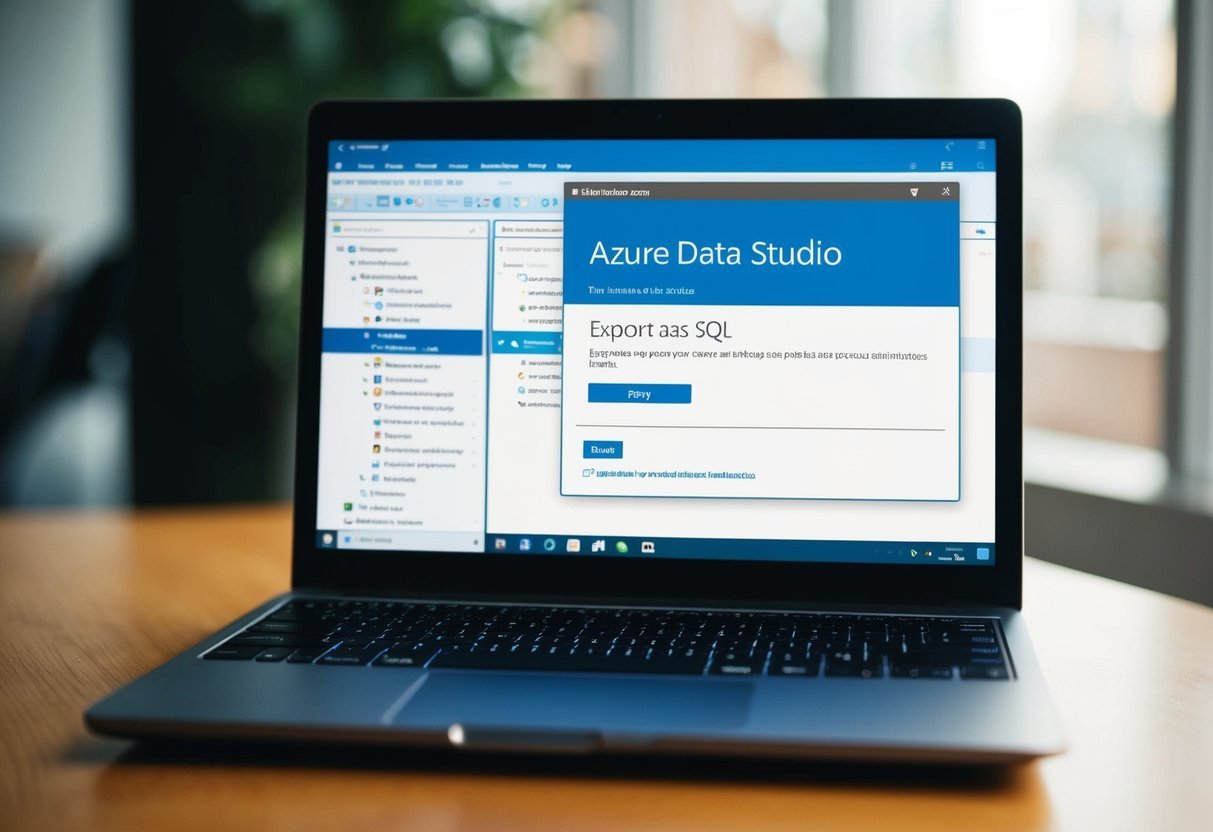
A laptop screen displaying the Azure Data Studio interface with the "Export as SQL" feature highlighted in the menu bar

Azure Data Studio offers multiple features to export databases in different formats. Users can export tables to SQL files, convert data to CSV, and even work with BACPAC files. The tools and methods available are designed for both simple exports and more complex data management tasks.

How can I export a table from Azure Data Studio to a SQL file?

To export a table, one can use the right-click menu on the table name. Selecting “Script as Create” generates a SQL file that contains the table structure, making it easy to save locally.

What steps are involved in exporting a database schema using Azure Data Studio?

The process involves navigating to the database, right-clicking it, and choosing the “Export” option. This process typically includes selecting schema objects and specifying a destination for the SQL file.

Is it possible to export data directly to a CSV file in Azure Data Studio?

Yes, Azure Data Studio allows direct export to CSV. Users can execute a query and then select the export option from the result grid, which includes exporting to CSV.

Can Azure Data Studio be used to export and import BACPAC files?

Azure Data Studio supports operations with BACPAC files. Users can manage BACPAC imports and exports to move database structures and data between environments. Learn more about this on the Azure SQL Managed Instance page.

What is the process for exporting a table with INSERT statements in Azure Data Studio?

Users need to generate a SQL script with INSERT statements. After executing a query to return desired rows, Azure Data Studio can script these rows as INSERT statements through the right-click menu on the query result.

How can I transfer data from Azure Data Studio to an Excel spreadsheet?

Export the query results to a CSV file first. Once saved, you can easily open or import this CSV file into Excel for further analysis or presentation.

This process is straightforward, leveraging built-in export options within the query tool.

Categories
Uncategorized

Learning T-SQL – Create and Alter DML Triggers: A Practical Guide

Understanding DML Triggers in SQL Server

DML triggers in SQL Server react to changes made to table data. They are crucial for controlling operations that modify data, such as insert, update, and delete commands. A solid grasp of these triggers helps in maintaining data integrity and automating responses to data changes.

Definition and Importance of DML Triggers

DML triggers are special kinds of procedures in SQL Server that automatically execute when certain data modification events occur on a table. They act as a safeguard by enforcing rules and constraints on data changes. By triggering actions automatically, they ensure that data remains consistent with business logic and rules.

These triggers are integral because they allow developers to automate tasks such as logging changes or validating data. They provide a robust mechanism to maintain data consistency without manual intervention. The automatic nature of triggers helps prevent unauthorized or incorrect data modifications. This automation can lead to more efficient database management and improved data quality.

Types of DML Triggers: AFTER and INSTEAD OF

There are two main types of DML triggers in SQL Server: AFTER triggers and INSTEAD OF triggers.

AFTER triggers execute following the completion of an insert, update, or delete operation. They ensure that the changes successfully happened before carrying out additional actions. This feature is particularly important for tasks like synchronizing changes or auditing data modifications.

INSTEAD OF triggers replace the standard operation with the trigger’s defined action. Instead of executing the typical database operation, SQL Server carries out the alternative steps defined in the trigger. This is useful when specific checks or transformations are necessary before data changes are permanently applied.

Understanding the Insert, Update, and Delete Operations

Insert triggers activate when new records are added. They can validate incoming data or adjust related tables appropriately.

Update triggers respond to modifications in existing rows. They ensure that updates follow predefined rules and prevent unwanted changes from breaching data integrity.

Delete triggers execute when records are removed. They can prevent deletions if certain conditions aren’t met or log deleted records for auditing.

Each of these triggers plays a vital role in database operations, serving to automate complex tasks and maintain a secure and consistent data environment.

Preparing for Trigger Implementation

When preparing to implement DML triggers in T-SQL, it’s crucial to set up the database environment correctly, identify existing triggers within the schema, and ensure appropriate permissions and security settings.

Setting Up the Database Environment

Before creating or altering DML triggers, it is essential to have a well-configured database environment.

Ensure that your server and databases are updated to the latest versions to avoid any compatibility issues. Reliable backups should be in place to safeguard data during development or changes.

Configuring the logging and auditing settings ensures that any modifications can be tracked for further analysis.

Set up a development environment that mirrors the production setup. This reduces unexpected behavior when moving changes live.

Explore using database tools for efficient management and setup to keep processes streamlined.

Identifying Triggers in a Schema

Understanding the existing triggers within a schema is important. Start by querying the database to list triggers, as this gives insight into current automation and logic handled by existing triggers.

Using queries that check the schema_name helps in organizing and identifying which schema contains specific triggers.

Knowing the purpose and effect of each trigger will help in planning further implementations. Documentation of existing triggers can aid in maintaining or extending the current setup without introducing conflicts.

Use tools and scripts that can visualize the relationship between triggers and tables for better comprehension.

Permissions and Security Considerations

Granting the correct permissions is essential for creating and modifying triggers. A user must have the right level of access to make adjustments.

Restrict modification permissions to trusted individuals to prevent unauthorized changes.

Regular audits of the permissions can help ensure security is maintained.

Securing trigger codes against SQL injection and other vulnerabilities is crucial. Use parameterized queries and validations to safeguard data integrity.

Always test security settings in a controlled environment before applying them to the production database.

Creating Triggers with T-SQL

When working with SQL Server, triggers are special stored procedures that execute automatically in response to certain events on a table or view. This section covers T-SQL commands to create and modify triggers, explaining their syntax and how T-SQL handles them.

Basic SQL Server Trigger Syntax

In T-SQL, triggers are defined to respond to specific changes like inserts, updates, or deletes in a table. The basic syntax includes the CREATE TRIGGER statement followed by the trigger_name. Here’s a simple structure:

CREATE TRIGGER trigger_name
ON table_name
AFTER INSERT, UPDATE, DELETE
AS
BEGIN
    -- SQL statements to execute
END

This shows the type of event that the trigger responds to and the table involved.

CREATE TRIGGER Statements

The CREATE TRIGGER statement is essential in defining a trigger’s behavior in SQL Server. It specifies the timing (AFTER, INSTEAD OF), the events (INSERT, UPDATE, DELETE), and the logic contained in the trigger. For example:

CREATE TRIGGER trgAfterInsert
ON Employees
AFTER INSERT
AS
BEGIN
    PRINT 'An insert occurred on the Employees table.';
END

In this example, the trigger trgAfterInsert activates after an insert operation on the Employees table.

Trigger Execution Context

Understanding the execution context is crucial for working with triggers. The EXECUTE AS clause can define the security context under which the trigger contractually operates. It ensures the trigger actions perform with specific permissions. Here’s how it can be defined:

CREATE TRIGGER trgExecuteAs
ON Sales
AFTER UPDATE
EXECUTE AS 'User'
AS
BEGIN
    -- Actions with 'User' permissions
END

The trigger runs with the privileges of the specified user, impacting how data is handled securely and effectively within the T-SQL environment. This is particularly helpful in managing permissions and ensuring only authorized actions occur during trigger execution.

Altering and Managing Triggers

Altering and managing triggers in SQL involves using specific commands to modify and control trigger behaviors. This is crucial for maintaining database integrity and ensuring procedures execute under the correct conditions.

The ALTER TRIGGER Statement

The ALTER TRIGGER statement is used to change an existing trigger’s behavior or logic. It allows developers to update the trigger without having to drop and recreate it. This can save time and reduce errors in a database environment.

In SQL Server Management Studio, altering a trigger is straightforward. Users can open the trigger’s script, make necessary changes, and execute the script to apply updates.

This statement can also be used to rename the trigger, or modify its conditions and actions efficiently.

Common Uses for Modifying Triggers

Modifying triggers often involves updating the logic due to changes in business requirements or database structures.

For instance, a trigger might need to adjust its logic if new columns are added to a table.

Additionally, triggers can be changed to improve performance, such as reducing overhead by modifying trigger logic.

Developers may also need to modify triggers to handle new types of data operations or conditions to ensure robust and efficient database management.

Managing Trigger States

Managing the states of triggers involves enabling or disabling them based on specific needs.

In SQL Server, triggers can be temporarily disabled to prevent them from executing during maintenance periods.

Using the DISABLE TRIGGER statement, users can stop a trigger from running without deleting it. Conversely, the ENABLE TRIGGER statement reactivates it.

This flexibility is essential for maintaining uninterrupted operations and ensuring that triggers only execute when required.

Managing trigger states helps in conducting systematic troubleshooting and updates without impacting the overall system.

Working with AFTER Triggers

AFTER triggers in T-SQL are key for operations that need to occur after a specific DML event has been successfully executed. Each type of AFTER trigger serves a particular purpose, such as for inserts, updates, or deletions.

AFTER INSERT Triggers

AFTER INSERT triggers activate after new records are added to a table. They allow for actions like logging changes or validating data integrity.

For instance, when a new entry is made, the trigger can automatically add a record to a history table.

These triggers can also help maintain relationships between tables by updating related records elsewhere in the database. This ensures that dependent data stays consistent with the newly inserted information.

Using AFTER INSERT triggers is essential in scenarios where subsequent actions must rely on the successful insertion of new data. This type of trigger provides a safeguard, ensuring that necessary steps are taken immediately after a record is inserted, enhancing both data consistency and integrity.

AFTER UPDATE Triggers

AFTER UPDATE triggers are used when actions are required right after data in a table is updated. They can be set up to track changes and notify other systems of the update.

This is particularly useful for synchronizing data across different databases or applications.

These triggers can validate whether the updated values meet specific business rules, serving as a backup to enforce data integrity and business logic.

They play a vital role in maintaining accurate and reliable data operations.

Additionally, AFTER UPDATE triggers can log previous values before the update to maintain a history of changes. This feature aids in auditing and can help revert changes if needed, supporting robust data management practices.

AFTER DELETE Triggers

AFTER DELETE triggers are executed after a data row is deleted from a table. They are important for cleaning up related data, such as removing child records in related tables to prevent orphaned records.

These triggers can also assist in archiving deleted data to another table for future reference or analysis.

Another use is to ensure that related systems or components are notified of deletions so that they can adjust their operations accordingly. This helps maintain overall system harmony and prevent potential issues from orphaned or unsynchronized data.

Creating INSTEAD OF Triggers

INSTEAD OF triggers in T-SQL replace standard data modification operations and offer more control over how data is inserted or updated in a table or view. They are particularly useful for complex scenarios where standard constraints might not apply effectively.

Use Cases and Syntax

INSTEAD OF triggers are used to override standard actions like INSERT or UPDATE. These triggers execute instead of the usual operations, providing flexibility for more complex processing.

A common use is handling data changes in views, where modifications might be restricted.

To create an INSTEAD OF trigger, use the CREATE TRIGGER statement. The syntax starts with declaring the trigger name, specifying the modification type (INSERT, UPDATE), and defining the logic to execute. Here’s a basic format:

CREATE TRIGGER TriggerName
ON TableOrView
INSTEAD OF INSERT
AS
BEGIN
    -- Trigger logic here
END

These triggers provide exceptions handling and specialized data processing where standard operations fall short.

INSTEAD OF INSERT Triggers

An INSTEAD OF INSERT trigger allows custom handling of data insertion into tables or views. They are often used with views that join multiple tables.

This type of trigger is useful when the direct INSERT operations are either unsupported due to view complexity or need additional logic before committing the data.

When an insert operation is attempted, the INSTEAD OF INSERT trigger captures this attempt and processes the data as specified in its logic block. For instance, it can redistribute data across several tables or validate data before insertion.

A simple example:

CREATE TRIGGER ValidInsert
ON MyView
INSTEAD OF INSERT
AS
BEGIN
    -- Custom logic to handle insert
END
```### INSTEAD OF UPDATE Triggers

When updates are needed but standard update operations cannot be applied directly, INSTEAD OF UPDATE triggers become invaluable. They are especially relevant for views that aggregate or join data from multiple sources. 

This trigger type captures an update attempt and applies custom procedures instead.

An INSTEAD OF UPDATE trigger ensures consistency and can perform additional processing like logging updates or enforcing complex business rules. The setup is similar to the INSERT version, allowing developers to tailor the update logic to specific needs.

Example:

```sql
CREATE TRIGGER CustomUpdate
ON MyView
INSTEAD OF UPDATE
AS
BEGIN
    -- Logic to handle update appropriately
END

These triggers are integral in situations demanding precise control over data modifications beyond typical constraints.

Designing Triggers for Data Integrity

Triggers in T-SQL play a crucial role in maintaining data integrity. They enforce business rules and protect data from invalid changes.

These automated mechanisms act on specific data manipulation language (DML) operations like insert, update, and delete. Understanding how to design these triggers effectively can ensure data remains consistent and reliable.

Enforcing Business Rules with Triggers

Triggers are invaluable for enforcing complex business rules within a database. They can automatically check conditions when a specific DML operation occurs.

For instance, a trigger might enforce that no order is processed unless the customer has sufficient credit. Triggers ensure that these operations do not proceed if the conditions aren’t met, maintaining business logic directly in the database.

Using triggers to enforce rules can reduce errors since the database itself handles the logic rather than application code. This centralized approach helps maintain consistency across different applications accessing the same database.

Triggers can be particularly useful when multiple tables are involved in validating a business rule, ensuring that all necessary checks are made before committing changes.

Safeguarding Data Against Invalid Modifications

Safeguarding data against invalid modifications is critical for preserving data integrity. Triggers can automatically reverse changes or log attempts when invalid data manipulations occur.

For example, a trigger can prevent deletion if a table contains related records in another table, ensuring referential integrity.

Triggers also help in maintaining data accuracy by validating new data entries and updates. For instance, it can check if the entered data type complies with the existing data standards before allowing the operation.

In this way, triggers prevent invalid data from corrupting the database, providing an essential layer of protection for maintaining database accuracy and reliability.

For more information on triggers and data integrity, you can explore topics on exploring their use in various database scenarios.

Advanced T-SQL Trigger Concepts

Understanding advanced T-SQL triggers involves exploring transactions, error handling, optimizing trigger performance, and managing nested triggers and recursive events. These concepts enhance data integrity and system efficiency by handling complex interactions within the database.

Transactions and Error Handling

Transactions in T-SQL are crucial for maintaining data consistency. When a trigger executes, it automatically runs within the scope of the transaction that fired the trigger. This ensures that the trigger’s operations are atomic.

If any part of the trigger fails, the entire transaction rolls back, preventing partial updates.

Effective error handling is vital. Using the TRY...CATCH construct in triggers can manage errors gracefully. This allows logging of errors or taking specific actions when issues arise.

However, careful design is necessary, as improper handling can lead to unhandled exceptions or incomplete transactions.

Optimizing Triggers for Performance

Optimizing trigger performance is key for reducing unnecessary resource use. One approach is to minimize the operations performed within a trigger.

It’s important to only include essential logic, as complex operations can slow down processes.

Consider using conditional logic to reduce the frequency of trigger execution. For example, evaluate whether the data change necessitates firing the trigger.

Indexing involved columns can improve performance by speeding up data retrieval. Monitoring execution time and resource utilization helps identify performance bottlenecks and optimize them for faster execution.

Nesting Triggers and Recursive Events

Nested triggers occur when one trigger causes another to fire. This can lead to complex chains of events that need careful management.

In SQL Server, nesting triggers is supported, and up to 32 levels can be configured.

Recursive triggers re-invoke themselves, either directly or indirectly. To manage these, SQL Server provides settings to enable or disable recursion.

By default, recursive triggers are off, preventing potential infinite loops. When using recursion, ensure business logic supports such behavior and that it doesn’t lead to unexpected results or performance issues.

Structured use of nested and recursive triggers ensures complex data operations are handled safely and effectively, preserving database stability and data integrity.

Understanding the Inserted and Deleted Tables

In T-SQL, the Inserted and Deleted tables are special tables that are used within triggers to monitor changes in the database. They hold data temporarily during insert, update, and delete operations, aiding in tracking changes.

Working with the Inserted Table in Triggers

The Inserted table is crucial for monitoring changes in data during insert and update operations. When a new row is added to a table, this virtual table stores the row’s data temporarily. It allows users to check and utilize the new data without directly accessing the main database table.

In update operations, it contains the data for the new version of the row, making it useful for comparisons or logging.

For example, if a trigger is set to log whenever a salary is updated, the Inserted table lets you see the new salary value.

By referencing the Inserted table, database administrators can ensure data integrity and enforce business rules when new data is introduced into the system. It provides a way to react dynamically to newly-inserted data.

Utilizing the Deleted Table in Data Changes

The Deleted table comes into play during delete and update operations. Whenever a row is removed or updated, this table holds the old version of the data.

It’s useful when it’s necessary to keep track of changes or maintain a record of deleted information.

For instance, if a table logs departing employees, the Deleted table can capture details before a row is permanently removed from the main table. In update scenarios, it stores the original row data prior to changes, allowing a comparison between old and new values.

This functionality is essential for rollbacks, audits, or maintaining historical data trends. By accessing the Deleted table, developers can ensure operations such as data recovery or historical tracking are effectively managed.

Deployment and Testing of DML Triggers

When deploying and testing DML triggers in SQL Server, ensuring robust verification of trigger logic and seamless deployment processes is essential. This ensures data integrity and effective system operations.

Verifying Trigger Logic and Data Flow

Proper testing of trigger logic involves confirming that triggers activate under correct conditions. This process includes checking if the trigger modifies data as expected and audits the changes accurately.

Use test databases to run typical and edge-case scenarios to ensure reliability.

Verify interactions between triggers and other database objects to avoid conflicts or unwanted dependencies that might disrupt workflows.

Employ SQL Server’s profiling tools to monitor trigger performance and identify potential bottlenecks.

Deploying Triggers to Production

Deploying triggers to a production environment requires careful planning. Use scripts to automate deployment, which minimizes the risk of errors from manual input.

Before deployment, ensure the testing phase has accounted for potential performance impacts.

Database administrators should review and approve deployment scripts. Backup current database states to prevent data loss in case of errors.

It’s important to monitor trigger performance post-deployment to adjust configurations if needed, ensuring smooth operation.

Troubleshooting Common Trigger Issues

When working with T-SQL, triggers can sometimes lead to problems. Common issues include errors causing transactions to fail or unexpected results.

Error Handling

  1. Use TRY...CATCH blocks in T-SQL to manage errors. They help identify issues without halting operations.
  2. Check trigger logic for accurate condition handling.

Performance
Triggers may affect performance.

  • Keep them simple and efficient.
  • Avoid complex logic that can cause delays or blocking.

Testing
Always test triggers in a controlled environment. This helps detect issues before deployment. Ensure that scenarios cover all possible data inputs and edge cases.

Debugging

  1. Use PRINT statements or logging to trace execution.
  2. Analyze SQL Server logs for error messages related to trigger execution.

Deadlocks and Blocking
In some cases, triggers might cause deadlocks.

  • Review transaction scope.
  • Use SET DEADLOCK_PRIORITY LOW to avoid conflicts.

For more details, you can explore T-SQL troubleshooting techniques here. Keep your approach methodical and well-documented to minimize future issues.

Best Practices for DML Triggers

Effective management of DML triggers in T-SQL involves maintaining clean and simple code while minimizing potential performance issues. Here are two important practices to enhance code maintenance and reduce complexity.

Writing Maintainable Trigger Code

To ensure DML triggers are easy to maintain, clear and concise code is crucial. Developers should use meaningful names for triggers and related components, keeping track of their purpose.

Commenting the code helps others understand the logic and purpose without wading through complex sections. Consistent formatting, such as indentation and spacing, makes the code readable.

Organizing triggers by functionality can also aid maintenance. Use separate triggers for different operations instead of one catch-all trigger that handles multiple tasks.

This modular approach makes troubleshooting easier, as each trigger has a distinct role. For further reading on T-SQL activities, check out this introduction to T-SQL programming.

Minimizing Trigger Complexity

Keeping triggers simple improves database performance and reduces debugging time. Avoid performing complex operations within triggers, as they execute automatically with DML statements and can significantly slow down database operations.

Instead, consider using stored procedures for more involved logic, which can be called by the trigger.

Use only necessary trigger events. For example, if an action is needed only on insertions, avoid setting the trigger to respond to updates and deletions.

Monitoring performance metrics can help identify triggers that are too demanding or inefficient. For more information on triggers’ efficiency, review the practices in managing SQL implementations.

Frequently Asked Questions

This section addresses common inquiries about creating and modifying DML triggers in SQL Server. It covers the necessary steps, provides an example of a trigger after an INSERT operation, explains how to modify existing triggers, and differentiates DDL from DML triggers. Best practices for creating and altering triggers are also discussed.

What are the steps for creating a DML trigger in SQL Server?

To create a DML trigger in SQL Server, first decide on the table and the event that should trigger the action. Then, use the CREATE TRIGGER statement along with the event type, such as INSERT, UPDATE, or DELETE.

Specify the logic to execute when the event occurs.

Can you provide an example of a trigger after an INSERT operation in SQL?

An example of a trigger after an INSERT operation could be:

CREATE TRIGGER trgAfterInsert
ON tableName
AFTER INSERT
AS
BEGIN
    -- Trigger logic
    PRINT 'Row inserted'
END

This code prints a message after an INSERT into tableName.

How does one modify an existing trigger in SQL Server?

To modify an existing trigger in SQL Server, use the ALTER TRIGGER statement. This allows changes to the trigger definition without needing to drop and recreate it.

Specify the trigger name and begin with ALTER TRIGGER, followed by the new logic.

What would differentiate a DDL trigger from a DML trigger?

A DDL trigger responds to changes in the definition of database objects like tables or views (CREATE, ALTER commands). A DML trigger, on the other hand, activates in response to data manipulation events such as INSERT, UPDATE, or DELETE on a table or view.

Is it possible to define multiple DML triggers on a single table in SQL Server, and if so, how many?

Yes, multiple DML triggers can be defined on a single table in SQL Server. There is no strict limit to the number of triggers, allowing flexibility to address different business logic scenarios.

Each trigger can handle different or overlapping sets of operations and logic.

What are some best practices to follow when creating and altering triggers in SQL Server?

When creating and altering triggers in SQL Server, it’s important to ensure clear and efficient logic to avoid performance issues. Triggers should be used sparingly and only when necessary.

Additionally, testing triggers thoroughly can help prevent unexpected behaviors or conflicts with existing database operations.

Categories
Uncategorized

Azure Data Studio vs SQL Server Management Studio: Key Differences and Use Cases

Comparison Overview

When evaluating Azure Data Studio and SQL Server Management Studio (SSMS), both stand out with unique capabilities.

Azure Data Studio shines in cross-platform flexibility, while SSMS is celebrated for its robust administrative features.

Key Differences Between SSMS and Azure Data Studio

SSMS is a well-established tool, known for its deep integration with SQL Server. It’s favored for comprehensive administrative tasks, like advanced features critical to database management.

SSMS offers powerful tools for tasks such as performance monitoring, configuration management, and security management, making it a staple in many database administrators’ toolkits.

Azure Data Studio, however, takes a different approach. Built on the Visual Studio Code platform, it emphasizes versatility and ease of use.

It’s particularly popular among developers for its lightweight nature and strong support for extensions, which facilitate customizable SQL coding experiences. This makes Azure Data Studio ideal for data-focused tasks and quick querying across multiple databases.

Supported Operating Systems

One of the major distinctions between these tools is their compatibility with different operating systems.

SSMS is primarily a Windows application. Its deep integration with Microsoft SQL Server means it doesn’t natively run on Linux or macOS.

In contrast, Azure Data Studio offers significant cross-platform support. It runs natively on Windows, Linux, and macOS.

This versatility makes Azure Data Studio an attractive choice for teams operating in diverse environments or those requiring flexibility in their development workflows. Its ability to function seamlessly across different systems is a key feature for users needing a modern, adaptable SQL management tool.

User Interface and Experience

Azure Data Studio and SQL Server Management Studio offer distinct user interfaces, impacting how users manage databases.

Azure Data Studio is seen as modern and is often chosen for its sleek design, while SQL Server Management Studio has a traditional look that appeals to long-time developers.

Customization and Settings

Azure Data Studio emphasizes flexibility, allowing users to tailor the experience to their preferences. With numerous extensions, users can enhance functionality.

Dark Mode is a popular feature, reducing eye strain during long coding sessions. The dashboard allows users to create custom layouts, displaying only essential information. This customization makes it easier to focus on critical tasks without distractions.

In contrast, SQL Server Management Studio offers less customization but remains reliable.

It has a wide range of built-in features, although fewer options for altering the user interface. SSMS settings are mainly geared towards maintaining a consistent look, beneficial for those who prefer stability over customization.

Intuitive Design Elements

Azure Data Studio’s graphical user interface is designed for ease of use, making it accessible to newcomers. The interface is sleek and user-friendly, with features like IntelliSense enhancing code writing efficiency.

On the other hand, SQL Server Management Studio’s interface, while more traditional, remains robust for database management.

It includes comprehensive tools that cater to experienced users. Even though it may seem complex, experienced developers appreciate the array of features readily available for in-depth management tasks. It balances legacy appeal with functional efficiency, providing what many long-time users expect from a trusted tool.

Feature Set and Functionality

When comparing Azure Data Studio and SQL Server Management Studio (SSMS), both platforms offer distinct tools and features for database management. They differ significantly in areas like SQL Server database tools, development features, and performance tools.

Advanced Tools for SQL Server Databases

SQL Server Management Studio offers a comprehensive set of tools specifically designed for SQL Server databases. These include Database Administration capabilities, allowing users to manage database security, backup, and restoration effectively.

SSMS also provides Performance Tuning tools that facilitate identifying slow queries and improving database performance. SQL Server Agent support is another feature, enabling users to schedule and automate database tasks, making SSMS well-suited for complex SQL Server deployments.

Azure Data Studio, while less feature-rich in these areas, still offers some advanced querying capabilities. It’s ideal for users who do not require extensive database administration tools but need robust query editing.

Integrated Development Features

Azure Data Studio excels in integrated development features, especially for those working on different operating systems. It supports cross-platform development on Windows, macOS, and Linux.

Its query editor is known for its enhanced IntelliSense, which aids in writing precise T-SQL queries efficiently.

Users can leverage many third-party extensions, making Azure Data Studio a flexible option for database developers. It is preferred for tasks involving database development across various platforms, as indicated in the Devart Blog.

In contrast, SSMS is more restrictive, being Windows-exclusive, but offers a rich set of tools aimed primarily at deep SQL Server development and administration needs.

Security and Performance Tools

Security Management in SSMS includes Vulnerability Assessment tools that help in identifying potential security risks in databases. These tools provide essential insights for maintaining secure environments.

SSMS also offers built-in tools for optimizing performance, making it easier to maintain high database efficiency and reliability.

Azure Data Studio presents a lighter version of these tools, focusing more on ease of use and flexibility.

It is designed for developers who may not need in-depth security assessments but still require reliable performance monitoring features, as explained in the CData Software blog.

Extensibility and Integration

An open laptop displaying Azure Data Studio and SQL Server Management Studio with various database integration icons

Azure Data Studio and SQL Server Management Studio offer various features for enhancing and integrating the functionality needed by database professionals. These tools support different types of extensions, plugins, and source control systems to improve the database management experience.

Extensions and Plugins Usage

Azure Data Studio is particularly notable for its support of a wide range of extensions. Users can customize their experience through plugins that enhance functionality.

It supports popular scripting languages such as Python and R, making it versatile for data analysis and visualization tasks. The integration of Jupyter Notebooks is a highlight that allows users to document their work alongside code and results. This flexibility in extension support is crucial for those who require specialized data handling and presentation tools.

On the other hand, SQL Server Management Studio, while more traditional in approach, does include some extensibility.

Its support is not as broad but focuses on Microsoft ecosystem tools like PowerShell for automation tasks. While SSMS may not offer the same breadth of extension opportunities as Azure Data Studio, it provides sufficient capabilities for those within the Microsoft stack.

Source Control Integration

Source control integration is essential for maintaining version control and collaboration.

Azure Data Studio excels with its built-in support for Git, making it straightforward to integrate with DevOps workflows. This aligns well with today’s open-source and collaborative development environments. The built-in source control management ensures that users can track changes and collaborate effectively on projects.

SQL Server Management Studio does not have built-in source control features but allows integration with external systems.

Users can connect to Azure DevOps or other third-party tools to maintain version control. For teams that use Microsoft’s suite of development tools, this setup can work seamlessly, even if it requires a bit more configuration compared to Azure Data Studio.

Development and Administration Workflow

A person using a computer to compare Azure Data Studio and SQL Server Management Studio for development and administration workflow

When choosing between Azure Data Studio (ADS) and SQL Server Management Studio (SSMS), understanding their strengths in database development and administration is key.

ADS excels in certain areas due to its lightweight, cross-platform nature, while SSMS offers comprehensive tools for detailed administrative tasks.

Streamlined Database Development

Azure Data Studio caters to developers with its integration capabilities, especially with modern DevOps environments. It supports SQL databases like MySQL and allows for the use of notebooks, which facilitate a smooth workflow.

Developers benefit from its customizable interface and the ability to collaborate with team members through interactive scripts. ADS also offers an array of useful extensions.

SSMS, on the other hand, is typically favored for traditional database development due to its robust debugging and design features. It supports detailed database management events which are essential for more complex SQL database tasks.

Effective Database Administration Strategies

For database administrators (DBAs), the choice largely depends on the nature of the administration work.

SQL Server Management Studio offers a wide array of features suited for advanced administrative tasks. This includes comprehensive management of server instances and detailed security configurations.

SSMS covers tasks ranging from database restoration to performance tuning, which are crucial for maintaining the health of SQL databases.

Azure Data Studio is often preferred in environments that require quick insights and data exploration, frequently used by DBAs focused on agile administration. Its integration with cloud services, as referenced in tools like Azure Data Studio, enhances its appeal for certain administrative workflows.

Support for Diverse Data Management

A modern office desk with two computer monitors displaying Azure Data Studio and SQL Server Management Studio

Azure Data Studio and SQL Server Management Studio (SSMS) offer tools for managing databases, emphasizing their compatibility with various systems and flexibility between local and cloud environments. These features cater to different data management needs, making them valuable for teams working with diverse databases.

Multiple Database Systems Compatibility

Azure Data Studio is noteworthy for its cross-platform compatibility. It supports multiple database systems, making it versatile for data professionals.

Users can manage Microsoft SQL Server, Azure SQL Database, PostgreSQL, and MySQL. This diversity facilitates operations across different relational databases, enhancing productivity for projects using varied architectures.

Visual Studio Code plugin support allows integration with other databases, further broadening its scope.

In contrast, SSMS is primarily aimed at Microsoft databases and offers comprehensive tools for these environments. It provides detailed functionalities for stored procedures, security configurations, and performance monitoring, making it a robust tool for database management within Microsoft ecosystems.

Cloud-Based and Local Database Solutions

Azure Data Studio excels in its cloud integration capabilities, particularly with Azure Synapse Analytics and cloud-based data management.

It offers seamless transitions between local and cloud databases, giving users the flexibility needed in today’s digital landscape. This feature is crucial for businesses leveraging both on-premises and cloud infrastructure.

SSMS, while deeply integrated with SQL Server Reporting Services, focuses more on local management but supports Azure for hybrid environments.

The ability to manage data in cloud and local databases helps teams maintain data accessibility across platforms. They can customize their environments using Azure or SSMS, depending on their specific needs and resource usage, ensuring optimized database management solutions.

Frequently Asked Questions

A comparison chart showing features of Azure Data Studio and SQL Server Management Studio

Azure Data Studio (ADS) and SQL Server Management Studio (SSMS) are two popular tools for managing SQL databases. They differ in features like platform support, user interface customization, and extension capabilities, making each suitable for different needs.

What are the key differences between Azure Data Studio and SQL Server Management Studio?

Azure Data Studio is a cross-platform tool that runs on Windows, macOS, and Linux. In contrast, SQL Server Management Studio is mainly for Windows environments. SSMS provides comprehensive administration features, while ADS focuses on modern data development with advanced code editors.

Can Azure Data Studio be used as an alternative to SQL Server Management Studio for SQL Server?

Azure Data Studio can act as an alternative for many tasks, such as connecting to databases, writing queries, and viewing data. However, SSMS is better suited for advanced administration tasks like configuring high availability and managing SQL Server agents.

Is there a difference in extension support between Azure Data Studio and SQL Server Management Studio?

Azure Data Studio offers a range of extensions to enhance features, thanks to its foundation on the Visual Studio Code platform. Users can quickly add capabilities like version control or remote servers.

On the other hand, SSMS has some add-in options, but it lacks the flexibility and variety offered by ADS’s extension ecosystem.

How does user interface customization, like Dark mode, compare between Azure Data Studio and SQL Server Management Studio?

Azure Data Studio features a highly customizable interface, including the option for Dark mode, which many developers prefer for reduced eye strain.

SQL Server Management Studio also offers customization options, but they are generally more limited than those available in ADS.

In terms of database administration and development, how do Azure Data Studio and SQL Server Management Studio differ?

For database administration, SQL Server Management Studio is the preferred choice because of its extensive built-in features. It excels in tasks such as performance tuning and security management.

On the other hand, on the development side, Azure Data Studio shines with its solid query-editing capabilities and cross-platform support, ideal for developers working in diverse environments.

Are there any differences in platform compatibility between Azure Data Studio and SQL Server Management Studio?

Azure Data Studio supports multiple platforms, including Windows, macOS, and Linux, which makes it versatile for diverse work environments.

SQL Server Management Studio is primarily designed for Windows, limiting its usability for teams working across different operating systems.

Categories
Uncategorized

Learning Math for Machine Learning – Mastering Derivatives and Differentiation Concepts

Understanding the Basics of Derivatives

Derivatives lie at the heart of calculus. They are essential in understanding how functions change and are crucial in fields like machine learning, where they help optimize models.

Introduction to Derivatives in Calculus

In calculus, derivatives measure how a function changes as its input changes. They provide insight into the rate of change, akin to velocity in physics.

The derivative of a function at a point is the slope of the tangent to the curve of the function at that point. Calculating derivatives involves various rules, such as the power rule, product rule, and chain rule. These rules simplify finding the derivative of more complex functions. Understanding these rules helps in solving real-world problems where change is a key factor.

The Power of Differentiation in Machine Learning

Differentiation uses derivatives to find optimal solutions. In machine learning, this helps in minimizing error and improving model accuracy. The concept of gradient descent, a technique that relies heavily on derivatives, is used to update model parameters correctly and efficiently.

By calculating gradients, models learn to adjust their predictions. This is especially important in neural networks, where differentiation enables the backpropagation algorithm to update weights and biases to minimize errors across training samples.

Calculus for Machine Learning: An Overview

Calculus is integral to machine learning, offering tools to solve many problems. Derivatives provide a way to understand how changes in input affect output, making them vital for tuning algorithms and models.

Functions common in machine learning, like activation functions, are often analyzed with derivatives to see how changes will influence outcomes.

A strong grasp of calculus allows one to understand and create models that can predict or adjust based on new data. Differentiation can shine in various applications, from simple linear regression to complex deep learning challenges, always helping optimize tasks and improve processes.

Calculation Techniques for Derivatives

Calculating derivatives is key in differential calculus, which is crucial for understanding the behavior of functions. Key techniques such as the basic rules of differentiation and the chain rule are foundational tools in solving complex problems.

Rules of Differentiation

Rules of differentiation provide the framework for finding derivatives of various types of functions.

Some fundamental rules include the power rule, product rule, and quotient rule.

The power rule is used when differentiating functions of the form ( f(x) = x^n ). Its derivative is ( f'(x) = nx^{n-1} ).

The product rule applies to functions that are products of two functions: ( f(x) = u(x)v(x) ). The derivative is found by ( f'(x) = u'(x)v(x) + u(x)v'(x) ).

For the quotient rule, used with functions that are quotients, ( f(x) = \frac{u(x)}{v(x)} ), the derivative is ( f'(x) = \frac{u'(x)v(x) – u(x)v'(x)}{[v(x)]^2} ).

These rules are essential for simplifying the differentiation process and understanding function behavior.

Applying the Chain Rule

The chain rule is a key technique used in differential calculus when differentiating composite functions. It is vital for dealing with nested functions.

When a function is composed as ( f(g(x)) ), the chain rule states that the derivative is ( f'(g(x)) \cdot g'(x) ). This means that the derivative of the outer function is evaluated at the inner function, then multiplied by the derivative of the inner function itself.

For instance, to differentiate ( h(x) = (3x^2 + 2)^5 ), apply the chain rule by finding the derivative of the outer function ( (u^5) ), then multiply it by the derivative of the inner function ( (3x^2 + 2) ).

Understanding the chain rule allows the differentiation of more complex structures often encountered in advanced calculus problems. This rule is often highlighted in the context of machine learning, where deep learning frameworks utilize automatic differentiation, according to a survey on automatic differentiation.

Essential Linear Algebra for Machine Learning

Understanding linear algebra is crucial for machine learning. It helps describe data through matrices and vectors, optimize algorithms, and transform data for better learning models. Several key concepts such as matrices, vectors, eigenvalues, eigenvectors, and linear transformations are fundamental to the field.

Understanding Matrices and Vectors

Matrices and vectors are the building blocks of linear algebra.

A matrix is a rectangular array of numbers, symbols, or expressions, arranged in rows and columns. These are used to represent data or weights in machine learning models.

Vectors are special matrices, consisting of a single column or row, and can represent data points or weights.

The importance lies in their ability to perform operations efficiently.

Matrix operations include addition, subtraction, and multiplication. Vectors are often used to describe data in multi-dimensional space. The dimensions of a matrix are referred to as its rank, indicating the number of independent rows or columns.

Eigenvalues and Eigenvectors

Eigenvalues and eigenvectors play a crucial role in simplifying matrix operations.

An eigenvector of a matrix is a non-zero vector that remains in its span when a linear transformation is applied, only scaled by an eigenvalue. They are essential for understanding properties of matrices and are calculated from the characteristic equation of a matrix.

These concepts are vital in machine learning, as they help reduce dimensions in datasets, making computations more efficient. Principal component analysis (PCA), a common technique, uses eigenvectors to identify the most important features.

Linear Transformations and Their Importance

Linear transformations refer to changes in data achieved through matrix multiplication. They allow for scaling, rotating, and shifting data, which is essential for tuning machine learning algorithms.

These transformations maintain vector space structure, making them predictable and allowing for easier optimization.

Their importance in machine learning lies in representing data transformations efficiently. By applying linear transformations, it becomes possible to manipulate and adjust data to improve model performance. Understanding these transformations aids in better designing architectures such as neural networks, where data is transformed at each layer.

The Role of Multivariable Calculus

Multivariable calculus is crucial in machine learning, especially when dealing with functions that have multiple inputs or dimensions. This field is essential for understanding how changes in input variables affect outcomes, which aids prediction and optimization tasks.

Partial Derivatives and Predictions

Partial derivatives are fundamental in multivariable calculus when exploring how a change in one variable impacts a function, while other variables remain constant.

In machine learning, this concept helps predict outcomes by analyzing various inputs.

Partial derivatives can help identify the rate of change of a function in a particular direction, providing insight into the relationship between variables and the function. This is especially useful in complex models where multiple inputs interact with each other. In such cases, understanding the influence of each input becomes crucial.

The concept of directionality given by partial derivatives is vital in predictive modeling. It helps in assessing which features are more important and why certain predictions are made. By understanding this, models can be fine-tuned to improve accuracy and performance.

Optimization in Higher Dimensions

Optimization plays a critical role in enhancing the efficiency and effectiveness of machine learning models, particularly in higher dimensions. Multivariable calculus provides tools for finding optimal solutions in these complex scenarios.

In optimizing functions with multiple inputs, gradient descent is often employed. This method uses partial derivatives to navigate the multidimensional space, seeking minima or maxima of a function.

Optimization in higher dimensions involves minimizing errors and enhancing the model’s success rate. By understanding the landscape created by multiple variables, it becomes easier to navigate towards solutions that improve predictions, ensuring that machine learning models perform at their best. Multivariable calculus provides the mathematical basis for these applications, making it indispensable.

Application of Derivatives in AI and Neural Networks

Derivatives play a crucial role in AI and neural networks by enabling optimization through algorithms like gradient descent and facilitating the learning process via backpropagation. These techniques are essential for training deep learning models.

Gradient Descent Algorithm

The gradient descent algorithm is fundamental in optimizing neural networks. It helps in minimizing the loss function by adjusting the weights of the network.

At each step, the algorithm calculates the derivative of the loss function with respect to the network parameters. This derivative indicates the direction in which the weights should be adjusted to decrease the error.

Gradients are calculated using techniques like automatic differentiation. This ensures precise updates in large and complex models.

Learning rate, a key parameter, influences the size of the steps taken towards the minimum. Proper tuning of the learning rate is essential to avoid overshooting or slow convergence.

This method allows AI models to learn from data effectively by iteratively improving their performance.

Understanding Backpropagation

Backpropagation is essential for training deep learning models. This method updates weights in neural networks by calculating the error gradient across network layers.

By using derivatives, backpropagation efficiently propagates errors from the output layer back to the previous layers, allowing adjustments to be made at each step.

This process relies heavily on partial derivatives to manage the contribution of each parameter to the output error.

Through these adjustments, the algorithm ensures that the model learns to produce accurate predictions. Understanding this concept is critical for those working with neural networks, as it directly impacts the accuracy and effectiveness of AI models.

Statistics and Probability in Machine Learning

Statistics and probability are key components in the field of machine learning. These mathematical concepts help in predicting outcomes, understanding data patterns, and estimating uncertainties.

Probability Theory and Expectation

Probability theory is crucial for making predictions in machine learning. It involves calculating the likelihood of different outcomes.

For example, a model might predict whether an email is spam based on prior data. Probabilities are often expressed as values between 0 and 1, indicating the chance that a specific event will occur.

Expectation is another important concept. It provides the average outcome if an experiment is repeated many times.

In machine learning, expectation helps in improving model accuracy by estimating the expected loss or error, thus guiding optimization processes.

Statistical Implications of Derivatives

Derivatives in machine learning are not limited to optimization; they have statistical implications too. They are used in statistical models to describe changes.

For example, derivatives can indicate how a small change in input affects the output prediction of a model.

Understanding these derivatives helps in adjusting models for better accuracy. The process involves differentiating various statistical functions and applying them to real-world data.

This assists in creating more reliable and precise predictions, enhancing the overall effectiveness of machine learning models.

Optimizing Algorithms for Machine Learning

Optimizing algorithms is essential for enhancing the performance of machine learning models.

Effective optimization deals with refining computational processes and improving model accuracy in both small scale and large scale scenarios.

Solving Optimization Problems

Optimization problems in machine learning focus on minimizing or maximizing a function to improve model performance.

Key techniques include gradient descent, which iteratively adjusts parameters to find optimal solutions. Variations like stochastic gradient descent can handle noisy data effectively.

Incorporating regularization techniques like L1 and L2 helps prevent overfitting by penalizing large coefficients.

Setting appropriate learning rates is vital for convergence.

Adaptive learning rate methods, such as Adam and RMSprop, adjust steps during training based on data gradients.

Tracking loss functions helps in determining when optimization has achieved desired accuracy. Training eventually stops when improvements become marginal or convergence criteria are met.

Large-Scale Optimization Techniques

Large-scale optimization requires handling extensive datasets and complex models efficiently.

Distributing computations across multiple processors or GPUs reduces execution time and enhances performance. Techniques like MapReduce and Hadoop manage large-scale data processing effectively.

Parallel optimization approaches, such as distributed gradient descent, update model parameters concurrently on different nodes.

This distribution reduces computation time significantly.

Streaming data allows algorithms to process data in real-time, keeping models updated with minimal latency.

Using approximate methods can also help manage extensive computations. Techniques like randomized algorithms simplify complex computations while maintaining acceptable accuracy levels for large datasets.

Programming Tools for Derivatives and Differentiation

Understanding programming tools is crucial for handling derivatives and differentiation effectively. Python stands out for mathematical calculations, while TensorFlow and PyTorch provide robust libraries for machine learning tasks.

Leveraging Python for Mathematical Calculations

Python is a versatile language that excels in mathematical computations due to its vast library ecosystem.

NumPy is one of its core libraries, offering a powerful array object and tools for working with these arrays. It supports operations like element-wise math, matrix operations, and, importantly, differentiation.

For derivatives, SymPy is particularly useful. It enables symbolic computations that allow users to perform algebraic calculations, including derivatives.

SymPy’s ability to express and manipulate mathematical expressions symbolically is a significant advantage when dealing with complex math in machine learning.

Another helpful package is SciPy, which builds on NumPy and provides additional tools for optimization, differentiation, and integration. Its functions can handle tasks like finding derivatives over complex systems efficiently.

Python’s extensive community support and documentation make it easier to learn and implement differentiation in real-world applications.

Introduction to TensorFlow and PyTorch Libraries

TensorFlow is a popular framework for building machine learning models. It employs automatic differentiation, making it easier to calculate gradients for optimization tasks.

TensorFlow’s GradientTape is particularly handy, allowing dynamic computation of gradients during runtime, which is critical in training neural networks.

PyTorch, another leading library, offers a dynamic computation graph, making it intuitive for developers. Its autograd feature automatically computes derivatives, which simplifies backpropagation in deep learning models.

PyTorch is often praised for its ease of use and flexibility, making it a favorite among researchers experimenting with new ideas.

Both TensorFlow and PyTorch integrate well with Python, offering extensive functionalities for machine learning. These libraries are not only essential for calculating derivatives but also for implementing entire learning models.

Their active communities and comprehensive documentation provide ample support for developers navigating complex differentiation tasks.

Advanced Topics in Derivatives for ML

Advanced derivative techniques in machine learning involve the use of the Jacobian matrix and automatic differentiation. These topics enhance the efficiency and accuracy of machine learning models.

Understanding the Jacobian Matrix

The Jacobian matrix is a crucial tool in machine learning, especially in optimization problems. It represents the first-order partial derivatives of a vector-valued function. The Jacobian helps determine how changes in inputs affect outputs.

Example: In neural networks, the Jacobian is used to compute gradients, essential for updating weights during training. By analyzing the Jacobian, one can understand sensitivity and stability in systems.

The structure of the Jacobian is a matrix where each element represents the rate of change of an output variable with respect to an input variable. This makes it vital in backpropagation and in algorithms where precise gradient calculation is necessary. It is also key in linearizing nonlinear systems around operating points.

Automatic Differentiation Techniques

Automatic differentiation (AD) is a method to compute derivatives efficiently. Unlike symbolic differentiation, which can become complex, or numerical differentiation, which can introduce errors, AD offers a balance of accuracy and efficiency.

AD works by breaking down functions into operations for which derivatives are known. Using the chain rule, derivatives of complex functions are calculated.

This process is automatic and does not require analytical computation by the user.

Common libraries like TensorFlow and PyTorch utilize AD to perform gradient calculations quickly and accurately, supporting the training of large-scale models.

AD is integral for neural network frameworks, allowing for seamless integration with gradient-based optimizers, making it indispensable for modern machine learning applications.

Practical Uses of Calculus in Data Science

Calculus plays an essential role in data science by allowing data scientists to model and understand complex changes in data. It also provides tools to optimize algorithms, especially in machine learning.

Data Scientists and Calculus

Data scientists use calculus to handle data changes and trends effectively. Calculus enables them to create predictive models and perform optimization.

For instance, partial derivatives help in calculating the rate of change in multivariable functions, which is crucial for building accurate models. This is particularly important in training algorithms where precision is key.

Moreover, data scientists use differential calculus to understand relationships between variables. By analyzing how one variable affects another, they can derive insights and suggest data-driven decisions.

Understanding these changes allows data scientists to make informed predictions, enhancing analytical accuracy and effectiveness.

Machine Learning Engineering Challenges

Machine learning engineers often face challenges that require calculus-based solutions.

For example, finding the minimum or maximum of functions is essential in machine learning models. Calculus tools, like derivatives, help engineers optimize algorithms by adjusting parameters to achieve desired outputs.

Calculus also assists in gradient descent, a method used to minimize a function by iteratively moving toward the steepest descent. This technique is crucial in neural network training and other machine learning frameworks.

Calculus concepts underpin machine learning techniques like backpropagation, where understanding the chain rule allows for efficient computation of gradients, crucial for learning and improving model predictions.

Specialized Applications of Derivatives

Derivatives play a crucial role in various machine learning tasks. They are especially useful in specialized fields like computer vision and natural language processing, where they enhance the model’s ability to learn and improve.

Tackling Computer Vision with Geometry and Calculus

In computer vision, derivatives help machines understand and interpret visual information. They are essential for edge detection, where they identify changes in image intensity.

By calculating the gradient of pixel values, algorithms can pinpoint edges in images, which are important for identifying shapes and objects.

Derivatives also aid in feature extraction. They help in transforming raw image data into meaningful information by analyzing texture and patterns.

This enables algorithms to classify and recognize objects accurately. For instance, convolutional neural networks (CNNs) rely heavily on derivatives to optimize image recognition through backpropagation. This process adjusts the network’s weights by minimizing error, enhancing the model’s performance and precision.

Incorporating Calculus in Natural Language Processing

Natural language processing (NLP) uses derivatives to refine text analysis and understanding.

Calculus helps in training models like recurrent neural networks (RNNs) and transformers by optimizing their learning processes.

When applied to NLP, derivatives contribute to adjusting model parameters, which is vital for improving language translation, sentiment analysis, and text generation tasks.

Derivatives are also vital for gradient-based optimization methods used in NLP. For instance, they aid in fine-tuning models by adjusting learning rates according to the nature of the dataset.

This results in more efficient learning and better handling of large and complex datasets, enhancing the machine’s ability to comprehend and generate human language effectively.

Learning Resources for Machine Learning

Finding the right resources for learning the math behind machine learning involves exploring ebooks and online platforms. Ebooks provide structured content, while online platforms, like deeplearning.ai, offer interactive courses to help learners build strong math skills.

Selecting the Right Mathematics Ebook

Choosing a well-structured mathematics ebook can greatly enhance one’s learning journey in machine learning.

It’s important for the ebook to cover fundamental topics such as derivatives and differentiation. A good ebook should also present concepts in a clear, step-by-step manner, integrating examples and exercises to reinforce learning.

Basic prerequisites include understanding calculus and linear algebra. Books like “Mathematics for Machine Learning” are designed to bridge gaps between high school math and complex machine learning concepts.

Ebooks often offer the advantage of portability and interactive elements, such as embedded quizzes or links to further resources, enhancing the learning experience.

Benefiting from Online Platforms like deeplearning.ai

Online platforms like deeplearning.ai provide a comprehensive approach to learning machine learning math.

These platforms offer courses that cover essential math skills, presented by industry experts. They often include video lectures, hands-on projects, and quizzes to test understanding.

Learners benefit from a flexible schedule, allowing them to learn at their own pace. Discussion forums and peer collaborations on these platforms foster a community learning environment.

This interactive learning can help solidify mathematical concepts through practical applications, making it an effective supplement to more traditional learning resources like ebooks.

Frequently Asked Questions

In the field of machine learning, understanding derivatives and differentiation is crucial for optimizing models and applying algorithms effectively. Several mathematical concepts are essential, especially when dealing with neural networks and matrix calculus.

What is the significance of derivatives in optimizing neural network models?

Derivatives play a key role in adjusting neural network weights. By calculating derivatives, one determines how much to change weights to minimize errors. This allows the model to learn from data quickly and efficiently.

How do gradient descent algorithms utilize differentiation?

Gradient descent algorithms use differentiation to find the best parameters for a model. By following the slope given by derivatives, these algorithms can identify the direction in which to adjust parameters, gradually reducing the model’s error term.

What are the fundamental calculus concepts necessary for understanding deep learning?

Basic calculus concepts such as limits, derivatives, and integrals are important for deep learning. They help in understanding how neural networks are trained through backpropagation, which relies heavily on these calculus principles.

In what ways do matrix calculus and derivatives intersect in machine learning?

Matrix calculus is crucial for dealing with neural networks that involve multiple input and output nodes. Differentiation in this context helps manage the computations of multivariable functions, which is typical in machine learning models.

Can a strong grasp of derivatives predict success in learning machine learning algorithms?

A strong understanding of derivatives can greatly enhance one’s ability to grasp machine learning concepts. It enables efficient learning and implementation of optimization techniques, a core part of most machine learning algorithms.

What prerequisites in mathematics should one have to effectively tackle the concept of differentiation in machine learning?

A solid foundation in algebra, calculus, and linear algebra is essential. Knowledge of these areas will make it easier to understand how differentiation operates within various machine learning models. This includes training deep learning networks.

Categories
Uncategorized

Learning SQL for Data Analysis: Mastering Essential Functions and Techniques

Getting Started with SQL Basics

SQL is the backbone for managing and manipulating data in a database. By learning SQL basics, users can execute simple commands like inserting and retrieving data. These commands set the foundation for more advanced data analysis tasks.

Understanding SQL Syntax and Structure

SQL, short for Structured Query Language, is the standard language for interacting with databases. Its syntax is straightforward but precise, requiring each command to follow a specific order. Commands like SELECT, FROM, and WHERE are essential parts of SQL queries. Structuring these queries properly ensures that the database can understand and execute them efficiently.

Common SQL elements include keywords, identifiers, and clauses. Keywords, such as SELECT and INSERT, are standard terms recognized by all SQL-compliant databases. Identifiers, like table and column names, are unique to the database being queried. Clauses, such as WHERE or ORDER BY, modify what the SQL statement does.

Mastering these basic elements allows one to construct powerful queries to manipulate and retrieve data effectively.

Executing Basic SQL Commands

Executing basic SQL commands allows users to interact with the database at a fundamental level. Key commands include CREATE, INSERT, and DELETE. These commands enable users to set up new tables, add records, and remove unwanted data, respectively.

For beginners, practicing these commands helps build confidence. For example, the INSERT INTO command allows data insertion, while DELETE removes data based on specific conditions. Each command must be precisely written to avoid unwanted data loss or modification. Practical experience with these commands lays a strong foundation in managing database content efficiently and safely.

Mastering Data Retrieval with SELECT

The SELECT command is one of the most powerful tools in any SQL user’s toolkit. It is designed to retrieve data from one or more tables and can be customized to display specific columns. Mastery over the SELECT statement enables users to extract meaningful insights from large datasets.

Key components of the SELECT command include the FROM clause, which specifies the table to retrieve data from, and the WHERE clause, which filters records based on defined criteria. With the addition of ORDER BY or GROUP BY, users can sort or categorize the data.

Understanding how to use SELECT effectively can transform raw data into actionable information.

Advanced Data Manipulation Techniques

Advanced SQL techniques for data manipulation are crucial for efficient data analysis. These methods include combining data with JOINs, modifying records with commands like INSERT, UPDATE, and DELETE, and handling complex tasks using subqueries. Understanding these can greatly enhance data management skills.

Using JOINs to Combine Data

JOINs are essential for merging data from different tables. SQL offers several types of JOINs like INNER JOIN, LEFT JOIN, RIGHT JOIN, and FULL OUTER JOIN. Each type serves a specific purpose and can be used depending on the data relationship.

INNER JOIN is the most common type, retrieving rows present in both tables. It is useful when combining related data. LEFT JOIN returns all rows from the left table and matched rows from the right table. It is helpful when dealing with incomplete data. Meanwhile, RIGHT JOIN returns all rows from the right table and matched rows from the left table. FULL OUTER JOIN retrieves all rows when there is a match in either table.

JOINs are a versatile method, especially when combining large datasets such as sales and product information. They improve data analysis by providing a unified way to view data.

Manipulating Records: INSERT, UPDATE, DELETE

Data manipulation in SQL involves adding, modifying, and removing records using INSERT, UPDATE, and DELETE commands. These operations are fundamental for maintaining and updating databases.

The INSERT statement allows new records to be added to a table. It’s essential for expanding datasets with new information. Meanwhile, UPDATE changes existing data within a table. It is used to correct, modify, or refresh data entries. Lastly, DELETE removes records from a table, ensuring only relevant data is retained.

Careful use of DELETE is crucial to prevent accidental data loss.

Leveraging Subqueries for Complex Tasks

Subqueries are powerful for handling complex SQL tasks. A subquery is a query nested inside another query, often used to fetch data that depends on information in another query.

Subqueries can be in places like the WHERE clause, helping to filter records more precisely. Correlated subqueries are a type where the subquery depends on the outer query, providing dynamic data processing.

Subqueries simplify complex operations by dividing them into manageable tasks. They empower SQL users to derive insights from complicated data patterns, enhancing data analysis capabilities.

Mastering SQL Functions and Aggregations

Learning how to use SQL functions and aggregation techniques can significantly enhance data analysis skills. Understanding built-in functions, data grouping, and aggregation with COUNT, SUM, and AVG is essential for efficiently managing and interpreting data.

Applying Built-in SQL Functions

Built-in SQL functions offer tools for manipulating data in various ways. Functions like UPPER() and LOWER() change the case of text. LEN() provides the length of strings, while ROUND() adjusts numerical precision. These functions streamline data cleaning and presentation tasks.

Date functions, such as GETDATE(), are useful for fetching the current date and time. Mathematical functions like POWER() and SQRT() allow complex numerical operations.

By applying these functions, database users can perform detailed data transformations and ensure cleaner data outputs, aiding in deeper analysis.

Grouping Data with GROUP BY

The GROUP BY clause is a powerful SQL feature that organizes data into meaningful categories. It works by collecting rows with similar values in specified columns, thereby facilitating detailed analysis.

For instance, one can group sales data by region or product to identify trends.

Using GROUP BY with aggregate functions such as COUNT, SUM, and AVG allows users to perform calculations on each group. This helps in generating reports that summarize data effectively. When combined with conditions, GROUP BY becomes a tool for highlighting specific insights, making it indispensable in querying structured databases.

Aggregating Data with COUNT, SUM, AVG

Aggregate functions like COUNT, SUM, and AVG are essential for summarizing large datasets. COUNT determines the number of entries in a dataset, which is helpful when a tally of database records is required.

SUM adds values in a numeric column, useful for calculating total sales or expenses. Meanwhile, AVG calculates the mean value of a column, providing insights into average performance or trends.

Using these functions in conjunction with GROUP BY allows analysts to create detailed summaries, revealing hidden patterns in the data.

Data Analysis Specific SQL Techniques

SQL provides numerous techniques for effective data analysis, allowing analysts to process data efficiently and generate valuable insights. Key approaches include using window functions for detailed data examination, creating summary reports for quick evaluation, and optimizing queries to handle large datasets efficiently.

Analyzing Data with WINDOW Functions

WINDOW functions in SQL are essential for performing complex calculations across sets of rows that are related to the current row. Analysts use these functions to rank data, calculate running totals, and perform moving averages.

For example, the ROW_NUMBER() function helps assign unique numbers to rows within a partition, making it easier to analyze sequences or trends in the dataset.

These functions do not require grouping results, allowing analysts to maintain row-level detail while performing aggregate calculations. This approach is especially useful in scenarios where insights depend on seeing individual records alongside aggregated figures.

Understanding how to apply window functions can significantly enhance the data analysis process by simplifying complex queries and providing more insightful results.

Creating Summary Reports with SQL

Creating concise summary reports is vital for data analytics, as it allows stakeholders to make informed decisions quickly. SQL offers a variety of aggregate functions, such as SUM(), AVG(), and COUNT(), which enable the summarization of large volumes of data.

These reports often include totals, averages, or counts that provide a comprehensive snapshot of the dataset.

Grouping data using the GROUP BY clause can further enhance reports by displaying results segmented by specific criteria.

For example, analysts can create a report showing total sales by region or average scores by department. Mastering these SQL techniques enables the creation of efficient and informative reports that are critical for strategic decision-making.

Optimizing Queries for Large Datasets

Efficient query optimization is crucial when dealing with large datasets to ensure timely retrieval and processing of data. Indexing is one effective method to speed up data access by organizing database records for quick searchability.

Additionally, utilizing the EXPLAIN command can help identify performance bottlenecks and optimize SQL queries accordingly.

Other techniques include using subqueries judiciously and avoiding unnecessary computations. Limiting rows with the WHERE clause or indexing frequently queried columns can result in significant performance improvements.

Understanding these optimization strategies is essential for anyone performing data analysis on extensive datasets, as it directly impacts the speed and effectiveness of data processing.

SQL Data Cleanliness and Integrity

Clean data is vital for effective data analysis. SQL provides tools to ensure data integrity and clean data through constraints and efficient query writing. This helps maintain data validity and optimizes SQL queries for data cleaning tasks.

Ensuring Data Validity with Constraints

Constraints in SQL are essential for maintaining data integrity. They act as rules applied to table columns to ensure valid data entry.

Common constraints include PRIMARY KEY, FOREIGN KEY, UNIQUE, NOT NULL, and CHECK.

  • PRIMARY KEY: Ensures each record is unique.
  • FOREIGN KEY: Maintains referential integrity between tables.
  • UNIQUE: Guarantees no duplicate values in a column.
  • NOT NULL: Requires a column to have valid, non-null data.
  • CHECK: Validates data based on a condition, such as age must be greater than zero.

These constraints help avoid inconsistencies and ensure clean data. Proper configuration of constraints reduces errors during data entry or updates.

Writing Efficient Queries for Data Cleaning

Writing efficient queries is crucial for cleaning data. Optimizing SQL queries can improve performance by reducing processing time.

  • Use JOIN operations to combine tables and filter results, avoiding unnecessary data processing.
  • Leverage functions like TRIM, REPLACE, and UPPER to standardize data formats and remove unwanted characters.
  • Implement subqueries and window functions to handle complex data transformation tasks efficiently.

Efficient queries minimize resource usage and enhance the ability to work with large datasets. This leads to quicker data cleaning and better data analysis outcomes.

Programming Structures in SQL

Programming structures in SQL allow developers to create more dynamic and flexible data management tasks. This section explores how to implement logic using IF statements, develop user-defined functions, and manage control flow with stored procedures. These tools enhance SQL’s capability as a powerful programming language for data manipulation.

Implementing Logic with IF Statements

IF statements in SQL offer a way to execute different actions based on certain conditions. They are crucial for making decisions within a query. This conditional logic can be applied to update rows, calculate values, or manipulate text based on specific criteria.

An SQL IF statement operates similarly to conditional statements in other programming languages. It evaluates a condition and runs the associated block of code if that condition is true.

For example, using IF statements can help categorize data. If a sales amount exceeds a target, a bonus can be calculated and added to the employee’s record.

In practice, IF statements are often used in conjunction with stored procedures, enhancing their ability to handle complex business logic. They’re essential for scenarios where queries need to adapt based on data input or variable changes.

Developing User Defined Functions

User-defined functions (UDFs) in SQL allow database developers to extend SQL statements’ functionality. They also create reusable code blocks for complex calculations or data transformations. UDFs can be scalar, returning a single value, or table-valued, returning a table result.

Creating UDFs involves defining a function with a specific return type and using SQL statements to perform operations. For instance, a UDF might calculate the total sales tax for a given transaction based on multiple rates and conditions.

UDFs encapsulate logic and promote code reuse. This makes it easier to maintain consistent logic across an application. It also simplifies complex queries and improves code efficiency.

Managing Control Flow with Stored Procedures

Stored procedures in SQL are precompiled collections of SQL statements that execute a specific task. They are essential for automating repetitive tasks, data validation, and enforcing business rules. Stored procedures can include parameters, allowing them to handle varying input values and return different results.

Unlike simple SQL queries, stored procedures support a sophisticated control flow with loops, conditionals, and error handling. They can encapsulate complex operations such as multi-step data processing tasks or detailed reports.

By using stored procedures, developers can improve performance by reducing network traffic and taking advantage of database server caching. Their structured nature also aids in ensuring safer and more consistent data management, minimizing the risk of human error during manual queries.

Dynamic SQL for Flexible Queries

Dynamic SQL is a technique used to build SQL statements as strings at runtime, allowing for more adaptable queries. This approach makes it easy to manipulate data in ways that static SQL can’t handle. For instance, dynamic SQL can be beneficial when table names or filtering criteria might change based on user input.

Advantages of Dynamic SQL:

  • Flexibility: Adjusts to changing query needs without altering code.
  • Complex Queries: Handles intricate operations that static SQL might struggle with.

In dynamic SQL, queries are usually constructed using variables. These variables can later influence the SQL statements, offering a way to tailor the query to specific needs. This allows developers to create more generalized queries that are not limited to predefined structures.

Here’s a simple format of dynamic SQL:

DECLARE @sqlQuery AS NVARCHAR(MAX);
SET @sqlQuery = 'SELECT * FROM Employees WHERE Department = ''Sales''';
EXEC sp_executesql @sqlQuery;

This example demonstrates how a query is stored in a variable and executed using sp_executesql, a method common in SQL Server. A similar method applies to other SQL systems.

Using dynamic SQL also requires caution. Techniques like parameterization should be used to avoid SQL injection attacks. Developers must ensure that input data is sanitized and safe before it’s incorporated into a query.

Those who master dynamic SQL can design systems that adapt to changing requirements and data structures. This adaptability enhances their ability to handle real-world data scenarios effectively.

Database Design and Management Best Practices

A person working on a computer, writing SQL code, surrounded by books on database design and management best practices

Effective database design and management are crucial for optimizing performance and ensuring data integrity. Key strategies include the use of indexes and partitions and following guidelines for data storage and retrieval. These practices help in managing relational databases efficiently within database management systems.

Effective Use of Indexes and Partitions

Indexes significantly enhance data retrieval speed in relational databases. They work by creating a data structure that allows for faster searches, which can dramatically improve query performance. However, it’s vital to use indexes judiciously as they can increase the time needed for data insertion and updates.

Partitions divide large tables into smaller, more manageable pieces. This process can optimize performance by focusing searches only on necessary sections of data, which is particularly useful in handling large datasets. Partitions also facilitate easier maintenance and can enhance parallel processing in some database management systems.

Choosing the right columns for indexing and partitioning, and understanding the query patterns of the application, are crucial to maximizing the benefits of these techniques. Balancing the number of indexes and partitions is key to maintaining speed and efficiency without wasting system resources.

Guidelines for Data Storage and Retrieval

Effective data storage involves organizing data in a way that supports efficient retrieval and maintenance. Using normalized structures can help reduce data redundancy and improve data integrity. Normalization involves organizing data into related tables to minimize duplication and ensure consistency.

For data retrieval, writing optimized queries is fundamental. Efficient queries utilize proper join techniques and avoid unnecessary columns in the select statements. It’s important to be mindful of using appropriate data types for columns, as this affects the performance and storage.

Incorporating caching strategies can enhance retrieval performance by storing frequently accessed data temporarily. This reduces the need for repeated database access. Employing these practices within a database management system helps in achieving faster performance and maintaining high data quality.

Security and Access Control in SQL

Security and access control in SQL are fundamental to protecting sensitive information and ensuring proper data management. This involves managing user permissions, roles, and implementing secure data access techniques to safeguard SQL server environments.

Managing User Permissions and Roles

Managing user permissions in SQL is crucial for data security. SQL servers use logins and user roles to regulate who can access what data. Each user is assigned a role with specific privileges. This granularity ensures that sensitive operations are restricted to authorized personnel only.

SQL Server offers predefined roles like db_datareader and db_datawriter which help streamline permission assignments. Furthermore, user-defined roles can be created to match an organization’s specific needs. Permissions can be managed through SQL commands like GRANT, REVOKE, and DENY, allowing fine-tuned control over data access.

Implementing these measures helps prevent unauthorized access and ensures that users adhere to security best practices, reducing the potential for data breaches. Proper configuration of permissions and roles is fundamental to maintaining a secure SQL environment.

Techniques for Secure Data Access

Ensuring secure data access involves implementing several techniques tailored to SQL environments. SQL views and stored procedures are commonly used to control data visibility and access. Views allow users to see specific data subsets without accessing the entire database, enhancing security by limiting exposure.

Stored procedures encapsulate complex queries, providing controlled data access paths to users. This method reduces direct interaction with raw data, minimizing risks associated with ad-hoc data handling. Row-Level Security (RLS) is another valuable technique. It restricts data access based on user roles, ensuring users only see data they are permitted to access.

Encryption of sensitive data, along with regular security audits, further fortifies SQL servers against potential threats. These strategies ensure data remains protected from unauthorized access, preserving its integrity while complying with privacy regulations.

Hands-on Projects and Real-World Applications

Learning SQL through hands-on projects and real-world applications is vital for mastering data analysis. Implementing practical projects leverages SQL techniques and offers real-world scenarios that build confidence and expertise.

Building Practical SQL Projects for Data Analysis

Practical projects are essential for learning SQL. They provide learners with the chance to apply SQL skills to solve real data problems. By engaging in such projects, learners can practice with dataset modeling, querying, and data manipulation.

Examples include analyzing sales data to identify trends and performing customer behavior analysis. These projects not only help refine technical skills but also enhance critical thinking and problem-solving abilities. For creative project ideas, Analytics Vidhya offers resources on SQL projects for data analysis.

Gaining Experience with Industry-Centric Scenarios

Industry-centric scenarios help learners understand how SQL is used in different fields. By simulating real-world applications, learners can gain insights into industry demands and practices. Practical experience with these scenarios equips them to handle tasks such as big data management and reporting.

For instance, tackling a project that involves real estate market analysis can be highly beneficial. By examining property value trends using SQL, learners can develop a keen understanding of market dynamics. DataCamp offers projects that provide hands-on experience with SQL tailored to this purpose.

Engaging with these projects provides a bridge between theoretical knowledge and practical application, fostering a deeper understanding of SQL in real-world contexts.

Continuous Learning and Professional Development

Building expertise in SQL for data analysis requires continuous education and skill refinement. Exploring advanced courses and leveraging certifications can significantly boost one’s proficiency. Utilizing free trial resources can also offer practical insights into SQL functions and industry best practices.

Expanding SQL Proficiency through Advanced Courses

Advanced courses help data analysts and data scientists enhance their SQL skills beyond basic commands. These courses often cover complex topics like table-valued functions, stored procedures, and dynamic SQL.

Studying such content allows learners to build robust SQL reports and implement dynamic data analysis solutions. Platforms like Coursera and Udemy offer specialized classes that tackle these complex areas, ensuring analysts have a well-rounded SQL knowledge.

Hands-on projects in these courses reinforce learning, making it easier to apply new skills in real-world scenarios.

Certifications and Free Trial Resources

Certification programs validate SQL skills and are recognized by employers, making them valuable for career growth. Achieving certification in SQL demonstrates a commitment to professional development and mastery of data analysis techniques.

Platforms such as LinkedIn Learning and Udacity provide trial resources that can offer a glimpse into more comprehensive courses.

These free trials help learners evaluate the course content before committing, ensuring that the selected program aligns with their learning needs. Additionally, they provide a risk-free opportunity to enhance SQL data analysis skills and keep up with industry best practices.

Frequently Asked Questions

This section covers several important aspects of SQL user-defined functions, table-valued parameters, and stored procedures. It also touches on basic functionalities and explains when to use specific features like scalar functions.

What are the different types of user-defined functions in SQL and how do they vary?

User-defined functions (UDFs) in SQL can be categorized into three types. Scalar functions return a single value, while table-valued functions return a table. In-line table-valued functions are simpler and generally faster, offering a direct result set from a single SQL statement.

How can you create and execute a user-defined function in SQL Server?

To create a user-defined function in SQL Server, use the CREATE FUNCTION statement followed by the function name and parameters. Define the function logic within a BEGIN and END block. Execute the function using a SELECT statement, as it is treated like a table or a scalar value depending on its return type.

In what scenarios should you use table-valued parameters (TVPs) in SQL Server?

Table-valued parameters are useful when passing multiple rows of data to a stored procedure or function. They are efficient for bulk inserts or updates because they minimize the need for multiple calls to the database, reducing overhead.

Can you explain the difference between stored procedures and user-defined functions in SQL?

Stored procedures and user-defined functions serve different purposes. Stored procedures can perform actions such as modifying data in a database and do not have to return a value. User-defined functions, however, must return a value and cannot change database state.

What are the basic functionalities provided by SQL for data analysis?

SQL allows for data retrieval, filtering, sorting, grouping, and aggregation. It supports complex queries, joins across multiple tables, and the use of window functions to perform analytics over a result set, making it a powerful tool for data analysis tasks.

How do scalar user-defined functions in SQL Server work and when should they be utilized?

Scalar UDFs accept multiple arguments and return a single value. They are suitable for encapsulating repetitive calculations or transformations. However, they can impact performance, so they should be used when the benefits of encapsulation outweigh the potential performance cost.

Categories
Uncategorized

Learning about Linear Regression – Residual Plots: A Clear Guide to Visualization

Understanding Linear Regression

Linear regression is a key statistical method used in data science to model the relationship between variables. It helps predict the value of a dependent variable based on one or more independent variables.

Concepts of Linear Regression

Linear regression focuses on establishing a linear relationship between variables. The regression model is expressed as an equation where the dependent variable, often called the response variable, is predicted from independent variables or predictor variables.

The result is a straight line that best fits the data points, known as the line of best fit.

This method is widely used because of its simplicity and efficiency. The slope of the line indicates the strength and direction of the relationship between the variables. Researchers use this information to make data-driven decisions, like estimating trends over time or understanding how changes in predictors influence the response.

Assumptions of Linear Regression

Linear regression comes with several assumptions that must be satisfied for the model to provide valid results.

Linearity assumes a straight-line relationship between predictor and response variables. This can be verified through scatter plots or residual plots.

Another assumption is independence, which means observations are not related to each other, ensuring accuracy in predictions.

Homoscedasticity is another important assumption, meaning that the variance of residuals is consistent across all levels of the independent variables. Lastly, the normality of residuals suggests that they should approximately follow a normal distribution.

These assumptions are critical to verify when using linear regression to avoid misleading conclusions.

Diving into Residuals

Residuals play a crucial role in understanding linear regression models. They help reveal how well a model fits the data and highlight any potential issues affecting accuracy. This section explores the definition of residuals and their significance in regression analysis.

Defining Residuals

Residuals are the differences between observed values and predicted values generated by a regression model. When a regression line is drawn through data points, it represents the best-fitted values for that dataset. However, not all data points will lie perfectly on this line.

Residuals are these vertical distances: calculated by subtracting the predicted value from the observed value for each data point.

Residuals provide insight into the level of error in a model. A smaller residual indicates that a predicted value closely matches the observed value, while larger residuals suggest greater inaccuracies.

Residuals can help identify outliers, points that significantly deviate from the expected pattern of the regression line. Such deviations could indicate that other variables might influence the data or that the model needs adjustment.

The Role of Residuals in Regression

Residuals are vital in evaluating the effectiveness of a regression model. They are used in residual analysis, which examines the distribution and pattern of these errors.

A good model will have residuals that are randomly distributed with no discernible pattern. If the residuals display a pattern, it can suggest issues like non-linearity, heteroscedasticity, or model misspecification.

Residual plots, graphical representations of residuals, help assess these aspects visually.

For example, patterns such as a funnel shape in a residual plot may indicate heteroscedasticity, where the variance of errors differs across observations. Consistent residuals can highlight a need for using different techniques or transformations to improve model fit.

Residual analysis aids in enhancing model accuracy and ensuring the reliability of conclusions drawn from regression.

Exploring Residual Plots

Residual plots are essential tools in analyzing linear regression models. They offer valuable insights into the suitability of the model by showing how residual values are distributed and if any patterns exist.

Purpose of Residual Plots

Residual plots serve as a graphical representation of the differences between observed and predicted values in regression models. By plotting residual values against the predicted values or independent variables, one can assess the adequacy of a linear regression model.

Using these plots, one can detect non-linearity, identify heteroscedasticity, and pinpoint influential data points that might affect the model’s accuracy. A plot with a random pattern suggests that the model is appropriate, while visible patterns indicate potential issues.

Interpreting Residual Plots

When interpreting a residual plot, several factors are taken into account. A scatter plot of residuals should appear randomly distributed with no clear patterns for a well-fitting model.

Patterns like a funnel shape could suggest heteroscedasticity, where the variance of errors changes across levels of independent variables.

Symmetry around the horizontal axis is a desirable property. It implies that errors are evenly distributed, confirming the model’s assumptions. Observing clustering or systematic trends might suggest model inadequacies or that important predictor variables are missing.

Checking for these aspects enhances residual plot analysis and ensures the model’s reliability in predicting outcomes.

For more insights on how these characteristics are crucial in regression models, you can explore resources like this comprehensive guide.

Elements of a Residual Plot

Residual plots are essential for assessing linear regression models. They help identify patterns and outliers that might indicate issues with the model. Recognizing these elements is crucial to ensure model accuracy.

Detecting Patterns in Residual Plots

A residual plot shows the residuals on the y-axis and the fitted values on the x-axis. An ideal residual plot displays a random pattern. This randomness suggests that the model is capturing all systematic information, and errors are randomly distributed.

Patterns to watch for:

  • Linear patterns: May suggest that a linear relationship is not suitable.
  • U-shaped patterns: Can indicate issues like missing variables or incorrect model form.
  • High density of points close to the zero line typically indicates a good model fit. Consistency across the horizontal line without forming a clear pattern is key.

A random scatter around the horizontal axis is one of the main characteristics of a good residual plot.

Identifying Outliers and Leverage Points

Outliers appear as points that do not follow the trend of the other points. These points can influence the regression line and skew results.

  • Outliers: They can distort the model’s predictions and need careful consideration. Identifying them requires looking for points far from the zero line.
  • Leverage points: Unlike typical outliers, these are influential points with high leverage, usually located far from the mass of other data points in terms of x-values. They have the potential to greatly affect the slope of the regression line.

Addressing outliers and leverage points ensures a more reliable model, as these points can lead to biased conclusions if not handled properly.

Statistical Software Tools

Python offers powerful tools for statistical analysis and visualization. Libraries such as Seaborn and Statsmodels stand out by providing robust capabilities for linear regression and residual plot analysis.

Introduction to Python Libraries

Python is widely used in data science due to its extensive collection of libraries for statistical analysis.

Numpy is foundational, offering support for arrays and matrices and many mathematical functions. This support is crucial for handling data sets efficiently.

Another essential library is Matplotlib, which works seamlessly with Numpy for plotting graphs. This makes it easier to visualize complex data relationships and trends.

By leveraging these libraries, users can perform linear regression analysis and create residual plots that illuminate the performance of their data models without diving into overly complex computations.

Utilizing Seaborn and Statsmodels

Seaborn is built on top of Matplotlib, providing a high-level interface for drawing attractive and informative statistical graphics. It simplifies the process of creating residual plots and enhances the visual appeal of data visualizations.

On the other hand, Statsmodels offers a plethora of classes and functions to explore data and estimate statistical models. It also provides built-in functionality for regression analysis, making it easy to assess model assumptions via residual plots.

Using Seaborn and Statsmodels together allows users to effectively analyze and present their regression results, making insights more accessible to non-technical audiences. The combination of these tools offers a comprehensive environment for statistical modeling in Python.

Assessing Model Fit

A scatter plot with a line of best fit and residual points scattered around it, showing the relationship between the independent and dependent variables

Assessing model fit is crucial in confirming if a regression model accurately represents the relationship in the data. It involves examining the pattern of residuals and computing specific statistical metrics to ensure precision and reliability.

Analyzing the Residual Distribution

Residuals are the differences between observed and predicted values. A well-fitted model shows a random pattern of residuals scattered around the horizontal axis. If residuals have a funnel shape or curve, this could suggest a poor fit.

Residual plots and scatter plots help visualize these patterns.

Standardized residuals give a clearer picture by adjusting residuals based on their variance. A normal distribution of standardized residuals indicates good model performance.

Correlation and Determination Metrics

R-squared is a key metric in evaluating a regression model. It measures the proportion of variability in the dependent variable explained by the independent variables. A higher R-squared value indicates a better fit, although it does not guarantee prediction accuracy.

MAPE (Mean Absolute Percentage Error) is another important metric. It measures prediction accuracy by calculating the percentage difference between observed and predicted values. This helps in understanding the model’s performance. Reliable models have lower MAPE values.

Distribution of Residuals

In linear regression, checking the distribution of residuals is essential. It helps ensure that the assumptions of the model are met, leading to reliable results. This involves examining normality and testing for homoscedasticity.

Normality in Residuals

Residuals should ideally follow a normal distribution. When residuals are plotted, they should form a symmetric pattern centered around zero.

A normal Q-Q plot provides a graphical method to assess normality.

In this plot, the residual quantiles are compared to the quantiles of a normal distribution. Points lying on or near the line indicate normal residuals. Deviations might suggest that the data does not meet the assumptions of the linear regression, which can affect predictions.

Identifying non-normality allows for adjustments or transformations to improve the model fit.

Testing for Homoscedasticity

Homoscedasticity refers to the residuals having constant variance across different levels of the predictor variables. This means the spread of residuals remains stable, an assumption of linear regression models.

A disturbance in this variance, known as heteroscedasticity, can distort the model’s credibility.

Visual inspection of a residual plot can reveal variance issues. Ideally, the residuals should display a random spread without any clear pattern.

Consistent variance ensures the accuracy and reliability of the model’s predictions. Detecting heteroscedasticity may require transforming variables or employing weighted regression techniques. These adjustments can lead to a more stable relationship between the independent and dependent variables.

Complexities in Linear Models

A scatter plot with a line of best fit, showing the relationship between independent and dependent variables with residual points scattered around the line

Understanding the complexities in linear models involves analyzing factors like heteroscedasticity and the independence of error terms. These aspects are crucial for improving the accuracy and reliability of the models.

Heteroscedasticity and its Effects

Heteroscedasticity occurs when the variance of error terms varies across observations.

In a linear regression model, this can lead to inefficient estimates, potentially skewing predictions.

The presence of heteroscedasticity might suggest that the model does not fully capture the data’s complexity.

Identifying heteroscedasticity often involves examining residual plots. A pattern in these plots indicates potential issues.

Correcting heteroscedasticity usually requires transforming the data or using weighted least squares to achieve homoscedasticity, where variances are consistent.

Addressing heteroscedasticity is essential for improving model performance. It helps ensure that predictions are as accurate as possible, allowing the model to generalize well to new data.

Evaluating Independence of Errors

The independence of error terms is another important complexity. It means that the error of one observation should not influence another.

When errors are correlated, it suggests a violation of a key regression assumption, affecting the model’s validity.

Detecting lack of independence can be done using tests like the Durbin-Watson statistic, which helps identify autocorrelation, commonly found in time series data.

Correcting for correlated errors might involve modifying the model structure or using techniques like differencing data points in time series.

Ensuring error independence helps in maintaining the integrity of predictions and enhances the usability of the model.

Advanced Regression Types

Advanced regression models go beyond basic applications, providing deeper insights and more accurate predictions. Two key topics in this area are contrasting multiple linear regression with simple linear regression and understanding their applications in various fields.

Exploring Multiple Linear Regression

Multiple linear regression is a powerful technique that helps in predicting the value of a dependent variable using two or more independent variables.

This model is beneficial in situations where a single predictor isn’t sufficient to explain the variability in the target variable. In the context of machine learning, multiple linear regression is used to uncover relationships in complex data sets.

The process begins with identifying variables that might be relevant, testing their significance, and ensuring the model meets key assumptions like linearity and homoscedasticity.

By evaluating the relationships among multiple variables, this method provides more comprehensive insights compared to simpler models.

Simple vs. Multiple Linear Regression Comparisons

Simple linear regression involves only one independent variable used to predict a dependent variable.

This model is beneficial for understanding the basic influence of a single predictor, but it often lacks the depth required for nuanced analyses. In contrast, multiple linear regression incorporates several predictors, enabling it to address more intricate datasets.

The choice between these methods depends on the research question and the complexity of the data.

When the impact of multiple factors needs to be assessed simultaneously, multiple linear regression becomes essential. Machine learning techniques often prefer multiple predictors for better performance and accuracy in real-world applications.

Case Examples in Regression Analysis

In regression analysis, practical examples from different fields highlight how this statistical method can be applied to understand patterns and make predictions. Applications range from economic forecasting to enhancing sports performance.

Economic Data and Market Trends

Regression analysis plays a key role in analyzing economic data. Economists use it to examine market trends and make predictions about future conditions.

By analyzing historical data, they can identify patterns and factors such as interest rates, unemployment, and inflation. Analysts model these relationships to forecast economic outcomes.

A dataset containing variables like GDP growth and consumer spending can help predict future economic conditions.

This analysis aids in policy-making and business strategy planning. Companies use regression models to predict sales based on various market indicators. These insights enable stakeholders to adjust strategies according to predicted economic shifts effectively.

Sports Performance Analytics

In sports, regression analysis enhances performance evaluation and predictions. For basketball players, statistical models evaluate and predict various performance metrics like scoring, rebounds, and assists.

Data science tools process vast datasets containing game statistics and player attributes. Regression models help teams identify key performance drivers and potential areas of improvement.

For instance, by examining past player performances, teams can predict future player contributions and overall team success.

Using regression, coaches can make informed decisions on player selection and match strategies to optimize performance outcomes. This analytical approach fosters a competitive edge by leveraging data-driven insights into athletic performance.

Practical Applications of Residual Analysis

Residual analysis is vital for enhancing regression models. It’s used in diverse fields to improve predictions and decisions. By examining residuals, professionals can ensure data models accurately reflect real-world dynamics.

Residuals in Business and Finance

In the business and finance sectors, residuals play a crucial role in assessing investment models.

By analyzing residuals, financial analysts can determine the reliability of linear regression models used for forecasting stock prices or market trends. A random distribution of residuals suggests that the model is well-suited to the data, enhancing confidence in financial predictions.

Businesses also use residuals to evaluate customer behavior models. By checking residual patterns, firms can refine marketing strategies and improve customer retention.

For instance, if residuals show patterns, it may indicate that factors influencing sales are not fully accounted for, guiding businesses to adjust their models accordingly.

Healthcare and Residual Plot Utilization

In healthcare, residual plots assist in refining predictive models for patient outcomes.

By analyzing residuals, medical researchers can ensure that the machine learning models used for predicting disease progression are accurate. Patterns in residuals might reveal unaccounted variables such as lifestyle factors in a patient’s health prediction model.

For healthcare management, residual analysis of cost models can identify inefficiencies in hospital operations.

If residuals show a systematic pattern, it might suggest that external factors, like regional healthcare policies, are not fully reflected in the cost predictions. This helps healthcare managers tweak their models for better accuracy and resource allocation.

Frequently Asked Questions

Residual plots are important tools in linear regression analysis, offering insights into model fit and potential problems. They help in determining whether a linear relationship is adequate, what kind of patterns exist, and if the residuals suggest any issues.

How do you interpret a residual plot in linear regression?

In a residual plot, residuals should scatter randomly around the horizontal axis. This pattern suggests a good fit between the model and the data.

If residuals form a pattern, it indicates non-linearity or other issues. A random spread shows that the model’s assumptions hold true.

What indicates a good or bad residual plot?

A good residual plot is one where residuals are evenly distributed around the axis, showing no clear pattern. A bad residual plot shows structured patterns, like curves or clusters, indicating problems like heteroscedasticity or non-linearity.

Can you describe different types of residual plots?

Residual plots can vary. A common type is plotting residuals against predicted values. Another is plotting against each independent variable. Each type helps check different aspects of the model, like variance consistency and linearity. Residual histograms can also show normality of the residual distribution.

How can you identify patterns in residual plots?

Patterns in residual plots, such as curved lines or systematic structures, suggest the model might miss a relationship. Clusters might indicate potential outliers affecting predictions.

These patterns help identify if any assumptions are violated or if transformation of variables is necessary.

What does a residual plot reveal about the fit of a linear model?

Residual plots reveal how well data points fit the linear model by showcasing the residuals’ distribution. Randomly scattered residuals suggest an appropriate fit. Patterns or trends indicate the model might not fit the data well, suggesting a need for revisiting the model.

How do the residuals in linear regression analysis inform model accuracy?

Residuals inform model accuracy by indicating deviations from predicted values.

Smaller and randomly distributed residuals imply higher accuracy and a better model fit.

Large or patterned residuals suggest inaccuracies, indicating the need for further model refinement or alternative approaches.

Categories
Uncategorized

Learning What Data Scientists Do: A Comprehensive Overview

The Role of a Data Scientist

Data scientists play a crucial role in analyzing and interpreting complex data to help organizations make informed decisions.

Their work involves collecting information from various sources, using advanced techniques to process it, and deriving valuable insights.

Understanding of Data Science

Data scientists use analytical skills to work with both structured and unstructured data from different fields such as social media, email, and internet sources.

They require proficiency in programming languages like Python and R to develop algorithms for data processing and analysis.

A solid grasp of machine learning is essential, as it allows them to create predictive models and automate decision-making processes.

This technical expertise enables them to build comprehensive systems that support organizational goals.

Daily Responsibilities

The daily tasks of a data scientist are diverse and dynamic.

Data collection is fundamental, followed by cleaning and validating to ensure accuracy.

They use various tools to visualize data, making complex information accessible and understandable.

Engaging with large datasets, they identify patterns and draw conclusions that drive strategic initiatives.

Presenting their findings clearly is key, as it helps stakeholders understand and act on the insights.

Additionally, they propose data-driven solutions and strategies, collaborating with other teams to implement them.

For more information on the responsibilities of data scientists, check this Northeastern Graduate Blog.

Educational Pathways

To become a data scientist, individuals often pursue formal education and certifications.

They might start with a bachelor’s degree, advance to a master’s degree, and supplement their education with specialized certifications and courses. Each of these paths provides essential skills and knowledge needed for a successful career in data science.

Bachelor’s Degree

A bachelor’s degree in fields like computer science, statistics, or mathematics is a common starting point.

These programs cover foundational topics such as programming, data structures, and statistical analysis.

Students typically learn to work with databases, perform data mining, and explore data visualization techniques.

This level of education helps build critical thinking and problem-solving skills, which are essential for data science roles.

Some universities also offer specialized data science programs to give students a more tailored experience.

Master’s Degree

Pursuing a master’s degree allows individuals to deepen their expertise in data science.

Programs often include advanced coursework in machine learning, artificial intelligence, and big data analytics.

Students might engage in research projects or collaborate with industry partners, gaining hands-on experience.

A master’s degree can open doors to more advanced positions and lead to higher earning potential.

Many professionals choose to specialize in a niche area of data science during their graduate studies, allowing them to become experts in topics like predictive analytics or natural language processing.

Certifications and Courses

Certifications can enhance or supplement formal education by focusing on specific tools or techniques.

The IBM Data Science Professional Certificate is one popular option that provides practical skills in areas like Python, SQL, and data visualization.

Online platforms like Datacamp and Coursera offer courses that are more flexible and accessible, catering to those looking to upskill or shift their careers.

These programs often involve interactive learning and projects, enabling learners to apply what they’ve learned in practical settings.

Certifications can boost a resume and demonstrate commitment to continuous learning in a rapidly evolving field.

Technical Expertise

Data scientists possess a range of technical skills that are crucial for analyzing and interpreting data. Key areas of technical expertise include programming skills, a solid foundation in statistics and mathematics, and the use of tools for data analysis.

Programming Proficiency

Programming is a critical skill for data scientists. They often use languages like Python and R to handle data and perform analyses.

Python is popular due to its simplicity and vast library support, making it suitable for tasks involving machine learning and data manipulation. R is favored for statistical analysis and visualization.

SQL is another essential tool, enabling data scientists to query databases and manage data efficiently.

Understanding these languages allows data scientists to build algorithms and automate processes, enhancing their analytical capabilities.

Statistical and Mathematical Foundations

A strong grasp of statistics and mathematics is vital for interpreting data trends and validating models.

Knowledge in areas such as probability, regression analysis, and statistical inference helps data scientists make accurate predictions and decisions based on data.

Understanding algorithms and their underlying principles supports building effective models for machine learning tasks.

These mathematical skills are foundational for designing experiments, testing hypotheses, and deriving insights from complex datasets.

Data Analysis and Exploratory Tools

Data scientists use various tools to explore and visualize data, an integral part of the analysis process.

Tableau is a popular tool for creating interactive visualizations, making complex data more accessible and understandable.

Data analysis involves using techniques for cleaning, transforming, and modeling data. It helps uncover hidden patterns and insights.

This process often requires a combination of Python libraries like Pandas and NumPy for data manipulation, along with visualization tools to present findings clearly.

These technical skills ensure that data scientists can effectively interpret and communicate data-driven insights within organizations, driving decision-making and innovation.

Data Management Skills

A person working at a computer, organizing and analyzing data sets with charts and graphs displayed on the screen

Data management involves handling large amounts of data, requiring understanding of databases and expertise in cleaning and preprocessing data. This helps data scientists effectively organize and analyze both structured and unstructured data.

Database Knowledge

Data scientists need solid database knowledge. They often work with large data sets that can come from various sources. Understanding databases helps them store, retrieve, and manipulate data effectively.

Structured data is often handled using databases like SQL. These databases allow data scientists to perform complex queries to extract meaningful insights.

Familiarity with NoSQL databases is also useful, especially when dealing with unstructured data. These databases are flexible and can handle data types like text, images, and videos, which don’t fit neatly into traditional tables.

Knowledge of data engineer skills, especially related to databases, can further enhance a data scientist’s ability to manage data effectively. For those looking to deepen their database skills, resources and courses are available online.

Data Cleaning and Preprocessing

Before analysis, data must be cleaned and preprocessed. Dirty data can lead to incorrect results, which makes cleaning a crucial step in data management.

Data scientists remove duplicates, fill missing values, and correct inconsistencies to ensure data integrity.

Data cleaning involves transforming raw data into a usable format. With big data becoming more common, this task has grown more challenging. It requires understanding both structured and unstructured data, ensuring each type is handled correctly.

Techniques include normalization, which organizes data to reduce redundancy.

Preprocessing also includes feature scaling and might involve converting data into a format suitable for machine learning models. This step ensures that the data is ready for analysis, leading to accurate and reliable outcomes.

Advanced Analytics to Drive Decisions

A data scientist surrounded by screens and graphs, analyzing complex data sets to drive strategic decisions

Advanced analytics uses sophisticated techniques to provide valuable insights that help organizations make data-driven decisions. It involves using predictive models and data mining techniques to identify patterns and trends that are not immediately obvious. This approach can improve decision-making processes across various fields.

Predictive Models and Analytics

Predictive models apply statistical methods to analyze current and historical data to forecast future events.

These models are essential for businesses looking to anticipate trends and make informed decisions. For example, they help in fraud detection by identifying unusual patterns in transaction data. Companies like SAS utilize these models to enhance decision-making.

Predictive analytics can range from simple statistical approaches to more complex machine learning algorithms.

These techniques are widely used in finance, marketing, and healthcare. They help in predicting customer behavior, optimizing marketing strategies, and even forecasting product demand.

By leveraging predictive models, organizations can reduce risks and create competitive advantages.

Data Mining Techniques

Data mining involves examining large datasets to uncover hidden patterns and extract valuable information.

Modern organizations use these techniques to support data-driven decisions. They rely on tools that utilize algorithms to sift through vast volumes of data quickly and efficiently.

Techniques in data mining include classification, clustering, and association rule learning. They help in segmenting customers, identifying trends, and discovering relationships within data.

This process is integral in sectors like retail, where understanding consumer behavior is crucial. By applying these methods, businesses can improve operational efficiency and strategic planning, driving better outcomes.

Innovations in Data Science

Innovations in data science are rapidly transforming how businesses and researchers approach problem-solving. Key areas include advancements in artificial intelligence and machine learning, along with innovations in natural language processing and text analysis.

Artificial Intelligence and Machine Learning

Artificial intelligence (AI) and machine learning are revolutionizing data science by enabling systems to learn from data patterns.

These technologies enhance decision-making through automation and predictive analytics.

AI models utilize complex algorithms that process large datasets, improving in accuracy over time. Machine learning techniques, such as deep learning, advance fields like image recognition and autonomous systems.

Mathematical foundations are crucial, as they drive algorithm development. Tools like Apache Spark enable scalable data processing, making it possible to handle vast amounts of information efficiently.

Natural Language Processing and Text Analysis

Natural language processing (NLP) focuses on the interaction between computers and human language. It’s critical for applications like chatbots and voice assistants.

NLP involves techniques like semantic analysis and sentiment detection to understand context and emotion in text. Text analysis helps in extracting relevant information from massive text corpora, leading to insights valuable in fields like marketing and customer service.

Advanced models incorporate neural networks to enhance language understanding.

These innovations stem from improvements in computational power and data availability, pushing the boundaries of what machines can comprehend from human languages.

Visualization and Storytelling

Data visualization and storytelling are crucial for data scientists. They help in making complex data more accessible and understandable for diverse audiences.

Tools for Data Representation

Data visualization tools are essential for representing data effectively. Microsoft Power BI and Tableau are widely used for creating dynamic visualizations.

These platforms offer features like drag-and-drop functionalities and interactive dashboards, allowing users to engage with data in real-time. They help in presenting clear insights through graphs and charts that are easy to interpret.

Excel, though more basic, is also a popular choice for simple visualizations. It’s suitable for quick analysis with its built-in charts and pivot tables. Advanced users can leverage Power Query and Power Pivot within Excel for more complex data manipulation.

Communicating Insights

Data storytelling goes beyond simple charts and graphs. It’s about crafting a narrative that connects with the audience, making data meaningful.

This requires combining visuals with narrative elements to communicate insights clearly. For example, a bar chart combined with a brief written explanation can highlight key trends and correlations.

Understanding the audience is key. Visualization choices should match the audience’s preferences and learning styles.

Visual learners might prefer infographics, while auditory learners may benefit from presentations that verbally explain the data. Combining various methods ensures that insights are communicated effectively to everyone involved.

Industry Applications and Real-world Impact

A data scientist analyzing graphs and charts, surrounded by computer monitors and data visualization tools in a modern office setting

Data science is transforming how industries operate by leveraging data in innovative ways. Businesses increasingly use data-driven methods to shape decisions and strategies. E-commerce and healthcare are just a few areas where these techniques prove invaluable, improving efficiency and outcomes across the board.

Business Intelligence and Strategy

Companies are increasingly using data science for business intelligence to gain a competitive edge.

By analyzing data, businesses can develop insights that inform strategy.

Data visualization tools play a critical role.

These tools help transform raw data into visual formats such as charts and graphs, making it easier for decision-makers to interpret information.

This enhances strategic planning and operational efficiency.

In addition, real-world applications include optimizing supply chains and improving customer service by predicting consumer preferences.

Companies can pinpoint inefficiencies and uncover new opportunities for growth by examining purchasing patterns and market trends.

This approach ensures decisions are not based on guesswork, but on solid data analysis.

Predictive Analytics in Different Sectors

Predictive analytics is increasingly important in sectors like healthcare, finance, and e-commerce.

In healthcare, it helps predict disease outbreaks or patients’ future health risks using historical data and patterns. This empowers healthcare providers to offer proactive care.

Finance uses predictive models to assess credit risks and manage investments effectively.

These models analyze financial behaviors to forecast trends, guiding better investment decisions.

Similarly, in e-commerce, predictive analytics is useful for recommending products to customers.

By leveraging user data, businesses can create personalized shopping experiences that enhance customer satisfaction and boost sales.

Data-driven predictions help industries plan better for potential challenges, improving the overall decision-making process and operational efficiency.

The Data Science Job Market

The data science job market is booming with numerous opportunities.

Data scientists are in high demand, with impressive salary ranges and various roles catering to different expertise levels.

Two important aspects to consider are the job growth and the diverse roles available in this field.

Job Growth and Outlook

Data science continues to be a rapidly growing field.

The employment of data scientists is expected to grow by 36% from 2023 to 2033, reflecting a strong job outlook.

This is significantly faster than many other occupations. On average, there are about 20,800 job openings annually as companies seek skilled professionals.

Data analysts, data engineers, and statisticians are all part of this expanding landscape.

Companies are increasingly reliant on data-driven decisions, which boosts demand for roles such as database administrators and business intelligence analysts.

These professionals play a vital role in interpreting vast amounts of data to provide actionable insights.

Roles and Titles in Data Science

In the diverse world of data science, various roles cater to different skills and interests.

While a data scientist typically uses technology to derive insights from complex data sets, a data analyst focuses on interpreting and visualizing data to drive business decisions.

Data engineers work on building the infrastructure required to manage large data volumes.

Other key roles include business analysts and deep learning engineers.

Business analysts bridge the gap between IT and business units. They help organizations improve processes through data insights.

Meanwhile, deep learning engineers specialize in creating complex AI models that mimic human decision-making processes.

Each of these positions offers unique career paths and potential for growth in this exciting field.

Building a Successful Career

A data scientist analyzing complex datasets on a computer, surrounded by books and charts, with a whiteboard filled with equations and diagrams

Becoming a data scientist involves more than just mastering technical skills.

Two key areas can significantly boost a career in data science: networking with the community and committing to continuous learning and adaptation.

Networking and Community

Networking is crucial for those looking to build a strong data science career.

Engaging with peers and industry leaders can open doors to new opportunities and provide insights into industry trends.

Attending conferences and joining online forums are effective ways to connect with others in the field.

These interactions can lead to collaborations on data science projects and access to advanced data science tools.

Community involvement also helps in improving communication skills, essential for sharing exploratory data analysis insights.

Additionally, networking often leads to learning about unadvertised job openings, providing a strategic edge in job hunting.

Networking is not only about gaining but also sharing knowledge and offering support to peers.

Continuous Learning and Adaptation

Data science is a dynamic field with constantly evolving tools and techniques.

Continuous learning is essential to keep pace with these changes.

This can be achieved through courses, bootcamps, and certifications that focus on advanced skills and innovative technologies.

Staying updated with the latest data science tools and methodologies enhances problem-solving capabilities.

Adaptation is equally important.

As the field evolves, being flexible and open to change allows data scientists to tackle new challenges effectively.

Learning about continuous learning strategies enhances their ability to adapt.

By embracing lifelong learning, individuals ensure they remain relevant and competitive in this fast-paced industry.

The Interview Process

A data scientist at a desk surrounded by computer screens and data charts, deep in thought and analyzing information for a project

Navigating the interview process for data science roles involves understanding various stages and preparing effectively.

Knowing how to showcase skills and evaluate job opportunities is crucial.

Preparing for Data Science Interviews

Preparing for a data science interview requires a strong grasp of technical skills and an understanding of the interview format.

Technical skills typically include knowledge of machine learning, programming languages like Python or R, and data manipulation with tools like SQL.

These skills are often assessed through practical tasks or coding challenges.

Soft skills are also essential.

Candidates should practice explaining complex concepts in simple terms, as communication is a key part of the role.

Participating in data science communities, attending workshops, and reviewing job descriptions can be helpful for understanding expectations.

Before attending interviews, candidates may benefit from mock interviews to get feedback on performance.

It’s also helpful to familiarize oneself with common questions and problems, such as those related to hypothesis testing and sampling techniques.

This preparation can help candidates feel more confident.

Evaluating Job Opportunities

When evaluating job opportunities, it’s important to consider various factors beyond just the role description.

The interview process itself can offer insights into the company culture and expectations.

Candidates should assess whether the company’s career path aligns with their personal goals.

Understanding the types of projects worked on and the team structure is beneficial.

Consider the balance between technical work and business interaction required by the role.

A role involving significant communication with non-technical stakeholders might indicate the importance of soft skills.

Another factor to evaluate is growth potential.

Candidates may want to explore opportunities for advancement within the company and how skills can be developed over time.

Identifying support for continuous learning, such as training programs or mentorship opportunities, is crucial for long-term success in a data science career.

By carefully weighing these elements, candidates can make informed decisions that best suit their career aspirations.

Frequently Asked Questions

A data scientist at a computer, surrounded by books and papers, deep in thought, with a whiteboard full of equations and diagrams in the background

Data scientists handle diverse responsibilities and need specific qualifications and skills. Their role is distinct from that of data analysts and spans various industries, offering competitive salary ranges.

What are the typical responsibilities of a data scientist?

Data scientists analyze complex data sets to help organizations make decisions.

They use statistical methods and machine learning to develop models, identify trends, and provide insights.

Their work often includes data cleaning, preparing reports, and communicating findings to stakeholders.

What qualifications are necessary to become a data scientist?

A bachelor’s degree in fields like computer science, statistics, or a related area is typically required.

Many data scientists also hold advanced degrees such as a master’s or Ph.D.

Professional certifications can enhance prospects by demonstrating specialized knowledge and skills.

What skills are essential for a career in data science?

Proficiency in programming languages like Python or R is crucial.

Data scientists should also have strong analytical and statistical skills.

Familiarity with machine learning, data visualization, and tools like SQL or Hadoop is important.

Problem-solving and communication skills are also key to success in this field.

How does the role of a data scientist differ from that of a data analyst?

Data scientists focus on creating predictive models and algorithms, often tackling more complex problems.

Data analysts, on the other hand, typically handle data interpretation and reporting.

Analysts may use existing data to provide insights, whereas data scientists may also generate new data through experiments.

In what industries are data scientists most commonly employed?

Data scientists work in various sectors, including technology, finance, healthcare, and e-commerce.

They play vital roles in any industry that relies on data to drive decisions and improve products or services.

The demand for data science expertise continues to grow across these fields.

What is the average salary range for a data scientist?

The salary of a data scientist varies by location, experience, and industry.

In the United States, data scientists can earn between $95,000 and $165,000 annually.

Factors such as advanced qualifications, expertise in a niche area, and leadership roles can lead to higher earnings.

Categories
Uncategorized

Learning about SQL Correlated Subqueries: A Comprehensive Guide

Understanding SQL and Subqueries

Learning SQL involves grasping how Structured Query Language (SQL) enables effective data management in databases.

One crucial concept is the subquery, which performs operations within another query to handle complex data retrieval tasks efficiently.

Introduction to SQL

Structured Query Language (SQL) is a standard language used to communicate with databases. It allows users to create, read, update, and delete data stored in a database.

SQL is known for its powerful capabilities in managing structured data and is used by various database systems like MySQL, PostgreSQL, and SQL Server.

This language supports various commands such as SELECT, INSERT, and UPDATE, each serving specific purposes.

Creating tables with defined columns and types is one fundamental task. SQL also supports querying for data retrieval, which is essential for applications and reporting.

SQL’s ability to handle large datasets and perform complex queries makes it a staple in data-driven environments.

It’s both user-friendly and powerful, presenting an accessible entry point for beginners while offering advanced features for more experienced users.

Defining Subqueries

Subqueries are queries nested inside another query, often used to perform calculations or filter results.

A simple subquery returns data to be used in a main query, helping achieve tasks that might be complex with a single query alone.

Correlated subqueries are a type of subquery that uses values from the outer query, making them dynamic. These subqueries can efficiently solve intricate SQL problems by executing row by row and are discussed extensively in guides for SQL beginners.

Subqueries are employed in various operations, such as filtering results, where their use of the EXISTS and NOT EXISTS operators becomes critical.

They enhance SQL’s capability to manage and retrieve data effectively, making them a valuable tool in any SQL user’s toolkit.

Essentials of Correlated Subqueries

Correlated subqueries in SQL rely on data from a related outer query to filter results. Unlike simple subqueries, these dynamic queries adapt to each row in the outer query, providing powerful solutions for complex data tasks.

Correlated vs. Simple Subqueries

Correlated subqueries differ from simple subqueries in significant ways.

A simple subquery is independent and executed only once for the entire outer query. In contrast, a correlated subquery is dependent on the outer query, evaluating each row individually.

This means the inner query uses values from the outer query, which can lead to varied results for each row processed.

Consider a scenario where a database needs to list employees earning more than their department’s average salary. A simple subquery calculates the department’s average salary once, while a correlated subquery recalculates it per employee.

This adaptability makes correlated subqueries essential for precise data filtering. They process row-by-row, seamlessly integrating with dynamic datasets and handling complex queries with ease.

Understanding the Correlation

The key to SQL correlated subqueries lies in their ability to incorporate outer query data.

The process involves an inner query that refers to columns in the outer query, creating a link between them. This interaction provides the subquery context, allowing it to filter results based on each outer query row.

Syntax differences highlight these relationships. In a correlated subquery, it’s common to see references from the outer query used in the inner query’s WHERE clause. This enables the inner query to adjust its criteria dynamically.

Understanding this relational structure is crucial for building effective correlated subqueries, as it directly influences their functionality and outcome.

SQL Correlated Subquery Syntax

A SQL correlated subquery is a type of subquery that references columns from an outer query. This interaction means that the subquery depends on the outer query for its operation.

Basic Structure

The basic syntax often involves a SELECT statement combined with a WHERE clause. This allows the correlated subquery to filter results based on values from the outer query.

SELECT column1
FROM table1
WHERE column2 = (
    SELECT column2
    FROM table2
    WHERE table1.column = table2.column
);

Considerations for INNER JOIN

While both INNER JOINs and correlated subqueries can be used to match rows, their purpose and performance characteristics differ.

Correlated subqueries are often used when you want to implement more complex filtering criteria that wouldn’t be as straightforward with a standard JOIN.

Key Points

  • Row-by-Row Execution: Correlated subqueries execute once for each row processed by the outer query.
  • Reference to Outer Query: They typically have a condition in the WHERE clause that allows them to connect to the outer query’s current row.
  • Performance Impacts: They can be slower than INNER JOINs because of the row-by-row execution method. Optimization often requires understanding when a direct JOIN might be more efficient.

Example with SELECT

An example of a correlated subquery in action might look like this:

SELECT employee_id, name
FROM employees e
WHERE salary > (
    SELECT AVG(salary)
    FROM employees
    WHERE department = e.department
);

In this example, only employees with a salary higher than the average salary of their department are selected.

Implementations of Correlated Subqueries

Correlated subqueries are used to handle dynamic data retrieval by referencing columns from the outer query. These subqueries can be particularly useful in certain SQL clauses to refine and optimize queries.

Using Correlated Subqueries in WHERE Clause

In SQL, the WHERE clause can benefit greatly from correlated subqueries. These subqueries use values from the outer query to filter results dynamically.

Each row processed by the outer query is evaluated by the subquery, which helps in applying precise conditions to the data.

Consider a scenario where one needs to find employees who earn more than the average salary of their department.

The correlated subquery computes the average salary for each department on the fly, making the operation efficient and context-specific. This technique is powerful when filtering data based on aggregates or relative comparisons.

The outer query runs, and for each row, the subquery executes, leading to tailored results.

The Roles of EXISTS and IN Clauses

The EXISTS operator is often used with correlated subqueries to determine if a condition is met within the data set. It checks for the presence of rows meeting the criteria defined in the subquery.

For example, determining if any records meet a specific condition, such as orders placed by VIP customers, can be efficiently handled using EXISTS.

The IN clause, on the other hand, allows for set comparisons. Although less common with correlated subqueries, it can sometimes achieve the desired result by listing possible values.

Both EXISTS and IN help in crafting robust queries to handle various logical conditions. They offer different approaches to checking data presence, with EXISTS often preferred for efficiency in correlated subqueries.

Aggregation in Correlated Subqueries

Correlated subqueries play a crucial role when dealing with complex queries, especially when aggregation functions are involved. These subqueries allow you to calculate results such as counts, maximum values, and averages by referencing columns from the outer query.

This section explores how to effectively use these functions and implement grouping in correlated subqueries.

Utilizing COUNT, MAX, and AVERAGE

Using aggregation functions like COUNT, MAX, and AVERAGE within correlated subqueries can greatly enhance data analysis.

The correlated subquery references columns from the outer query, allowing aggregation to be dynamically based on related data.

For example, finding employees with salaries greater than the average salary involves a correlated subquery that calculates the average salary.

The subquery dynamically uses the AVERAGE function, comparing each employee’s salary against this computed average.

Similarly, using COUNT can help determine the number of entries meeting a specific condition linked to each row in the outer query. The MAX function is useful for identifying the maximum value of a column related to each row.

Group By with Correlated Subqueries

The GROUP BY clause is vital when summarizing data from correlated subqueries. It allows results to be organized meaningfully, making it easier to handle grouped data analysis tasks.

For instance, if a user wants to group employees by department and find the highest salary in each, a correlated subquery with a MAX function provides a solution.

The subquery considers each group’s context to dynamically calculate maximum salaries. Similarly, using COUNT with GROUP BY helps determine how many employees meet specific criteria within each department.

This enhances the ability to aggregate and categorize data effectively, providing more detailed insights into grouped datasets.

Advanced SQL Query Techniques

A complex web of interconnected data tables with SQL queries weaving through them

Advanced SQL queries often involve optimizing data retrieval and improving performance. Explore how to use joins to efficiently connect tables and employ the DISTINCT keyword to filter unique records in complex datasets.

Optimizing with Joins

Using joins in an SQL query allows linking multiple tables through a common attribute, enhancing data retrieval efficiency.

The inner join is the most commonly used type, fetching only the records that have matching values in both tables, thus reducing unnecessary data load.

Joins help streamline complex queries by minimizing redundancy and speeding up query execution. They enable data from related tables to be combined, offering a comprehensive view without requiring multiple separate queries.

Properly indexed tables can further optimize the performance of join operations, making the query process faster.

There’s a balance in choosing the right type of join depending on the data and the results needed. Inner joins are chosen for precise matching, while outer joins can fetch both matching and non-matching data for broader insights.

Joins are foundational in structuring queries that need to connect disparate sources of information.

Incorporating DISTINCT Keyword

The DISTINCT keyword is crucial for filtering out duplicate records in SQL query results. This ensures that each entry in the output is unique, enhancing data quality and accuracy.

By using DISTINCT, complex queries can be made more efficient by minimizing redundant data processing.

The DISTINCT keyword is often used in combination with SELECT statements to sort through large datasets.

It can operate across one or or more columns, removing duplicates based on the entire row content or just certain fields. This is essential in situations where unique records are required, such as in reports or analytics.

Incorporating DISTINCT is straightforward but requires attention to what fields are selected.

It can be applied to a single column or across multiple columns, which affects the uniqueness criteria. Understanding how DISTINCT applies to dataset structure is important for avoiding unintentional data loss.

Practical Usage Scenarios

A person at a computer, studying SQL correlated subqueries with books and notes scattered around

SQL correlated subqueries are invaluable in complex data retrieval tasks. They allow users to perform context-aware filtering and dynamic data analysis.

These subqueries are particularly useful for data analysts and developers looking to refine their SQL skills for real-world applications.

Correlated Subqueries in Data Analysis

Correlated subqueries are essential tools for data analysts focusing on nuanced analysis. Unlike regular subqueries, these depend on external queries for their execution, thus allowing detailed insight into datasets.

Analysts can use them to compute values like averages or sums based on dynamic conditions.

For example, finding employees earning more than the employee with the lowest salary showcases how correlated subqueries provide depth and dimension to problem-solving.

SQL subqueries exercises allow analysts to practice these techniques in realistic scenarios.

When dealing with large databases, such queries offer the ability to extract meaningful patterns by combining multiple conditions.

Their implementation can help in filtering and organizing massive datasets, making them an indispensable part of a data analyst’s toolkit.

SQL for Data Analysts and Developers

For SQL developers, mastering correlated subqueries is a key to advancing their database management capabilities. These subqueries enable complex joins and condition-based filtering, empowering developers to construct highly efficient queries.

By using correlated subqueries, developers can optimize query performance and manage resources effectively. This is vital in applications where data retrieval speed impacts user experiences.

Examples are applications where quick updates or real-time data processing is necessary.

Practicing exercises like those found in correlated subquery examples can boost these skills.

Ultimately, developing proficiency with correlated subqueries can lead to advanced SQL skill sets, enabling both analysts and developers to tackle intricate data challenges confidently. This ensures more robust applications and smarter data-driven decisions.

Common SQL Correlated Subquery Challenges

A database schema with interconnected tables and SQL queries on a computer screen

Understanding the challenges in using SQL correlated subqueries helps in writing efficient and accurate SQL queries. These challenges often involve recognizing repeating subqueries and addressing performance issues.

Identifying Repeating Subqueries

A correlated subquery is executed once for each row considered by the outer query. This can lead to inefficiencies, especially when the same subquery is repeated multiple times across different rows. Identifying such repetition is crucial.

Developers can sometimes overlook how often a correlated subquery runs within a larger query. By carefully checking query execution plans or using profiling tools, they can see these repetitions and adjust their approach.

Rewriting a correlated subquery as a join might help reduce or eliminate redundancy, leading to better performance.

Understanding the nature of how subqueries operate within the outer query context is critical for optimization. This insight helps in crafting queries that avoid unnecessary repetitions and can significantly improve efficiency.

SQL Performance Considerations

Correlated subqueries might make SQL queries slower because each subquery must run for every row processed by the outer query. Thus, performance becomes a major concern, especially with large datasets. Monitoring and optimizing these queries is important.

One approach to mitigate performance issues is to minimize the number of repeated executions. Using indexes on the columns involved in the subquery’s conditions can speed up execution.

However, for large datasets, converting correlated subqueries into joins may offer a better solution. This can enhance query execution time by reducing overhead.

Optimization becomes essential when dealing with complex SQL problems caused by correlated subqueries, as it helps maintain efficient database performance.

Working with Specific SQL Clauses

A database diagram with tables connected by arrows, showing correlated subqueries within specific SQL clauses

Working with SQL subqueries involves understanding different clauses and how they control data retrieval. Two key clauses include the HAVING clause in filtering query results and the SELECT clause in specifying what data is retrieved.

Leveraging the HAVING Clause

The HAVING clause is used to filter query results based on aggregate functions. While the WHERE clause filters rows before aggregation, the HAVING clause filters after the aggregation has taken place. This makes it essential for queries that group data.

For example, if one wants to find all departments with an average salary over $50,000, the HAVING clause would be used to filter out departments that do not meet this condition.

HAVING is often combined with the GROUP BY clause to restrict the result set of aggregate functions. It allows for refined control over the data output.

This clause is particularly helpful for analysis-focused queries when summary statistics are needed, allowing for more precise insights without modifying the main data set.

For more details on SQL clauses, refer to SQL Correlated Subqueries.

Refining Queries with the SELECT Clause

The SELECT clause is crucial in defining which columns from the tables will appear in the results of the query. It can also be used to include subqueries that provide calculated columns.

By specifying certain columns, the SELECT clause helps streamline data retrieval, ensuring that only necessary information is presented.

This clause can also include arithmetic operations and functions to transform data. For example, calculating total sales or applying a conditional statement directly within the SELECT clause enables end-users to receive processed data.

Additionally, using the SELECT clause to include subqueries can offer detailed insights without complicating the primary query structure. More on the specifics of subqueries is explored in LearnSQL.com’s article on Correlated Subqueries.

Modifying Data with Correlated Subqueries

A database server with multiple interconnected tables, each containing different sets of data. Queries being executed to modify data based on correlated subqueries

Correlated subqueries in SQL are useful for modifying data based on conditions that involve multiple tables or complex criteria. This section outlines the use of correlated subqueries with DELETE and UPDATE statements.

DELETE Statement in Correlated Subqueries

Correlated subqueries can be used with the DELETE statement to efficiently remove rows that match certain criteria. A common use is deleting records from one table based on conditions met in another table.

For example, to delete rows from a Sales table where the product does not exist in the Products table, a correlated subquery can reference the Products table while checking each row of the Sales table.

DELETE FROM Sales
WHERE ProductID NOT IN (
    SELECT ProductID FROM Products
);

In this example, the subquery runs for each row in Sales, checking if the ProductID is missing from Products. This method is precise, ensuring only unwanted rows are removed.

Updating Entries Using Correlated Subqueries

When using correlated subqueries with UPDATE statements, the goal is often to match the data in one table with another. For instance, you might want to update prices in a Products table based on recent sales figures stored in a SalesData table.

UPDATE Products
SET Price = (SELECT AVG(SalePrice) FROM SalesData WHERE ProductID = Products.ProductID)
WHERE Price IS NULL;

Here, the subquery calculates the average SalePrice for each ProductID found in SalesData. The outer query updates the Price in Products for each product where its price is not set.

This technique is valuable for ensuring databases reflect the latest data trends accurately.

Database Specific SQL Syntax

A computer screen displaying SQL code with correlated subqueries, surrounded by reference books and notes

Correlated subqueries in SQL are used differently across databases. Each system may have unique syntax and behavior that affects how these subqueries execute and interact with data like customer table or department_id.

SQL Server’s Correlated Subquery Handling

In SQL Server, correlated subqueries allow for row-specific operations. These subqueries reference columns from parent queries and execute once per row processed by the outer query.

This approach can be useful when comparing data such as a department_id against specific conditions.

Incorporating correlated subqueries in SQL Server often involves careful tuning. Due to their frequent execution for each row, they can impact performance if not optimized.

Using indexed columns in the outer query or restructuring queries can sometimes reduce execution times.

Adapting SQL for Different Databases

Adapting SQL syntax for various databases ensures compatibility and efficiency. Each database has nuances that may affect a correlated subquery’s structure and behavior.

For instance, query optimizers in different systems might handle category_id differently, impacting performance.

When adapting SQL for a particular database, checking the documentation or guidelines specific to the system is crucial. This can help avoid unexpected errors and ensure queries perform effectively.

Understanding how each database handles query execution and indexing can help tailor the SQL code for optimal results.

Frequently Asked Questions

A computer screen displaying a webpage with a list of frequently asked questions about SQL correlated subqueries, surrounded by open books and notepads

Correlated subqueries are a powerful tool in SQL, providing ways to query data based on dynamic conditions that depend on the outer query. These subqueries are essential in scenarios where relationships between data from different tables need in-depth analysis.

What is the distinction between correlated and non-correlated subqueries in SQL?

Correlated subqueries depend on data from the outer query for their execution. They reference one or more columns.

Categories
Uncategorized

Learn About Gathering Requirements of the Database: Essential Steps and Best Practices

Understanding Requirements Gathering

Requirements gathering is essential for successful database projects.

It involves defining the project scope, identifying key stakeholders, and establishing methods for effective requirements collection.

Defining Project Scope

Defining the project scope is crucial. It sets the boundaries for what the project will achieve and helps avoid scope creep.

A well-defined scope includes the objectives, deliverables, and constraints. This ensures that all team members have a clear understanding of what needs to be accomplished.

A detailed project scope reduces misunderstandings and provides a reference point throughout the project.

It involves creating a scope statement that outlines what the project will and will not include.

Identifying Stakeholders

Identifying stakeholders helps pinpoint who will impact or be impacted by the project.

Stakeholders can be internal team members or external partners and customers. Understanding their needs and expectations is crucial for gathering accurate requirements.

Engaging stakeholders early is important. It ensures their needs are met and helps anticipate and address potential issues.

Effective communication with stakeholders can lead to better project outcomes and stakeholder satisfaction.

Establishing Effective Requirements Gathering

Establishing effective requirements gathering processes ensures that the project’s needs are accurately captured.

This involves using techniques such as interviews, surveys, and workshops to collect information.

Utilizing tools like flowcharts or software aids in organizing and analyzing the gathered data. This helps create a comprehensive list of requirements that aligns with stakeholder goals and business objectives.

Clear documentation and regular updates to the requirements keep the project on track and aligned with the initial goals.

Eliciting User Needs and Software Requirements

Gathering information on user needs is crucial for successful software development.

It involves various techniques to ensure that requirements are well understood and properly documented. Key methods include conducting interviews, utilizing surveys and questionnaires, and applying observations and document analysis.

Conducting Interviews

Interviews are a direct way to gather detailed information from stakeholders.

By engaging in conversations, analysts can uncover user needs and preferences.

It’s important to prepare open-ended questions that encourage detailed responses. Face-to-face meetings can provide insights into the nuances of user requirements.

Listening actively and asking follow-up questions can reveal underlying issues not initially mentioned.

Interviews also help establish a rapport, which can be beneficial for ongoing collaboration.

For best results, it’s advised to conduct interviews with a variety of stakeholders, such as end-users and project sponsors, to gain a rounded perspective.

Utilizing Surveys and Questionnaires

Surveys and questionnaires are useful for collecting data from a large group of people efficiently.

These tools allow users to provide input on functionality and preferences.

By designing questions carefully, analysts can ensure that they align with project goals and gather relevant information.

Multiple-choice formats help in getting quantitative data, while open-ended questions can provide qualitative insights.

To maximize response rates, it’s helpful to keep surveys concise and provide a clear context about their purpose.

Analysis of survey results can highlight trends and common needs among users, enabling the team to prioritize requirements effectively in software development.

Applying Observations and Document Analysis

Observations involve watching users interact with existing systems to identify usability issues and unmet needs.

This real-world evidence can be particularly valuable when people find it hard to articulate their requirements.

Observing users in their natural environment can uncover tacit requirements that might not come up in interviews or surveys.

Document analysis involves reviewing existing documentation such as manuals, reports, and business plans.

This helps in understanding the current system and any known constraints.

Combining observations with document analysis offers a comprehensive view that informs requirement specifications, ensuring that user needs are accurately captured and communicated to the development team.

Delineating Functional and Non-Functional Requirements

Understanding the differences between functional and non-functional requirements is vital for effective database management. This section explores key aspects such as system behavior, performance, and how these requirements impact scalability and security.

Specifying Functional Requirements

Functional requirements describe what the system will do. They define specific actions and processes, including user authentication and data retrieval.

These requirements focus on the tasks that ensure the database functions correctly, like processing transactions or managing data entries.

Tasks like user login, data validation, and workflow operations are typical examples. The system behavior outlined here lays the groundwork for the database’s core purpose.

Clearly specifying these requirements helps in building a robust database that meets the intended functional needs.

Examples of functional requirements:

  • User Actions: Login, logout
  • Data Management: Read, write, update
  • Task Processing: Transactions, reports

Functional requirements are crucial for maintaining the database’s intended behavior and ensuring user needs are met effectively.

Clarifying Non-Functional Requirements

Non-functional requirements focus on how well the system performs tasks. They address attributes such as speed, scalability, and security.

Unlike functional requirements, which define specific actions, non-functional requirements concern the quality of these actions.

Scalability ensures the system can handle growth in users or data. Performance measures how quickly an operation is completed. Security requirements safeguard data against unauthorized access.

Core non-functional requirements:

  • Performance: Speed, response time
  • Security: Data encryption, authentication
  • Scalability: Capacity handling, adaptability

By clarifying these requirements, the database can achieve high levels of efficiency and reliability, ensuring it meets user expectations in terms of performance and security.

Managing Data Requirements and Database Design

Managing data requirements and database design involves creating a structured framework to ensure data is stored efficiently and securely. It is crucial to focus on both how data is organized and the rules for data relationships to improve database integrity and performance.

Understanding Data Structure and Ownership

Data structure refers to how data is organized within the database. It is essential to understand data types and relationships, such as those managed through primary keys and foreign keys.

These components play a crucial role in ensuring data integrity and enabling efficient queries.

Properly defining data ownership ensures that each piece of data is accurately maintained and protected against unauthorized access.

Organizations must decide who has control over specific data elements. This decision affects how data is updated, accessed, and shared across different systems.

It is important to know who is responsible for updating specific data, as this affects database reliability.

Clearly defining ownership helps maintain consistency and prevents data duplication or loss.

Detailing Database Schema Design

Database schema design involves creating a blueprint for how data will be stored, including its tables and relationships. It ensures the database will meet user needs while being scalable and efficient.

Techniques like normalization help minimize redundancy and improve data consistency. When designing schema, consider the primary keys that uniquely identify records and foreign keys that establish relationships between different tables.

Choosing the right schema design impacts database performance and maintenance efforts.

The design process should account for future growth and changes, ensuring flexibility. This involves anticipating how data requirements might evolve and building a structure that can adapt.

By focusing on these factors, developers create a database that is robust and efficient, meeting both current and future data management needs. For more details, consider reading about database schema design.

Ensuring Data Security and Integrity

In database management, maintaining security and integrity is essential to protect sensitive information and ensure accurate data processing. Key practices include implementing robust security measures and enforcing data integrity methods.

Implementing Security Measures

To protect databases, it’s critical to implement strong security frameworks.

This often starts with encryption, which scrambles data to keep it safe from unauthorized access.

Databases should use both encryption at rest and in transit to maintain confidentiality.

Modern databases, like TiDB, use multiple data encryption techniques to ensure data remains secure.

Access control mechanisms are also key. Users should have access only to the data they need.

Authentication methods like multi-factor authentication add an additional layer of protection, ensuring that only authorized individuals can access sensitive data.

Regular security audits are crucial to identify and fix vulnerabilities. These audits should be complemented with up-to-date security patches.

By following these practices, organizations can mitigate risks and address ethical issues related to data management.

Enforcing Data Integrity Methods

Data integrity focuses on maintaining accurate and consistent data within the database.

A common approach is to enforce validation rules. These rules check the accuracy of data as it is entered into the system.

For instance, validation rules in an e-commerce platform can prevent the acceptance of invalid credit card information, ensuring data accuracy.

Integrity can also be maintained through constraints, which ensure that data abides by certain business rules and relationships.

For example, foreign key constraints maintain relationships between tables, preserving consistency throughout the database.

Regular audits and data cleansing help in identifying discrepancies and correcting errors.

These practices are integral to protecting data integrity from ethical issues and maintaining trustworthiness in data management.

Planning for Database Scalability and Efficiency

Planning for database scalability and efficiency involves preparing systems to handle large volumes of data while maintaining performance. It’s about allocating resources effectively and ensuring quick query responses.

Scaling Database Resources

To handle growing data requirements, databases need to scale effectively.

Scalability in databases ensures systems can manage increasing workloads without compromising performance.

Horizontal scaling, which involves adding more machines, helps distribute the load, making the system more robust.

Vertical scaling, increasing resources like CPU and memory, can also enhance capacity, though it may reach physical limits.

Cloud-based solutions enable flexible scaling, providing resources as needed, thus improving efficiency.

Monitoring and analytics tools can track system performance, helping database administrators make informed scaling decisions at the right time.

Implementing such techniques supports stable and efficient database operations.

Optimizing Query Performance

Optimizing query performance is crucial for database efficiency.

Queries should be structured to retrieve data quickly, minimizing resource use.

Indexing is a key technique, speeding up data retrieval by reducing the need to scan entire tables.

Database administrators should analyze query patterns to identify performance bottlenecks.

Updating outdated queries or restructuring them can enhance efficiency significantly.

Use of caching mechanisms can reduce query load by storing frequently accessed data, making subsequent retrievals faster.

Regularly monitoring query performance can detect inefficiencies and guide improvements.

It’s vital to balance maintaining swift query responses with efficient resource usage to ensure a well-performing database system.

Adapting to Evolving and Changing Requirements

A person at a computer, surrounded by documents and diagrams, capturing evolving requirements for a database

Adapting to changing requirements in database projects is critical for success. Key focus areas include managing scope creep and addressing shifting stakeholder expectations effectively.

Managing Scope Creep

Scope creep occurs when a project slowly expands beyond its original objectives.

To manage this, teams should set clear project goals and maintain an updated project documentation.

Regular communication helps keep everyone aligned.

It is important to prioritize requirements and use tools like change logs to track modifications.

Regular reviews during development phases can identify potential scope creep early.

By catching these changes, the team can make informed decisions about adjustments.

This proactive approach helps in avoiding unnecessary changes that do not add significant value.

Tracking time and resources is also crucial.

When scope changes are documented and reviewed, it allows teams to manage resources effectively and stay on budget.

Monitoring these elements ensures adherence to the original project timeline.

Addressing Changing Stakeholder Expectations

Stakeholder expectations often evolve as projects develop. To address these changes, teams must maintain open lines of communication.

Regular stakeholder meetings and updates help gather feedback and discuss any changing needs. Agile methods, which embrace flexibility, can be useful in adapting to evolving requirements by facilitating iterative development.

Documenting all stakeholder feedback allows the team to evaluate which changes are feasible.

Prioritizing these changes based on impact and resources ensures that the project meets critical needs first. Keeping stakeholders informed about the progress on their concerns builds trust and encourages ongoing collaboration.

Project teams should also set realistic expectations about what can be achieved within the given constraints. By doing so, they can better manage stakeholder interests and ensure alignment with the overall project goals.

Leveraging Modeling Techniques for Precision

A person using a computer to analyze data and create a database model

Modeling techniques play a crucial role in database requirements gathering, ensuring precision in both structure and function.

By focusing on specific methods like use cases and data flow diagrams, developers can effectively translate stakeholder needs into clear and actionable database designs.

Crafting Comprehensive Use Cases

Crafting detailed use cases is essential for accurately capturing requirements. They are narratives that describe how different stakeholders interact with a system to achieve specific goals.

Use cases help in identifying functional requirements by showcasing real-world scenarios. They provide a clear understanding of how users will interact with the database, ensuring all necessary interactions are considered.

Prototyping can be an effective complement to use cases. By building simple models or prototypes, stakeholders can visualize and verify requirements, reducing the risk of miscommunication.

This hands-on approach allows for quick adjustments to align the database design with user needs. Properly developed use cases lead to efficient database architectures that fulfill user expectations and functions precisely as needed.

Constructing Data Flow Diagrams

Data flow diagrams (DFDs) are another powerful tool in database modeling. They visually represent how data moves within a system, detailing inputs, processes, and outputs.

By using DFDs, developers can pinpoint where data is coming from, where it goes, and how it is processed. This clarity helps in defining both data structures and storage needs accurately.

Constructing precise data flow diagrams requires understanding the system’s operational context and data interactions.

By mapping out data flows, it becomes easier to identify potential bottlenecks and ensure data integrity and efficiency. DFDs play a critical role in optimizing database performance by revealing essential pathways and interactions, supporting developers in building a system tailored to meet its intended specifications.

Navigating the Software Development Life Cycle (SDLC)

Understanding the Software Development Life Cycle is crucial for planning and executing a software project efficiently. It involves transforming requirements into functional systems while ensuring each phase is thoroughly addressed.

Logical design plays an integral role in translating these requirements into a detailed structure that guides the development process.

Incorporating Requirements into Logical Design

In the SDLC, requirements are gathered and analyzed to form a clear understanding of what the system needs to achieve. This analysis informs the logical design phase, where the focus is on structuring these requirements into a coherent system architecture.

Logical design involves creating models and diagrams, such as Entity-Relationship Diagrams (ERD), to visualize data flow and interactions. This phase outlines how components interact and depend on one another.

By detailing each element, developers can predict potential challenges and streamline the coding process.

A well-executed logical design acts as a bridge between conceptual ideas and actual coding. It ensures that all parties involved have a unified understanding of the system’s structure, contributing to a smoother development process.

Understanding the Development Life Cycle

The development life cycle is divided into distinct phases that guide the transformation of requirements into a finished product. These stages typically include planning, analysis, design, implementation, testing, and deployment.

During the design phase, requirements are converted into specifications.

Proper documentation is crucial here, as it sets the foundation for subsequent development and testing. Ensuring precision in these documents reduces errors during the development phase.

In the testing phase, the focus is on verifying that the software adheres to specified requirements and is free of defects. Iterative testing helps to uncover issues early, saving time and resources.

This phase ensures the final product is reliable for users and meets the initial project goals. Engaging stakeholders during testing can provide valuable feedback, enhancing the software’s quality and user satisfaction.

Overcoming Communication Barriers in Requirements Gathering

A group of diverse people sit around a table, pointing at a whiteboard filled with diagrams and charts, discussing database requirements

Clear communication is vital in the requirements gathering process. Miscommunication can lead to incomplete or misunderstood requirements. Utilizing visualization and fostering open dialogue with stakeholders are key strategies to tackle these challenges.

Employing Visualization Techniques

Using visualization tools like mind maps and diagrams can help break down complex ideas. These tools provide a clear visual representation of the project, making it easier for everyone to understand different aspects of the requirements.

Mind mapping is especially useful during brainstorming sessions. It allows teams to organize ideas and see connections between concepts. This approach makes abstract ideas concrete, which reduces ambiguity in communication.

Team members can visualize how each requirement fits within the larger system.

Flowcharts and other diagrammatic tools also aid in illustrating workflows and relationships. These visuals ensure that both the development team and stakeholders have a common understanding of the requirements. As a result, it minimizes errors and promotes a shared vision for the project.

Facilitating Effective Stakeholder Communication

Engaging stakeholders early and frequently is essential. Regular meetings and open forums encourage stakeholder communication and participation. This involvement ensures everyone has a voice in the requirements gathering process, reducing potential communication barriers.

Active listening during these discussions is crucial. It helps teams identify the real needs and priorities of the stakeholders.

Using clear language and avoiding technical jargon promote understanding and prevent confusion.

Documenting discussions can also help. Written records of meetings and decisions serve as a reference point, ensuring that everyone stays aligned with the agreed-upon requirements. This practice can significantly decrease misunderstandings and foster a collaborative environment.

Implementing a Robust Requirements Management Process

Implementing a robust requirements management process involves managing changes and ensuring alignment with existing business processes. It’s crucial for effective project management and helps in minimizing risks by keeping everything organized and efficient.

Tracking Requirement Changes

Tracking changes in requirements is essential for maintaining order and consistency in project management. As projects evolve, new requirements may arise, and old ones may change.

Keeping a detailed log of requirement changes allows teams to quickly identify what has been updated, ensuring that all stakeholders are informed.

Using tools like traceability matrices can help track these changes effectively. They link requirements to specific project elements, making it easier to understand their impact. Regular meetings can also facilitate clear communication about changes, further mitigating risks associated with misalignment.

Ensuring Alignment with Business Processes

Ensuring requirements align with business processes helps maintain harmony and efficiency across different departments. This alignment ensures every requirement serves a business purpose and supports overall goals.

Teams should regularly review requirements to ensure they are consistent with business functions and objectives.

Collaborating with stakeholders, including business analysts and process owners, ensures that requirements reflect actual needs. Using process modeling techniques can also visualize how requirements integrate with business operations.

These practices help reduce misunderstandings and foster a collaborative environment where business needs are always at the forefront of decisions.

Frequently Asked Questions

A group of people discussing and brainstorming ideas on a whiteboard, with charts and diagrams related to database requirements displayed around the room

The following sections address important topics related to gathering requirements for database projects. From best practices to effective tools, these points illuminate key aspects of the process.

What are the best practices for collecting requirements in a software development lifecycle?

Best practices include engaging stakeholders throughout the process and validating requirements regularly. It’s also important to prioritize clarity in documentation to prevent misunderstandings.

Can you provide an example of a requirement gathering process for a database project?

A typical process might start with stakeholder interviews to understand business needs. This is followed by drafting requirement documents, soliciting feedback, and making necessary revisions until a consensus is reached.

What tools or templates can aid in the efficient gathering of project requirements?

Tools like Requiment’s requirements gathering software can guide users through the process. They offer structured templates and questions that help define the project scope and capture detailed requirements.

How do you identify and document data-specific requirements for a new database?

Data-specific requirements are identified by closely analyzing the types of data and operations the database will support. Documentation should clearly define data types, sources, and access protocols.

What are the critical stages of requirement gathering, and how do they impact project success?

Critical stages include initial stakeholder interviews, requirement validation, and documentation. Each stage ensures that the final database design meets user needs and prevents costly redesigns later in the project.

What techniques are most effective for eliciting clear and actionable project requirements?

Techniques like workshops, interviews, and surveys can be very effective. These methods involve collaboration and allow for detailed feedback. This is crucial for refining requirements into actionable goals.

Categories
Uncategorized

Learning T-SQL – Table Creation Simplified Guide

Understanding T-SQL and SQL Server Basics

Learning T-SQL and SQL Server basics lays the foundation for strong database management skills. Key elements include understanding the differences between SQL and T-SQL and how to use SQL Server Management Studio (SSMS) effectively.

Defining SQL and T-SQL

Structured Query Language (SQL) is the standard language for interacting with databases. It allows users to create, modify, and manage data easily. SQL is crucial for tasks like querying databases, inserting data, and updating records.

Transact-SQL (T-SQL) is an extension of SQL used by SQL Server. It includes additional features such as procedural programming, local variables, and support for functions like IF statements and loops. These enhancements make T-SQL powerful for complex database operations and efficient data management within SQL Server environments.

Understanding both languages is vital. SQL forms the backbone of database manipulation, while T-SQL provides advanced tools for more sophisticated tasks. Learning their differences ensures effective use of SQL Server capabilities.

Exploring SQL Server Management Studio (SSMS)

SQL Server Management Studio (SSMS) is an essential tool for managing SQL Server databases. It offers a user-friendly interface to interact with databases, run queries, and configure database settings.

In SSMS, users can create and modify database objects, execute T-SQL scripts, and perform administrative tasks like backups. Features such as the query editor and graphical tools enhance database management and provide a comprehensive view of SQL Server infrastructure.

SSMS supports T-SQL development and simplifies troubleshooting with debugging capabilities. Its visual designers help users navigate SQL Server environments, making it easier to handle the complexities of database operations. Being familiar with SSMS allows users to harness the full potential of SQL Server, improving productivity and efficiency in daily tasks.

Setting up Your SQL Server Environment

Setting up an SQL Server environment involves creating a new database and deciding on a default schema. These steps are crucial for organizing data and ensuring smooth operations in SQL Server.

Creating a New Database

When creating a new database, the SQL command CREATE DATABASE is used. This command requires a unique database_name as the primary argument. For instance, to create a database named “SalesData,” you would execute CREATE DATABASE SalesData. This command informs SQL Server to allocate space for the new database and establishes default settings.

Once the database is created, it’s important to configure settings such as file locations and sizes. This can be done by specifying options like FILENAME or MAXSIZE. These settings help in managing storage and performance. By organizing files properly, users can optimize database access and maintenance.

Understanding Default Schema

In SQL Server, the default schema is significant when users create new database objects like tables or views. By default, many objects are created within the dbo (database owner) schema if not specified otherwise. This is manageable for many applications, but selecting appropriate schemas is encouraged for complex environments.

Having a defined schema helps categorize objects based on their roles or applications. For example, organizing schema by department (sales, hr, finance) ensures clear data segregation. This approach minimizes conflicts and aids in maintaining a clean database structure, facilitating easier management and security configuration.

Using commands like ALTER USER or CREATE SCHEMA, users can specify or change the default schema, ensuring that new objects integrate appropriately into the existing structure.

Designing Robust Database Tables

Designing robust database tables requires careful planning to ensure data integrity and organizational efficiency. Key aspects of this process include determining the table structure and establishing effective naming conventions, as well as using schemas to efficiently organize data.

Planning Table Structure and Naming Conventions

The table structure is critical to how data is stored and accessed. When creating a database table, defining clear and logical columns is essential. Column names should accurately describe the data they hold, making it easier for others to understand their purpose. Choosing appropriate data types for each column helps maintain data integrity and optimize storage.

Naming conventions play a crucial role in database management. Consistency in naming conventions makes database tables more readable and maintainable. For example, using a standard prefix or suffix for all table names can quickly inform users about the content or nature of each table. Naming conventions should be agreed upon by the team and documented for future reference.

Leveraging Schemas for Organizational Efficiency

Schemas are powerful tools in database design for segmenting and organizing data logically. By using schemas, developers can group related tables together, improving both structure and retrieval times. This organization allows for more efficient data management and can help prevent naming conflicts.

Schemas also provide a means to enforce security and permissions by controlling who can access specific groups of tables. In many systems, schemas are used to separate different modules or features of an application, which simplifies development and maintenance. Designing a thoughtful schema structure from the beginning contributes to a scalable and manageable database architecture.

Fundamentals of Data Types and Columns in T-SQL

In T-SQL, choosing the right data types and defining columns properly ensures efficient database management. It affects how data is stored, accessed, and processed.

Choosing the Right Data Types

Selecting the correct data type is crucial for optimizing storage and performance. Common data types include integers (int), characters (char, varchar), datetime, decimal, and money.

For numeric data, use int for whole numbers or decimal for precise values. Text data can be stored as char for fixed length or varchar for variable length. Datetime is used for date and time values, while money handles financial data.

Consider storage size and application needs. A smaller data type reduces storage space, but ensure it meets data requirements.

Defining Columns and Nullability

Defining columns involves choosing their names and data types. It’s important to set whether a column can hold a null value or not.

A column with null allows missing or unknown data, providing flexibility. When a column is defined as not null, every entry must have a value, ensuring data completeness.

When designing a table, use not null for columns requiring mandatory data. For optional data, null can be used. Understanding column nullability affects data integrity and application logic.

Mastering the CREATE TABLE Statement

Creating tables in SQL involves understanding the syntax and applying constraints to ensure data integrity. It’s important to craft a functional table structure and incorporate necessary elements like constraints and indexes. This ensures the table’s seamless performance and reliability.

Crafting the Basic Create Table Syntax

To start with the SQL CREATE TABLE statement, one must know the essential components involved. A basic CREATE TABLE involves defining the table name, followed by specifying columns and their data types. For example:

CREATE TABLE Employees (
    EmployeeID INT,
    Name VARCHAR(50),
    HireDate DATE
);

This syntax sets up a table named “Employees” with three columns. Each column has a specific data type – INT for EmployeeID, VARCHAR for Name, and DATE for HireDate. By structuring columns correctly, users ensure that data is accurately stored and accessible.

Incorporating Table Constraints and Indexes

In an SQL CREATE TABLE statement, constraints such as PRIMARY KEY, FOREIGN KEY, UNIQUE, and NOT NULL maintain data accuracy and relationships. For example:

CREATE TABLE Employees (
    EmployeeID INT PRIMARY KEY,
    Name VARCHAR(50) NOT NULL,
    DepartmentID INT,
    FOREIGN KEY (DepartmentID) REFERENCES Departments(DepartmentID)
);

This example uses a PRIMARY KEY to uniquely identify each record. A FOREIGN KEY ensures that every DepartmentID matches a valid department entry. Constraints like NOT NULL prevent empty fields, adding data reliability.

Indexes enhance query performance. While they aren’t specified within the CREATE TABLE syntax, planning their inclusion is key. Indexing frequently queried columns decreases data retrieval time, optimizing table functionality.

Implementing Constraints and Keys

In T-SQL, implementing constraints and keys is essential for maintaining data accuracy and consistency within a database. This involves using primary keys to uniquely identify records, and foreign keys to uphold relationships between tables.

Working with Primary Keys

A primary key serves as a unique identifier for each record in a table, ensuring no duplicate rows exist. This key is crucial for database normalization and efficient data retrieval. A primary key constraint combines the NOT NULL and UNIQUE constraints, meaning every value must be unique and not missing.

Tables in T-SQL often utilize an integer datatype for primary keys due to its efficiency. Implementing primary keys not only helps with data integrity but also aids in referential integrity, which connects related tables. Without a unique primary key, maintaining a reliable database structure becomes challenging. Understanding primary keys is fundamental in learning T-SQL.

Ensuring Data Integrity with Foreign Keys and Checks

Foreign keys ensure referential integrity by linking tables and maintaining consistency across related data. When a table uses a foreign key, it references a primary key from another table, establishing a parent-child relationship. This means updates or deletions to the parent data will reflect in the child, maintaining consistent relationships.

The CHECK constraint is another tool used to define rules for the data in a column, such as ensuring a column only accepts positive numbers. Combining these constraints helps preserve data integrity and prevents invalid data from entering the system. They are crucial for anyone learning how to implement constraints and keys effectively in T-SQL.

Inserting and Managing Data

Inserting and managing data in T-SQL involves executing specific commands to handle entries in a database. Understanding how to use the INSERT INTO and UPDATE statements is crucial for effective data management.

Performing INSERT INTO Operations

The INSERT INTO command is essential for adding new records to a table. This statement ensures that data is input directly into specified columns. A typical INSERT INTO operation requires naming the table and listing columns where the data will exist.

Example:

INSERT INTO Employees (Name, Position, Salary) 
VALUES ('John Doe', 'Developer', 70000);

For multiple entries, the query can include several sets of values. Using the SELECT statement is an efficient way to insert data from one table into another. This method copies rows between tables, maintaining structure and relationships.

Example:

INSERT INTO NewEmployees (Name, Position, Salary) 
SELECT Name, Position, Salary FROM OldEmployees;
```### Updating Data with the UPDATE Statement

Updating existing entries in a table uses the `UPDATE` statement. This function changes data within the specified columns. 

It's important to use the `WHERE` clause to target specific records. Without it, all rows get updated, which might lead to errors. 

*Example:*

```sql
UPDATE Employees 
SET Salary = 75000
WHERE Name = 'John Doe';

This statement adjusts the salary only for John Doe’s entry.

To confirm updates, implementing a SELECT statement post-update helps verify that the right adjustments have occurred.

Efficient querying ensures that data integrity remains intact during these operations.

Utilizing SQL Functions and Expressions

T-SQL provides powerful tools for managing data. Key elements such as functions and expressions enhance data handling.

They allow for efficient data manipulation, column definition, and data entry, helping ensure attributes like data types and unique values are correctly implemented.

Leveraging Functions for Data Manipulation

SQL functions play a vital role in manipulating data efficiently. Functions like SYSDATETIME() and CURRENT_TIMESTAMP automatically generate date and time values when rows are inserted. This is helpful in maintaining accurate records without manual input.

Another important function is IDENTITY which generates unique numbers for each row in a table. This is especially useful for primary keys, ensuring that each row can be uniquely identified.

Data types and conversions are essential when working with functions.

Ensuring data is stored with the appropriate data type, SQL conversion functions like CAST or CONVERT can format data as needed. They ensure compatibility and accuracy across databases.

Using Expressions in Data Entry

Expressions in SQL allow for calculated data entry and default values.

For example, a DEFAULT expression can auto-fill a column with a specific value if none is provided. This ensures consistency and complete data sets.

Expressions can also enforce unique values by using unique constraints and conditional logic during data entry. This prevents duplicate data entries, maintaining data integrity across the database.

Column definitions also use expressions to specify data attributes, like NOT NULL to ensure necessary fields are never empty. This improves data completeness and reliability, essential for any robust database system.

Managing Database and Table Permissions

Managing permissions in a database involves determining who can access or modify data. This is important for maintaining security and data integrity.

Assigning roles and understanding who owns the database help in setting clear access controls.

Assigning Roles and Permissions

Assigning roles is crucial for defining access levels within a database. Each role can have specific permissions, such as the ability to read, write, or modify data tables.

Permissions are generally granted using T-SQL commands like GRANT and REVOKE.

Roles: Common roles include admin, user, and viewer. An admin can manage other roles and permissions, while a user might only add or modify existing data. A viewer could only read data without making changes.

Permissions: These must be tailored to each user’s needs. Access can be specified at multiple levels, such as at the database level or in relation to specific tables or schemas.

For example, giving a user permissions to SELECT from a table without allowing INSERT or DELETE.

Understanding Database Ownership

Database ownership determines who has ultimate control over all aspects of a database. The database owner typically has full permissions and usually manages user access and roles.

Ownership is often assigned at the database creation stage and involves responsibilities like maintaining database integrity and security.

Database Owner: An individual or role designated as the owner has unique rights. They can transfer ownership, alter database settings, and override permissions.

Schema Names and Permissions: Schemas group database objects such as tables, views, and functions under a distinct namespace.

By controlling schema permissions, one can organize who accesses specific parts of the database. Using schema names allows for easier management of tables with similar functions across databases, providing clear organization within the database_name and schema_name.

Advanced Table Options in T-SQL

T-SQL allows for advanced table management options that can significantly enhance database operations. In the following sections, you will learn about using temporary tables, transaction processing, and the importance of indexing.

Working with Temporary Tables

Temporary tables play a key role in T-SQL for managing large datasets or intermediate results without altering the original data. They are created in the system database tempdb, making them ideal for short-term operations.

Temporary tables can be defined with the CREATE TABLE statement. The table names typically start with a # to distinguish them.

When using temporary tables, data integrity and isolation must be maintained. They are automatically dropped when the user session ends, reducing the need for manual cleanup. This makes them efficient for testing and debugging.

Temporary tables provide flexibility, allowing changes and experiments without affecting the existing tables. Consider these when managing complex queries or when storing data temporarily is beneficial for the task.

Diving into Transaction Processing and Indexing

Transaction processing is essential in T-SQL for maintaining data consistency and integrity, especially during multiple data operations.

Transactions are initiated using BEGIN TRANSACTION. This ensures that a group of operations is completed successfully or not at all, thanks to COMMIT or ROLLBACK commands.

Indexing in T-SQL allows faster retrieval of rows in a table by creating a data structure that the database can search efficiently.

Choosing the right columns to index can dramatically improve query performance.

Indexes can be created using the CREATE INDEX command on existing tables. However, over-indexing may slow down write operations due to the additional maintenance required.

Balancing between transaction processing and indexing is crucial in optimizing database performance and reliability. Proper indexing strategies not only improve speed but also aid in maintaining a robust data management system.

Exploring Scalability and Performance

A computer screen displaying T-SQL code for creating tables, with a focus on scalability and performance

Understanding how to improve scalability and performance is essential when working with T-SQL. This involves optimizing query execution and maintaining consistent database performance, crucial for handling large data sets and complex operations efficiently.

Optimizing SQL Queries

Optimizing SQL queries is vital for efficient database management. Reducing query execution time can significantly enhance the user experience and resource utilization.

Techniques such as indexing and query refactoring play a crucial role in performance improvement.

Indexing helps in quickly locating data within tables, especially on large datasets. Refactoring involves rewriting queries for better execution plans.

Using execution plans to identify bottlenecks in queries allows for targeted optimizations.

In environments like the Azure SQL Database, monitoring query performance is straightforward due to built-in tools.

Query optimization can leverage SQL Server’s in-memory capabilities, reducing latency and improving throughput.

Maintaining Database Performance

Maintaining database performance involves regular monitoring and adjustments to settings and configurations.

It’s essential to manage resources effectively, especially when dealing with Azure SQL Managed Instance, which offers features for scalability.

Routine checks on disk usage, memory allocation, and CPU usage can prevent performance degradation.

Keeping an eye on workload patterns and adjusting resources accordingly help maintain optimal performance.

Utilizing features of the Analytics Platform System can enhance data processing capabilities, supporting scalability for large-scale operations.

Consistently updating and maintaining indexes, adjusting database settings, and performing database tuning tasks are key practices for maintaining a high-performance database environment.

Frequently Asked Questions

A person typing on a computer, creating a table in a database using T-SQL

This section addresses common questions about creating tables using T-SQL, including how to set up primary and foreign keys, the syntax for table creation, and best practices for naming. The examples provided will help in understanding and applying these concepts practically.

How do I create a table in T-SQL with a primary key?

To create a table with a primary key, use the CREATE TABLE statement and define the primary key with the PRIMARY KEY keyword. This ensures that the column specified uniquely identifies each record in the table.

What is the syntax for creating a new table using T-SQL?

The basic syntax for creating a table in T-SQL is:

CREATE TABLE table_name (
    column_name1 data_type1 constraints,
    column_name2 data_type2 constraints,
    ...
    PRIMARY KEY (column_name)
);

This statement outlines the table’s structure, including column names, data types, and any constraints.

Can you show an example of using CREATE TABLE AS SELECT in SQL Server?

In SQL Server, you can’t directly use CREATE TABLE AS SELECT like other SQL variants. Instead, you’d use SELECT INTO to create a new table from an existing table’s data:

SELECT *
INTO new_table_name
FROM existing_table_name
WHERE condition;

How to define foreign keys when creating a table in T-SQL?

To define a foreign key, include the FOREIGN KEY constraint in the CREATE TABLE statement:

FOREIGN KEY (column_name) REFERENCES parent_table(parent_column)

This links the table to another, enforcing referential integrity.

What are the best practices for naming columns and tables in T-SQL?

Names should be descriptive and follow a consistent format. Avoid using reserved SQL keywords.

Use underscores to separate words in names for readability, like user_id or order_number.

How do you add constraints during table creation in T-SQL?

Constraints like NOT NULL, UNIQUE, CHECK, PRIMARY KEY, and FOREIGN KEY are added directly in the CREATE TABLE statement.

For example:

CREATE TABLE example (
    id INT PRIMARY KEY,
    name VARCHAR(50) NOT NULL,
    age INT CHECK (age >= 0)
);

Constraints ensure data integrity and control what data can be entered into the table.