Categories
Uncategorized

Learning Lead and Lag Functions in SQL: Mastering Data Analysis Techniques

Understanding Lead and Lag Functions

The LEAD and LAG functions in SQL are important tools for accessing data from subsequent or previous rows. Both functions belong to the family of window functions.

These functions help in analyzing sequential or time-series data without needing complex joins.

LEAD retrieves data from a row that follows the current row, while LAG accesses data from a row preceding the current one.

Syntax Examples:

  • LEAD:

    LEAD(column_name, offset, default_value) OVER (ORDER BY column_name)
    
  • LAG:

    LAG(column_name, offset, default_value) OVER (ORDER BY column_name)
    

Components Explained:

  • column_name: The column to retrieve data from.
  • offset: The number of rows forward or backward from the current row.
  • default_value: A value to return if no lead or lag value exists.
  • ORDER BY: Specifies the order of data for determining lead or lag.

Use Cases:

  • Comparing Row Values: Identify trends by comparing sales figures from month to month.
  • Time-Series Analysis: Evaluate changes in data points over time.

By allowing users to grab values from different rows within a partition, LEAD and LAG simplify queries and enhance data insight without self-joins.

These functions are versatile and can be combined with other SQL functions for more dynamic data analysis. For more comprehensive insight into SQL’s usage of these functions, consult resources on LEAD and LAG functions.

Exploring Window Functions in SQL

Window functions in SQL offer powerful tools for analyzing and processing data. They let users perform calculations across a set of rows related to the current row, based on conditions defined within the query.

Defining Window Functions

Window functions are a special type of SQL function that performs calculations across a range of rows related to the current query row. Unlike aggregate functions, they don’t group the results into single output values but instead partition the results as defined by the user. This capability is especially useful for tasks like ranking, calculating running totals, or comparing row-wise data.

Each window function operates within a specified “window” determined by the PARTITION BY clause, if present. Without this clause, the function is applied to all rows in the result.

Functions like LAG and LEAD allow users to fetch data from rows that are outside of the current row’s immediate dataset, which proves beneficial for analyses involving trends over time.

Window Function Syntax and Parameters

The typical syntax of window functions includes the function name, an OVER clause, and optionally PARTITION BY and ORDER BY clauses. Here’s a basic format:

function_name() OVER (PARTITION BY column_name ORDER BY column_name)
  • PARTITION BY divides the result set into partitions and performs the function on each partition. Without this, the function applies to the entire dataset.
  • ORDER BY specifies how the rows are ordered in each partition. This is crucial because some functions, like RANK and ROW_NUMBER, require specific ordering to work correctly.

The OVER clause is mandatory for all window functions. It defines the borders for each function to operate within.

These syntaxes are essential for ensuring accurate and efficient data processing using window functions in SQL.

The Basics of Lead Function

A computer screen displaying SQL code with lead and lag functions

The LEAD function in SQL is a window function that allows you to access subsequent rows within a specific dataset without the need for a self-join. It helps analysts identify trends and patterns by comparing current and future data points.

Syntax of Lead Function

The syntax of the LEAD function is straightforward, yet powerful. It typically uses the format:

LEAD(column_name, offset, default_value) OVER (PARTITION BY partition_column ORDER BY order_column)

Parameters:

  • column_name: This is the column from which you want future values.
  • offset: Specifies how many rows ahead the function should look. By default, this is 1 if not specified.
  • default_value: Optional. This is the value returned when no future row exists.
  • PARTITION BY: Divides the results into partitions to which the function is applied.
  • ORDER BY: Determines the order in which rows are processed in each partition.

Each part plays a significant role in how data is analyzed, allowing for precise control over the calculations.

Using Lead() in Data Analysis

Using the LEAD function can greatly enhance data analysis efforts by offering insights into sequential data changes.

For instance, it can be useful in tracking sales trends where the next sale amount can be compared to the current one.

Consider a sales table where each row represents a transaction. By applying LEAD to the sales amount, an analyst can see if sales increased, decreased, or stayed the same for the following transaction.

SQL query examples help illustrate this further by showing practical applications, such as:

SELECT sale_date, sale_amount, LEAD(sale_amount) OVER (ORDER BY sale_date) AS next_sale_amount FROM sales;

In this example, analysts can observe how sales change over time, offering valuable business insights.

The Fundamentals of Lag Function

A computer screen displaying SQL code with lead and lag functions, surrounded by reference books and notes

The Lag function in SQL is a window function that accesses data from a previous row in the same result set without using self-joins. It is especially useful in data analysis for observing trends over time.

Syntax of Lag Function

The Lag function has a straightforward syntax that makes it easy to use in SQL queries. The basic structure is LAG(column_name, [offset], [default_value]) OVER (PARTITION BY column ORDER BY column).

  • column_name: Specifies the column from which data is retrieved.
  • offset: The number of rows back from the current row. The default is 1.
  • default_value: Optional. Used if there is no previous row.

Examples illustrate syntax usage by pulling data from previous rows.

For instance, using LAG(sale_value, 1) OVER (ORDER BY date) returns the sale_value of the prior row, helping track day-to-day changes.

The presence of offset and default_value parameters allows customization based on query needs.

Applying Lag() in Data Analysis

In data analysis, the Lag() function is instrumental for observing temporal patterns and comparing current and previous data values.

For instance, companies can use it for sales analysis to examine periodic performances against past cycles.

Consider a table of sales data: by applying Lag(), one can easily calculate differences in sales transactions over time. This function aids in discovering trends, such as monthly or yearly growth rates.

For example, using LAG(total_sales, 1) OVER (ORDER BY month) reveals each month’s change compared to the previous one’s total.

Practical applications in businesses and analytics may involve tracking user activity, financial trends, and other datasets where historical comparison is crucial. This turns the Lag function into a powerful tool for deriving meaningful insights from sequential data.

Ordering Data with Order By

A computer screen displaying a SQL query with the "ORDER BY" clause, alongside a chart illustrating the use of lead and lag functions

In SQL, the ORDER BY clause is crucial for organizing data in a meaningful way. It allows you to sort query results by one or more columns, making the data easier to read and analyze.

The syntax is simple: ORDER BY column_name [ASC|DESC];. By default, the sorting is in ascending order (ASC), but descending (DESC) can also be specified.

When using ORDER BY, multiple columns can be listed, and the sorting will be applied in sequence.

For example, ORDER BY column1, column2 DESC will first sort by column1 in ascending order and then sort by column2 in descending order if there are duplicate values in column1.

Using Offset in Lead and Lag Functions

A computer screen displaying SQL code with lead and lag functions

The LEAD() and LAG() functions in SQL are used to access data in a different row from the current one. The concept of offset is key to both functions.

Offset determines how many rows forward (LEAD) or backward (LAG) the function will look. By default, the offset is 1, meaning the function looks at the next or previous row.

Here is a quick example:

Employee Salary Next Salary Previous Salary
Alice 50000 52000 NULL
Bob 52000 53000 50000
Charlie 53000 NULL 52000

In this table, Next Salary is found using LEAD(Salary, 1). Similarly, Previous Salary is determined using LAG(Salary, 1).

Custom Offsets can also be used:

  • LEAD(Salary, 2) would skip the next row and take the value from two rows ahead.
  • LAG(Salary, 2) would pull from two rows back.

These functions were introduced in SQL Server 2012, enhancing query capabilities by eliminating complex joins.

Using offset with LEAD and LAG simplifies data analysis, allowing users to easily compare values across rows without creating extra joins or subqueries.

Partitioning Data with Partition By

A computer screen displaying SQL code with partition by, lead, and lag functions

When using SQL, dividing data into sections or groups is often necessary. The PARTITION BY clause helps achieve this. It’s used with window functions like LEAD() and LAG() to process rows in specific partitions of a data set.

Tables can be partitioned by one or more columns. For example, partitioning sales data by region helps analyze sales performance in each area separately.

Column Name Data Type
Region String
Sales Decimal

When combined with the ORDER BY clause, PARTITION BY ensures data is not just grouped but also ordered within each group. This is essential for functions that depend on row sequence, such as ROW_NUMBER() and RANK().

Using PARTITION BY improves query performance. By breaking down large data sets into smaller, more manageable pieces, it allows for more efficient querying and analysis.

An example is analyzing employee salaries by department. Here, each department is its own partition, and functions can compare salary figures within each department.

The use of PARTITION BY is important in window functions to focus analysis on relevant data subsets, aiding in precise and meaningful data insights. Take a look at how partitioning data can improve performance.

Understanding the structure of the data set, including how partitions are defined, plays a vital role in leveraging PARTITION BY effectively, enabling clear and targeted data analysis.

Analyzing Time-Series Data

A computer screen showing a SQL query with time-series data and lead/lag functions

Analyzing time-series data is crucial for understanding trends and making forecasts.

Time-series data points are collected or recorded at specific intervals, allowing for an analysis of how values change over time.

Stock prices, weather temperatures, and sales figures are common examples.

SQL’s LEAD() and LAG() functions are invaluable tools for this type of analysis. They allow users to access data from previous or upcoming rows without complicated queries.

This makes it easier to spot patterns, such as an increase or decrease in values over time.

LEAD() accesses data from the upcoming row. For instance, it can help forecast future trends by showing what the next data point might look like based on current patterns.

This is particularly useful in financial and sales data analysis where predicting future outcomes is essential.

LAG() provides data from the previous row. This helps identify past trends and see how they relate to current values.

It’s especially handy when assessing how past events influence present performance, such as analyzing historical sales performance.

A simple example in SQL could be:

SELECT 
    date,
    sales,
    LEAD(sales, 1) OVER (ORDER BY date) AS next_sales,
    LAG(sales, 1) OVER (ORDER BY date) AS previous_sales
FROM 
    daily_sales;

This query helps extract insights into how sales figures trend over time. Window functions like LAG() and LEAD() make such analyses more efficient and informative. They’re important in time-series data analysis for both recognizing past patterns and predicting future trends.

Default Values in Lead and Lag Functions
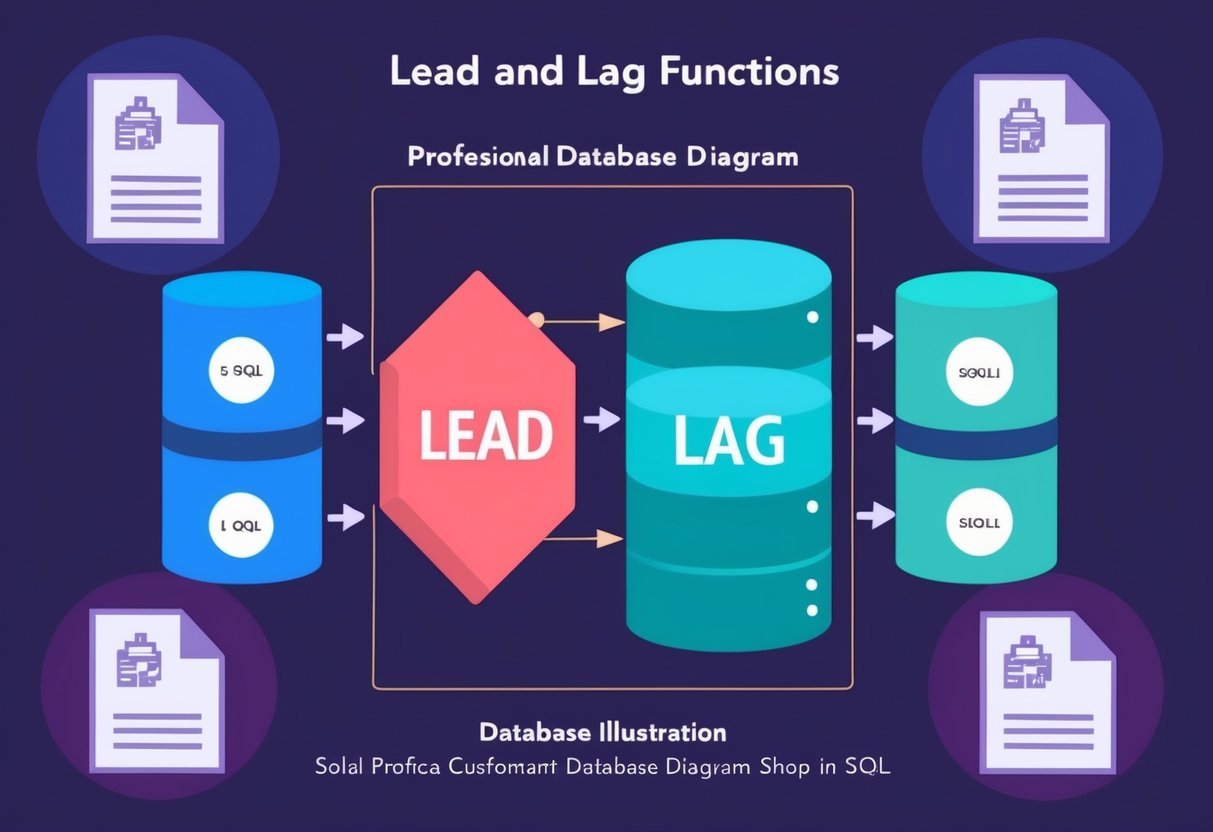
A database diagram with lead and lag functions in SQL

In SQL, the LEAD() and LAG() functions are used to compare rows within a dataset. These functions can access data from a subsequent or previous row, respectively.

When there is no row to reference, a default value can be provided. This ensures that no data is missing from the output.

For example, LEAD(column_name, 1, 0) sets 0 as the default when there is no next row.

Using a default value helps maintain data integrity and avoids null entries.

By specifying a default, analysts ensure clarity in results, especially when the dataset has gaps or the number of entries varies.

Here’s a simple illustration:

Function Behavior
LEAD() Accesses the next row’s value
LAG() Accesses the previous row’s value

Understanding default values in the context of LEAD() and LAG() functions can aid in constructing more reliable SQL queries. With these defaults, users can handle data efficiently without worrying about missing values.

Lead and Lag Functions in SQL Server

A computer screen displaying SQL code with lead and lag functions

SQL Server introduced the LEAD and LAG functions in SQL Server 2012. These functions are useful for accessing data from a row at a specified physical offset from the current row within the same result set.

LAG allows you to access data from a previous row. It is helpful for comparing current values with the previous ones without using complex operations like self-joins.

LEAD fetches data from the next row, which can be handy for forward-looking calculations in reports or analytics.

Both functions are window functions, and their syntax includes the OVER clause, which defines the data partition and order.

Here’s a simple syntax example:

LAG (scalar_expression [, offset] [, default]) 
OVER ( [ partition_by_clause ] order_by_clause )

Practical Example: Suppose there is a table Sales with data on daily sales amounts. Using LAG and LEAD, you can calculate differences between consecutive days to track sales trends.

These functions simplify queries by removing the need for complex subqueries or self-joins. They help make code more readable and efficient while analyzing data that requires information from adjacent rows. More information on how these functions work can be found in articles like the one on LearnSQL.com.

Working with Lead and Lag in MySQL
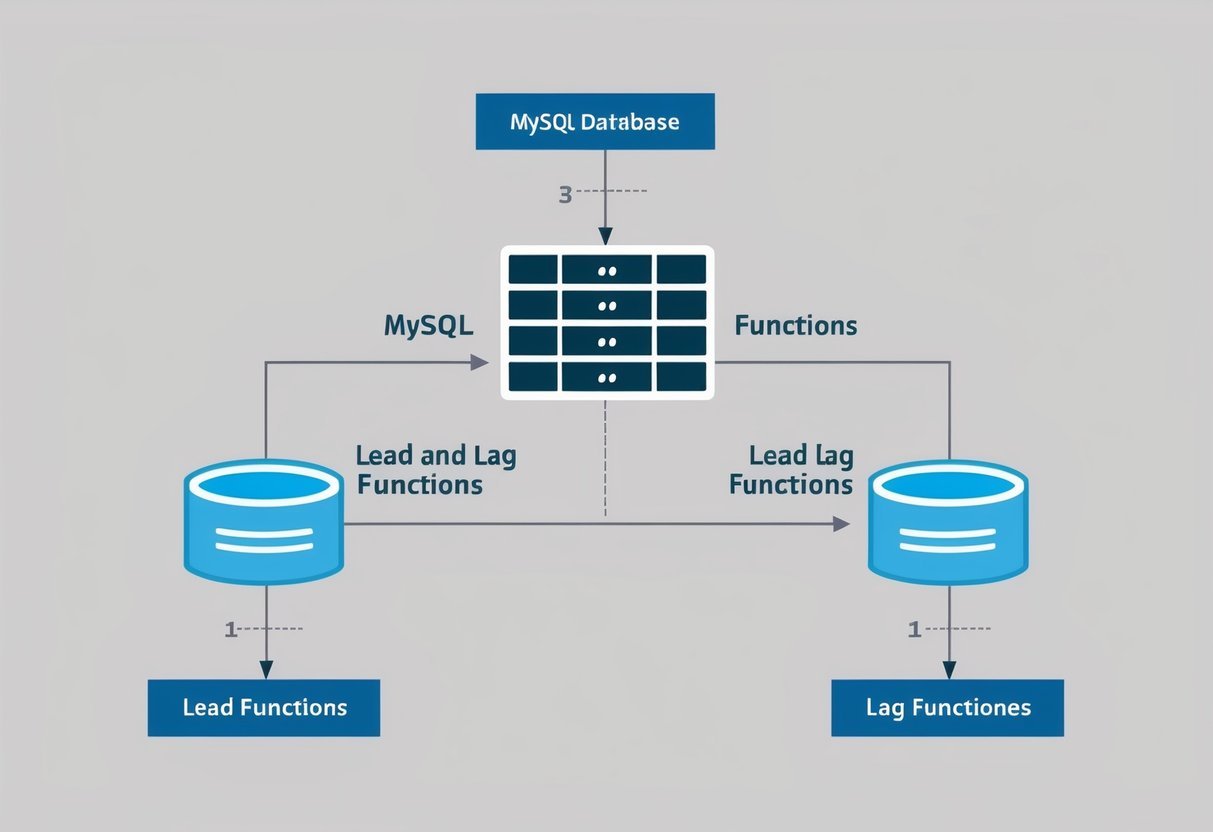
A MySQL database diagram with lead and lag functions being used in SQL queries

MySQL provides two powerful functions, LEAD() and LAG(), that help in accessing data from other rows in a result set. These functions simplify tasks that require examining sequential data.

LEAD() retrieves values from the next row in a dataset. This is particularly useful for making comparisons or finding trends between consecutive entries. For example, tracking year-over-year sales growth can be simplified using LEAD().

LAG() allows access to the data from the previous row. This can be helpful when there is a need to look back at earlier records to compare results or find differences.

These functions are commonly used in MySQL’s window functions. They provide a more efficient way to analyze sequential data without needing complex subqueries or self-joins.

Usage Example:

Consider a sales table with columns for employee ID and sales amount.

Employee Sales Current Leads Previous Lags
Alice 5000 5500 NULL
Bob 5500 7000 5000
Carol 7000 NULL 5500

LEAD() extracts future sales data, while LAG() retrieves past sales data.

For those interested in practical applications, detailed guides for using these functions in MySQL can be found at resources such as GeeksforGeeks and Sling Academy.

Real-World Examples and Analysis

A computer screen displaying SQL code with lead and lag functions, surrounded by data analysis charts and graphs

In the realm of data analysis, SQL’s LEAD and LAG functions are pivotal. They allow for insights across adjacent rows without complex joins. These functions simplify data examination, enabling users to analyze trends or patterns efficiently.

E-commerce Transactions
In an e-commerce dataset, the LEAD function can anticipate future sales. For example, if a particular product sells for $20 on Monday, LEAD can show Tuesday’s sale price next to it. This helps predict price trends or demand changes.

Stock Market Analysis
Analyzing stock trends is another area where these functions shine. Analysts use the LAG function to compare a stock’s current price with its previous day’s price. This approach helps in understanding market fluctuations and spotting investment opportunities.

Performance Tracking
For monitoring employee performance, both functions are beneficial. By using LAG, a manager could compare an employee’s current performance metrics to their previous results, identifying improvements or declines over time.

Here’s a simple table illustrating how LEAD and LAG function:

Employee Current Score Previous Score (LAG) Next Score (LEAD)
Alice 85 82 88
Bob 78 85 80

This table makes it easy to track progress or identify areas that may need attention. Using these functions ensures that data evaluation is both streamlined and effective.

Frequently Asked Questions

SQL users often have questions about utilizing the LEAD and LAG functions. These functions are critical for accessing data from different rows without complex joins. Here, common questions cover their differences, practical uses, and how they function in various SQL environments.

How do you use the LEAD function in conjunction with PARTITION BY in SQL?

The LEAD function can be combined with PARTITION BY to divide the data into sections before applying the LEAD operation. This makes it possible to access the next row’s data within each partition, facilitating comparisons or calculations within a specific group of records.

What are the differences between the LEAD and LAG functions in SQL?

LEAD and LAG functions both access values from other rows. The LEAD function fetches data from rows following the current one, while the LAG function retrieves data from rows that precede it. This makes the functions particularly suitable for analyzing trends over time or sequential records.

Can you provide an example of using the LAG function to find differences between rows in SQL?

Yes, the LAG function can calculate differences between rows by comparing current and previous row values. For instance, in a sales table, LAG can compare sales figures between consecutive days, allowing analysis of daily changes.

How do LEAD and LAG functions work in SQL Server?

In SQL Server, LEAD and LAG are implemented as window functions. They help perform calculations across a set of table rows related to the current row. These functions require an ORDER BY clause to define the sequence for accessing other row data.

What are some practical applications of LEAD and LAG functions in data analysis with SQL?

LEAD and LAG functions are widely used in time-series analysis and trend monitoring. They are instrumental in financial calculations, inventory tracking, and any scenario where changes over a sequence must be calculated or visualized. They simplify analyzing data progression over time or categories.

How are LEAD and LAG functions implemented in MySQL compared to Oracle SQL?

In MySQL, LEAD and LAG functions are similar to those in Oracle SQL but vary slightly in implementation syntax.

They offer seamless access to adjacent row data in both systems, enhancing analysis efficiency and reducing the need for complex query-building.


Categories
Uncategorized

Learning Math for Machine Learning – Eigenvectors and Eigenvalues Explained Simply

Foundations of Linear Algebra

Linear algebra is a field of mathematics essential for machine learning. It focuses on vectors and vector spaces, as well as matrices and their operations. These concepts form the backbone of data processing and analysis.

Vectors and Vector Spaces

Vectors are fundamental in linear algebra. A vector is a list of numbers that can represent points in space. They have both magnitude and direction.

Vectors help in describing physical quantities like force and velocity. In a vector space, vectors can be added together and scaled by numbers, known as scalars.

Vector spaces are defined over fields and require operations like addition and scalar multiplication to satisfy certain properties such as closure, associativity, and distributivity. Understanding these properties is crucial to analyzing complex data.

Matrices and Matrix Operations

Matrices are rectangular arrays of numbers arranged in rows and columns. They are used to represent linear transformations and systems of linear equations.

Basic operations with matrices include addition, subtraction, and matrix multiplication. Matrix multiplication combines data in a way that preserves the structure of linear equations.

The identity matrix acts like the number one in matrix arithmetic. It does not change other matrices when involved in multiplication.

A square matrix has the same number of rows and columns, and it has special properties that are important in computational tasks. Mastery of these operations is vital in areas such as graphics, cryptography, and machine learning.

Core Principles of Math in Machine Learning

Mathematics is a fundamental part of machine learning. It helps in understanding algorithms and improving models. To excel in this field, one needs a strong grasp of several mathematical concepts.

Linear Algebra plays a key role. It’s essential for working with vectors and matrices, which form the basis of many algorithms. Concepts like eigenvectors and eigenvalues are crucial for techniques such as Principal Component Analysis (PCA). You can explore these in Mathematics for Machine Learning.

Calculus is vital for optimizing algorithms. It helps in understanding how changes in input affect the output. This is particularly important in training deep learning models, where derivatives are used to minimize errors.

Probability and Statistics enable practitioners to make predictions and deal with uncertainty in data. Techniques such as Bayesian networks rely heavily on these concepts.

Python is the most popular programming language in AI and data science. Libraries like NumPy assist with complex calculations, making it easier to implement math-based solutions in machine learning. An insight into these operations can be found in the Deep Learning and Machine Learning tutorial.

Solid math skills are indispensable for anyone interested in AI and data science. Understanding mathematical principles allows one to interpret data and create accurate models effectively.

Eigenvalues And Their Significance

Eigenvalues are a core concept in linear algebra, with significant applications in various fields, including machine learning and data analysis. Their primary importance lies in simplifying complex systems and matrices through transformation and dimensionality reduction.

Understanding Eigenvalues

Eigenvalues are scalars associated with a matrix that provide insights into the matrix’s properties. When a matrix is transformed, the eigenvalue indicates how much an eigenvector is stretched or compressed.

Matrices often arise in applications involving transformations, and eigenvalues help in understanding these changes. They are essential in determining the stability of systems, aiding in calculations where complex matrix equations are simplified.

In machine learning, eigenvalues are used in techniques such as Principal Component Analysis (PCA). Here, eigenvalues help rank dimensions by importance, allowing data to be reduced efficiently.

When the eigenvalues are large, they suggest that the direction associated with their eigenvectors significantly impacts the system, which is critical for model predictions. In this way, understanding the eigenvalues of a matrix provides a deep insight into its characteristics.

Characteristic Equation

The characteristic equation is a polynomial obtained from a matrix by subtracting a scalar multiple of the identity matrix from the original matrix and calculating its determinant.

It is given by the equation: det(A – λI) = 0, where A is the matrix, λ is the eigenvalue, and I is the identity matrix.

Solving this equation yields the eigenvalues of matrix A.

In practice, solving the characteristic equation is crucial for finding eigenvalues in many applications. It aids in performing eigenvalue classification, especially in computational algorithms involving data processing, optimization, and more.

The solutions provide values reflecting various transformation properties and stability indicators, offering a window into the matrix’s behavior. This concept is fundamental in the study and application of eigenvalues across diverse scientific disciplines.

Eigenvectors Explained

Eigenvectors play a critical role in understanding various mathematical concepts, especially in machine learning and data analysis. They offer insights into linear transformations and other mathematical operations.

Interpreting Eigenvectors

Eigenvectors are vectors that do not change direction during a linear transformation. While their magnitude might be scaled, their direction remains constant.

For example, in a geometric sense, imagine a transformation that stretches or compresses, yet the eigenvector maintains its original orientation.

Mathematically, an eigenvector (\mathbf{v}) of a matrix (A) satisfies the equation (A\mathbf{v} = \lambda\mathbf{v}), where (\lambda) is the eigenvalue. This means that when matrix (A) is applied, the vector (\mathbf{v}) is stretched by a factor of (\lambda).

Knowing how to interpret eigenvectors helps in many applications, such as explaining data variance in principal component analysis or understanding the dynamics in systems governed by differential equations. The direction given by eigenvectors often reveals crucial information about the system or data structure being studied.

Eigenvectors in Linear Transformations

In linear transformations, eigenvectors describe invariant directions in vector spaces. When vectors undergo transformations, eigenvectors specify the paths that remain proportionally unchanged, which is key in simplifying complex mathematical models.

For example, consider a transformation matrix in computer graphics. Applying this matrix to a vector results in rotation, scaling, or reflection.

If a vector is an eigenvector, it retains its fundamental direction even as it might be resized. This property is essential in discerning important attributes in data, such as identifying principal components in datasets or solving stability problems in engineering.

By exploring how eigenvectors act during these transformations, one can grasp their effectiveness in solving practical problems across various fields.

Dimensionality Reduction Techniques

Dimensionality reduction is crucial in simplifying complex datasets by reducing the number of variables while preserving essential information. Two main techniques are Principal Component Analysis (PCA) and Singular Value Decomposition (SVD), both used to manage data more efficiently and improve computational performance.

Principal Component Analysis (PCA)

PCA is a widely-used method for dimensionality reduction. It works by identifying the directions (principal components) in which data varies the most. These components are linear combinations of the original variables and are orthogonal to each other.

The process involves finding the top eigenvectors of the data’s covariance matrix. These eigenvectors represent the principal components, and the ones with the highest eigenvalues capture the most variance in the data.

PCA can reduce a dataset to a lower-dimensional space, making it easier to analyze without losing significant information. It is especially effective in fields like image processing and genomics where data can be overwhelming.

Singular Value Decomposition

Singular Value Decomposition (SVD) is another powerful dimensionality reduction tool. SVD decomposes a matrix into three smaller matrices, revealing the intrinsic properties of the original matrix. It represents the matrix as a product of its singular vectors and singular values.

The singular values in SVD are akin to the eigenvalues in PCA, indicating the importance of each dimension. By zeroing out smaller singular values, SVD reduces noise and compresses the data effectively.

This method is particularly useful in signal processing and natural language processing, where datasets need to be compressed while retaining meaningful structures.

Python for Math Applications

Python is a powerful tool for mathematical computations, often used for statistics, probability, and linear algebra. It offers libraries that simplify complex tasks, making it accessible for those learning machine learning concepts like eigenvectors and eigenvalues.

Numpy in Mathematics

Numpy is a popular Python library used to perform numerical operations efficiently. It provides support for large multi-dimensional arrays and matrices, along with a vast collection of mathematical functions.

For mathematics, Numpy is crucial because it allows operations on entire arrays without needing explicit loops. This makes computations faster and simpler.

Users find Numpy’s linear algebra capabilities particularly helpful for calculating eigenvectors and eigenvalues, which are key concepts in machine learning and data analysis.

By utilizing Numpy, tasks such as matrix multiplication, finding determinates, and performing eigen decomposition become streamlined.

Its integration with Python enhances the learning process by allowing users to apply mathematical theories in practice. Numpy’s comprehensive documentation also makes it easier to get started and use effectively.

Python Examples

Python shines in its ability to execute mathematics through clear and concise code. For example, calculating eigenvectors and eigenvalues is straightforward with Numpy. Here is a simple illustration:

import numpy as np

matrix = np.array([[4, -2], [1, 1]])
eigenvalues, eigenvectors = np.linalg.eig(matrix)

print("Eigenvalues:", eigenvalues)
print("Eigenvectors:\n", eigenvectors)

This script showcases how Python’s Numpy library can be used to achieve complex calculations with minimal lines of code. Such examples demonstrate the practical application of mathematical theories and make Python an excellent choice for learning and teaching statistics and probability.

Mathematical Pedagogy in AI

Mathematics is the foundation of many concepts in machine learning, such as eigenvectors and eigenvalues. Understanding how math is taught for AI reveals the shift from traditional methods to modern approaches.

Traditional vs Modern Methods

Traditional mathematics pedagogy often focuses on rote memorization and procedural knowledge. Students usually learn through lectures and solve set problems to apply formulas. This method creates a strong base but might miss fostering problem-solving skills.

With machine learning, there is a need for a deeper practical approach. Modern methods emphasize conceptual understanding and collaborative learning tactics.

These include project-based learning, which engages students with real-world machine learning problems. Interactive platforms and software are also used to simulate complex AI systems, making abstract concepts more concrete and understandable.

Teaching Math for AI

Teaching math specifically for AI involves focusing on applicable topics such as linear algebra, calculus, probability, and statistics. These areas are crucial because they are the backbone of machine learning algorithms. Educators push for a curriculum that integrates these disciplines effectively.

Introducing coding exercises alongside math theories helps in constructing a bridge between math concepts and AI applications.

Using programming languages like Python allows students to write algorithms, giving them hands-on experience with machine learning models. Encouraging the use of digital tools for visualization assists in grasping complicated ideas, promoting a more engaging and efficient learning process.

Scalability and Efficiency

Understanding scalability and efficiency in computations is essential for advancing machine learning applications. These aspects ensure that algorithms remain robust and perform well even as data sizes grow.

Optimizing Algebraic Computations

In machine learning, optimizing algebraic computations is crucial for efficiency. A common approach is to improve the speed of matrix operations, which are central to many algorithms.

Tools like numpy or scipy enable faster computations by leveraging optimized mathematical libraries.

Parallel processing can also be utilized to perform calculations more quickly by splitting tasks across multiple processors. This significantly reduces computation time and makes processes scalable.

As algorithms become more complex, especially in AI applications, improving algebraic computations can greatly enhance performance and make it feasible to handle large datasets common in industries using advanced algorithms to upskill.

Scaling Algorithms in ML

Scaling algorithms efficiently in machine learning involves adapting them to manage larger datasets and more complex models. One method is distributing computations across clusters or using cloud computing platforms. This approach allows for handling vast amounts of data without a drop in performance.

Efficient algorithms for calculating large-scale eigenvectors, like those discussed in large-scale generalized eigenvector computation, illustrate the importance of balancing computational load.

By focusing on scalable machine learning practices, it becomes possible to maintain accuracy and efficiency in AI systems. This ensures that machine learning models can keep pace with rapidly growing data volumes while still developing essential math skills.

Algebra in Computer Vision

Algebra plays a crucial role in computer vision, particularly with matrices and vectors. These mathematical tools help in processing and understanding images.

Matrices are used to transform images in various ways. Whether rotating, scaling, or translating images, matrices help perform these operations efficiently.

Vectors are essential in representing features of images. They aid in image recognition, a key task in computer vision applications, including facial recognition and object detection.

Python is often used in computer vision tasks because of its versatile libraries. Tools like OpenCV and TensorFlow allow easy manipulation of matrices and vectors.

In deep learning, algebra is vital for training models. Convolutional neural networks (CNNs) heavily rely on matrix operations to process image data. These models improve AI by enhancing how systems understand visual information.

For those interested in learning more about these concepts, the study of eigenvectors and eigenvalues can be beneficial. These are often applied in geometric transformations and data reduction tasks. The study of eigenvectors and eigenvalues helps in the visualization and interpretation of image data.

Algebraic methods provide the backbone for many computer vision applications, offering powerful tools to solve complex problems in artificial intelligence.

Real-World Applications

Eigenvectors and eigenvalues are crucial in many technology fields. They play a vital role in algorithms and machine learning methods. Additionally, they are important in data science, impacting how AI processes information.

PageRank Algorithm

The PageRank algorithm, developed by Google, is a clear example of eigenvectors and eigenvalues in action. In this context, the algorithm uses a webpage’s link structure to rank its importance.

Think of the web as a network where each page represents a node. The algorithm uses a large matrix that reflects the link connections between these pages.

This matrix is then analyzed to find its eigenvalues and eigenvectors. By doing this, the algorithm identifies which pages should be seen as more authoritative and relevant.

This ranking process helps determine search result order. PageRank illustrates how these mathematical concepts are applied in real-world scenarios to make AI more effective.

Machine Learning Use-Cases

In machine learning, eigenvectors and eigenvalues help simplify data complexity. They aid in reducing dimensions while retaining important information.

One well-known method that uses these math concepts is Principal Component Analysis (PCA). PCA allows data scientists to transform large datasets into smaller, more manageable forms.

This is particularly useful for visualizing high-dimensional data in two or three dimensions. By keeping only the significant components, PCA improves data processing efficiency.

EigenClass, another machine learning method, uses eigenvalues for classification tasks. It improves accuracy and stability in predictions. Such methods are essential in enabling AI to handle real-world data, thus enhancing decision-making and predictive capabilities in practice.

Advanced Mathematical Concepts

The application of advanced mathematical concepts is integral to understanding machine learning. Key topics include calculus and complex statistical measures, which play significant roles in optimization and data analysis.

Calculus in Machine Learning

Calculus is essential for optimizing algorithms in machine learning. It helps with understanding how functions behave, which is crucial for algorithms that learn from data.

The concept of derivatives allows for determining the slope of a curve, aiding in minimizing or maximizing functions.

Gradients are used to find the direction of steepest ascent or descent, helping in optimizing the function.

Partial derivatives allow for understanding functions with multiple inputs, which is key for multivariate models. Calculus assists in tuning parameters to get the best predictions from a model.

Complex Statistical Measures

Statistics provide the tools to interpret and make predictions from data. Measures like mean, variance, and standard deviation form the foundation of data analysis.

Probability theory is used to model and predict outcomes, which is crucial in algorithms for tasks such as classification and regression.

Understanding correlation and regression helps in identifying relationships between variables.

Complex statistical tools, like hypothesis testing and determinants, assist in making decisions based on data. These measures help in validating models and understanding the data’s structure, providing insights for better algorithm design.

Challenges in Learning Math for AI

Learning math for artificial intelligence can be tough due to several reasons. Traditional mathematics pedagogy often emphasizes theory over application. This approach can make it hard for students to see how math like eigenvalues relates to AI.

Machine learning relies heavily on concepts such as matrices and eigenvectors. These topics can seem abstract and hard to grasp. Many students find themselves struggling to connect these mathematical ideas to real-world AI applications.

Practice doing math is essential. Without regular practice, it becomes difficult to understand and apply mathematical concepts in AI. Students often need guided practice to bridge the gap between theory and practical application.

The vocabulary used in mathematics and AI can be another barrier. Specialized terms and symbols may feel alien, leading to misunderstanding. A strong focus on developing clear definitions and examples can help ease this challenge.

AI complexity adds another layer of difficulty. As AI evolves, so does the level of math needed. Keeping up with the rapidly changing technology while mastering complex math is often challenging for learners.

Using real-world applications and step-by-step visualization, like those studied by math majors, can make learning math for AI more engaging and less daunting. Access to resources like deep learning architecture books can further enhance understanding.

Frequently Asked Questions

Eigenvalues and eigenvectors play critical roles in machine learning, particularly in areas such as dimensionality reduction and data analysis. These concepts facilitate understanding data structures and optimizing machine learning algorithms.

How are eigenvalues and eigenvectors applied in machine learning algorithms?

Eigenvalues and eigenvectors assist in simplifying data structures, making complex algorithms easier to handle. They help identify principal components in datasets, which is crucial for algorithms like Principal Component Analysis (PCA).

What is the significance of eigenvalues and eigenvectors in dimensionality reduction techniques?

In dimensionality reduction, eigenvalues determine the importance of corresponding eigenvectors. Techniques like PCA use them to reduce large datasets into smaller, more manageable ones while preserving important data patterns.

How do eigenvalues and eigenvectors contribute to understanding data distributions in machine learning?

Eigenvalues and eigenvectors reveal variance within datasets, showing the directions of maximum data spread. This insight helps in identifying underlying patterns and correlations in the data, which is essential for classification and clustering tasks.

What methods are commonly used to compute eigenvalues and eigenvectors in numerical computations?

Common methods include the QR algorithm, power iteration, and singular value decomposition. These approaches facilitate efficient computation, which is important for handling large datasets typical in machine learning applications.

In what ways do eigenvalues and eigenvectors play a role in optimizing machine learning models?

They reduce complexity in models by aiding in feature selection and transformation. By focusing on the most significant features, they improve model performance and decrease computational costs.

What is the intuitive explanation of eigendecomposition in the context of machine learning?

Eigendecomposition breaks down matrices into eigenvalues and eigenvectors. This explains data transformations. It allows models to understand linear transformations in data. It provides a clearer picture of data structure and dynamics.

Categories
Uncategorized

Learn About Design Considerations: Key Insights for Successful Projects

Principles of Architectural Design

Architectural design revolves around creating structures that are both aesthetically pleasing and functional.

Key principles include achieving balance between form and function, understanding scale, proportion, and symmetry, and using rhythm and contrast to enhance design.

Balancing Form and Function

Designing a building requires a careful balance between aesthetics and usability.

Architects must ensure a structure is visually appealing while meeting practical needs. This means considering both the building’s purpose and its environment.

Functionality includes providing adequate space for intended activities and ensuring safety and accessibility for users.

Balance is achieved by integrating practical design with creative expression, leading to a harmonious structure.

Innovative designs, like energy-efficient systems, can enhance both beauty and function, illustrating how thoughtful design accommodates utility without sacrificing form.

Embracing Scale, Proportion, and Symmetry

Scale, proportion, and symmetry are fundamental in creating well-organized architectural spaces.

Scale refers to the size of a structure in relation to humans or its surroundings. It ensures that buildings fit comfortably within their context.

Proportion involves the relationship between elements, creating a sense of harmony. It affects how space is perceived, influencing the comfort and appeal of an area.

Symmetry provides balance and order, often leading to aesthetically pleasing results.

These principles work together, ensuring that designs are balanced and coherent, with each part contributing to the overall aesthetic and functional quality of the building.

Incorporating Rhythm and Contrast

Rhythm and contrast are used to guide the viewer’s eye and create dynamic architecture.

Rhythm involves repeated elements, like windows or columns, to create a sense of movement within a space. It can lead to a more engaging environment, enhancing the viewer’s experience.

Contrast highlights differences between various elements, adding visual interest and depth. This can include variations in materials, colors, or shapes.

By thoughtfully applying rhythm and contrast, architects can design spaces that are not only visually appealing but also tell a story, ensuring each visit offers something new and compelling. These elements make the structure memorable and unique.

Understanding Design Elements

Design elements play a crucial role in creating visually engaging work. They affect how people perceive and interact with design pieces, making the choice of color, texture, and space significant.

Color Theory and Visual Appeal

Color is one of the most impactful design elements. It affects emotions and conveys messages.

Warm colors like red and orange can evoke excitement or energy, while cool colors such as blue and green tend to be calming.

Understanding color theory helps designers make informed choices about which hues will best convey the desired experience.

Using a color wheel can assist in selecting complementary and contrasting palettes to enhance visual appeal and create balance within a design.

Designers should consider cultural associations and the psychological effects of color to effectively reach their audience.

Textural Considerations

Texture adds depth and interest to designs, influencing how they are perceived. It can be visual, creating an illusion of surface variation, or physical, where users can feel the texture.

Incorporating different textures can guide a viewer’s focus and highlight key areas or elements within a design.

Subtle textures can provide a sense of professionalism, while bold textures may convey creativity and vibrancy.

Textural balance is key; combining smooth and rough elements without overwhelming the viewer enhances both the style and functionality of the design.

Influence of Negative Space and Emphasis

Negative space, also known as white space, is the empty area around design elements. It allows the main parts of the composition to stand out and breathes life into a piece.

Effective use of negative space emphasizes key features and improves readability. It can guide viewers’ eyes smoothly across the design, enhancing their experience.

Emphasis can be created by strategically placing bold elements where audience attention is required.

Balancing negative space with focal points ensures that the composition remains engaging and navigable.

Design Process and Development

The design process and development in architecture involve taking initial ideas and refining them into detailed plans through careful project management.

This involves engaging with clients and managing the whole lifecycle of the project to ensure successful outcomes.

From Concept to Reality

The journey from concept to a finished building is both creative and technical. Architects start with a broad idea and gradually work through phases to add detail and specification.

This includes creating floor plans and elevations during the design development phase. Each step builds on the previous, ensuring that the initial vision aligns with practical and regulatory requirements.

Attention to detail and ongoing iteration are key to transforming concepts into structures that meet both aesthetic and functional goals.

Managing Project Lifecycle

Effective management throughout the project lifecycle ensures timely and within-budget completion.

The design development stage allows architects to refine their ideas while considering cost estimates and code compliance.

Project management strategies, such as detailed scheduling and resource allocation, help mitigate risks.

By managing each phase—from pre-design through construction—professionals can adapt to changes and challenges, ensuring the project’s success at every stage.

Client Engagement and Feedback

Active engagement with clients is crucial for a successful design process.

Architects must maintain open communication, integrating client feedback into the project as it evolves.

This interaction not only ensures the final design meets the client’s needs but also builds a strong working relationship.

Regular updates and collaborative decision-making are essential, allowing for timely adjustments and client satisfaction.

Feedback loops are established to refine designs and align with client expectations, ultimately leading to a successful and well-received project.

Material Selection and Sustainability

A table with various sustainable materials such as bamboo, recycled plastic, and reclaimed wood. A designer considers their environmental impact

Material selection is crucial in sustainable design. It not only impacts the environment but also affects the longevity and upkeep of products.

Eco-Friendly Materials and Construction

Choosing eco-friendly materials is key to sustainable design. These materials reduce environmental impact by minimizing resource depletion and pollution.

For example, selecting materials with environmental certifications like ISO 14001 can help maintain standards of sustainability.

Prefabrication techniques further support eco-friendly construction by minimizing waste and efficiently using resources. Builders can also utilize recyclable materials to ensure resources are repurposed at the end of a product’s life.

This approach leads to lower energy consumption and a reduced carbon footprint.

Durability and Maintenance Considerations

Durability is a crucial factor in sustainable design. Materials should withstand wear and tear, reducing the need for frequent replacements.

High durability leads to a longer product lifecycle, which supports sustainability by lowering overall material consumption.

Maintenance is an important aspect to consider; selecting materials that require minimal upkeep can decrease environmental impact.

This involves choosing surfaces that resist corrosion and decay. Durable choices ultimately reduce waste and resource usage, aligning with sustainable practices by focusing on long-term functionality over short-term convenience.

Sustainable Design Strategies

Sustainable design strategies focus on reducing environmental impact by utilizing renewable resources and enhancing energy efficiency. These methods are crucial in architectural projects where sustainability is a key objective.

Renewable Resources and Energy Efficiency

Incorporating renewable resources into design practices is a major factor in achieving sustainability.

Solar panels and wind turbines can drastically cut down on non-renewable energy use and reduce carbon footprints. Designers aim to harness these technologies to provide clean, sustainable energy.

Energy-efficient building materials, like insulated windows and smart thermostats, also play a vital role.

Designers also explore ways to let buildings adapt to natural light and temperature, which minimizes energy consumption.

This approach not only reduces costs but also encourages environmentally responsible development.

Sustainability in Architectural Projects

Architects aim to integrate sustainable design in their projects by using eco-friendly materials and green building designs.

This includes selecting materials that are recyclable and have a minimal environmental impact.

Strategies such as green roofs and rainwater harvesting systems contribute to self-sustaining architecture.

Projects often focus on improving indoor air quality and reducing waste disposal during construction.

Such practices ensure that sustainability is the core of the architecture, benefiting both residents and the environment.

Technological Advancements in Design

A futuristic city skyline with sleek, innovative buildings and advanced transportation systems, showcasing the integration of technology in design

Technological advancements are profoundly shaping the design industry. Design professionals are increasingly leveraging automation and smart design techniques. New technologies are being integrated into the design process to create more efficient and innovative outcomes.

Automation and Smart Design

Automation is transforming how designers work. By utilizing software that automates repetitive tasks, designers can save time and increase accuracy.

For instance, generative design software can create complex structures by using algorithms, allowing designers to explore numerous options quickly. This technological integration enhances productivity and creativity.

Smart design involves incorporating technology into everyday objects, making them more functional and user-friendly.

For example, smart furniture can adapt to different needs and environments. This concept extends to smart homes, where integrated systems create seamless experiences for occupants.

By using these advancements, the design process becomes more dynamic and responsive to user needs.

Integrating New Technologies

Integrating new technologies in design involves using the latest digital tools to improve and innovate.

Tools like 3D printing and virtual reality (VR) are now crucial in terms of rapid prototyping and visualization. VR allows designers to test and present their work in immersive ways that traditional methods cannot match.

Incorporating sustainability and ethical practices into design is another focus.

Designers strive to minimize environmental impact by choosing sustainable materials and methods.

As shown in design innovation examples, there is a growing emphasis on creating solutions that are both functional and environmentally friendly. This approach ensures that technological progress aligns with ethical and sustainable goals.

Accessibility and Universal Design

Accessibility and Universal Design aim to create environments that are usable by everyone, regardless of abilities. This involves both considering diverse user needs and adhering to established accessibility standards to ensure inclusivity.

Designing for Diverse Needs

Designing with a focus on diverse needs involves creating products and environments that accommodate people with varying abilities and preferences. Universal Design is a key concept here, aiming for inclusivity from the start rather than through modifications later.

For example, in digital spaces, features such as text-to-speech, adjustable text size, and voice controls can significantly enhance accessibility. Physical spaces must also consider elements like wheelchair access and tactile paving for visually impaired individuals.

Design that incorporates these considerations not only broadens access but also improves safety and security for all users. A universally designed environment or product is inherently safer because it anticipates and mitigates potential barriers and risks.

Compliance with Accessibility Standards

Compliance ensures that products and environments meet established guidelines, such as the Web Content Accessibility Guidelines (WCAG).

These standards help developers and designers create more accessible digital content, ensuring that important information remains available to everyone.

By following these standards, organizations demonstrate a commitment to inclusivity and legal obligations.

For instance, accessible digital designs should include features like multimedia captioning and keyboard navigability, which are crucial for users with disabilities.

Adhering to accessibility standards not only fulfills legal requirements but enhances the overall user experience, leading to higher satisfaction and trust.

Implementing accessibility standards from the initial design phase makes integration smoother and more effective in reaching diverse audiences.

Architectural Design and Site Analysis

Architectural design heavily relies on site analysis to enhance both functionality and aesthetics. Understanding the topography and evaluating the climate are crucial in aligning a building with its environment.

Topography and Orientation

Topography plays a vital role in architectural design, as it affects drainage, access, and even the building’s aesthetic appeal.

Analyzing the land’s contours helps architects understand how to position a structure to maximize natural light and views. The slope, elevation, and natural features like rocks or water bodies are considered to create a cohesive design that integrates seamlessly into the landscape.

Orientation involves situating the building to capitalize on solar gain, promoting energy efficiency and user comfort.

Orientation also affects wind flow patterns, impacting heating and cooling needs.

One important consideration is south-facing windows, which can enhance natural lighting and warmth in colder climates.

Effective topographic analysis ensures that buildings minimize environmental disruption and blend into their natural surroundings.

Evaluating Climate and Weather

Climate and weather patterns are key factors in architectural site analysis. Understanding local weather conditions, such as prevailing wind directions and seasonal changes, influences decisions related to materials, ventilation, and insulation.

For instance, buildings in warmer climates may require cooling strategies like shade structures, while those in colder regions need extra insulation.

Architects assess climatic conditions, including rainfall, humidity, and temperature extremes. This provides insights into necessary design adjustments to optimize comfort and energy efficiency.

Effective weather assessment ensures that structures withstand local conditions, preventing issues like water infiltration or excessive heat gain.

Cultural and Contextual Influence

Understanding how cultural and contextual factors influence design is crucial. A design must respect both the local culture and the environment where it will exist. By focusing on these aspects, designs become more effective and meaningful.

Integrating Local Culture in Design

Incorporating local culture into design involves recognizing and celebrating cultural elements and traditions. Designers consider aspects like local art, tradition, history, and even societal norms.

This approach leads to a design that resonates with people and enhances its acceptance.

For example, color choices might reflect traditional palettes that hold significance in a culture. Effective integration requires research and sensitivity to local customs.

Designs become more engaging by embedding cultural symbols and materials specific to the region. This not only creates a strong connection with the community but also adds authenticity and relevance to the design.

Contextual Analysis and Adaptability

Contextual analysis in design involves evaluating the surrounding environment and how a new design will fit within it. Considerations include the landscape, climate, and existing architectural styles.

A thorough analysis ensures that new designs harmonize with their surroundings. The process includes studying climate effects, local building materials, and spatial dynamics.

Adaptability plays a crucial role as well. Design must be flexible enough to adjust to changes in the environment or cultural shifts.

For instance, using adaptable features that can withstand weather variations is vital. Structures might incorporate flexible spaces to serve multiple purposes as community needs change. This ensures longevity and relevance over time, reflecting an understanding of both current context and future needs.

Safety, Security, and Performance

Design plays an essential role in ensuring structures are safe, secure, and perform well. It involves careful consideration of how buildings support weight and protect against hazards like fire.

Structural Design and Load-Bearing Capacity

Structural design ensures that buildings and infrastructures can withstand various stresses and forces. Engineers analyze the load-bearing capacity of a structure to guarantee that it can hold the weight of its contents and users.

This includes understanding the distribution of loads across beams, foundations, and other critical components. For instance, in high-rise buildings, materials like steel and reinforced concrete are often used for their strength and durability.

Engineers also consider environmental factors such as wind, earthquakes, and snow loads. They employ simulation tools to predict the behavior of structures under these conditions.

Safety is a primary concern, and engineers adhere to building codes and standards to safeguard occupants. Load analysis and stress testing help in identifying potential weaknesses in design.

Fire Safety and Emergency Preparedness

Fire safety is a crucial component of building design, addressing both the prevention of fires and the response to emergencies.

Effective strategies involve using fire-resistant materials and incorporating fire detection and suppression systems. Smoke alarms and sprinkler systems are standard features that help maintain a safe environment in the event of a fire.

Emergency preparedness also includes clear evacuation routes and exit signage to ensure occupants can vacate the premises quickly.

Buildings may have features like stairwells with pressurized air to keep smoke out, enhancing safety during an evacuation. Design considerations also include fire barriers and compartments to slow the spread of flames, providing more time for evacuation and reducing damage.

Interior Design and Spatial Planning

A spacious, well-lit room with modern furniture arranged for optimal flow and functionality. Soft colors and clean lines create a harmonious and inviting atmosphere

Effective interior design often emphasizes making the most of available space while ensuring functionality. Clever storage solutions can greatly enhance organizational efficiency in any environment.

Maximizing Space and Function

Space planning is crucial in interior design for creating functional areas that cater to the needs of the occupants.

Properly utilizing space involves considering the proportions and scale of furniture and decor. Placing large pieces in a tiny room can make it feel cramped. In contrast, small furniture in a large room might feel lost or disproportionate.

Arranging seating to promote conversation without cluttering the area is essential. Flexible layouts allow for multifunctional spaces, which means a room can serve various purposes, like a living room that doubles as an office.

By planning carefully, each area will have a purpose and minimize wasted space.

Storage Solutions and Organization

Incorporating smart storage solutions is vital for maintaining an organized interior.

Hidden storage options such as coffee tables with compartments or ottomans that open up are great for storing items discreetly. This helps keep clutter at bay while maximizing the use of available space.

Custom shelving units can be tailored to fit specific spaces and needs. They offer room for decorative items and essentials, seamlessly blending with the environment.

Utilizing vertical space with tall cabinets or shelving is another effective way to increase storage without sacrificing floor space. These approaches not only enhance the aesthetic appeal but also improve overall functionality.

Frequently Asked Questions

A designer's desk with tools, sketches, and a computer displaying design considerations. A bookshelf with design books in the background

Design considerations in architecture touch on elements like functionality and aesthetics. These considerations vary based on the type of building and specific accessibility needs. Here is more detail on common questions related to design considerations.

What are the essential elements to consider in architectural design?

Architectural design requires attention to many factors, including site analysis, user needs, and sustainability. Architects also focus on aesthetics, spatial planning, and the integration of technology. Considerations like lighting and material selection are also crucial to ensure the success of a project.

How do accessibility requirements influence architectural design considerations?

Accessibility plays a vital role in design. Architects must ensure that spaces are usable for everyone, including people with disabilities.

This involves integrating ramps, wide doors, and tactile signage. Compliance with regulations is essential to provide inclusive environments.

What factors should be considered when designing residential buildings?

When designing residential buildings, functionality and comfort are key. Factors include layout, privacy, natural lighting, and ventilation. Architects must also consider the local climate, cultural preferences, and energy efficiency to create suitable living spaces.

How do design considerations vary between different types of buildings?

Design considerations differ based on the building type. For example, a hospital design focuses on hygiene and patient flow. In contrast, commercial buildings emphasize space efficiency and brand identity. Each building type has unique requirements that influence design choices.

Can you describe some common examples of design considerations in construction?

Design considerations in construction include cost, safety, and environmental impact. Choices about materials, structural stability, and compliance with codes are crucial. Additionally, factors like aesthetics and functionality play significant roles in successful construction projects.

What is the process for effectively documenting design considerations?

Documenting design considerations involves clear communication and detailed records.

Architects use drawings, specifications, and guidelines to convey their decisions.

This documentation is shared with all stakeholders to ensure that the design intent is understood and implemented throughout the project.

Categories
Uncategorized

Learning T-SQL – Query and Manage XML Data Strategies Explained

Understanding XML Data in SQL Server

In SQL Server, XML data can be managed effectively with specific data types and schema collections.

Knowing the basics of XML data types and how to use XML Schema Definitions (XSD) can enhance data handling in SQL environments.

Basics of XML Data Type

The XML data type in SQL Server allows users to store and query XML formatted data. This data type offers great flexibility for handling semi-structured data within a relational database system.

Users interact with XML data using server functions like XMLNODE, XMLQUERY, and XMLVALUE. These functions help parse and manipulate the data easily.

The XML data type supports methods to extract data, transform it, and even validate the structure to ensure it matches expected patterns.

Utilizing the XML data type improves data interchange between SQL Server and various applications. It is crucial for scenarios where the data generated or consumed needs to be in a hierarchical format rather than a flat, tabular structure.

This is particularly beneficial for data exchange in web services and applications requiring complex data structures. In short, it allows seamless integration of XML formats with relational data.

XML Schema Collection and XSD

XML Schema Collection in SQL Server serves as a container for one or more XML Schema Definitions (XSDs). This collection helps validate XML data stored within an XML column, ensuring that XML documents meet specific structural and data requirements. This process improves data integrity and reliability.

When XML data is inserted, the server uses the XSD to check for compliance with defined rules. This validation process makes sure that the XML data adheres to predetermined formats and constraints, akin to data validation in traditional databases.

The schema collection reduces overhead in repeated validation, helping maintain performance efficiency. It is instrumental in environments where structured data modeling is critical.

By using XML Schema Collections, users can manage complex data more effectively and enforce strict data integrity rules. This capability ensures that XML data remains consistent, accurate, and reliable over time.

Working with the T-SQL Query Language

T-SQL is a powerful tool for working with XML data. It provides functions and methods like query(), value(), exist(), modify(), and nodes() to query and manipulate XML within SQL Server. These capabilities make it easier to manage complex data formats.

Introduction to T-SQL for XML

T-SQL offers robust support for handling XML data. One vital feature is the ability to query XML data using T-SQL’s specialized methods.

The query() method retrieves fragments of XML, allowing detailed data extraction. The exist() method checks for the presence of specific nodes or values, enhancing conditional logic within queries.

Through the modify() method, users can alter XML content directly within the database, improving workflow efficiency.

These methods work together to provide comprehensive XML manipulation directly within SQL Server, facilitating smooth data management for developers.

T-SQL’s integration of these XML features allows precise operations, ensuring that developers can extract, verify, and update XML data efficiently.

Utilizing the Value() Method

The value() method in T-SQL is used to extract values from XML data as SQL types, enhancing the ability to work with different data formats. This method converts XML nodes or attributes into scalar values, which can then be easily handled within SQL queries.

For example, when combined with the nodes() method, value() enables the extraction and use of specific XML values for calculations or data transformations.

By leveraging the value() method, developers ensure that their applications can efficiently translate XML data into usable formats, streamlining both data retrieval and processing within SQL environments.

Executing Basic XML Queries

When working with XML data in T-SQL, it’s essential to understand how to query XML and use the FOR XML clause effectively. These tools allow for the retrieval and management of XML data stored in SQL Server.

Using the Select Statement

The SELECT statement is crucial for querying XML data in SQL Server. It allows the user to extract specific data from XML nodes.

To retrieve information, one can use the value() method, which extracts the value of a single node in the XML data. The nodes() method is used to define how the XML data is shredded into rows.

Inline functions like OPENXML, XQuery, and XMLTABLE simplify data retrieval.

For example, SELECT with XQuery expressions can query XML documents directly, making it easier to handle complex hierarchical data structures.

With these tools, users can perform precise and efficient queries on XML data stored within SQL databases.

Employing the For XML Clause

The FOR XML clause is a powerful feature in T-SQL, used to convert SQL query results into XML format. This is particularly useful when transferring data between systems that support XML well.

There are different modes available such as RAW, AUTO, EXPLICIT, and PATH, each offering unique ways to structure the XML output.

The RAW mode produces a simple, element-centered XML tree, while AUTO creates nested XML by automatically identifying the hierarchy from the table relationships.

In more complex scenarios, PATH provides greater customization by allowing users to define the XML structure explicitly.

Through these modes, SQL Server users gain robust flexibility in creating XML documents from query results.

Advanced Query Techniques

When working with T-SQL to handle XML data, advanced techniques like XQuery and the Cross Apply function provide powerful tools. These methods enhance querying efficiency and allow for detailed manipulation and analysis of XML data within SQL Server.

Leveraging XQuery in SQL Server

XQuery is a robust language for querying XML data. It is integrated within SQL Server, enabling precise queries on XML instances. This allows users to extract, transform, and interact with XML directly within the database.

Using the query() method, developers can retrieve specific portions of XML data. This is essential for applications needing dynamic XML content manipulation.

For instance, selecting specific XML nodes or attributes can be achieved with a query like '//book/title', which targets the title elements within book nodes.

Utilizing XQuery expressions can significantly enhance database operations and efficiency, enabling complex querying and data retrieval directly from XML documents stored in SQL Server.

Its capability to handle hierarchical data structures makes it indispensable for applications with diverse and complex data needs.

Cross Apply for XML Nodes

The CROSS APPLY operator is crucial in SQL Server for accessing XML data more effectively. It works in conjunction with the nodes() method to transform XML data into a relational format, allowing for more straightforward querying and data manipulation.

When combined, CROSS APPLY and nodes() enable precise targeting of XML nodes. For example, retrieving node lists or performing operations on each node becomes seamless.

This is particularly useful when dealing with nested XML structures, as it allows for iteration over child nodes, extracting relevant data efficiently.

This approach streamlines accessing, transforming, and leveraging XML data, making it a valuable addition to any database handling complex XML data processing.

Integrating XML with Relational Data

A computer screen displaying XML code and a relational database table, with a person querying and managing the XML data using T-SQL

Integrating XML data with a relational database involves processes that allow seamless query and management of data. The main steps include transforming XML data into a relational format and effectively retrieving data using OpenXML functions.

Transforming XML to Relational Format

Transforming XML data into a relational format is a critical step for databases. XML files often have a complex hierarchy, making it necessary to map this structure into tables with rows and columns.

This is achieved by defining a schema that relates XML elements to database columns.

Tools like SQL Server let users import XML data, providing formats and tools for conversion. Using special data types designed for XML, users can store and query XML efficiently in relational databases.

Doing this ensures that the integrity of the XML data remains intact and query performance is optimized.

Many database systems offer built-in functions or methods to perform this transformation, making the process more straightforward for developers.

Retrieving Data with OpenXML

OpenXML is a crucial function used in SQL Server for reading XML data. It allows users to work with XML data as if it were a database table.

By parsing the XML document, OpenXML can select and retrieve data efficiently from within the file.

First, an XML document is prepared, and OpenXML is initialized. When the function is executed, it converts XML into a rowset that mirrors table rows.

This makes it simple to query and join XML data with traditional tables.

Using OpenXML in SQL Server provides flexibility in handling XML data, allowing complex data operations without needing to transform XML into another format first.

This function is particularly powerful for developers dealing with dynamic or nested XML structures.

Managing XML Variables and Data Models

Managing XML variables and data models in T-SQL involves handling XML type variables and leveraging XML for effective data organization. It details the creation of XML data instances and the design of models that can store and retrieve structured data efficiently.

Defining XML Type Variables

XML type variables allow T-SQL users to store and manipulate XML data within SQL Server. When defining an XML type variable, it is important to declare it correctly to ensure that it can handle the expected XML document structure.

These variables are defined using the xml data type in SQL Server.

For example, to declare an XML variable named @xmlData, one can use the following syntax:

DECLARE @xmlData xml

This variable can then be assigned XML values and queried for data extraction.

It allows users to create instances of XML data, manipulate them, and query specific nodes or attributes. Proper use of XML variables enables efficient storage and retrieval of structured data within SQL databases.

They offer flexibility in handling both small snippets and large XML documents.

Designing Data Models Using XML

XML data models offer a structured approach to managing complex data. By using XML, it is possible to create rich, hierarchical data relationships that are easy to navigate and query.

This design is beneficial when dealing with data that naturally fits into a tree structure, such as catalogs or configuration settings.

The process involves defining the structure of the XML document, which serves as the model. This model specifies how data is organized in terms of elements, attributes, and nesting, providing a clear blueprint for data storage and retrieval.

Additionally, with the use of T-SQL capabilities, developers can query and manipulate XML nodes, supporting a wide range of applications.

Models can be used to validate the structure of XML data before insertion into the database, ensuring data integrity and consistency.

This approach allows for dynamic and adaptable data models, greatly enhancing the flexibility and scalability of the database systems.

Utilizing XML Namespaces

Using XML namespaces in T-SQL allows developers to effectively organize and manage XML data. Learning how to use these namespaces is crucial for handling XML documents correctly, especially when dealing with attributes and elements that might have the same names but different meanings.

Understanding Namespaces and Prefixes

XML namespaces are identifiers that differentiate elements or attributes with the same name but different contexts. They prevent confusion and collisions by providing a unique namespace URI.

Prefixes act as shorthand for these URIs. For example, xmlns:ex="http://example.com/schema" declares a namespace prefix ex. This allows developers to reference XML elements like <ex:item> clearly linked to the declared namespace.

Singletons, in this context, refer to unique attributes or elements defined within that namespace. A carefully chosen prefix helps maintain readability and access specific XML content without ambiguity.

Querying with XMLNamespaces

The WITH XMLNAMESPACES clause in T-SQL is used to declare the XML namespaces that are needed for a query. By defining prefixes, developers can extract and manage data accurately from XML documents.

Consider a query designed to select XML data with specific namespaces. It uses the WITH XMLNAMESPACES clause to assign prefixes, ensuring elements like <ex:item> are correctly parsed.

When querying, these prefixes help avoid errors and ensure the correct elements are retrieved. The query syntax typically involves brackets to specify the desired elements, using the prefixes defined in the XML namespaces clause to streamline the access process to the structured XML content.

Working with Typed vs. Untyped XML

Typed and untyped XML have different uses and benefits when working with database systems. Typed XML is associated with an XML Schema (XSD), providing more structure and validation. Meanwhile, untyped XML is more flexible and can hold any XML content without strict data type definitions.

Differences Between Typed and Untyped XML

Typed XML is linked to an XML Schema (XSD), which defines the structure, elements, and data types. This enables strong validation and data integrity by ensuring that XML documents adhere to a predefined format. Using typed XML means the database can enforce these rules whenever data is inserted or modified.

In contrast, untyped XML is not tied to any schema, allowing for greater flexibility but sacrificing the strict validation that typed XML provides. As a result, untyped XML can store a wide range of XML documents without checking for specific data types or structures. This can be useful in scenarios where data structures might change frequently or are not predefined.

Implementing Typed XML

To implement typed XML, define an XSD that describes your data model. This schema includes details about the XML format and the types of data each element or attribute can contain.

Once the schema is defined, it is linked to the XML data type column in SQL Server. This setup allows T-SQL to use various XML data type methods for querying and modifying XML content.

These methods include query(), value(), exist(), and nodes(), enabling efficient data manipulation. By enforcing typed XML, it ensures compliance with the schema on both function calls and data operations. Typed XML is ideal for scenarios requiring strict data consistency and validation.

Manipulating XML Data with T-SQL

Manipulating XML data with T-SQL involves using methods like modify() and nodes() to efficiently handle XML instances. These methods allow developers to update, insert, or delete XML nodes, as well as navigate through complex XML structures, enabling streamlined data management tasks.

Using Modify() Method in XML

The modify() method is a crucial tool for altering XML data directly within SQL Server. It allows a user to update, insert, or delete XML content in an XML column. This method uses XML DML (Data Manipulation Language) expressions to perform its functions.

For updates, the modify() method can replace existing values within an XML instance. For example, changing a specific node value requires an update expression. Insertion is handled by specifying a node and the position where new data should be inserted. Deletions involve selecting the appropriate node to remove, which helps maintain the structure without affecting other data. Mastering the modify() method can significantly enhance efficiency when working with XML data.

Handling XML Nodes with Nodes() Method

The nodes() method is essential for breaking down XML data into a form that can be queried more easily in T-SQL. It allows the conversion of complex XML structures into row sets, which can then be queried using regular SQL statements.

By using the nodes() method, developers can extract specific parts of the XML for detailed querying. This method assigns the XML nodes to a table structure, making it possible to navigate through each node systematically. Converting XML to row data enhances readability and analysis, particularly when dealing with large XML documents. The ability to handle individual nodes efficiently through the nodes() method simplifies XML data management and query processes.

Incorporating XML Data into Azure SQL

Integrating XML data into Azure SQL involves understanding both Azure SQL Database and Azure SQL Managed Instance. With XML, you can handle hierarchical data effectively and Azure SQL offers robust support for this.

Azure SQL Database and XML

Azure SQL Database allows users to store, query, and manage XML data seamlessly. XML data types can be used for storing XML documents, enabling complex data structures to be embedded within database tables. Users can employ XQuery for querying XML data, providing flexible ways to retrieve and manipulate hierarchical information.

Moreover, T-SQL functions like query(), value(), and exist() help in extracting data from XML documents. Developers may also use xml.modify() for updating XML instances stored in the database. Designing the schema ensures efficient data processing when dealing with XML files.

Azure SQL Managed Instance Considerations

Azure SQL Managed Instance shares many features with Azure SQL Database, but there are some additional considerations. This service supports cross-database queries, which is advantageous when dealing with XML data across multiple databases. Additionally, it provides integrated security features that safeguard XML data transactions.

Managed Instance also supports SQL Server Agent for scheduling jobs, making batch processing of XML data more efficient. It’s important to handle XML namespaces correctly when storing and retrieving XML data to avoid conflicts and ensure data integrity. Proper setup facilitates smooth integration of XML files and data streams.

XML Data Import and Export

When working with XML data in SQL Server, it is crucial to know how to effectively import and export data. This involves techniques for pulling XML data into the database and exporting it in useful formats.

Importing Data Using OpenRowset and Bulk

OpenRowset is a versatile function in SQL Server that enables data import from various sources. For XML data, it’s used to read data from a file and insert it into a table. The syntax often includes specifying BULK along with the file path to load the XML content.

For instance, using OpenRowset with a bulk option allows loading XML data efficiently in one batch. This method does not require creating a linked server and is useful for ad-hoc access.

sp_xml_preparedocument can also be utilized for parsing XML data. This stored procedure takes an XML document into a local variable, making it easier to work with in queries. After importing, data can be queried and inserted into tables for further analysis and management.

Exporting Data with For XML

The For XML clause in SQL Server is a powerful tool for exporting data as XML. When appended to a SELECT statement, it formats the result set as XML. This is useful for creating XML documents from database tables.

Using the PATH mode in For XML gives fine control over XML formatting, allowing custom structuring of the output. This clause is essential for applications needing XML-formatted output, making data easily shareable across different systems.

To efficiently export large data sets, batch processing can be applied. Exporting in smaller chunks prevents exceeding limits and ensures smoother performance.

Maintaining XML Data Integrity

A computer screen displaying a T-SQL query code manipulating XML data with a focus on data integrity

Ensuring the accuracy and consistency of XML data is vital in databases. This involves working with various tools and techniques to guarantee that XML data is well-formed and valid according to defined schemas.

Working with XML Schema Collections

An XML Schema Collection is a database object that holds XML schemas. These schemas define the structure and rules for XML documents stored in a database.

By using a schema collection, you can enforce constraints on XML data, ensuring it meets specific requirements for structure and data types. This process helps in maintaining the integrity of the data.

Adding schemas to a collection involves using Transact-SQL commands. Once defined, the schemas in the collection help validate incoming XML data, ensuring it adheres to the predefined structure before it’s stored. This approach minimizes errors and enhances consistency across XML documents.

Learn more about defining data integrity using schemas in Transact-SQL.

Cleaning Up with SP_XML_RemoveDocument

The sp_xml_removedocument procedure in SQL Server is used to free memory resources by cleaning up the XML documents stored in memory.

When XML data is opened using sp_xml_preparedocument, memory is allocated for handling the XML content. To avoid memory leaks and optimize performance, it is crucial to use sp_xml_removedocument once you finish with the XML processing.

This procedure accepts a handle to the document and releases the resources associated with that handle. Effective use of sp_xml_removedocument is important for maintaining system performance and preventing resource wastage. Proper management of these documents ensures that the server can efficiently handle concurrent XML processing tasks without degradation.

Explore the management of XML features and T-SQL queries on SQL Server.

Frequently Asked Questions

Working with XML data in SQL Server involves parsing, generating output, and converting data effectively. Knowing these processes helps manage and query XML data efficiently.

What are the steps to parse XML data within SQL Server?

To parse XML data, one can use the nodes method to break down XML into a rowset. The value method extracts data from XML nodes. Using these methods together allows effective navigation through XML structures in SQL Server.

How can you generate XML output from a SQL query?

Generating XML output involves using the FOR XML clause in SQL Server queries. This clause can be added to a SELECT statement to format the result set as XML. Options like RAW, AUTO, and PATH determine the structure of the output.

What is the process for converting XML data into a SQL query?

Converting XML data into a SQL query can be achieved with the OPENXML function. This function, along with the sp_xml_preparedocument stored procedure, allows SQL Server to read and execute queries on XML data as if it were a table.

In what ways can SQL Server read XML files?

SQL Server can read XML files by using OPENROWSET or BULK INSERT to import data from an XML file into a database table. Another way is through the XML data type, which can store and query XML data directly.

Can you provide examples of querying XML data with SQL Server?

Examples of querying XML data include using the XQuery language to extract XML node values. The query and exist methods allow retrieval and checking for specific nodes or values, helping users access and manipulate XML content.

What methods are available for the fast parsing of XML in SQL Server?

Fast parsing of XML can be optimized with techniques like using indexes on the XML column. The nodes method can also be used to split large XML documents. Additionally, limiting the XML content processed in queries can enhance performance.

Categories
Uncategorized

Learning Linear Algebra for Data Science – Matrix Spaces Explained for Beginners

Understanding Linear Algebra Concepts

Linear algebra is essential in data science. It provides tools to manipulate and understand data efficiently. Key concepts include vectors and vector spaces, which present data in multi-dimensional forms. Matrices and their properties are also vital for operations like transformations and system solutions.

Vectors and Vector Spaces

Vectors are one-dimensional arrays of numbers, representing points in space. They are the building blocks of linear algebra. Vectors can be added together or scaled by a number, called a scalar, which modifies their direction and magnitude.

Vector spaces consist of vectors and provide a structure where these operations can happen. A vector space is defined by a set of vectors, a field of scalars, and operations of vector addition and scalar multiplication. Understanding how vectors operate within these spaces is crucial for data manipulation and machine learning applications.

Matrices and Their Properties

Matrices are two-dimensional arrays of numbers. They can represent systems of linear equations, perform transformations, and store data.

Common operations with matrices include addition, subtraction, and multiplication.

Special properties of matrices, such as their dimensions and rank, profoundly affect their applications. Square matrices, having the same number of rows and columns, are particularly important because certain operations, like finding the determinant or inverse, only apply to them. Knowing these properties helps in understanding how matrices can be used to solve complex problems in data science.

Special Types of Matrices

Certain matrices have unique attributes. The identity matrix acts like the number one in multiplication; multiplying any matrix by it leaves the original matrix unchanged.

A zero matrix contains all zeros and acts like zero in addition.

Symmetric matrices have identical entries across their main diagonal, while scalar matrices are diagonal matrices with the same value repeated throughout the diagonal. A sparse matrix has mostly zero elements, useful for efficiently storing large datasets without wasting memory. Recognizing these types of matrices is vital for efficiently performing calculations in linear algebra and optimizing algorithms.

Matrix Operations and Transformations

Matrix operations are fundamental in data science for processing and manipulating data. Understanding these operations enables efficient computation and transformation of data, which is essential for tasks such as feature extraction and model training.

Matrix Addition and Scalar Multiplication

Matrix addition involves adding two matrices of the same dimensions by summing corresponding elements. This operation is essential in combining datasets or adjusting data points.

Each element in the resultant matrix is the sum of the corresponding elements from the matrices being added.

Scalar multiplication is the process of multiplying each element of a matrix by a constant number, called a scalar. This operation is used to scale data, which is crucial in normalizing values or modifying data intensity.

These operations maintain the dimensions of the original matrix and are fundamental in preparing data for more complex computations.

Matrix Multiplication and Its Rules

Matrix multiplication combines two matrices to produce a new matrix. Unlike addition, the number of columns in the first matrix must match the number of rows in the second matrix.

Each element in the new matrix results from the sum of products of elements from the rows of the first matrix and the columns of the second.

This operation is vital in combining datasets in ways that emphasize specific features or interactions. For example, multiplying a matrix by its transpose can produce a symmetric matrix useful in optimization problems.

Matrix multiplication is non-commutative, meaning the order of multiplication matters, which can impact computational approaches significantly.

Determinants and Inverse Matrices

The determinant of a matrix is a scalar value that provides information about the matrix’s properties, such as singularity and invertibility. A nonzero determinant indicates that the matrix is invertible and has a well-defined volume transformation in space.

Inverse matrices are used primarily to solve systems of linear equations. If matrix A is invertible, multiplying it by its inverse A^-1 results in the identity matrix.

Calculating an inverse involves more complex operations, often utilizing determinants. Inverse matrices are crucial when data manipulation requires reversing transformations or computations.

Linear Transformations

Linear transformations map input vectors to output vectors through matrices. These transformations preserve properties like linearity and proportion.

In data science, linear transformations are vital for procedures such as feature scaling and dimensionality reduction.

A powerful tool within linear transformations is the dot product. This operation helps measure the angle or similarity between vectors, influencing tasks like clustering and classification.

Such transformations make it easier to visualize and understand relationships in data, as they can reshape datasets while maintaining their essential characteristics.

Solving Systems of Linear Equations

In the study of linear algebra, solving systems of linear equations is crucial. This process involves methods such as Gaussian elimination and LU decomposition, each serving practical roles in data science for optimizing algorithms and making predictions.

Gaussian Elimination

Gaussian elimination is a method to solve systems of linear equations by transforming the system’s matrix into a simpler form, usually the row-echelon form. This transformation involves performing row operations to achieve zeros below the diagonal, simplifying the problem into a sequence of simpler equations.

Once in this form, back substitution is used to find the variable values. This method is especially useful because it can be systematically applied to any matrix, offering a straightforward approach to solving linear systems. In data science, Gaussian elimination helps in training algorithms that require matrix solutions.

LU Decomposition

LU decomposition involves breaking down a matrix into the product of a lower triangular matrix (L) and an upper triangular matrix (U). This process simplifies solving systems of linear equations by allowing solutions to be found through forward and backward substitution more efficiently than with Gaussian elimination alone.

By creating these triangular matrices, complex matrix equations become easier to manage. LU decomposition is widely applied in data science, particularly when solutions need to be recalculated multiple times with different right-hand sides, offering computational speed advantages.

Applications in Data Science

In data science, solving systems of linear equations is pivotal for various algorithms. Techniques like Gaussian elimination and LU decomposition assist in performing regression analysis and optimizing machine learning models. These methods allow data scientists to handle large datasets efficiently and accurately.

Solving linear systems could also contribute to methods like classification and clustering, which rely on algebraic solutions to improve model precision and performance. By understanding these techniques, data scientists can leverage them to enhance predictive modeling and data manipulation tasks, ensuring rigorous and efficient computation.

Vectors and Matrix Spaces in Data Science

Vectors and matrix spaces are essential in data science. They help represent data and perform operations needed for various algorithms. Understanding how vectors add up and form combinations, as well as how spaces like span and null space work, is key for efficient data analysis.

Vector Addition and Linear Combinations

Vector addition involves combining two or more vectors to create a new vector. In data science, this operation is useful for combining different data features.

A linear combination is formed by multiplying each vector with a scalar and adding the results. These combinations are instrumental in forming complex models and algorithms, like regression analysis.

Consider vectors A and B. Adding them results in:
A + B = (a1 + b1, a2 + b2, …, an + bn)

In machine learning, this process aids in compiling and transforming data sets. By understanding vector addition and linear combinations, data scientists can manipulate data efficiently to fit different models.

Basis and Dimensions

A basis is a set of vectors in a vector space that are linearly independent and span the space. The number of vectors in the basis defines the dimension of the space.

Knowing the basis helps in simplifying data by reducing dimensions without losing essential information. This technique is critical for dimensionality reduction methods like Principal Component Analysis (PCA).

For a matrix space, if the basis is found, it can be expressed in terms of minimal vectors, making operations simpler. In data science, this is crucial for optimizing algorithms and processing data sets efficiently.

Span, Null Space, and Column Space

The span of a set of vectors is all possible vectors that can be formed through linear combinations of the given vectors. In data science, the span represents the total space that data can take within the confines of the models. It informs about the potential reach and coverage of the data.

The null space consists of all vectors that, when multiplied by the matrix, result in a zero vector. It’s important for understanding constraints within data models.

The column space is formed by the set of all linear combinations of a matrix’s columns. It shows the range of the matrix and is useful for solving system of linear equations, impacting how solutions to data problems are found and interpreted.

These concepts form the backbone of data manipulation and model optimization in data science. They provide the mathematical foundation needed for robust data analysis and are indispensable tools for any data scientist.

Eigenvalues, Eigenvectors, and Diagonalization

Understanding eigenvalues, eigenvectors, and the process of diagonalization is integral to grasping advanced concepts in linear algebra. These concepts are pivotal in fields like data science, especially when dealing with dimensionality reduction and matrix transformations.

Calculating Eigenvalues and Eigenvectors

Calculating eigenvalues and eigenvectors involves solving specific mathematical equations. For a given square matrix, an eigenvalue is found by determining the scalar values for which there is a non-zero vector (the eigenvector) that satisfies the equation Av = λv. Here, A is the matrix, λ is the eigenvalue, and v is the eigenvector.

To solve this, one typically finds solutions by calculating determinants and solving characteristic polynomials. This involves rearranging the matrix to form A – λI, where I is the identity matrix, and finding values where the determinant equals zero. Understanding this process is essential, especially in higher dimensions where manual calculations become challenging.

Applications in Dimensionality Reduction

Eigenvalues and eigenvectors are crucial for dimensionality reduction techniques like principal component analysis (PCA). In PCA, data is transformed to a new coordinate system, which is defined by the eigenvectors of the covariance matrix of the data.

The eigenvectors determine the directions of the new axes, and the eigenvalues indicate the importance or amount of variance captured by each axis. Larger eigenvalues signify more significant variance.

By selecting components with the largest eigenvalues, PCA reduces data dimensionality while retaining most of the variance, which is valuable in machine learning where processing lower-dimensional data is computationally efficient.

Eigenvalue Decomposition and Diagonalization

Eigenvalue decomposition involves breaking down a square matrix into a product of its eigenvectors and eigenvalues. Specifically, it transforms it into PDP⁻¹, where P is a matrix formed by the eigenvectors and D is a diagonal matrix formed by the eigenvalues.

This process, known as diagonalization, simplifies many matrix operations, such as computing matrix powers and exponentials. Diagonalization is not always possible but is of great use in systems that can be decomposed in this way.

When diagonalization is applicable, it offers efficient computation methods, aiding in solving linear differential equations and conducting sophisticated simulations in dynamical systems.

Advanced Matrix Operations and Decompositions

Advanced matrix operations like Singular Value Decomposition (SVD), QR Decomposition, and Cholesky Decomposition are crucial for solving complex problems in data science, particularly in machine learning and data transformation. Understanding these techniques can significantly enhance data analysis and modeling capabilities.

Singular Value Decomposition (SVD)

Singular Value Decomposition (SVD) is a technique that breaks down a matrix into three distinct matrices—U, Σ, and V*. This method is important for data scientists because it simplifies matrix operations and is used in applications like noise reduction or data compression.

SVD helps to reveal latent information by decomposing data into a set of orthogonal vectors, known as feature vectors.

In machine learning, SVD supports dimensionality reduction, making it easier to work with large datasets. This decomposition reduces the complexity of data, which improves the efficiency of algorithms, such as Principal Component Analysis (PCA).

Additionally, SVD is vital for recommendation systems, like those used by streaming services.

QR Decomposition and Cholesky Decomposition

QR Decomposition is a technique that decomposes a matrix into an orthogonal matrix Q and an upper triangular matrix R. This is particularly useful for solving linear equations and least squares optimization problems. QR Decomposition also plays a role in computing eigenvalues and eigenvectors.

Cholesky Decomposition is used for more specialized cases where the matrix is symmetric and positive definite. It breaks down a matrix into a product of a lower triangular matrix and its transpose.

This method is faster than other decompositions and is especially useful for efficient numerical solutions in simulations and optimizations.

These decompositions are essential tools in computational mathematics and are frequently used in algorithms for regression analysis and machine learning model evaluation.

Applications to Machine Learning

In machine learning, matrix decompositions play a critical role in algorithms and data preprocessing. SVD is widely used in reducing dimensions of large data, facilitating more efficient model training and enhancing prediction accuracy. It simplifies the dataset while retaining essential patterns and relationships.

QR and Cholesky decompositions support optimization tasks, particularly in training models that rely on solving linear equations, such as linear regression. These techniques allow for improved model performance by optimizing data handling and algorithm operations.

In real-world scenarios, they are also employed in natural language processing and image classification tasks.

Optimization Techniques in Linear Algebra

Optimization is central to many data science applications, especially in developing and refining models. Techniques such as Gradient Descent, Least Squares, and different types of regression are essential for solving optimization problems effectively.

Gradient Descent

Gradient Descent is an iterative method used to find the minimum of a function. It is critical in training machine learning models, especially neural networks.

The process involves taking iterative steps proportional to the negative gradient of the function at the current point. This means moving in the direction that reduces the function’s value the fastest.

Learning rates control the size of the steps. Too large a rate might overshoot the minimum, while too small a rate results in slow convergence.

A crucial part of Gradient Descent is its variants, such as Stochastic Gradient Descent, which updates the parameters for each training example. This variant can handle large datasets efficiently by approximating the gradient across small batches of data.

Least Squares and Projections

The Least Squares method is widely used for optimization in linear algebra, especially in linear regression models. It solves the problem of minimizing the sum of the squares of differences between observed and predicted values. By doing this, it calculates the best-fitting line through a set of points.

In mathematical terms, this involves the projection of data points onto a subspace spanned by the feature vectors. The goal is to find the vector that minimizes the distance between the actual data and the model’s predictions.

Projections help simplify complex data sets into lower dimensions, retaining the most important features. They turn optimization problems into manageable challenges by reducing computation complexity.

Ridge and Lasso Regression

Ridge and Lasso are two regularization methods that handle multicollinearity in linear regression.

Ridge Regression adds a penalty equal to the square of the magnitude of coefficients to the loss function. This results in shrinkage of coefficients, addressing potential optimization problems in overfitting.

Lasso Regression, on the other hand, adds a penalty equal to the absolute value of the magnitude of coefficients. This technique can drive some coefficients to zero, selecting a simpler model that is easier to interpret.

Both methods balance bias and variance, ensuring a robust predictive model that generalizes well to new data.

Applications of Linear Algebra in Machine Learning

Linear algebra plays a critical role in the development of machine learning models. It provides the mathematical framework necessary for algorithms used in support vector machines, neural networks, and various clustering techniques. Understanding these applications can enhance model performance significantly.

Support Vector Machines

Support vector machines (SVM) utilize linear algebra to separate data using hyperplanes. The goal is to find the optimal hyperplane that maximizes the margin between data points of different classes. Linear algebra is used to compute these margins efficiently.

To construct hyperplanes, SVMs rely on dot products between feature vectors. This allows the algorithm to determine similarities and differences between data points.

In some cases, the kernel trick is employed, which transforms data into higher dimensions, allowing for separation when it is not linearly separable.

Neural Networks and Deep Learning

Neural networks and deep learning architectures benefit greatly from linear algebra. These models consist of multiple layers, with each layer applying transformations to data using matrices and vectors. Matrix multiplication is central to calculating activations as data passes through each layer.

Weight matrices and bias vectors are adjusted during training using techniques such as backpropagation. This process relies on gradients computed through linear algebra operations.

Understanding these operations is essential for optimizing the networks and improving model accuracy. Linear algebra also aids in efficient computations, making training faster and more scalable.

Clustering and Dimensionality Reduction Techniques

Clustering and dimensionality reduction methods like Principal Component Analysis (PCA) and t-Distributed Stochastic Neighbor Embedding (t-SNE) heavily rely on linear algebra concepts. These techniques reduce data dimensions while preserving relevant information, which aids in visualizing and understanding datasets.

PCA uses eigenvectors and eigenvalues to identify principal components, which capture the most variance in the data. It simplifies datasets, making them easier to analyze.

t-SNE, on the other hand, focuses on preserving local structures within data. Clustering algorithms classify data points into groups based on similarity, leveraging distance metrics calculated via linear algebra.

Statistical Methods and Data Representation

A chalkboard filled with mathematical equations and graphs, surrounded by books on statistics and data representation

Statistical methods are essential in analyzing large data sets and extracting significant patterns. Data representation involves techniques like matrices and vectors to organize and manipulate data efficiently.

Statistics in Data Science

Statistics play a crucial role in data science by helping to understand and interpret data. Key concepts include mean, median, and standard deviation, which summarize data sets. Probability concepts help predict outcomes and assess risks.

Hypothesis testing is used to determine if data insights are significant. This forms a foundation for machine learning algorithms that rely on statistical principles to make predictions about future data points.

Statistical tools like regression analysis assess relationships between variables, aiding in predictive modeling. Descriptive statistics, which include graphs and charts, also help in visualizing data patterns and trends.

Covariance Matrix and Correlation

The covariance matrix is a vital tool in data science for understanding relationships between multiple variables. It provides insights into how two or more datasets vary together.

Covariance, an essential element, measures how changes in one variable relate to changes in another. It helps identify variables with similar trends.

The correlation extends this idea by normalizing covariance values, offering a scaled measure ranging from -1 to 1, where values close to 1 or -1 indicate strong relationships.

These concepts are crucial for feature selection in machine learning, where identifying dependent variables can improve model accuracy and efficiency.

Data Compression and Reconstruction

Data compression reduces the amount of data needed to store or transmit information, which is crucial for handling large datasets. Techniques like Principal Component Analysis (PCA) reduce dimensionality by transforming features into a lower-dimensional space while retaining important patterns. This helps improve computing efficiency and data analysis speed.

Data reconstruction involves reversing the compression process to restore the original data, as seen in lossy and lossless compression methods. It is important in maintaining data integrity and ensuring meaningful results in applications like image processing and signal transmission.

Effective data compression and reconstruction streamline data handling and enhance storage capabilities.

Programming and Tools for Linear Algebra

Mastering linear algebra involves understanding various programming tools that make the process efficient and interactive. Python with NumPy, MATLAB, and specialized libraries play a crucial role in implementing and solving linear algebra problems.

Python and NumPy

Python is a widely used language in data science due to its simplicity and powerful libraries. NumPy is one of the most important libraries for linear algebra in Python.

It provides support for arrays, matrices, and a large number of mathematical functions. With NumPy, users can perform matrix operations like addition, multiplication, and finding determinants easily.

Moreover, NumPy is optimized for performance, making it suitable for handling large datasets common in data science. Its ability to integrate with other libraries like SciPy and Pandas enhances its functionality, offering a comprehensive toolkit for linear algebra.

MATLAB and Its Functions

MATLAB is another key tool for linear algebra, especially popular in academic and engineering circles. It offers a variety of built-in functions that simplify complex linear algebra tasks.

MATLAB’s environment is optimized for matrix computations, allowing for efficient manipulation and visualization of data. It supports advanced operations like eigenvalue decomposition, singular value decomposition, and solving systems of linear equations.

MATLAB’s intuitive syntax and extensive documentation make it a suitable choice for both beginners and experts.

Additionally, it includes toolboxes that extend its capabilities to various technological and engineering fields, making it a versatile platform for linear algebra applications.

Linear Algebra Libraries and Algorithms

Beyond general programming tools, there are specialized linear algebra libraries that focus on performance and advanced algorithms. Libraries such as SciPy in Python build on NumPy and provide additional functions for optimization and statistics.

SciPy offers modules for solving differential equations and advanced algebraic equations, which are crucial in data science.

Other libraries like LAPACK and BLAS are written in low-level languages for maximum efficiency. These libraries implement sophisticated algorithms for critical operations like LU decomposition and matrix factorizations, facilitating faster computation.

These tools are essential for data scientists dealing with large-scale data and complex model building, offering a range of efficient solutions for various linear algebra problems.

Frequently Asked Questions

A chalkboard filled with matrices and equations, surrounded by students taking notes and asking questions

Learning linear algebra is crucial for understanding data science, especially in matrix spaces. This section provides answers to common questions related to key topics such as essential concepts, recommended courses, and practical applications.

What are the essentials of matrix spaces I should learn for data science?

For data science, understanding vectors, matrices, vector spaces, and linear transformations is vital. Concepts like matrix multiplication, eigenvalues, and eigenvectors help in handling data operations and machine learning algorithms effectively.

Can you recommend any comprehensive online courses for linear algebra in the context of data science?

Coursera offers a course called Linear Algebra for Machine Learning and Data Science that covers vector representation, matrix operations, and more. It’s designed to help beginners and those needing a refresher.

How crucial is a thorough understanding of linear algebra for a career in data science?

A deep understanding of linear algebra is essential for success in data science. It forms the foundation for many techniques and models used to analyze and manipulate data, such as regression analysis and dimensionality reduction.

What are some practical applications of linear algebra in data science?

Linear algebra enables data manipulation through operations like matrix multiplication and vector addition. It is crucial in algorithms like regression, classification, and in optimization models such as gradient descent which are essential for machine learning techniques.

Could you suggest some textbooks that cover linear algebra for data science?

Several textbooks cater to this field, including “Linear Algebra and Its Applications” by David C. Lay and “Introduction to Linear Algebra” by Gilbert Strang. These books emphasize the practical applications of linear algebra in data science.

Why are matrices fundamental in data analysis and how are they applied?

Matrices are fundamental because they efficiently handle large datasets and perform linear transformations. These transformations are key for algorithms like PCA (Principal Component Analysis). They help summarize and simplify complex data operations.

Categories
Uncategorized

Learning MatPlotLib for Data Science – Plot() Method: A Step-by-Step Guide

Getting Started with Matplotlib

Matplotlib is a powerful Python library used for creating static, interactive, and animated visualizations. This section will explore how to understand and set up Matplotlib, as well as the process of importing this essential data visualization library.

Understanding Matplotlib and Its Plotting Library

Matplotlib is a widely used data visualization library that provides a range of plotting capabilities like line, bar, scatter plots, and more. It is particularly favored for its versatility and ease of use in creating comprehensive plots.

Its plotting library, matplotlib.pyplot, offers a MATLAB-like interface that simplifies the process of generating plots in Python.

Setting Up Your Environment

Before you can use Matplotlib, ensure that your environment is properly configured. The library requires Python to be installed, as it builds on Python’s capabilities to offer its plotting features.

Installing Matplotlib is straightforward with package managers like pip or conda.

To install using pip, run the command:

pip install matplotlib

Once installed, Matplotlib can be seamlessly integrated into your Python projects. For an enhanced data analysis experience, using Jupyter Notebook allows for interactive plots and real-time coding, which is exceptionally useful for tweaking and exploring data.

Importing Matplotlib

To start creating plots, importing the library is crucial. Begin by importing matplotlib.pyplot as a common practice, which shortens the calls to plot functions. It’s often imported using the alias plt, which makes the code concise and readable.

import matplotlib.pyplot as plt

By importing Matplotlib in this manner, users can access plotting functions and manipulate plot properties such as axes and legends. This import statement is essential for activating Matplotlib’s functionality in scripts and notebooks. Once imported, users are ready to create and modify plots efficiently.

Basic Plots Using plot()

Creating basic plots in MatPlotLib using the plot() method is a fundamental skill in data science. This section will explore creating line plots, customizing plot appearance, working with Numpy arrays, and plotting multiple sets of data.

Creating Line Plots

The plot() method in MatPlotLib is a versatile tool for creating line plots. This method can visualize data trends over time or across categories.

To create a simple line plot, users load their dataset into Python and then call pyplot.plot(), specifying the x and y data points.

Line plots are ideal for displaying continuous data. For instance, plotting stock prices over time can reveal trends and fluctuations. Incorporating labels and titles is also crucial, as it enhances the plot’s readability, helping viewers easily grasp the subject matter conveyed by the graph.

Plot Appearance Customization

MatPlotLib offers extensive customization options for enhancing the appearance of plots. Users can modify line styles, colors, and markers to suit specific needs.

The plot() function allows for these customizations by including various parameters like color, linewidth, and marker.

For example, setting color='red' makes the line red, while linewidth=2 makes it thicker. Customizations improve visual appeal and make it easier to distinguish between different datasets. Utilizing legend, grid, and label options further enhances the communicative power of plots, ensuring they convey the intended message effectively.

Working with Numpy Arrays

Numpy arrays are often used with the plot() method in MatPlotLib due to their efficient data handling.

Using Numpy, users can quickly generate arrays of data points, which can be directly plotted using MatPlotLib’s functions.

Numpy facilitates easy mathematical operations on entire datasets, which is beneficial for preprocessing data before plotting.

By integrating Numpy, tasks like data scaling, normalization, and mathematical function plotting become straightforward and efficient, streamlining the data visualization process.

Plotting Multiple Sets of Data

Plotting multiple datasets in a single plot is essential for comparative analysis. The plot() method supports this by allowing multiple x, y pairs in a single function call. This results in overlaid line plots, distinguishing each dataset by varying colors or styles.

Adding a legend is crucial when plotting multiple sets, as it helps differentiate between the datasets. For instance, plotting temperature trends from different regions on a single graph requires clear labels and color-coded lines, ensuring viewers can easily compare the data across regions.

Enhancing Plots with Labels and Legends

Creating clear and informative plots is essential in data visualization. Properly using labels and legends helps identify plot elements, making the data easier to understand. This section explores techniques for adding axis labels, configuring legends, and customizing titles and grids using Matplotlib.

Adding X and Y Axis Labels

Axis labels provide context for the data points on a plot. In Matplotlib, this can be done using the xlabel and ylabel functions from matplotlib.pyplot.

By calling plt.xlabel('X-axis Label'), one can add a label to the x-axis, describing the data it represents. Similarly, using plt.ylabel('Y-axis Label') adds a label to the y-axis.

Clear and descriptive labels are crucial. They ensure that viewers quickly grasp what each axis represents. Using concise terms or abbreviations can be helpful when space is limited. Labels should be easy to read, with a font size that is neither too large nor too small and should not overlap with other elements.

Configuring Plot Legend

Legends help distinguish different data series in a plot. In Matplotlib, adding a legend involves the legend() function, which is used after defining plot elements and their labels via the label attribute.

For example, plt.plot(x, y1, label='Data 1') followed by plt.legend() would display a legend for ‘Data 1’.

It’s important for legends to be positioned strategically to avoid blocking important information. Matplotlib’s loc parameter can specify legend placement, such as plt.legend(loc='upper right'). Consistent color coding and clear legend titles enhance readability and effectiveness.

Title and Grid Customization

A plot’s title provides an overview of what the plot represents. This is achieved using plt.title('Plot Title'). A concise title gives readers immediate insight into the plot’s purpose. It should be positioned prominently but must not distract from the plot itself.

Grid lines, added with plt.grid(True), help improve the readability of plots by making it easier to follow data trends across the axes. The grid can be customized with different line styles and colors to match the plot’s theme without overwhelming the data. Both titles and grids contribute to a polished and professional look.

Data Visualization Techniques

Data visualization techniques are crucial for presenting data insights clearly and effectively. Understanding the tools like histograms, scatter plots, bar charts, and pie charts helps in conveying complex data in an understandable way.

Leveraging Histograms for Data Distribution

Histograms are useful for showing the distribution of numerical data. They divide data into bins, making it easier to see patterns such as skewness, central tendency, and variability.

A histogram is ideal for identifying data distribution because it allows the viewer to assess the shape and spread of data points. When using histograms, selecting the right number of bins is important to accurately represent the data while avoiding clutter.

Histograms help in detecting outliers or variances, which are critical for data analysis. They work well when trying to understand the underlying frequency distribution of a dataset, making them a staple in data science.

Designing Effective Scatter Plots

Scatter plots are effective for observing relationships between two numerical variables. They help in identifying correlations, trends, and outliers by plotting individual data points on a two-dimensional graph.

By examining the plot, one can determine if there’s a positive, negative, or no correlation between variables. Proper labelling and scaling enhance the readability of the scatter plot.

Scatter plots are valuable for their simplicity and ability to present complex data in a visually appealing manner. If there are many data points, using transparent or smaller points can improve visibility and prevent overlap. These plots are essential for exploratory data analysis, offering a straightforward way to see potential connections in data.

Utilizing Bar Charts for Comparison

Bar charts are excellent for comparing quantities across different categories. Each bar represents a category with its length proportional to the value it depicts, making it easy to compare data at a glance.

Bar charts can be arranged vertically or horizontally, depending on what is clearer for the viewer. They are particularly useful when displaying discrete data or categorical variables.

Grouped or stacked bar charts allow for an additional dimension of comparison, showing relationships within subgroups. For precise communication, labels and a clear legend are critical.

Bar charts are versatile tools in data visualization, making them extremely popular for business and academic presentations.

Exploring Pie Charts for Proportions

Pie charts represent parts of a whole as slices of a circle, making them useful for showing proportions. Each slice’s angle reflects the percentage it represents of the entire dataset.

Pie charts are best when the number of categories is limited, as too many slices can cause confusion. It’s important to use contrasting colors for clarity and make sure the percentages add up to a comprehensible whole.

Though often debated for their effectiveness, when used correctly, pie charts can quickly convey a message about the relative size of data components. They’re ideal for simple illustrations of proportions, making them a widely recognized format in presentations.

Advanced Plot Customizations

When creating plots using MatPlotLib’s plot() method, fine-tuning elements like line styles, markers, colors, and axes can make visuals more informative and appealing. Each of these customizations aids in presenting data clearly and effectively.

Customizing Line Styles and Markers

MatPlotLib offers a variety of line styles and markers to enhance plot visuals. Line styles such as solid, dashed, or dotted lines can be applied through simple style strings. For example, using '-' for solid or '--' for dashed lines.

This flexibility allows for distinction among multiple data sets on a single plot.

Markers, like circles and triangles, help highlight specific data points. These can be customized by using marker symbols such as 'o' for circles or '^' for triangles. Adjusting marker size and edge color further enhances clarity, enabling readers to better grasp data points.

Applying Different Line Widths and Colors

The line width of plots can be adjusted to emphasize particular data trends. By default, lines have a width of one point, but this can be altered with the linewidth parameter.

Thicker lines can signify highlight important trends or data sets.

Incorporating different line colors using predefined color names or hex codes can visually separate data sets. MatPlotLib supports a wide range of color formats, including 'b' for blue or '#FF5733' for custom colors.

This approach ensures key data is prominently displayed.

Managing Twin Axes in Plots

Utilizing twin axes in plots is essential when handling data with different units or scales. Twin axes, created using the twinx() or twiny() functions, allow for independent y or x axes while sharing the same x or y axis.

This is particularly useful when comparing two data sets with contrasting scales.

Customization options for twin axes include setting unique labels or scaling each axis separately. This ensures clarity when presenting complex data relationships in a single plot.

Proper management of twin axes facilitates the comprehension of varied data dimensions.

Working with Dataframes and Pandas

Pandas is a powerful Python library essential for data analysis and manipulation. It provides data structures such as DataFrames, which allow users to store and process large datasets efficiently.

This section explores how to use pandas to manage and visualize data.

Plotting from Pandas Dataframes

Using pandas, users can create plots directly from DataFrames. The plot() method in pandas provides a convenient way to generate various types of plots, such as line, bar, and scatter plots. This function is built on top of Matplotlib and offers a simplified interface.

For example, when working with time series data, one can quickly generate line plots to visualize trends over time. To plot a line graph, users simply call dataframe.plot(), specifying parameters like kind='line' for clarity.

Additionally, when visualizing categorical data, a bar plot is effective. By setting kind='bar', pandas will display each category’s frequency or value size.

For more complex plots, options such as subplots, title, and xlabel can customize the appearance to fit the analysis needs. This ease of integration with plotting makes pandas an indispensable tool for data analysts.

Integrating with Other Libraries

Matplotlib can be effectively integrated with several powerful Python libraries to enhance data visualization and scientific computing capabilities. The integration helps in creating more sophisticated plots and improves overall user experience by harnessing the strengths of each library.

Combining Matplotlib with Seaborn

Seaborn builds on top of Matplotlib and offers a high-level interface for drawing attractive statistical graphics. This is particularly useful for visualizing complex datasets and for producing intricate graphs like heatmaps or violin plots.

By combining Seaborn with Matplotlib, users can first use Seaborn for creating a base plot and then further customize it using Matplotlib. This provides flexibility, allowing for detailed tweaks on font size, color, or adding labels.

An important thing to consider when combining the two is the context feature in Seaborn, which adjusts the plot’s scale. Users can switch between contexts like poster, talk, or paper depending on the intended audience, drastically altering the plot’s appearance.

Using these libraries together can sharpen insights and make complicated data relationships clearer.

Interoperability with SciPy and Bokeh

SciPy, a library for scientific computing, complements Matplotlib by offering modules for statistics, optimization, and more. When used alongside Matplotlib, SciPy functions can process data before visualizing it, enabling tasks like curve fitting or signal processing. This preparation of data ensures that the visualized insights are based on thorough analytical groundwork.

Bokeh, on the other hand, excels at interactive and web-ready visualizations. Integrating Bokeh with Matplotlib can transform static plots into dynamic, interactive ones. Bokeh supports linking plots together and embedding them into web pages easily.

This is especially useful for dashboards or applications where user interaction is key. The combination of Bokeh interactivity and Matplotlib’s robust plotting engine can lead to powerful visualizations that engage users more effectively.

Exploratory Data Analysis with Matplotlib

Exploratory Data Analysis (EDA) with Matplotlib focuses on creating visualizations that provide insights into data for data scientists working in data science. These visual representations help in detecting trends, patterns, and potential anomalies in datasets.

Performing EDA with Visualizations

Visualization is key in EDA because it transforms raw data into a visual context, making it easier to identify relationships and outliers. Matplotlib is a powerful library for this task. Data scientists use it to plot a variety of graphs like histograms, scatter plots, and line graphs. Each of these visuals serves a different purpose.

Histograms show frequency distributions, revealing important insights about the data’s distribution. Scatter plots are great for identifying correlations between variables. They provide an immediate glimpse into the potential relationships between them. Line graphs are used for time-series data, highlighting trends over time. This clear presentation aids in quick comprehension of complex data patterns, making Matplotlib an essential tool for EDA.

Plotting for Machine Learning Projects

Matplotlib is a powerful tool for plotting data in machine learning projects. It helps in creating plots that are essential for both visualizing datasets and evaluating models. Mastering these plots is key to gaining insights and improving machine learning workflows.

Visualizing Machine Learning Data Sets

Visualizing data sets is crucial in machine learning to understand the distribution and relations within the data. Using Matplotlib, one can create plots like histograms, scatter plots, and line charts to showcase different data aspects.

For example, scatter plots can reveal correlations, while histograms can show the frequency distribution of data points.

Histograms help in identifying the shape of the data distribution. Scatter plots are used to display relationships between two variables, making them valuable for examining potential correlations. These visual tools are vital when preparing data for model training, as they offer insights into data patterns and anomalies that might need addressing.

Creating Plots for Model Evaluation

Model evaluation in machine learning involves analyzing the performance of a machine learning model. Plots such as confusion matrices, ROC curves, and precision-recall curves provide visual representations of a model’s performance.

Confusion matrices display true positives, true negatives, false positives, and false negatives, helping to evaluate classification models. ROC curves plot true positive rates against false positive rates at various threshold settings. Precision-recall curves focus on the trade-off between precision and recall, especially useful in class-imbalanced problems.

Such plots guide model refinement by highlighting areas needing improvement, like overfitting or underfitting, thus enhancing the overall predictive power of the machine learning model. Using Matplotlib, these plots can be generated efficiently, assisting data scientists in model assessment and improvement.

Specialized Plots and Customizations

Matplotlib provides a variety of specialized plots that enhance data analysis by offering specific insights. These plots allow for more detailed exploration and visualization of data characteristics, perfect for conveying complex information succinctly.

Generating Box Plots for Statistical Overview

Box plots are ideal for summarizing data distribution through five-number summaries: minimum, first quartile, median, third quartile, and maximum. They highlight the spread and potential outliers in a dataset.

In Matplotlib, creating a box plot is as simple as using the boxplot() function. This provides a clear view of the data’s variance and identifies anomalies efficiently.

Box plots are particularly useful for comparing multiple datasets side by side, offering a visual summary of their statistical properties. By indicating the range and interquartile range, they help in understanding the data at a glance.

Utilizing Violin Plots for Data Density

Violin plots expand on box plots by showing more details of data distribution. While retaining the summary statistics of a box plot, they additionally depict data density, making them valuable for identifying data concentration.

In Matplotlib, the violinplot() function is used to create these plots. Violin plots offer a richer visual insight into the data’s probability density, effectively highlighting peaks in the data distribution.

They are particularly useful for datasets with multiple peaks, allowing one to see nuances in data that box plots may miss. This additional detail is advantageous when analyzing more complex datasets.

Creating Stem Plots for Discrete Data

Stem plots are used to display discrete data points clearly. They are useful when illustrating sequences of data points or highlighting particular values along a baseline. These plots serve well in showcasing how individual data points relate to the overall dataset.

Matplotlib’s stem() function generates stem plots, providing a clear visualization of discrete values.

This type of plot is particularly effective for showing trends in small datasets where clarity of individual values is important. By connecting each data point with a line, stem plots efficiently communicate the structure and main features of discrete data.

Time Series and Financial Data

Time series data involves capturing data points indexed in time order. In financial data analysis, understanding patterns and trends over time is crucial. This section explores creating effective time series plots to help visualize financial trends.

Creating Time Series Plots

Creating a time series plot involves plotting data points over time to visualize trends. In Python, libraries like Matplotlib can be used to accomplish this effectively.

To create a plot, one starts by importing relevant libraries such as matplotlib.pyplot.

Financial time series plots often depict stock market prices or economic indicators. Use a plot() function to display data points with time on the x-axis and the value of interest on the y-axis. Ensuring clear labeling and date formatting enhances readability.

For financial data, adding features like moving averages provides insights into longer-term trends. A well-constructed plot can reveal seasonal patterns, trends, and potential outliers, vital for informed decision-making in finance. Examples of stock market analysis can be seen in Python-Powered Stock Market Analysis.

Best Practices for Plotting

Effective plotting is crucial in data science, especially when working with Python’s Matplotlib. It is important to write clean code and use efficient strategies for handling large datasets in order to produce meaningful visualizations. Consider the methods and tools that can optimize the plotting process.

Writing Clean and Maintainable Plotting Code

When writing plotting code, clarity and organization are key. Use comments to explain each step of the plot creation process clearly. This makes it easier for others—or yourself in the future—to understand the logic behind the code.

Consistent naming conventions for variables help keep the code readable.

Use functions to encapsulate plotting logic, reducing repetition and allowing for easy updates. For instance, a function can encapsulate the setup for the plot, such as setting labels and titles.

Leveraging libraries like Matplotlib effectively involves knowing these basic coding practices to maintain clean and efficient plotting scripts.

Effective Plotting Strategies for Large Datasets

Working with large datasets requires strategies to avoid performance issues. One effective approach is sampling a portion of the data, which reduces the processing load while still capturing the overall trend. This technique can prevent overloads when calling functions like plt.show().

Using efficient data structures and methods, such as pandas DataFrames, can streamline this process.

Techniques like using scatter plots instead of line plots for large volumes of data can also improve clarity and reduce rendering times. Additionally, employing Matplotlib functions to layer plots helps focus on specific data aspects, ensuring that the plot in Python accurately portrays the necessary insights.

Incorporating these practices provides a strong foundation for using plotting tutorials and data analysis to convey rich insights effectively.

Frequently Asked Questions

Matplotlib’s plot() method offers various options for visualizing data in data science. Understanding how to effectively create and customize these plots can enhance how information is presented and interpreted.

How do I create a basic line graph using the plot() function in Matplotlib?

To create a basic line graph, you need to import Matplotlib and use the plot() function. Simply provide two lists or arrays: one for the x-axis values and another for the y-axis values.

For example, plt.plot(x_values, y_values) will draw a line connecting your data points.

Can you explain the different parameters available in Matplotlib’s plot() method?

The plot() method includes parameters for line style, color, and markers. You can use the linestyle parameter to change the appearance of the line, such as solid or dashed.

The color parameter alters the line color, and marker adds symbols at each data point, like circles or squares.

What are the best practices for visualizing data science projects with Matplotlib?

For clear and effective visualizations, it’s important to label axes using xlabel() and ylabel(), and give each plot a title with title().

Adding a legend with legend() can clarify different lines in a graph. Consistent formatting improves readability and helps convey data insights clearly.

In what ways can I customize plots in Matplotlib to better represent my dataset?

You can customize plots by adjusting their size using figure(figsize=(width, height)).

Modifying axis limits with xlim() and ylim() can focus attention on specific data sections. Adding annotations with annotate() can highlight key points or trends in your dataset.

How do I save a plot created with Matplotlib’s plot() method to an image file?

To save a plot, use the savefig() method. Specify the filename and format, such as PNG or PDF, like this: plt.savefig('plot.png').

Ensure to call this method before show() to avoid a blank image. The dpi parameter adjusts the image quality.

What are some common pitfalls to avoid when learning to plot with Matplotlib in data science?

Beginners often forget to label axes or update existing plots repeatedly, creating multiple unwanted layers.

To avoid this, use clf() to clear a figure if needed.

Another common issue is neglecting to check data limits, which can lead to misleading graphs.

Categories
Uncategorized

Learning T-SQL – Synonyms and Dynamics: A Comprehensive Guide

Understanding T-SQL and Its Purpose

T-SQL (Transact-SQL) is a critical component in managing and querying databases, especially with SQL Server. It extends SQL with additional programming features.

This section explores T-SQL’s core elements and its role in SQL Server environments.

Fundamentals of T-SQL

T-SQL is an extension of SQL, designed by Microsoft. It offers more functionality for database tasks.

Users can perform standard operations like SELECT, INSERT, UPDATE, and DELETE.

Queries are powerful with T-SQL. It allows for complex data manipulation.

Users can create stored procedures, triggers, and transactions, which enhance data handling.

T-SQL’s control-of-flow language features offer enhanced adaptability. Using loops and conditions, it can conduct operations that simple SQL cannot manage efficiently.

Transact-SQL in SQL Server

SQL Server uses T-SQL to facilitate interaction with databases. It extends SQL’s capabilities, adding features like extended stored procedures and transaction management. This enables more efficient data processing.

Stored procedures and triggers expand how SQL Server manages data events and application logic.

T-SQL controls these processes, securing and optimizing database performance.

T-SQL also supports advanced error handling and optimized indexing. This results in faster query execution and reliable data security.

With its robust set of tools, T-SQL is indispensable for those working extensively with SQL Server.

Overview of Synonyms in SQL Server

Synonyms in SQL Server provide alternative names for database objects, making it easier to work with complex schemas. They simplify queries and improve code readability by allowing users to reference objects without needing to know their full path.

Defining SQL Synonyms

A synonym is a database object that serves as an alias for another object, such as a table, view, or stored procedure. It simplifies object access by allowing users to use a different name to reference the target object.

This can be particularly useful when dealing with complex schemas or when objects reside on remote servers.

To create a synonym, the CREATE SYNONYM command is used followed by the desired synonym name and the original object it represents.

This provides flexibility in accessing objects and helps abstract schema details, enhancing readability in SQL queries.

Use Cases for Synonyms

Synonyms are beneficial in situations where applications interact with multiple databases.

By using synonyms, developers can change the underlying database structure without needing to update the application code extensively.

This approach is helpful when migrating data across different environments or when dealing with divided schemas.

Another practical use is for security reasons. By restricting direct access to a database object, developers can expose a synonym instead, allowing controlled data access.

This ensures that users interact through a specific layer, improving control over user interactions with the database objects.

Synonyms streamline these processes, offering a robust tool for managing SQL Server environments effectively.

Creating and Managing Synonyms

In T-SQL, synonyms provide a way to simplify access to database objects. They enhance flexibility by allowing alternative names for these objects, which can be managed efficiently through a few specific commands.

How to Create a Synonym

To create a synonym in T-SQL, the CREATE SYNONYM statement is used. This allows a user to define an alternate name for a specific database object.

The syntax is straightforward:

CREATE SYNONYM [schema_name.]synonym_name FOR [schema_name.]object_name;

Here, synonym_name is the new name you want to use, and object_name is the original name of the object.

Specifying schema_name is optional unless needed for clarity or specificity.

Synonyms can be created for various types of objects, including tables and views, improving readability and maintenance.

Managing Synonym Lifecycle

Managing the lifecycle of a synonym involves both maintenance and removal.

To remove an outdated synonym, the DROP SYNONYM statement is employed:

DROP SYNONYM [schema_name.]synonym_name;

Regularly reviewing and removing unused synonyms helps maintain a clean database schema.

Effective management also includes monitoring changes in object definitions. Ensuring that synonyms point to valid objects prevents errors in database operations.

This attention to detail keeps the database environment both efficient and reliable. Managing synonyms effectively supports consistency and traceability in databases.

Security and Permissions with Synonyms

A computer screen displaying a T-SQL code with synonyms and dynamic permissions

In T-SQL, synonyms act as alternate names for database objects. They simplify access, but it’s important to manage them with care.

Security around synonyms is crucial. While they don’t store data themselves, they link to objects that do. Proper permissions must be ensured on the objects they reference. Without this, users might access sensitive data unintentionally.

Permissions for using synonyms mirror those of the underlying objects. For example, if a user needs to select data through a synonym, they must have the select permission on the base object.

To check synonyms, DBAs can query the sys.synonyms view. This view provides details like name, base object name, and schema.

Monitoring this can help maintain security and identify accidental public exposure.

Using synonyms correctly involves understanding who can create or drop them. Grant these abilities carefully to prevent unauthorized access.

Since synonyms can point to various objects, it’s vital to keep track of their connections.

Implementing proper role-based access control can help manage permissions effectively.

Regular audits can detect and rectify security gaps. This ensures that only authorized users have the necessary permission to use the synonyms.

Keeping an organized list of existing synonyms can also assist in maintaining order and security.

Involving a DBA in managing synonyms ensures that they are used safely and correctly within the organization.

Working with Database Objects

Working with database objects involves managing various elements like tables, views, stored procedures, and user-defined functions. Each plays a crucial role in the organization, retrieval, and manipulation of data within a SQL database environment.

Tables and Views

Tables are fundamental database objects used to store data in structured format. Each table consists of rows and columns, where columns define data types and constraints. Creating tables involves specifying these columns and defining primary keys to ensure uniqueness of data entries.

Views, on the other hand, are virtual tables generated by a query. They do not store data themselves, but provide a way to simplify complex queries.

Views can be used to limit data access, enhance security, and organize available data in meaningful ways.

Managing tables and views often involves performing operations like data insertion, updates, and deletions. Each operation requires proper permissions and consideration of data integrity constraints.

Stored Procedures and User-Defined Functions

Stored procedures are precompiled collections of one or more SQL statements that perform specific tasks. They can take input parameters and return results or messages.

Using stored procedures helps in improving performance as they run server-side and reduce client-server communication.

User-defined functions are similar to stored procedures but are mainly used to return a single value or a table object. Unlike procedures, functions can be used in SELECT and WHERE clauses, providing flexibility in data manipulation.

Both stored procedures and user-defined functions require careful definition to ensure they execute reliably and maintain operation efficiency within the database.

Proper understanding of their scope and permissions is crucial in deploying them effectively.

Querying with Synonyms

Synonyms in T-SQL offer a way to provide alternative names for base objects, enabling more flexible database management. They enhance maintainability by allowing developers to reference objects efficiently, improving code readability and adaptability.

Select Queries Using Synonyms

Using synonyms in SELECT queries simplifies object references and makes it easier to manage complex database systems.

A synonym acts as an alias for a database object, such as a table or view. When executing a SELECT query, the system retrieves data from the underlying object defined by the synonym.

For example, if a table has a complex name, a synonym gives it a simpler name, improving readability.

This is particularly useful in large databases with frequently accessed tables.

By using synonyms, developers can ensure that changes to object names do not impact existing queries, as they only need to update the synonym definitions.

Here’s a basic example:

CREATE SYNONYM EmpInfo FOR dbo.EmployeeDetails;
SELECT * FROM EmpInfo;

This query selects data from EmployeeDetails through the EmpInfo synonym, offering a cleaner query syntax.

Insert, Update, and Delete Through Synonyms

Synonyms are versatile and can be used for INSERT, UPDATE, and DELETE operations just like direct object references.

They help ensure consistency and simplicity across various database operations.

By leveraging synonyms, developers can maintain code consistency even when underlying object names change.

For INSERT operations, synonyms simplify data entry:

INSERT INTO EmpInfo (Name, Department) VALUES ('John Doe', 'Marketing');

Using synonyms in UPDATE and DELETE operations maintains data integrity:

UPDATE EmpInfo SET Department = 'Sales' WHERE Name = 'John Doe';
DELETE FROM EmpInfo WHERE Name = 'John Doe';

These examples illustrate how synonyms streamline database operations by masking complex object names, allowing for more straightforward code maintenance and easier understanding of SQL scripts.

Adding Layers of Abstraction

In T-SQL, adding layers of abstraction enhances database management and querying. These layers help in simplifying complex queries and improving performance.

Views are a common way to create an abstraction layer. They can present data from one or more tables without revealing the underlying structure. By using views, users interact with a simplified version of the database.

Another useful tool is synonyms. Synonyms allow you to create an alternate name for a base object. This can include tables, views, or stored procedures.

By using synonyms, developers can reference a base object without using its full name. This helps in maintaining code clarity and consistency.

A base object is the original database object that a synonym refers to. When accessing a base object through a synonym, the database engine resolves it back to the original object.

This structuring aids in database flexibility and helps accommodate changes without vast modifications in the code.

The function object_name() can be used to retrieve the name of an object. This is useful when managing abstraction layers, as it assists in verifying and referring to objects accurately within scripts.

Utilizing these strategies within T-SQL is essential for efficient database management.

It reduces complexity, aids in security, and allows easier maintenance as databases evolve.

By abstracting layers, the focus remains on logical data handling while technical complexities are minimized.

Dynamic SQL and Synonyms

Dynamic SQL allows developers to construct SQL statements during runtime. This technique is efficient for cases where queries need to change based on user input or conditions.

These statements can be executed using the EXECUTE command in SQL Server. It provides flexibility in how data is queried and managed.

Using dynamic SQL, developers can handle complex scenarios within stored procedures. This is useful when the exact structure of a query needs to adapt based on conditions or parameters.

Stored procedures with dynamic SQL can access data flexibly while maintaining organized code.

Synonyms in SQL Server simplify database management. They act as alternative names for database objects like tables or views, making it easier to reference them across multiple databases or schemas.

This feature is particularly useful when integrating various data sources or during database migrations.

Key Benefits:

  • Flexible Queries: Tailoring SQL queries at runtime based on different conditions.

  • Efficient Management: Creating synonyms reduces the need for complex joins and increases readability.

  • Transaction Handling: Dynamic SQL can be challenging to use with transactions. Ensuring proper error handling and transaction management is crucial to prevent data inconsistencies.

Integrating Synonyms in SQL Server Management Studio

Integrating synonyms in SQL Server Management Studio (SSMS) allows users to simplify queries and manage database objects more efficiently. A synonym acts as an alias, making it easier to reference an object, such as a table, view, or a stored procedure, without using its full name.

Using synonyms can enhance code readability and make applications more dynamic. Developers can use them to abstract database objects, which helps in managing and restructuring databases without significantly altering the calling code.

This abstraction reduces maintenance when there are changes.

Creating a synonym in SSMS is a straightforward task. The CREATE SYNONYM command is used to define a synonym, linking it to an object by specifying both a synonym name and the target object. For instance:

CREATE SYNONYM MyTableAlias FOR dbo.MyTable;

Views also benefit from synonyms. Synonyms improve how views reference other database objects. This can make them easier to update or modify.

In T-SQL, synonyms can be used like regular object names. They make it possible to execute commands without replacing the original object names throughout the database code.

By integrating synonyms, developers gain flexibility in SQL Server Management Studio. This feature supports dynamic database environments by facilitating cleaner, more manageable code and reducing hard-coding object dependencies.

Leveraging Synonyms in Azure SQL

Using synonyms in Azure SQL can improve query clarity by allowing an alias for database objects. This technique helps when managing databases on both Azure SQL Database and Azure SQL Managed Instance.

Azure SQL Database

Azure SQL Database supports synonyms as a way to simplify database complexity. A synonym is an alias, or an alternative name, for a database object, like a table or a view. This can help in large systems where object names are long or must be abstracted.

Synonyms help users by making code cleaner and reducing the risk of errors when renaming objects.

In Azure SQL Database, synonyms facilitate database scaling and cloud migrations. By using synonyms, developers can switch object targets without changing application code. For example, if a table moves to another schema or database, the synonym can point to the new location while keeping queries intact.

Azure SQL Managed Instance

Azure SQL Managed Instance offers more versatility with synonyms. It behaves similarly to SQL Server, allowing easy integration of on-premises and cloud databases.

Synonyms in Azure SQL Managed Instance enable seamless access to resources across different databases within a managed instance. This is especially valuable in complex systems where cross-database queries are needed.

The use of synonyms also enhances code portability between different environments. When managing databases, synonyms allow changes in object locations without hampering application connectivity.

This feature minimizes downtime and simplifies code maintenance. This makes Azure SQL Managed Instance a robust option for enterprises needing flexible database management.

Case Study: AdventureWorks2022

AdventureWorks2022 is a sample database used by Microsoft for learning purposes. It includes various features that help users understand complex SQL concepts like synonyms and dynamics in T-SQL. By exploring its tables and data, users can gain insights into real-world business scenarios.

The Contact table in AdventureWorks2022 stores information about employees, vendors, and customers. It includes columns such as FirstName, LastName, EmailAddress, and Phone. This table is essential for practicing queries that involve selecting, inserting, and updating data.

A key feature of AdventureWorks2022 is its comprehensive data set. It provides users with the opportunity to practice working with different types of data, including integers, varchar, and datetime.

Users can perform operations like joins, subqueries, and transactions, enhancing their understanding of T-SQL dynamics.

Synonyms play a crucial role in simplifying database queries by allowing users to reference objects with alternative names. AdventureWorks2022 allows users to practice creating and using synonyms, making it easier to reference tables across schemas or databases without altering existing code.

In AdventureWorks2022, the database structure is organized into various schemas, such as Sales, HumanResources, and Production. This organization helps users learn to navigate complex database environments, understand relationships between entities, and enforce data integrity rules.

Practicing with this database supports learners in mastering T-SQL by engaging with realistic data scenarios and exploring the nuances of SQL commands, boosting both their confidence and skills.

Educational Resources and Tools

Learning T-SQL is essential for working with databases like Microsoft SQL Server. Key resources for mastering T-SQL include Microsoft Learn, which offers structured courses, and third-party tools that provide practical, interactive learning experiences.

Learning with Microsoft Learn

Microsoft Learn is an excellent resource for anyone looking to improve their T-SQL skills. It offers a range of courses that cover the basics to advanced topics.

Interactive modules and hands-on labs help reinforce learning. These resources are designed with step-by-step instructions, making complex concepts more digestible.

Microsoft Learn also provides quizzes and assessments to track progress. For those with specific goals, certification paths are available to guide learners through the necessary skills and knowledge areas.

These courses are continually updated, ensuring that learners have access to the latest information and practices. This makes Microsoft Learn a highly reliable and comprehensive platform.

Exploring Third-Party Tools

Various third-party tools complement traditional learning methods, offering interactive and practical experiences for T-SQL learners.

These tools often include features such as practice environments, where users can execute T-SQL queries in simulated settings.

Some tools offer gamified learning experiences, motivating users through achievements and leaderboards. Others provide community forums for discussion, allowing users to gain insights from peers and experts.

In addition, these tools can integrate with environments like Microsoft SQL Server, which is beneficial for those looking to apply their skills in a real-world context.

Such integration ensures that learners can seamlessly transition from theoretical knowledge to practical application, enhancing their overall learning experience.

Frequently Asked Questions

Understanding synonyms in SQL Server is crucial for managing database references. Synonyms offer a way to abstract and simplify complex database references. Below are some common questions about using synonyms effectively.

How do I create a synonym in SQL Server?

To create a synonym, use the CREATE SYNONYM statement. This lets you give an alternate name to a database object, like a table or a view. For example:

CREATE SYNONYM MySynonym FOR dbo.MyTable;  

What is the difference between synonyms and views in SQL Server?

Synonyms act as an alias for a database object, providing an alternate name without changing the object itself. Views, on the other hand, are virtual tables defined by a query, which display data based on that query.

Can you modify an existing synonym using ALTER SYNONYM in SQL Server?

No, SQL Server does not support the ALTER SYNONYM statement. To change a synonym, you must drop the existing one using DROP SYNONYM and then create a new synonym with CREATE SYNONYM.

What is the process to verify existing synonyms within SQL Server?

To verify existing synonyms, query the sys.synonyms catalog view. This shows details about all synonyms in the database. You can use a query like:

SELECT * FROM sys.synonyms;  

How can you retrieve the base table name associated with a synonym in SQL Server?

You can retrieve the base table name by querying the sys.synonyms view. Look for the base_object_name column which keeps the original object name associated with a synonym.

Is there a method to create a synonym in SQL Server only if it does not already exist?

SQL Server doesn’t directly offer a conditional CREATE SYNONYM statement. You must first check if the synonym exists using the sys.synonyms catalog view. Then, create it if not present.

Categories
Uncategorized

Learning DAX – Scalar Functions: Mastering Key Techniques

Understanding DAX Basics

Data Analysis Expressions (DAX) is a formula language. It’s used in Microsoft Power BI, SQL Server Analysis Services, and Excel. It allows users to work with data in a powerful, yet straightforward way.

DAX functions enable users to create complex calculations. These include aggregate operations like sums and averages. This makes it easier to analyze large datasets.

Scalar functions in DAX operate on individual values. They return a single result for each row in a column. Examples include mathematical operations, text functions, and logical tests.

Key logical functions include SWITCH and COALESCE. SWITCH checks conditions and returns results based on those checks. It’s useful for replacing nested IF statements.

COALESCE returns the first non-blank value in a list of parameters. This is helpful in handling missing data.

Here is a quick look at some core DAX functions:

Function Description
SUM Adds values in a column
AVERAGE Calculates the mean of values
ROUND Rounds a number to a specified place
CONVERT Changes data types

DAX allows for creating custom calculated fields and measures, enhancing data models. It transforms raw data into meaningful insights, aiding in decision-making.

Scalar and Aggregation Functions

In DAX (Data Analysis Expressions), scalar and aggregation functions are essential tools for analyzing data. These functions help to calculate total values, averages, and other key insights from data sets.

Introduction to Aggregation Functions

Aggregation functions in DAX are used to compute a single result from a set of values. They play a crucial role in data analysis by summarizing and interpreting large volumes of data with ease. SUM, AVERAGE, and COUNT are fundamental aggregation functions.

SUM totals up all the values in a column. It is frequently used to add monetary values or quantities. AVERAGE calculates the mean of a set of values, which is useful for finding average sales or scores. COUNT is employed to tally the number of entries in a data set.

Summarizing Data with SUM, AVERAGE, and COUNT

The SUM function is perhaps the most direct way to get totals. For example, if users want to know total sales over a period, SUM helps aggregate the total value effortlessly.

AVERAGE, on the other hand, helps to determine the central tendency of numbers in a column. This function is crucial for determining what the typical value in a dataset might be, such as average monthly revenue.

COUNT functions aid in understanding datasets by showing how many data entries meet certain criteria. For example, determining the number of transactions or users can be done with clarity and precision by employing COUNT.

Working with DISTINCTCOUNT and MIN

DISTINCTCOUNT is a powerful function when counting unique entries. It helps identify how many distinct entries exist in a dataset, useful for counting unique customers or product types.

MIN can be used to find the smallest value in a dataset, providing insights into lowest costs or earliest dates in a list. This function helps quickly spot the minimum figures within large datasets, aiding the identification of outliers or the smallest values within data collections.

DAX Rounding Functions

DAX offers versatile rounding functions that help in managing numeric values with precision. This guide explores functions like ROUND, ROUNDUP, ROUNDDOWN, and their application in DAX formulas, emphasizing precision handling.

Using ROUND and Related Functions

The ROUND function in DAX is essential for controlling decimal places in calculations. It allows users to round to a specified number of digits. For instance, using ROUND(123.456, 2) results in 123.46, rounding up the third decimal place.

Other related functions include ROUNDUP and ROUNDDOWN. These ensure numbers are always rounded towards or away from zero. ROUNDUP(123.456, 2) results in 123.46, rounding the value up. Conversely, ROUNDDOWN(123.456, 2) provides 123.45, rounding down.

These functions are crucial when precision is needed for financial data or reporting. They ensure that figures are displayed accurately according to specific requirements, avoiding potential errors in large datasets.

Precision Handling in DAX

Precision is critical in financial and analytical applications. DAX offers tools to manage precision effectively. By using rounding functions like ROUND, users can standardize data to required decimal places. Precise handling helps in consistent reporting and analysis.

TRUNC is another relevant DAX function, used to truncate numbers without rounding. With TRUNC(123.456), the outcome is 123, discarding any decimal without altering the integer part. This is useful when decimals are not needed or can cause discrepancies.

Handling precision dependencies and data presentation becomes more streamlined, ensuring that DAX formulas maintain integrity. This is particularly valuable when data accuracy is imperative, allowing analysts to handle numbers confidently and transparently.

Information Functions in DAX

DAX Information Functions are crucial for dealing with data types and checking data validity within DAX formulas. They help identify errors and provide insights into the data elements processed by DAX. They are vital for ensuring data accuracy in analysis projects.

Leveraging Information Functions for Data Analysis

Information functions in DAX allow users to verify properties of data, such as type, validity, and structure. They can return useful values, like whether a cell is empty or if a value is an error. For example, the ISBLANK function checks if a cell is empty, while ISERROR identifies errors in data.

Leveraging these functions ensures accuracy when combining or comparing data from different sources. They can also improve calculation efficiency by preventing operations on incorrect data types. Using information functions during data analysis can provide insights into data quality and inform decisions about cleaning or reorganizing datasets.

Understanding Error Handling and Values

Error handling is essential in DAX formulas, as errors can disrupt data calculations. Information functions help manage these issues by identifying and handling errors within calculations. The IFERROR function, for instance, returns a specified value if an error occurs, ensuring continuity in data processing.

Values returned by information functions enhance error detection and management. By pinpointing errors early, these functions enable users to correct issues, maintaining the integrity of the data analysis process. DAX’s capability to manage various data states increases the robustness of data models and ensures reliable analysis results.

Conversion Functions

Conversion functions in DAX help transform data types to ensure consistency and compatibility across calculations and datasets. These functions play a crucial role when handling integers, text, or other types that need conversion.

Data Type Conversion Essentials

Intelligent data type conversion is key in DAX. CONVERT is a common function used to change data types. It helps transform expressions into different data types like integer or text.

Considerations include understanding the input and output data types, as converting can impact performance and accuracy. Transformations might include converting text to numbers, which requires using functions like VALUE. This ensures that arithmetic operations can be performed accurately and avoid errors.

Successful conversion requires awareness of possible data loss, especially when truncating numerical values to integers.

Handling Different Data Types with Conversion Functions

Handling various data types with conversion functions allows for seamless integration and processing of data. Functions such as FORMAT enable users to change values into strings with specific formatting. This is useful when you need to display numerical results as text with particular formats, like currency or percentage.

When dealing with numerical data types, converting between types like INT and float might be necessary. This is particularly useful in calculations requiring exactness. Understanding how these conversions impact calculations is vital. For instance, converting a float to an integer in DAX might involve rounding off, which can change result precision.

Conversion functions are essential for any tasks that demand data compatibility or particular result formatting.

Advanced Control with SWITCH and COALESCE

In DAX, using SWITCH and COALESCE functions can enhance control over calculations in models. These functions are essential for creating flexible and efficient DAX calculations.

The SWITCH function is useful for returning different results depending on an expression’s value. It works like a series of nested IF statements. For example, in a calculated column, it can assign categories based on numeric ranges, offering a clean and readable syntax.

Consider the following example:

Category = SWITCH(TRUE(),
    [Sales] < 1000, "Low",
    [Sales] >= 1000 && [Sales] < 5000, "Medium",
    [Sales] >= 5000, "High"
)

The COALESCE function deals with blanks by returning the first non-blank value from a list of expressions. This is particularly useful in calculated columns where missing data might impact results.

Consider this example:

FirstNonBlankValue = COALESCE([Value1], [Value2], [Value3])

These functions are not just limited to simplifying logic. They also help optimize DAX calculations, making them maintainable and robust. They are critical when dealing with scenarios where data might be incomplete or require specific categorization.

By effectively implementing SWITCH and COALESCE, users can develop more dynamic and reliable Power BI models. Both functions contribute to crafting cleaner data models by making the logic implementation clearer and more direct.

Logical Functions and Their Applications

Logical functions in DAX allow users to perform calculations based on given conditions. These functions are crucial for creating dynamic reports in data models. Understanding how to use logical operators and functions like IF helps tailor data analysis further.

Exploring IF and Logical Test Functions

Logical test functions like IF are fundamental in DAX for performing conditional operations. The IF function checks if a condition is met, then returns one value if true and another if false. It is similar to the IF function in Excel but used distinctly in DAX.

Users can build complex calculations by nesting multiple IF statements. For example, checking multiple levels of conditions can refine data analysis processes significantly. The use of logical tests in business scenarios, like evaluating financial thresholds or customer segments, makes reports more insightful.

Combining Multiple Conditions and Logical Operators

Combining conditions in DAX often involves logical operators like AND, OR, and NOT. These operators are similar to their function in basic programming. For example, the AND operator is used to check if all conditions are true, while the OR operator checks if any condition is true.

In practice, using logical operators allows users to customize data queries better. A practical application could be filtering sales data to include only certain products and sale dates. The ability to layer multiple logical conditions provides nuanced control over data output. This flexibility is essential in creating meaningful insights in data-driven environments.

Understanding Power BI and DAX Integration

A computer screen showing a Power BI dashboard with DAX code and scalar functions displayed, surrounded by reference materials and a notebook

Understanding how Power BI and DAX work together is essential for BI professionals looking to leverage powerful data analytics tools. Key aspects include how DAX can be connected within Power BI Desktop and its importance in business intelligence for data analysis.

Connecting DAX with Power BI Desktop

Power BI Desktop is a powerful interface that allows users to create complex data models. DAX, or Data Analysis Expressions, is crucial in crafting these models, providing a robust toolkit for data manipulation and calculation.

Users can input DAX expressions within Power BI to perform data aggregations or calculations not readily available through the standard GUI.

Inside Power BI, DAX is used to create calculated columns and measures. Calculated columns are created in the data model, whereas measures are used in reports and visualizations.

This integration process starts with importing data sources into Power BI Desktop and then applying DAX formulas to transform this data.

By harnessing DAX in Power BI, users can unlock deeper insights, making their reporting dynamic and comprehensive.

Exploring the Role of DAX in Business Intelligence

DAX plays a central role in business intelligence by enabling users to derive new insights from their data sets. In the business intelligence landscape, it supports creating metrics that matter most for decision-making, such as revenue growth or product performance.

By using DAX, BI professionals can perform complex calculations, seamlessly combining data from different systems. This flexibility allows for crafting detailed reports and dashboards tailored to specific business needs, fostering data-driven strategies.

The capacity to utilize functions like SWITCH and COALESCE further enhances data analysis, enabling nuanced logical evaluations and handling of null values. This capability is essential for companies aiming to transform data into actionable intelligence, driving strategic initiatives.

Evaluation Contexts in DAX

Understanding evaluation contexts is crucial when working with DAX (Data Analysis Expressions). They determine how formulas operate in different scenarios.

Two main contexts are essential: filter context and row context.

Distinguishing Between Filter and Row Contexts

In DAX, the filter context is a set of filters applied to data. It comes into play when using certain functions that manipulate data viewed within Power BI or Excel’s data model.

For example, when a report page has slicers or a filter, it forms a filter context. Each visual on the page can apply its own filter context, influencing the data displayed.

The row context is different. It refers to a single row of the table where calculations occur. This context is automatically applied when using calculated columns.

For instance, in a calculated column, the formula operates on each row individually, which can be essential when dealing with operations that need row-specific data.

Mastering Variables and Evaluation Contexts

Variables in DAX help manage complex calculations by storing intermediate results. They play an important role in evaluation context by making formulas easier to read and potentially improving performance.

For example, using variables can ensure a value is calculated once and reused, reducing the complexity.

Variables also contribute to clarity. By assigning meaningful names to calculations, they make the DAX code more understandable and maintainable.

Understanding how variables operate within the context of filter and row contexts allows for more precise control over the data and can lead to more accurate results.

Filter Functions and Relationships

A collection of mathematical symbols and charts representing various scalar functions and their relationships

In the world of DAX, filter functions and understanding relationships are crucial for creating accurate data models. Filtering helps narrow down data, while relationship functions ensure data interacts correctly across tables.

Applying FILTER and Related Functions

Filter functions in DAX are used to refine data sets. The FILTER function creates a table filtered by specific criteria. It allows users to focus on relevant data.

Another important function is ALL, which removes filters from columns or tables. This is useful for analyzing total figures or trends without restriction.

VALUES is another handy function that returns a unique list of values from a column.

In complex data models, using these functions enhances the precision of results. These functions work together to control and manipulate data flow effectively, ensuring that the calculations reflect the desired outcomes.

Understanding Relationship Functions

Relationship functions in DAX play a key role in determining how tables interact.

RELATED is used to fetch a value from a related table, which is essential for creating calculations across multiple tables. This function relies on existing relationships within the data model.

RELATEDTABLE retrieves a whole table related to the current row, offering insights into the broader context of specific data points.

Functions like USERELATIONSHIP can activate relationships not automatically detected by DAX.

Understanding these functions is critical for ensuring the data flows smoothly and correctly throughout the model. By managing these relationships, users can create more robust and insightful reports.

Time Intelligence and Analysis

Time intelligence is essential for analyzing data that varies over time. It helps to manage and interpret data to improve insights. The focus is on using specific functions to handle time-related challenges and enhance analysis techniques.

Utilizing Time Intelligence Functions

Time intelligence functions are critical in data analysis, helping users track data over various periods like weeks, months, or years.

Functions such as TOTALYTD, SAMEPERIODLASTYEAR, and DATESMTD allow for the comparison of different time frames. They enable users to analyze trends and patterns effectively, offering a clear view of performance over time.

Incorporating these functions can promote understanding of seasonal trends and long-term growth.

For example, using DAX to calculate the year-to-date total sales supports financial analysis. By setting specific time frames, users can recognize changes and respond to business needs efficiently.

Approaching Advanced Time Analysis

Advanced time intelligence involves working with complex time-based data. Analysts focus on predicting future trends and patterns by evaluating detailed historical data.

Techniques such as forecasting and predictive modeling are essential for preparing strategies.

Date and time functions, including DATEDIFF and EOMONTH, aid in creating more sophisticated analyses. These functions support detailed examination of timelines, improving decision-making.

Analyzing data with these tools provides deeper insights and guides future business strategies by revealing underlying patterns and potential opportunities.

Performance Tuning and Best Practices

Effective performance tuning in DAX involves optimizing queries for faster, more efficient processing. One essential tool for this task is DAX Studio, which provides a detailed view of query performance.

Users can analyze execution times and detect bottlenecks. By leveraging this tool, developers can make informed adjustments to their DAX code.

Query optimization is key to improving performance.

Simplifying complex expressions and reducing the usage of volatile functions can significantly speed up calculations.

Another best practice is to minimize the number of columns and rows processed by the DAX engine. This reduces resource consumption.

Here are some other best practices:

  • Use variables to store intermediate results, which can help avoid repetitive calculations.
  • Apply filter functions carefully to limit data to only what’s necessary.
  • Always check for unnecessary calculations that can be pre-computed.

The Performance Analyzer in Power BI is another valuable tool. It helps by providing metrics on how each visual element affects overall report performance. This allows developers to focus on optimizing the visuals that slow down the report.

Using functions like SWITCH and COALESCE efficiently can play a significant role in enhancing performance. These functions allow for cleaner, more readable code and help manage null values effectively.

Tables can help visualize data but might slow down performance if overused. Developers should consider this when designing reports or dashboards to keep them responsive.

Frequently Asked Questions

This section addresses common questions about DAX scalar functions, such as how to categorize different functions, efficiently use SWITCH, and apply aggregation techniques. It also covers rounding operations, effectively utilizing COALESCE, and converting data types in Power BI.

What are the different categories of DAX functions available?

DAX functions are categorized into various types. These include aggregation functions for summarizing data, logical functions for conditional operations, and information functions for accessing metadata. There are also rounding and conversion functions to modify data values, aiding in data analysis tasks.

How can I effectively use the SWITCH function in DAX?

The SWITCH function in DAX allows for simple conditional logic, similar to a series of IF statements.

It evaluates an expression and returns different results based on matching values. This function is effective when dealing with multiple conditions, making code more readable and easier to manage.

What are the best practices for using aggregation functions within DAX?

When using aggregation functions in DAX, it’s crucial to reference only the necessary data columns and employ filters wisely.

Utilizing the CALCULATE function can enhance aggregation accuracy by applying context modifications. Keeping formulas straightforward helps improve performance and readability.

How can I perform rounding operations in DAX?

Rounding in DAX can be performed using functions like ROUND, ROUNDUP, and ROUNDDOWN. These functions adjust numeric values to a specified number of digits.

Choosing the right function depends on whether you want to round to the nearest value, always round up, or always round down.

In what scenarios is the COALESCE function most effectively used in DAX?

The COALESCE function in DAX is used to handle null or blank values.

It evaluates a list of expressions and returns the first non-empty one. This is useful for ensuring your data always has a default value, which is essential for accurate calculations and reporting.

How do I convert data types using DAX in Power BI?

In Power BI, you can use functions like VALUE, FORMAT, and CONVERT to handle data type conversion in DAX. VALUE converts text to a number. Meanwhile, FORMAT adjusts the formatting of numbers and dates. Lastly, CONVERT is used for specific conversions between data types, ensuring compatibility with various analysis needs.

Categories
Uncategorized

Learning about Polynomial Regression – Exploring L2 Regularization and Ridge Regression Theory

Fundamentals of Polynomial Regression

Polynomial regression extends linear regression by allowing relationships between the independent and dependent variables to be modeled as polynomials. This approach provides flexibility to capture more complex patterns, making it a crucial tool in various regression problems.

Understanding Polynomial Features

In polynomial regression, new features are created by raising the original input features to varying powers. For instance, a single feature ( X ) becomes ( X^2, X^3 ), and so on.

This transformation results in a more complex regression model.

The newly derived features interact with coefficients to predict outcomes. This allows the model to fit the data more precisely, effectively handling non-linear patterns.

However, the addition of polynomial terms increases model complexity, which may lead to overfitting, especially if the training data is not sufficiently diverse.

Role of Polynomial Regression in Machine Learning

Polynomial regression plays a significant role in machine learning by modeling complex relationships that linear models cannot describe. By adjusting the polynomial degree, the model can adapt to varying levels of intricacy within the data.

This adaptability is useful in capturing complicated data trends while managing the trade-off between bias and variance.

Regularization techniques, such as Ridge regression, are often paired with polynomial regression to address overfitting. This approach penalizes excessive complexity by adjusting the magnitude of the coefficients, ensuring that the model remains generalizable to unseen data.

Employing polynomial regression in this manner offers a balance of flexibility and accuracy, which is valuable in predictive analytics and other real-world applications.

Ridge Regression Explained

Ridge regression, a form of L2 regularization, addresses overfitting in linear models by adding a penalty to the loss function. This technique is beneficial when dealing with multicollinearity in datasets, enhancing model stability and predictions.

Defining Ridge Regression

Ridge regression is a technique used to prevent overfitting in linear regression models. It achieves this by adding a regularization term to the objective function. This term is proportional to the square of the magnitude of coefficients (L2 regularization).

By penalizing large coefficients, ridge regression stabilizes the model’s predictions.

The objective function in ridge regression is modified by the addition of this penalty. It is expressed as:

Objective function:
RSS + λΣβ²

  • RSS is the residual sum of squares.
  • λ is the regularization parameter
  • Σβ² represents the sum of squared coefficients.

This approach is useful in scenarios with high-dimensional data or where predictor variables are highly correlated.

Ridge regression can effectively manage multicollinearity, improving the reliability of predictions by ensuring that the coefficients are not excessively large.

Benefits and Applications

Ridge regression offers several advantages in data modeling. It helps in managing multicollinearity and improving prediction accuracy.

A significant benefit is its ability to handle datasets with many independent variables, especially when these predictors are closely related.

The regularization parameter, λ, controls the extent of the penalty. Choosing a suitable λ involves balancing between bias and variance. A larger λ increases bias but reduces variance, stabilizing the model.

Ridge regression is widely used in machine learning applications where prediction accuracy is crucial. It is particularly beneficial in fields like finance and biology, where multicollinearity is common.

Its capacity to mitigate overfitting makes it a valuable tool for building robust predictive models.

L2 Regularization and Its Impact

L2 regularization, also known as Ridge Regression, plays a crucial role in addressing overfitting by adding a penalty term to the cost function. This approach maintains the balance between fitting the data well and keeping model complexity in check.

Mathematical Foundation of L2 Regularization

In L2 regularization, a penalty term proportional to the square of the magnitude of coefficients is added to the loss function. This penalty term, denoted as λ∑(coef_²), discourages large coefficients.

When λ is large, coefficients shrink significantly, reducing the model’s complexity. This helps prevent overfitting by ensuring the model doesn’t fit noise in the data.

The goal is to improve the model’s generalization to new data, making it a vital technique in machine learning.

For further detail, see the diagram on regularization in this Stanford University document.

Contrast with L1 Regularization

While L2 regularization prevents overfitting by controlling the magnitude of the coefficients, L1 regularization, or Lasso Regression, uses a different approach. L1 adds a penalty equal to the absolute value of the coefficients, λ∑|coef_|.

This can lead to some coefficients becoming exactly zero, effectively selecting features. This makes L1 useful for feature selection in high-dimensional data.

Both techniques can be combined in Elastic Net, which leverages L1’s feature selection and L2’s shrinkage. Each technique addresses different needs, ensuring flexibility in creating robust models.

You can learn more about these differences at Dataquest’s blog.

Preventing Overfitting in Practice

Preventing overfitting in machine learning is crucial for building efficient models. Two key areas are understanding the balance between overfitting and underfitting and tuning the regularization strength, often referred to as alpha.

Comparing Overfitting and Underfitting

Overfitting occurs when a model learns the training data too well, capturing noise along with the underlying pattern. This makes the model perform poorly on new data due to high variance.

Underfitting, conversely, happens when a model is too simple, failing to capture the data’s complexity, leading to high bias. Both extremes increase the mean squared error on unseen data.

To avoid these issues, it’s essential to monitor the model’s performance on both training and validation data.

Balance can be assessed through learning curves that plot error rates against the training set size.

Alpha: Tuning the Regularization Strength

The parameter alpha is vital for controlling the regularization strength in Ridge regression, which uses L2 regularization.

A higher alpha increases the penalty on large coefficients, reducing model complexity and potential overfitting.

Conversely, too high an alpha leads to underfitting as the model becomes overly simple.

Choosing an optimal alpha depends on the specific dataset and model goals.

Cross-validation is a practical technique to test different alpha values and find the one offering the best balance between bias and variance. This process ensures the model generalizes well to new data, maintaining a low mean squared error.

Working with Sklearn for Ridge Regression

Using Sklearn for Ridge Regression allows users to build and fine-tune models efficiently with built-in functions that simplify the process. Key considerations include implementation and understanding how hyperparameters like alpha and max_iter affect the model.

Implementing Ridge Regression with Sklearn

Ridge Regression can be implemented using the Ridge class from the sklearn.linear_model module. This allows for effective prediction while handling multicollinearity by adding an L2 penalty to the loss function. Here’s a simple example:

from sklearn.linear_model import Ridge

ridge = Ridge(alpha=1.0, random_state=42)
ridge.fit(X_train, y_train)
predictions = ridge.predict(X_test)

In this code, alpha controls the amount of regularization. A value of 1.0 is a starting point, but this can be adjusted accordingly.

Setting random_state ensures reproducibility, and fit trains the model on the training data. Predictions are easily made using the predict method on test data.

Hyperparameters and Their Effects

Hyperparameters like alpha, max_iter, and tol play vital roles in model performance.

The alpha parameter influences the strength of the regularization. A higher value typically increases bias and reduces variance, which can help prevent overfitting.

The max_iter parameter sets the maximum number of iterations for the solver. Increasing this may help convergence, especially for complex datasets, but can lead to longer computation times.

Threshold tol decides the solver’s tolerance for stopping. Lower values may increase accuracy but can also raise computational cost.

Understanding and tuning these parameters is essential to optimize Ridge Regression models effectively.

Understanding the Cost Function

In ridge regression, the cost function is crucial in managing the balance between fitting the training data and keeping model simplicity. It helps in controlling the complexity of the model by adding a regularization term that adjusts the coefficients.

The Role of the Cost Function in Ridge Regression

The cost function of ridge regression is an extension of the traditional mean squared error used in linear regression. What sets it apart is the addition of an L2 regularization term.

This term penalizes large coefficients by adding their squared values to the error. This way, the model not only focuses on minimizing the error but also reduces overfitting by shrinking the coefficients.

By integrating the squared magnitude of coefficients into the cost, ridge regression addresses issues like multicollinearity.

In datasets with highly correlated variables, the model performance improves as it prevents any variable from dominating the prediction. This stabilization makes ridge regression a reliable choice for handling complex datasets.

For more insights on this, the article on ridge regression provides useful information.

Minimizing the Cost for Better Model Performance

Minimizing the cost function in ridge regression means finding a set of coefficients that yield the smallest error while maintaining control over their size.

The process involves optimizing both the data fit and the penalty term. Regularization strength, controlled by a parameter known as lambda, plays a key role in this balance.

As lambda increases, the penalty on large coefficients also grows. This usually results in smaller coefficients, which helps in combating overfitting.

The trick is to choose a lambda that achieves a desirable bias-variance trade-off, where the model remains accurate on new data despite slight errors on the training set.

For a practical approach to implementing this, refer to the guide on ridge regression.

Key Model Evaluation Metrics

In evaluating polynomial regression models, understanding key metrics is vital. These include how the model’s score signifies its ability to predict accurately, along with interpreting the coefficients and the intercept to understand the model’s composition and influence.

Assessing Model Performance with Score

The score of a regression model typically refers to the R² value, which indicates how well the independent variables explain the variability in the dependent variable.

An R² value close to 1 implies that the model explains most of the variability.

Ridge Regression, using L2 regularization, adds a penalty to high coefficient values, which helps improve stability and prevent overfitting.

Models with excessively high coefficient values may perform well on training data but poorly on unseen data, a problem known as overfitting. Ridge Regression remedies this by moderating the importance given to each feature.

Calculating the adjusted R² can further refine insights by adjusting for the number of predictors in the model, ensuring a fair assessment.

Interpreting Coefficient Values and Intercept_

In regression analysis, coefficient values represent the amount of change in the dependent variable for a one-unit change in the independent variable, while all other variables are held constant.

In Ridge Regression, these coefficients are shrunk towards zero through L2 regularization, which controls multicollinearity and enhances model stability.

The intercept_ is the expected value of the dependent variable when all independent variables are zero. It provides a baseline prediction.

Adjusting coefficient values in the presence of high correlation among predictors is crucial for valid analysis. The process requires careful balancing to ensure that the model remains interpretable while effectively capturing the nuances of the data dynamics.

Regularized Linear Regression for Feature Selection

Regularized linear regression techniques like L2 regularization help in managing model complexity while selecting important features. These methods can reduce overfitting by controlling the size of the coefficients, leading to more generalizable models.

How Regularization Affects Feature Selection

Regularization modifies the learning algorithm to prevent overfitting by adding a penalty term to the loss function.

In ridge regression, this penalty is the sum of squared coefficients. When this penalty is applied, less important features tend to have their coefficients shrink.

Feature selection arises from this shrinking effect, as it leads to identifying which features have the most influence on the prediction.

By using L2 regularization, models can maintain a balance between fitting the training data and avoiding overly complex models. This approach helps in improving the model’s performance on unseen data.

Balancing Complexity and Performance

Balancing complexity and performance is critical in model development.

Regularization assists in striking this balance by penalizing large coefficients, which helps limit model complexity.

Notably, ridge regression is suitable for situations with many correlated features.

In scenarios where a large number of features are present, regularization techniques ensure that the model does not become just a memorization of the training data.

The regularization parameter, often denoted as λ, controls the strength of the penalty, enabling fine-tuning of the model’s complexity. This process results in a model that is neither too simple nor too complex, achieving both accuracy and generalization.

Optimizing Model Complexity for Generalization

Optimizing model complexity is crucial for ensuring a model’s ability to generalize well. This process involves finding the right balance between bias and variance while using regularization techniques to enhance model performance.

Understanding the Balance between Bias and Variance

Balancing bias and variance is vital in machine learning.

A model with high bias may be too simplistic, missing important patterns (underfitting). On the other hand, a model with high variance may capture noise instead of actual patterns, which leads to overfitting.

To achieve better generalization, a model should manage this balance effectively. Bias-variance trade-off refers to the balance between these two elements.

Lowering variance often involves accepting a bit more bias to avoid overfitting, thus improving the model’s performance on new data.

Finding this balance involves evaluating and adjusting model parameters, often requiring experimentation and iteration to identify the optimal settings.

It’s important to remember that neither extreme is desirable, and the goal is to find the middle ground where the model performs well on unseen data.

Applying Regularization for Generalization

Regularization helps prevent overfitting by adding a penalty to model parameters, which discourages complex models.

L2 regularization, also known as Ridge Regression, is a popular method that adds a penalty proportional to the square of the magnitude of coefficients.

This approach keeps coefficients small and helps maintain simpler models.

L1 regularization and other techniques are also used, but Ridge Regression is particularly effective for linear models.

By controlling model complexity, regularization enhances a model’s capacity to generalize well to unseen data, making it a crucial practice in designing robust machine learning models.

Data Handling for Robust Regressions

A chalkboard filled with equations and graphs related to polynomial regression and L2 regularization, surrounded by books and papers on data handling and ridge regression theory

Handling data effectively is critical for achieving strong regression models. Addressing outliers and properly splitting data into training and test sets are crucial steps that influence the reliability of predictive outcomes.

Dealing with Outliers in the Data

Outliers can skew the results of regression models, leading to inaccurate predictions. Identifying these outliers is essential, and methods such as box plots or statistical tests like the Z-score can help detect them.

Once identified, outliers may be treated in different ways. They might be removed, modified, or studied in depth to understand their significance.

For ridge regression, outliers can affect the penalty applied to variables, leading to possible biases. Proper handling ensures that the model’s coefficients remain stable and true to the data’s core patterns.

By maintaining a clean dataset, the predictability and reliability of the regression model are enhanced.

Preparing Training and Test Data

Proper preparation of training and test data is vital for creating robust regression models.

Data should be split into distinct sets—typically, 70% for training and 30% for testing. This ensures that the model learns on one set and is evaluated on another, minimizing overfitting.

Training data is crucial for parameter tuning, especially in ridge regression, where the regularization parameter λ must be optimized.

A good practice is to use techniques like cross-validation to determine the best parameter values. The test data, on the other hand, assesses how well the model generalizes to new, unseen samples.

This division ensures the prediction model remains robust and adaptable to real-world scenarios.

Advanced Topics in Ridge Regression

Ridge regression plays a crucial role in regularized linear regression. It addresses multicollinearity and overfitting by using a penalty on the size of coefficients. This section covers different ways to solve ridge regression problems and methods to prepare polynomial features for use in this technique.

Closed-Form Solution Versus Iterative Methods

The closed-form solution for ridge regression is often preferred for its computational efficiency. It involves using matrix operations to find the optimal coefficients by minimizing the regularized cost function.

This solution can be derived by adjusting the ordinary least squares formula to include the regularization term. This approach uses the formula:

[ hat{beta} = (X^TX + lambda I)^{-1}X^Ty ]

where (lambda) is the regularization parameter and (I) is the identity matrix.

This method quickly gives results for small to medium-sized data sets, but it may become impractical for very large matrices due to memory limitations.

On the other hand, iterative methods like gradient descent or coordinate descent are valuable for handling large-scale data sets. These methods iteratively adjust the coefficients, progressively moving toward the optimal solution.

While often slower on small problems, they scale more effectively with bigger data, making them an important alternative in ridge regression analysis.

Engineering Polynomial Features for Ridge Regression

Engineering polynomial features involves transforming original data into polynomial terms to capture more complex relationships. This process makes ridge regression more flexible when dealing with non-linear data patterns.

New features are created by raising the existing features to various powers, creating terms such as (X^2, X^3), and so on.

However, adding polynomial features can cause overfitting, especially with high-degree polynomials. Ridge regression helps manage this risk by including the regularization term that penalizes excessive model complexity.

Practitioners should carefully select the degree of polynomial features and tune the regularization parameter (lambda) for optimal model performance.

When engineering these features, it’s crucial to normalize or standardize the data. This ensures all features are on a similar scale, which favors the effectiveness of ridge regression.

Overall, constructing polynomial features paired with ridge regression allows for sophisticated modeling of complex data patterns while controlling for multicollinearity and overfitting.

Applying Ridge Regression to Unseen Data

A graph with a curved line representing polynomial regression, with a smaller, smoother line overlaying it to depict the L2 regularization and ridge regression

Applying ridge regression to unseen data requires careful handling to maintain robust predictive performance. This approach helps to prevent overfitting and allows the regression model to generalize well when introduced to new datasets.

Predictive Performance on New Data

When a regression model is exposed to unseen data, how well it predicts is crucial.

Ridge regression introduces a penalty term to handle overfitting by keeping coefficient values small. This regularization helps the model maintain stable predictive performance even with different datasets compared to models without such techniques.

Testing on unseen data provides a realistic measure of how well the model will perform in practical scenarios.

Evaluating ridge regression’s predictive performance often involves comparing R-squared values from training and test datasets. Consistently high values across both suggest the model’s ability to generalize well.

The goal is to ensure the model predicts outcomes accurately across diverse datasets, minimizing errors.

Case Studies and Practical Applications

In real-world applications, ridge regression shows effectiveness in fields such as finance, healthcare, and social sciences.

In finance, it helps in forecasting stock prices by accounting for numerous variables. In healthcare, predicting disease outcomes benefits from the model’s ability to manage multicollinearity in patient data.

Academic studies often demonstrate the advantages of ridge regression. For instance, ridge regression is applied in clinical research to predict patient responses based on multiple factors.

Such case studies emphasize the practical applications of ridge regression for handling complex data with many predictors while maintaining accuracy and interpretability.

Frequently Asked Questions

A chalkboard filled with equations and graphs related to polynomial regression and L2 regularization, with a focus on ridge regression theory

Ridge Regression, a type of L2 regularization, aids in addressing overfitting and multicollinearity issues in regression models. It is distinct from Lasso Regression and has specific applications in machine learning.

What is the purpose of using Ridge Regression in machine learning?

Ridge Regression is used to improve the predictive performance of linear models by adding a penalty for large coefficients, which helps prevent overfitting. This method is particularly useful when dealing with multicollinearity, where independent variables are highly correlated, thereby stabilizing the model.

How does L2 regularization in polynomial regression prevent overfitting?

L2 regularization, also known as Ridge Regression, adds a penalty term to the loss function proportional to the square of the magnitude of coefficients. This discourages complex models by shrinking coefficients, ensuring that the model generalizes better to unseen data rather than capturing noise from the training set.

What distinguishes Ridge Regression from Lasso Regression?

The key difference between Ridge and Lasso Regression lies in their penalty terms. Ridge Regression uses the L2 norm, which shrinks coefficients without setting any to zero. In contrast, Lasso Regression uses the L1 norm, which can shrink some coefficients to zero, effectively performing variable selection.

Can you explain the concept of Ridge Regression and L2 Regularization?

Ridge Regression involves enhancing linear models through L2 regularization, which adds a penalty on the size of coefficients. This helps mitigate issues caused by overfitting and multicollinearity by keeping the model coefficients small, thus leading to more robust predictions and reduced variance in the model’s output.

In what scenarios is Ridge Regression preferred over other types of regression?

Ridge Regression is suitable when dealing with datasets where independent variables are highly correlated, known as multicollinearity. It is also preferred when the goal is to mitigate overfitting without eliminating predictors from the model, making it a reliable choice for complex datasets with numerous predictors.

How is Ridge Regression implemented in programming languages like R?

In R, Ridge Regression can be implemented using packages like glmnet. This package provides functions to fit linear and generalized linear models with regularization paths. This enables the use of Ridge Regression through simple function calls.

Users can specify the regularization strength through the lambda parameter to control the penalty applied to the coefficients.

Categories
Uncategorized

Learning about SQL Generating Data Series with Recursive CTEs: A Clear Guide

Understanding Common Table Expressions (CTEs)

Common Table Expressions (CTEs) are a powerful feature in SQL used to simplify complex queries and enhance code readability.

CTEs are defined with the WITH clause and can be referred to in subsequent SQL statements, acting as a temporary named result set.

Defining CTEs and Their Uses

CTEs, or Common Table Expressions, provide a way to structure SQL queries more clearly. They are defined using the WITH clause and can be used in a variety of SQL operations like SELECT, INSERT, UPDATE, or DELETE.

CTEs help in breaking down complex queries into simpler parts.

A key benefit of CTEs is improving the readability and maintainability of code. They allow users to create temporary named result sets, which makes code more understandable.

This is particularly useful when dealing with recursive queries or when needing to reference the same complex logic multiple times in a single SQL statement.

CTEs also assist in handling hierarchical data and recursive data structures. This makes them versatile for tasks requiring data aggregation or when complex joins are necessary.

By using CTEs, developers can implement cleaner and more efficient solutions to intricate data problems.

Anatomy of a CTE Query

A typical CTE query starts with the WITH keyword, followed by the CTE name and a query that generates the temporary result set. The basic syntax is:

WITH cte_name AS (
    SELECT column1, column2
    FROM table_name
    WHERE condition
)
SELECT *
FROM cte_name;

In the example above, cte_name is the temporary named result set. The CTE can then be referenced in the SELECT statement that follows. This structure facilitates the separation of complex logic into manageable parts.

CTE queries often simplify the querying process by removing the need for nested subqueries.

Multiple CTEs can be chained together, each defined in sequence, to build upon one another within a single SQL statement. This flexibility is crucial for developing scalable and efficient database queries.

Fundamentals of Recursive CTEs

Recursive Common Table Expressions (CTEs) are crucial in SQL for dealing with hierarchical or tree-structured data. They work by repeatedly using results from one pass of a query as input for the next. This helps in simplifying complex queries and reduces the need for procedural code.

Recursive CTE Components

A recursive CTE consists of two main parts: the anchor member and the recursive member.

The anchor member provides the initial dataset. It is often a base query that sets the starting point for the recursion. In SQL syntax, it’s the part that gets executed first, laying the foundation.

The recursive member is built on the results obtained from the anchor state. It usually references itself to keep iterating over the data. This member runs until a termination condition is met, avoiding infinite loops.

The recursive member helps dive deeper into the dataset, allowing it to expand until all specified conditions are satisfied.

The Role of Recursion in SQL

Recursion in SQL through CTEs allows for the processing of hierarchical data effectively. For example, when handling organizational charts or file directory structures, recursion facilitates exploring each level of hierarchy.

This type of query references itself until all necessary data points are retrieved.

The use of recursion enables SQL to execute operations that require a loop or repeated execution, which can be represented as a simple SQL statement. It streamlines data manipulation and enhances the readability of complex queries.

Recursion is powerful when evaluating relationships within data sets, reducing the complexity of nested queries.

Configuring Recursive CTEs

Recursive CTEs in SQL are used to work with hierarchical and iterative data structures. Setting up involves defining an anchor member and then the recursive member, ensuring a correct flow and exit to prevent infinite loops.

Setting Up an Anchor Member

The anchor member forms the base query in a recursive CTE. This part of the query defines the starting point of the data set and is executed only once.

It’s crucial because it determines the initial result set, which will subsequently feed into recursive iterations.

A simple example involves listing dates from a start date. The anchor member might select this start date as the initial entry.

For instance, to list days from a particular Monday, the query would select this date, ensuring it matches the format required for further operations.

This sets up the basic structure for subsequent calculations, preparing the ground for recursive processing with clarity and precision.

Formulating the Recursive Member

The recursive member is central to expanding the initial result set obtained by the anchor member. It involves additional queries that are applied repeatedly, controlled by a union all operation that combines these results seamlessly with the anchor data. This step is where recursion actually happens.

Termination conditions are vital in this part to prevent infinite loops.

For instance, when listing days of the week, the condition might stop the recursion once Sunday is reached. This is achieved by setting parameters such as n < 6 when using date functions in SQL.

Proper formulation and planning of the recursive member ensure the desired data set evolves precisely with minimal computation overhead.

Constructing Hierarchical Structures

Hierarchical structures are common in databases, representing data like organizational charts and family trees. Using Recursive Common Table Expressions (CTEs) in SQL, these structures are efficiently modeled, allowing for nuanced data retrieval and manipulation.

Representing Hierarchies with CTEs

Recursive CTEs are essential tools when dealing with hierarchical data. They enable the breakdown of complex relationships into manageable parts.

For example, in an organizational chart, a manager and their subordinates form a hierarchy.

The use of recursive CTEs can map these relationships by connecting manager_id to staff entries. This process involves specifying a base query and building upon it with recursive logic.

A critical step is establishing the recursion with a UNION ALL clause, which helps connect each staff member to their respective manager.

In constructing these queries, one can create clear pathways from one hierarchy level to the next.

Hierarchical and Recursive Queries in SQL Server provide a deeper insight into this process, offering practical examples for better representation of organizational structures.

Navigating Complex Relationships

Navigating complex relationships is crucial for interpreting data structures like family trees and corporate hierarchies. Recursive CTEs facilitate efficient data traversal by repeatedly applying a set of rules to extract information at different levels.

When dealing with an organization, each manager and their subordinates can be connected recursively. The recursive query technique helps in understanding the reporting structure and paths in intricate setups.

For instance, finding all employees under a certain manager involves starting from a node and traversing through connected nodes recursively.

Leveraging tools and guides, such as this one on writing recursive CTEs, enhances the ability to manage and navigate data intricacies effectively.

These methods provide clear direction for accessing and interpreting all levels of a hierarchy, making SQL a powerful tool for managing complex data landscapes.

Advanced Use Cases for Recursive CTEs

Recursive CTEs are powerful tools in SQL, especially useful for tasks involving hierarchical and network data. They can simplify complex queries and make data analysis more efficient.

Analyzing Bill of Materials

In manufacturing, the Bill of Materials (BOM) is crucial for understanding product composition. It details all components and subcomponents needed to manufacture a product.

Recursive CTEs are ideal for querying this structured data. They allow users to explore multi-level relationships, such as finding all parts required for a product assembly.

For instance, a CTE can repeatedly query each level of product hierarchy to compile a complete list of components. This approach ensures a comprehensive view of the materials, helping to optimize inventory and production processes.

Modeling Social Networks

In social networks, understanding connections between individuals is essential. Recursive CTEs help to analyze and display these relationships efficiently.

Using these CTEs, one can trace social connections to identify potential influence networks or clusters of close-knit users.

For example, a query may identify all direct and indirect friendships, providing insights into the spread of information or trends.

By leveraging Recursive CTEs, analyzing social structures becomes streamlined, facilitating better decision-making for network growth and engagement strategies.

This ability to manage intricate relational data sets makes Recursive CTEs indispensable in social network analysis.

Handling SQL Server-Specific CTE Features

A computer screen displaying SQL code with recursive CTEs generating data series

Using SQL Server, one can take advantage of specific features when working with CTEs. Understanding how to implement recursive queries and the certain optimizations and limitations are crucial to maximizing their potential.

Exploring SQL Server Recursive CTEs

In SQL Server, recursive CTEs are a powerful way to generate sequences of data or explore hierarchical data. The recursive process begins with an anchor member, which establishes the starting point of the recursion.

After this, the recursive member repeatedly executes until no more rows can be returned.

A typical setup involves defining the CTE using the WITH keyword, and specifying both the anchor and recursive parts. For example, a basic CTE to generate a series might start with WITH CTE_Name AS (SELECT...).

Recursive queries handle situations like managing organizational hierarchies or finding paths in graphs, reducing the need for complex loops or cursors.

Recursive CTEs can depth-limit during execution to prevent endless loops, ensuring efficient processing. They are handy in scenarios where data relationships mimic a tree structure, such as company hierarchies.

To see more examples of working with recursive CTEs, including an explanation of SQL Server Recursive CTE, refer to practical articles.

Optimizations and Limitations on SQL Server

When working with CTEs, SQL Server provides optimizations to improve performance. One such feature is query execution plans, which SQL Server uses to find the most efficient way to execute statements.

Understanding these plans helps identify bottlenecks and optimize recursive CTE performance.

However, SQL Server’s CTEs have limitations. The maximum recursion level is set to 100 by default, which means that queries exceeding this limit will fail unless specifically adjusted using OPTION (MAXRECURSION x).

Also, while useful, recursive CTEs can be less efficient than other methods for large datasets or deep recursions due to memory usage.

Recognizing these constraints helps developers make informed decisions when using recursive CTEs within SQL Server. For more techniques and detail on how SQL Server handles recursive queries, see the SQL Server handle recursive CTE’s.

Preventing Infinite Loops in Recursive CTEs

A computer screen displaying a SQL script with a recursive common table expression generating a data series, with a focus on preventing infinite loops

Recursive CTEs are powerful tools in SQL that allow users to perform complex queries. However, they can sometimes result in infinite loops if not carefully managed.

Ensuring that these queries execute correctly is crucial.

One way to prevent infinite loops is to implement a termination condition. This involves setting a limit that stops the recursion when a certain condition is met.

For example, using a WHERE clause helps end the loop when a specific value is reached. A condition like WHERE level <= 4 allows for safe execution.

Different SQL systems may also allow for configuring a maximum recursion depth. This setting is often adjustable and starts at a default, commonly 100, to cap how many times the recursion can occur.

This feature acts as a built-in safeguard to halt potential infinite loops.

Additionally, incorporating stops in the logic of the recursive CTE can aid in preventing loops. This means avoiding scenarios where the loop might travel back to previous values, forming a cycle.

Moreover, database engines often have mechanisms to detect and break loops if they happen, but it’s best to handle such risks through careful query design.

Lastly, using unique identifiers within the recursive CTE structure can help maintain a clear path and avoid cycles.

Applying these practices ensures safer and more effective use of recursive CTEs, helping users utilize their full potential without encountering infinite loop issues.

Working with Temporary Tables and CTEs

A computer screen displaying SQL code for temporary tables and recursive CTEs

Understanding the roles and differences between temporary tables and Common Table Expressions (CTEs) is key when working with SQL. Each serves unique purposes and can optimize specific tasks within databases.

Differences Between Temporary Tables and CTEs

A temporary table is a physical table. It exists for the duration of a session or until it is explicitly dropped. They are useful when dealing with large datasets because they can store intermediate results. This helps reduce the complexity of SQL queries.

Temporary tables can handle indexed operations, allowing for faster access to data.

Common Table Expressions (CTEs), on the other hand, create a temporary result set that only exists within a query’s scope. They are defined with WITH and are useful for readability and modularizing complex queries.

CTEs do not allow indexing, which may affect performance with large datasets.

Choosing Between CTEs and Temporary Tables

When deciding between a temporary table and a CTE, consider the size of the dataset and the complexity of the query.

For small to medium datasets, CTEs can simplify the query process. They are effective for queries where the data does not need to persist beyond the query execution.

Recursive operations, such as hierarchical data traversals, are well-suited for recursive CTEs.

Temporary tables are ideal for large datasets or when multiple operations on the data are necessary. Since they support indexing, temporary tables may improve performance for certain operations.

Also, if multiple queries need to access the same temporary dataset, creating a temporary table might be more efficient.

Common Pitfalls and Best Practices

A computer screen displaying SQL code for generating data series with Recursive CTEs, surrounded by books on SQL best practices

Recursive CTEs are a powerful tool, yet they come with challenges. Understanding how to avoid common pitfalls and implement best practices helps improve performance and maintain complex queries effectively.

Avoiding Common Errors With Recursive CTEs

One common error with recursive CTEs is infinite recursion, which occurs when the termination condition is not specified correctly. It is essential to add a clear exit criterion to avoid running indefinitely.

When constructing a recursive query, ensuring that every iteration reduces the result set is crucial. This guarantees that the CTE eventually finishes execution.

Another mistake is excessive memory usage. Recursive CTEs can consume large amounts of resources if not designed carefully.

Limiting the dataset processed in each iteration helps manage memory more efficiently. Using indexes on columns involved in joins or filters can also enhance query performance.

Debugging recursive CTEs can be challenging. It helps to test each part of the query separately.

Beginning with static data before introducing recursion can make troubleshooting easier. By doing this, the user can identify issues early on and adjust incrementally.

Implementing Best Practices for Performance

To optimize recursive CTEs, using clear naming conventions is advised. This helps differentiate base and recursive components, which aids readability and maintenance.

Keeping the query simple and focused on a specific task avoids unnecessary complexity.

Monitoring query performance using execution plans can highlight areas that cause slowdowns. If a CTE grows too complex, breaking it into smaller, logical parts may help. This allows easier optimization and understanding of each segment’s role in the query.

Additionally, when necessary, use non-recursive CTEs for parts of the query that do not require recursion. This can minimize overhead and speed up execution.

Setting an appropriate MAXRECURSION limit can prevent endless loops and unintended server strain.

Developing SQL Skills with Recursive CTEs

A computer screen displaying SQL code with recursive CTEs generating a data series

Recursive CTEs are a valuable tool for developing SQL skills. They allow users to efficiently handle hierarchical data, making them essential for complex queries. This method refers to itself within a query, enabling repeated execution until the full data set is generated.

Working with recursive CTEs enhances a user’s ability to write sophisticated SQL queries. These queries can solve real-world problems, such as navigating organizational charts or managing multi-level marketing databases.

Consider this simplified example:

WITH RECURSIVE Numbers AS (
    SELECT 1 AS n
    UNION ALL
    SELECT n + 1 FROM Numbers WHERE n < 5
)
SELECT * FROM Numbers;

This query generates a series of numbers from 1 to 5. By practicing with such queries, users improve their understanding of recursive logic in SQL.

Key Skills Enhanced:

  • Hierarchical Data Manipulation: Recursive CTEs allow users to work with data structured in a hierarchy, such as employee-manager relationships.

  • Problem Solving: Crafting queries for complex scenarios develops critical thinking and SQL problem-solving abilities.

  • Efficiency: Recursive queries often replace less efficient methods, streamlining processes and improving performance.

Understanding recursive CTEs requires practice and thoughtful experimentation. Resources like the guide on writing a recursive CTE in SQL Server and examples from SQL Server Tutorial are helpful. As they progress, users will find themselves better equipped to tackle increasingly challenging SQL tasks.

Application in Data Science

A computer screen displaying a SQL code editor with a series of recursive common table expressions generating data for data science learning

In data science, understanding data hierarchies is essential. Recursive CTEs can efficiently query hierarchical data. For example, they are used to explore organizational structures by breaking down data into related levels. This approach simplifies complex data patterns, making analysis more manageable.

Recursive queries also help in generating data series. These are useful for creating test datasets. By establishing a starting condition and a recursive step, data scientists can create these series directly in SQL. This approach saves time and effort compared to manual data generation.

Recursive CTEs can also assist with pathfinding problems. These queries help trace paths in networks, like finding shortest paths in a graph. This is particularly beneficial when analyzing network traffic or connections between entities.

Furthermore, data scientists often need to deal with unstructured data. Recursive queries enable them to structure this data into meaningful insights.

By breaking complex datasets into simpler components, recursive CTEs add clarity and depth to data analysis, ultimately enhancing the understanding of intricate data relationships.

Analyzing data science workflows often requires advanced SQL techniques like recursive CTEs, which streamline processes and increase efficiency. Mastery of these techniques empowers data scientists to tackle challenging tasks involving complex data hierarchies and relationships.

Generating Data Series with Recursive CTEs

A computer screen displaying a series of code lines, with a database diagram in the background

Recursive Common Table Expressions (CTEs) are a powerful tool in SQL that allow users to generate data series efficiently. They are especially useful for creating sequences of dates and numbers without needing extensive code or external scripts.

Creating Sequences of Dates

Creating a sequence of dates using recursive CTEs is a practical solution for generating timelines or schedules. A recursive CTE can start with an initial date and repeatedly add days until the desired range is complete.

By utilizing a recursive query, users can generate sequences that include only weekdays. This is accomplished by filtering out weekends, typically using a function or a condition in the WHERE clause.

Here is an example structure:

WITH DateSeries AS (
    SELECT CAST('2024-01-01' AS DATE) AS Date
    UNION ALL
    SELECT DATEADD(DAY, 1, Date)
    FROM DateSeries
    WHERE DATEPART(WEEKDAY, DATEADD(DAY, 1, Date)) BETWEEN 2 AND 6
    AND Date < CAST('2024-01-31' AS DATE)
)
SELECT Date FROM DateSeries;

This query generates a date series from January 1st to January 31st, only including weekdays.

Generating Numeric Series

For numerical data, recursive CTEs efficiently create ranges or sequences. They are ideal for tasks such as generating numbers for analytical purposes or filling gaps in data.

To create a numeric series, start with a base number and increment it in a loop until reaching the target value. Recursive CTEs can be more efficient than other methods like loops due to their set-based approach.

Below is an example:

WITH Numbers AS (
    SELECT 1 AS Number
    UNION ALL
    SELECT Number + 1
    FROM Numbers
    WHERE Number < 100
)
SELECT Number FROM Numbers;

This SQL code quickly generates numbers from 1 to 100, making it practical for various applications where numeric series are required.

Frequently Asked Questions

A computer screen displaying SQL code for generating data series with Recursive CTEs, surrounded by FAQ materials

Recursive CTEs in SQL offer a dynamic way to generate series such as date sequences, perform hierarchical queries, and optimize performance in databases. Understanding the differences between recursive and standard CTEs is crucial for effective use.

How can I use recursive CTEs to generate a date series in SQL?

Recursive CTEs can be used to create a sequence of dates by iteratively computing the next date in a series. This is particularly useful for time-based analyses and reporting.

By starting with an initial date and iteratively adding intervals, one can efficiently generate a complete date range.

What are some real-world examples of recursive CTEs in SQL?

Recursive CTEs are commonly used in scenarios like hierarchies in organizational charts or generating sequences for calendar dates. Another example includes computing aggregate data over hierarchical structures, such as calculating the total sales of each department in a company.

Can you illustrate a recursive CTE implementation for hierarchical queries in SQL?

Hierarchical queries often involve retrieving data where each record relates to others in a parent-child manner. Using a recursive CTE, SQL can repeatedly traverse the hierarchy, such as finding all employees under a certain manager by starting with top-level employees and recursively fetching subordinates.

What are the main parts of a recursive common table expression in SQL?

A recursive CTE consists of two main parts: the anchor member and the recursive member. The anchor member defines the initial query. The recursive member references the CTE itself, allowing it to repeat and build on results until the complete dataset is processed.

How to optimize performance when working with recursive CTEs in SQL Server?

Optimizing recursive CTEs involves strategies like limiting recursion to avoid excessive computation and using appropriate indexes to speed up query execution.

Careful use of where clauses can ensure that only necessary data is processed, improving efficiency.

What is the difference between a recursive CTE and a standard CTE in SQL?

The primary difference is that a recursive CTE references itself within its definition, allowing it to iterate over its results to generate additional data.

A standard CTE does not have this self-referential capability and typically serves as a temporary table to simplify complex queries.